Pages & Co: Tilly and the Map of Stories / You Won’t Believe This

These are two immersive reads from Harper Collins Children’s Books – thanks for sending them for review

Pages & Co: Tilly and the Map of Stories
Anna James, illustrated by Paola Escobar

”I can’t quite remember the title, … Or the author … but I know that it has a blue cover”. Those words spoken by the man at the front desk of Pages & Co. on the opening page of this third book in Anna James’ wonderful series, sent me straight back to times when years ago during school holidays and on Saturdays I worked in a bookshop and often heard similar.

Tilly and her Grandad are puzzled by the customer’s words especially when Tilly says it’s happened previously; but for Tilly and her family a lot of things are changing, in particular, bookwandering (whereby children are able to enter the world of the book they’re reading) is no longer permitted; but why have the Underwood twins banned it?

Tilly is determined to find out although it means defying her Grandad, leaving the safety of the bookshop and jetting off along with best friend, Oskar, to the USA, destination The Library of Congress. There she hopes to find the long-lost Archivists – an institution that Tilly hopes will put things right once more.

It’s a search that sees them meeting several new characters including American bookwanderers and bookshop owners Orlando and Jorge, Horatio and his nephew Milo, visiting a flaming library, riding on a train named the Sesquipedalian and teaming up with a famous playwright from the 16th century.

Even though this cracking book brings the trilogy to a close, it’s not crucial to be familiar with the previous two adventures, it works as a stand alone novel that’s a veritable tribute to the power of stories, to reading and to the importance of the imagination. Paola Escobar’s occasional black and white illustrations …

help draw readers right inside Anna James amazing story world.

Completely different but equally wonderful in its own way is:

You Won’t Believe This
Adam Baron, illustrated by Benji Davies

Every bit as moving and funny, this captivating story is a sequel to Boy Underwater with Cymbeline Igloo as narrator in another story of family and friendship and events at school, interwoven with threads relating to loss, cultural identity and refugees.

We learn of the strange and terrible things at school happening to Cymbeline’s favourite teacher, Mrs Martin that the boy is determined to get to the bottom of, along with helping his friend Veronique find out why her beloved grandma Nanai is suddenly refusing to eat and making herself extremely ill by so doing.

With Cymbeline being the kind-hearted boy that he is, these two issues are taking up much of his time, time that could be a key factor if he is to prevent Nanai from starving herself to death.

It’s a story that truly tugs at the heartstrings especially when events of the past are revealed, but never does it feel heavy, such is Adam Baron’s lightness of touch as a storyteller.

With occasional strategically placed black and white illustrations by Benji Davies, this is an immersive book for individuals; it would make a smashing read aloud book to share with upper KS2 classes.

Wigglesbottom Primary: Dino Chick / Wulfie: Beast in Show

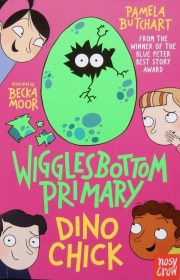
Wigglesbottom Primary: Dino Chick
Pamela Butchart, illustrated by Becka Moor
Nosy Crow

This contains three more episodes in the life of Class Two R and once again they’re in high spirits. At least that’s so in the first story when they learn from Miss Riley that she’s installed an incubator within which are four chicken eggs. They’re less excited to hear that the eggs will take several days to hatch especially when later in the day it comes to their notice that one egg has mysteriously changed colour. Miss Riley sits them down and tells everyone not to touch any of the eggs. Megan decides that the purple and green egg must contain a dinosaur. What a terrifying thought. Several days later three of the eggs have hatched and three fluffy chicks are in the incubator. Suddenly egg number four starts to crack … YIKES! what will emerge?

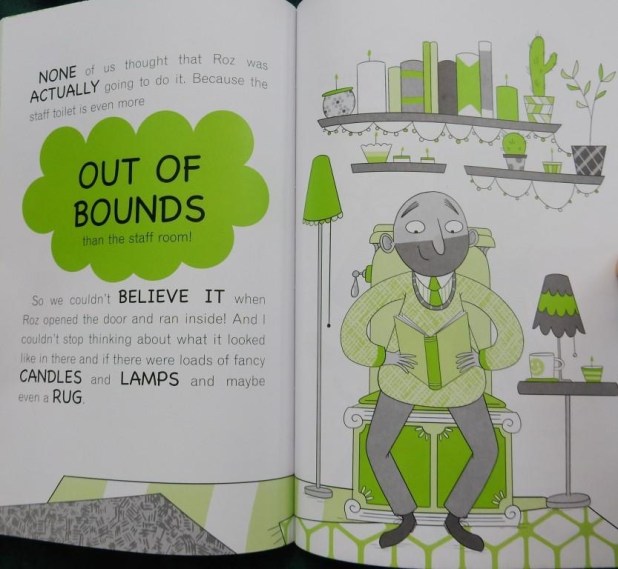
In the second story there’s a new girl in the class. Individuals take turns to show her parts of the school, including some that are strictly out of bounds. 

It’s an unlikely way to make somebody feel welcome but who gets the biggest surprise of all?

The final tale starts with the discovery that the school library is to close due to lack of funds. Can 2R come up with a plan to save it and keep Mr Hope in his job?

Another three wonderfully silly stories for new solo readers (or to read aloud) that show how easily children’s vivid imaginations can spiral into comedic craziness, a craziness that is echoed in Becka Moor’s lively illustrations.

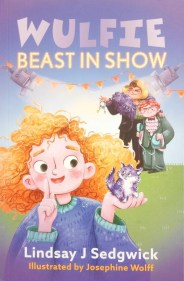
Wulfie: Beast in Show
Lindsay J. Sedgwick, illustrated by Josephine Wolff
Little Island Books

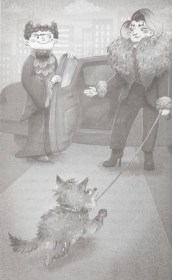
Libby and her beloved purple fluffy best friend, Wulfie (Wolfgang Amadeus Rachmaninoff the Third) return in a second adventure. Libby’s unpleasant stepmother announces the imminent arrival of her older sister, Aunt Ilda. A fanatical dog breeder, she’s determined to win the SNOB prize in the forthcoming dog show to be shown live on TV. Concluding that her failure to win on previous occasions is due to not having a child assistant, she wants to enlist Libby’s awful, spoilt step-brother Rex.

Libby knows she must try to ensure that with Wulfie being so dog-like in appearance, he stays out of sight during the visit. No mean task as the wulfen’s behaviour is, let’s say, somewhat unpredictable and he can sometimes change size at the most inopportune times. 

Times such as his emergence from the washing machine right in front of Aunt Ilda who immediately decides that Wulfie must be her entry in the dog show. And if taking Libby as well as Wulfie and Rex away with her is what it takes, then so be it. 

What she doesn’t know however, is that in addition to his size changing and talking, Wulfie’s sneezes freeze time.

When Libby hears the words, “Your creature belongs to me now, runt, and he is going to make me more famous than any other famous person ever in the whole world.” she knows that Wulfie desperately needs to be rescued. 

But perhaps not before he’s had the chance to make Aunt Ilda look a complete fool on television.

Another fun, action-packed drama with some rather unpleasant characters, as well as the determined, lovable Libby and her equally lovable bestie, all splendidly illustrated by Josephine Wolff.

Museum Kittens: The Sleepover Mystery / Mort the Meek and the Ravens’ Revenge

These are 2 new fiction titles from the Stripes Publishing imprint: thanks to Little Tiger for sending them for review

Museum Kittens: The Sleepover Mystery
Holly Webb, illustrated by Sarah Lodge

The Museum Kittens, Peter, Tasha, Bianca and Boris are proud of their new guarding duties though they’re finding it pretty tiring work. Tired as they might be, they’re all eagerly anticipating the museum’s latest enterprise to bring in extra visitors. A group of sixty children are to visit and stay overnight in the Dinosaur Gallery. Bianca above all the others is mega excited, so much so that she does something which causes a furore in the Costume Gallery and then, following a spat with the other kittens, wants to spend all her time with the children, even keeping them company during the night – the time when the nasty rats are on the prowl. It’s during the night that her siblings realise that Bianca is missing.

The search is on. Come morning they still haven’t found her:

surely she can’t have been intending to run away and got on the coach with the children …

There’s plenty of furry fun, frolics and frights as those who are familiar with the series will know. However, Holly’s latest book is an enjoyable read even if this is your first encounter with these lovable felines; and there are plenty of Sarah Lodge’s black and white illustrations to break up the text for less confident readers.

Mort the Meek and the Ravens’ Revenge
Rachel Delahaye, illustrated by George Ermos

The only Rachel Delahaye stories I’d read before this were her Little Animal Rescue series so this came as something of a surprise. It couldn’t be more different.
For starters it’s set in the kingdom of Brutalia – an island community – where violence is the way of life. Ravens circle overhead, dreaming of eating eyeballs or brains. With its motto LIVE OR DIE, this certainly isn’t a place to book your next summer holiday.

Its chief protagonist is young Mort the Meek who inherits the role of Royal executioner when his uncle dies. Mort is the kingdom’s only pacifist so imagine his horror when he learns that his first victim is to be his good friend Weed.

Nobody has ever dared to stand up to the heinous queen of this realm and survived. Could Mort possibly do so and perhaps even find a way to save his friend’s life?

It all sounds pretty horrifying but Rachel Delahaye’s narrative is often very funny and the tale is full of unexpected twists and turns, so if you can cope with the violent punishment regime (I share Mort’s pacifist principles) you will laugh a fair bit, especially at the ravens. that open each chapter. And, the ending is hugely satisfying …

George Ermos has done a terrific job with the illustrations that are littered with small humorous details.

Magnificent Mabel and the Egg and Spoon Race / Aisha and Silver

These are the latest titles in two of Nosy Crow’s series for younger readers kindly sent for review

Magnificent Mabel and the Egg and Spoon Race
Ruth Quayle, illustrated by Julia Christians

No matter what life throws at her, young Mabel is MAGNIFICENT. But for Mabel Chase, the book’s narrator things are sometimes not fair – at all. Seemingly however careful she is about things like being a worthy partner to Edward Silitoe on school sports day, the two just don’t see eye to eye or even arm to arm, let alone egg to spoon. No matter, somehow or other her magnificence always shines through – eventually.

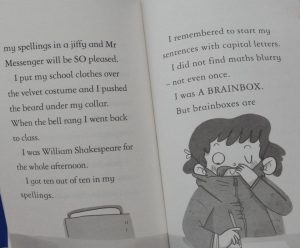
Next, there’s the class play and this term for a change, Mabel really, really wants to get a leading part, William Shakespeare, preferably. But then who is she asked to play but Titania. No matter, magnificence rules, and where there’s a Will, there’s a way …

Then comes the Dermot episode. It comes about when Mabel’s family finally agree to take her to a dog show one weekend. It’s somewhere you can only go (so her Dad says) if you have a dog, Time to start training for the agility event.

As always, our narrator comes out on top.

These latest comical slices of mischief of the Mabel kind with spirited illustrations by Julia Christians, will appeal to the slightly mischievous side of young children be they those readers just starting to fly solo or story time listeners in the foundation stage.

Aisha and Silver
Julie Sykes, illustrated by Lucy Truman

The Unicorn Academy series has captured the hearts of many young solo readers with its mix of sparkling magic and the kind of issues concerning friendship, loyalty and overcoming problems that most primary children have to contend with.

In this latest slice of enchantment Aisha faces problems: first the likelihood of having to repeat an entire school year as she hasn’t yet discovered Silver’s particular magic or bonded with him. Secondly, there’s been a spate of terrible hailstorms that have been causing damage to their beloved school and worse, might endanger the life of anybody caught out in one. That’s the reason for the early closure of the school leaving Aisha just five days to bond with Silver and to stop the storms.

It’s crucial to find out who or what has been causing them: with Aisha also intent on perfecting her music for the dorm’s display ride, she’s under a lot of pressure. It looks as though teamwork will be required to take on the mysterious LT.

Another engaging read with plenty of lovely illustrations by Lucy Truman to break up the text.

Kitty and the Twilight Trouble / Mirabelle Breaks the Rules

Oxford Children’s books do some cracking series for new solo readers: here are the latest books in two of those – thanks to OUP for sending for review: 

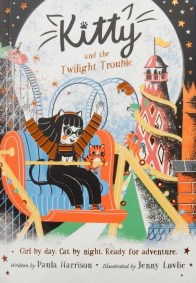
Kitty and the Twilight Trouble
Paula Harrison, illustrated by Jenny Lovlie

This is young Kitty’s sixth adventure and as the story opens she’s super excited at the thought of visiting the funfair with her cat crew. One of the crew, Pixie is super excited too for she has a cat new friend, Hazel. An introduction is arranged with Kitty for that night but it’s Figaro that turns up with a message from Pixie and Hazel, the latter claiming that she’s a Cat Superhero with her own special powers and important work to do.

It’s a rather dispirited Kitty who looks through her bedroom window into the velvety, moonlit sky contemplating the funfair. Suddenly into view come two cats skipping across the rooftop sporting matching scarves, and Kitty’s encounter with them leaves her feeling even less upbeat.

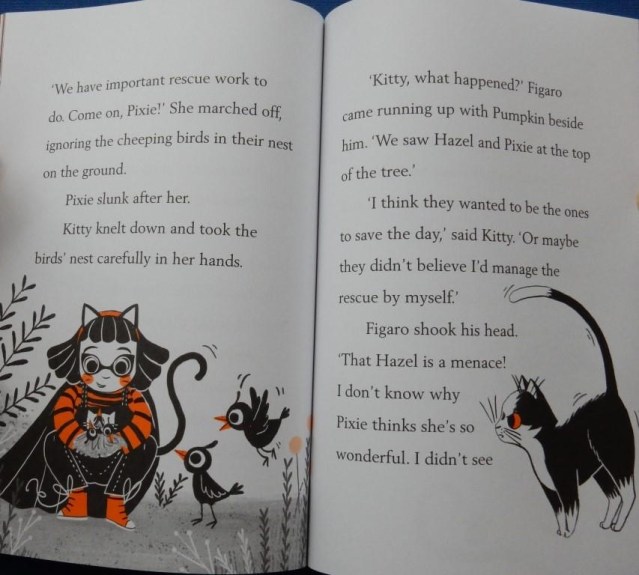
The following afternoon though, her parents keep their promise and take her to the funfair but once there, what should she see but Pixie and Hazel. As she watches them Kitty sees not superhero behaviour but feline foolishness and nastiness. Suddenly however, Kitty has other important things to attend to. Figaro reports that he’s seen a nest of baby birds that are in great danger. Guess who almost sabotages the entire rescue effort?

But that isn’t all, for back in bed that night Kitty receives another urgent message from Figaro. The supposed feline superheroes are stranded. Now it’s up to Kitty to use her own superpowers.

Yet another magical nocturnal story from team Paula and Jenny that will enthral young new solo readers. There are a considerable number on my radar who eagerly await each new Kitty story.

The same is true of another young character, Mirabelle who is also delightfully different and stars in …

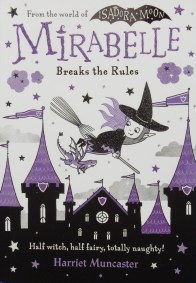
Mirabelle Breaks the Rules
Harriet Muncaster

Mirabelle, cousin to Isadora Moon, is half witch and half fairy. and as a new term starts at Miss Spindlewick’s witch school, her parents are hoping to receive better reports than before.

Mirabelle’s best friend, Carlotta has brought her a present from her holiday abroad – a bottle of shimmery multi-coloured magic dust which Mirabelle puts into her pocket. The snag is that its label is printed in a different language.

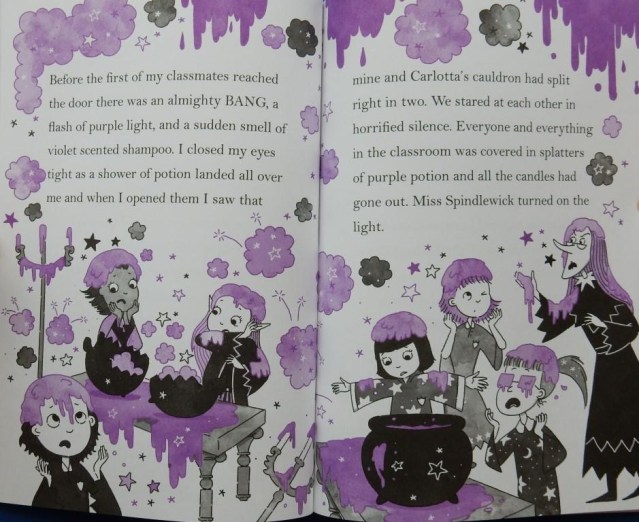
As the first lesson gets under way, Mirabelle volunteers to collect the ingredients for a colour changing potion from the store cupboard; most of these too she puts into her pocket. The potion mixing gets under way but before long something very untoward starts happening in the cauldron the two friends are sharing. Pretty soon the entire room is in chaos. Uh-oh! trouble again for Mirabelle.

She does her upmost to stay on the right side of Miss Spindlewick right up to the last lesson of the day with happens to be some loop the loop practice in the forest. Looping the loop is one of Mirabelle’s favourite things to do and she can’t resist flying over, rather than under the trees per the rule. Could she be heading straight for another disaster …

Mirabelle is a character whose mischief is the result of her struggle with rule keeping, rather than wrong intentions. Her first person narration endears her to readers right from the start and Harriet’s portrayal of her in those purple and black illustrations ensures that she looks every bit as enchanting as she sounds.

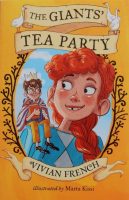
The Giants’ Tea Party / Lottie Luna and the Giant Gargoyle

The Giants’ Tea Party
Vivian French, illustrated by Marta Kissi
Walker Books

In the kingdom of Little Slippington, the royal coffers are empty and with the bills unpaid the king and queen are in desperate need of some gold.

Rather than marry a wealthy princess, the anything but heroic Prince Max reluctantly embarks on a mission to the valley of the giants who, according to legend, are rich beyond imagination and might (or might not) be persuaded to part with some of their gold. First though the prince needs a steed of some kind and the only one available is Horace a rather grumpy old donkey. Deal done, off they go, first stop the abode of the Wisest One. She tells him his journey will mean having to cross the Hungry Marshes.

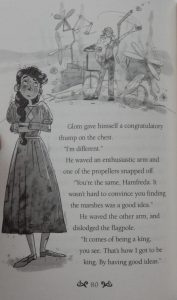
Meanwhile in Golden Hollow, Glom king of the giants also has a problem. Two actually, one being the need for some Papparelli roots (the only food that will make the geese lay their golden eggs), the second the constant interruption from his grand daughter Hamfreda reminding him of the first while he’s trying to put the finishing touches to his flying machine.

Wonderful weaver of words, and fashioner of neofairy-tales, Vivian French, includes a talking cat, marshes hungry for stories, a blank book and some decidedly unsavoury characters, the Crimps in her enchanting narrative: but will Max succeed against the odds? That’s the key question and to discover the answer you’ll have to read this cracking book. Marta Kissi’s illustrations bring out the humour inherent in the telling,

making this whole immersive world even more enjoyable.

Here’s another treat from Vivian: her 4th in the smashing Lottie Luna series:

Lottie Luna and the Giant Gargoyle
Vivian French, illustrated by Nathan Reed
Harper Collins Children’s Books

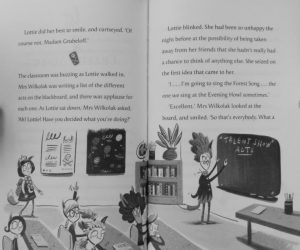
Young werewolf, Lottie Luna, she of super strength, super speed and X-ray vision , is concerned about all her Shadow Academy classmates discovering her special skills when an end-of-term talent show is announced,

and worse, she hears that all parents will receive a personal invitation from the head teacher. Her close friends, Marjory and Wilf are determined to help her keep her secret, but with ‘Awful Aggie’ always on the lookout to make trouble, she’s going to have more difficulty than she’s faced before convincing the other students she’s just like everyone else. No wonder she’s in no hurry to give her parents their invitation to the big event.

In the meantime Lottie wants to help Wilf and Marjory polish their magic act, as well as deciding what she’s going to do in the show. They certainly don’t want Aggie taking the prize gargoyle.

With Nathan Reed’s splendid black and white illustrations, this latest Lottie adventure will delight her many fans and likely win her some new ones too. Despite its setting and main protagonist, the pupils in this otherworldly story face challenges similar to those struggling to fit into a typical school, making it all the more easy to relate to.

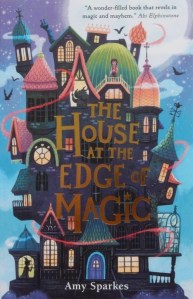
The House at the Edge of Magic

A House at the Edge of Magic
Amy Sparkes
Walker Books

Life is tough for young Nine: it certainly doesn’t give her strawberries. She spends her time on the streets stealing whatever she can to pay back Pockets, the Fagin like character who has sheltered her since her infancy in the Nest of a Thousand Treasures.

One day when attempting to steal a woman’s handbag, a tiny house-shaped ornament falls from it. Nine stuffs the object in her satchel and flees to a safer place to examine it more closely. As she strokes it imagining what life might be like to live in such a place, she touches the door knocker Bizarrely it emits a buzzing sound and the whole thing becomes a large, higgledy-piggledy house.

Thereafter the situation becomes progressively surreal for she’s pulled inside the house and she meets first a weird troll named Eric, shortly after to be joined by a strange wizard introducing himself as “Flabbergast. High Wizard, Chair of the Tea Tasters Committee, World Hopscotch Champion 1835”, and a spoon, aptly named Doctor Spoon, clad in a kilt and brandishing a sword. She learns that the three have been trapped in the house under a curse for years. They request Nine’s help to break said curse and set them free. For her help she’s offered a priceless gem.

At first she leaves without agreeing but then later realises that she’ll be far better off returning to the cursed house and helping its occupants. With the possibility of a new life, back she goes. Before you can say “cup of tea” it’s revealed that they have only till the clock strikes fifteen to discover the magic words to break that curse or face extinction. No pressure then.

Deliciously quirky with lots of humour, this story will definitely keep readers turning the pages till its wonderful finale. The magic house residents are brilliant fun. I love that feisty Nine finds solace in books she ‘acquires’ thanks to a genial librarian and that despite being desperate to escape her life on the streets, she acts for the greater good.There are some terrific bit-part players too.

Whether read solo, or aloud to a primary class, this will leave audiences wanting more – this reviewer included.

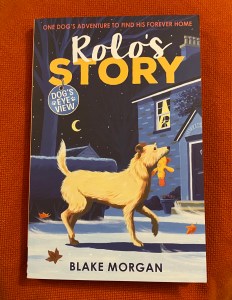
Rolo’s Story

Rolo’s Story
Blake Morgan
Little Tiger

This book starts with a bad dream, the dreamer being the puppy that acts as the story’s narrator. For the past week he’s been on the run from his cruel ‘Two Leg’ he calls humans and is having a hard time due both to the cold and the lack of sustenance. But then he meets Scrap, another stray; Scrap offers to act as his guide to ‘life on the wild side’ and there’s certainly a lot to learn.

She remains a loyal guide and playmate until one day something terrible happens: Scrap is out foraging for food to share one night but she doesn’t return. Next morning Mutt as Scrap calls the narrator, discovers his friend in a van about to be driven to the dog pound. Scrap persuades her friend not to attempt a rescue and so it’s back to the lonely life for the pup. Time to move on, but not entirely alone for the narrator discovers a scruffy stuffed duck that he takes along as company, calling it Beak Face.

After a day’s journey in the chilly weather, he seeks food and shelter in a village and the pup and Beak Face curl up together in a garden shed for the night.

Next morning a little girl, Freya is surprised to find visitors when she opens the shed door. Strangely this Two Leg seems friendly and thus begins another chapter in the pup’s life. Little by little he comes to trust the kindly disposed girl who, naming him Rolo, keeps him fed and warm; but her mother is another matter.

Can Rolo with the help of Freya, persuade a reluctant workaholic mum to find it in her heart to allow a scruffy, creature that wees all over the floor to stay and become part of the family?

Eventually yes, and there are some even bigger surprises in store before this wonderfully warm, gently humorous story concludes. Or perhaps it doesn’t, for there’s a slight hint that we might be hearing more from Rolo. I’m sure that a good many readers would be pleased should that be so.

The Wizard in the Wood / Diagnosis Danger

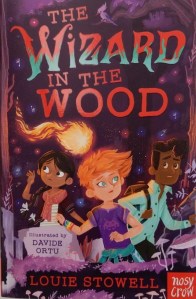
The Wizard in the Wood
Louie Stowell, illustrated by Davide Ortu
Nosy Crow

This is the third in Louie Stowell’s magical series.
A new term is about to begin for Kit, Josh and Alita. Before school starts though, Faith announces that the Wizards’ Council want to meet Kit.

Once in front of the council members, Kit learns that she has a very special mission – to take a new dragon’s egg to its new home beneath its own library where it will hatch.
Imagine her friends’ surprise and excitement when she and Faith return with a box containing said egg and Kit announces, “We brought you a present” and they discover what’s inside. It’s a dragon’s egg that must be planted beneath their very own school.

Faith makes two more exciting announcements: a new library awaits once school opens and that also means the arrival of a brand new wizard librarian. Surely nothing could be better than that.

The following day the term begins and the children meet this new librarian whom Faith has said is an old friend of hers. named Ben. He certainly seems a pretty cool guy. But is he?

Pretty soon the children discover that something isn’t right and they’re faced with solving a ginormous problem. It’s either that or face a world-changing disaster. Confronted by a hugely challenging, exciting mission, they really must all work as a team.

With plenty of jokes, great dialogue with lots of banter, and a smashing twist in its tail ,this is another cracker from Louie, especially as it celebrates the power of books and of story.

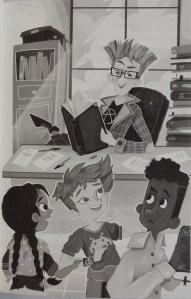
Whether shared as a primary classroom story time or read by individuals, this book is a delight, made all the more so by Davide Ortu’s offbeat illustrations.
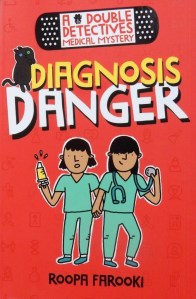
Diagnosis Danger
Roopa Farooki
Oxford University Press Children’s Books

Do you know primary readers in need of an antidote to the trials of lockdown and home schooling? Then try doctor Roopa Farooki’s second exciting double detectives mystery.

Twins Tulip and Ali, the daughters of a hospital doctor, return in another sleuthing story and again they’re faced with a mysterious case to solve. Fortunately with mum a hospital doctor, and thus some medical knowledge of their own, as well a considerable amount of unsquashabilty and noses for danger, this pair have the tools for the job.

It begins when an unknown person attacks their friend Momo and he ends up in hospital, the attacker vanishing without trace. Needless to say Ali and Tulip waste no time is trying to track down the assailant.
Before you can say ‘sliced popliteal artery’ they and Nan-Nan ( a brilliant character) are on their way to a ‘holiday’ destination (unknown to two of their number). Eventually they arrive at a place calling itself Catty’s Cattery; the twins are puzzled and anything but impressed.

However, things are set to get even more strange, when, standing at the reception desk of this weird ‘kitty-obsessed-hotel from hell’ as Ali calls it, is a man who bears a close resemblance to the villainous Evelyn Sprotland. But is this a case of diagnosis ‘bang on the head’ or perhaps, ‘Diagnosis Doppledanger’. What exactly is the real purpose of this peculiar establishment? And, who is Catty; its boss? She certainly seems very choosy about who’s allowed to stay. The mystery deepens.

More important, can the twins aided and abetted by Nan-Nan get to the bottom of things?

Roopa’s mix of unusual characters, witty dialogue, large doses of humour and scatterings of medical information, makes for a thoroughly enjoyable read that will enthral readers who like something a little out of the ordinary. Book your consultation with the twins right away.

Into the Wild / Poppy Goes Wild

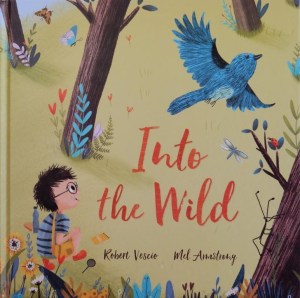
Into the Wild
Robert Vescio and Mel Armstrong
New Frontier Publishing

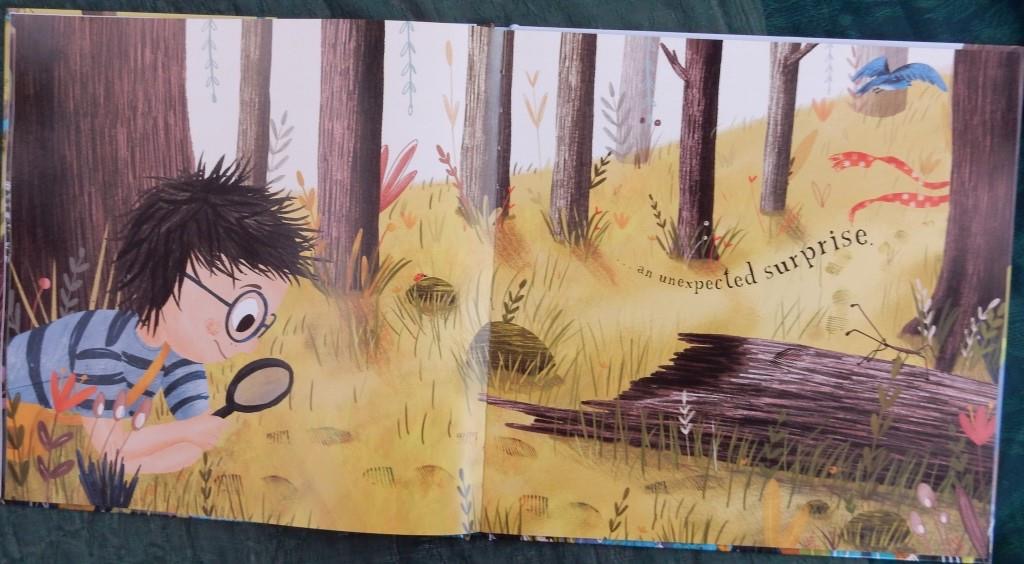
Young Roman has an adventurous spirit and a love of nature that often take him to new places where he makes exciting discoveries. They might be hidden away, mysterious, wonderfully wild or all of those. He needs to keep his senses alert ready for new sights, sounds and tactile experiences.

Sometimes though in the vast, wild depths of the natural world, Roman feels that despite the wonders he’s discovered something is missing; he longs to be able to share his excitement and enthusiasm.
And then unexpectedly he comes upon something that might just satisfy that longing – something interesting and rare …

Since the start of this pandemic and especially during lockdown, more and more of us, wherever we are, have been discovering (or rediscovering) the joys of the natural world. Equally, most of us have been longing to be able to share some of the pleasure with other people, not merely virtually but in the flesh. So, this story of Robert Vescio’s with its illustrations by Mel Armstrong is a smashing portrayal of the marvels of the natural world and friendship – especially when experienced together.

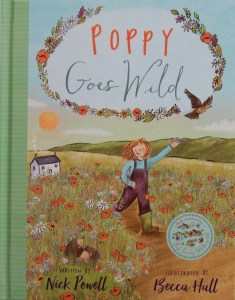
Poppy Goes Wild
Nick Powell and Becca Hall
Little Steps Publishing

TV producer Nick Powell has written this story of rewilding wherein he tells how young Poppy in partnership with her grandad embark on a scheme to return his farmland to the way nature intended it to be. The way it was some fifty years back when wildflowers grew in abundance and native animals such as hares and field mice, otters, insects and birds including peregrine falcons and soaring skylarks thrived.

As Poppy’s Grandad reminisces, she and readers learn of the dramatic changes that have happened due to such things as wetland drainage, intensive farming resulting in habitat loss, and the use of harmful pesticides. “We thought we were doing the right thing,“ Grandad tells her.

Poppy’s great enthusiasm for doing what some of the farmers she’s read about are trying, reignites her grandad’s love of the natural world and project ‘rewilding’ is agreed on. Every weekend and during school holidays Poppy intends to work on the plan but their first task is to identify areas for nature to replenish itself. Then comes providing the best conditions for this to happen.

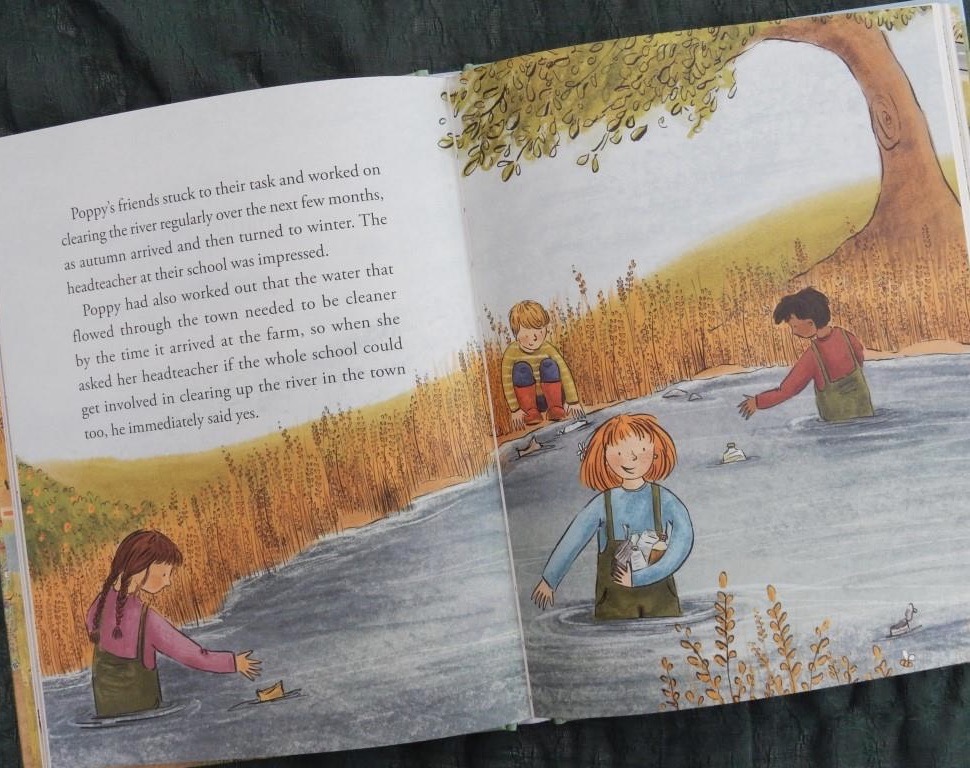
As the work gets under way, Poppy realises that it’s more than a two-person task. She enlists the help of her classmates from the town near the farm

and over the next few months great headway is made. But, as the story ends, the wonderful restorative transformation work goes on.

An inspiring, uplifting, hopeful story that presents many of the environmental challenges we face at the moment with so many of our species declining alarmingly thanks to the destabilising effects on ecosystems of human activity. In addition there are other themes – collaboration and the wonderful camaraderie between Poppy and Grandad that exemplifies intergenerational relationships.

Becca Hall’s painterly, carefully detailed, illustrations are simply gorgeous. Her colour palette is aglow with the sun’s warmth as well as evoking that inner warmth and exhilaration so many of us feel when immersed in nature.

Nick Powell hopes the book will inspire youngsters to do all they can to look after wildlife, while in a foreword, Hugh Fearnley-Whittingstall, celebrity chef, writer and broadcaster, urges us all to be part of the re-wilding movement in whatever way we can. One truly hopes that, inspired by Poppy et al. both young and not so young will respond to their rallying call.

How To Be a Hero / The Broken Leg of Doom

How To Be a Hero
Cat Weldon, illustrated by Kate Kear
Macmillan Children’s Books

Life as a trainee Valkyrie is not going at all well for young Lotta; she’s in danger of remaining forever stuck in the lowest class. Matters get even worse when the trainees are sent out to bring back a fallen warrior.

Mistaking young Whetstone, an unconscious viking thief as a fallen hero, Lotta carries him back up to Valhalla, and that’s where the real trouble starts. Live humans are not allowed in Valhalla.

Whetstone, a human who wants only to prove himself and achieve fame and fortune, has let himself be talked into crime. He steals, hides and loses a precious talking cup – a cup that trickster Loki desperately wants and will go to any lengths to get hold of.

Now anxious to make amends, Whetstone and Lotta have to try and work together as they embark on a journey to find the cup before Loki.

There’s even more trouble for the pair though when they manage to lose a crucial Dwarf harp as well as rousing a slumbering dragon.

Now Whetstone really MUST pull out all the stops and prove himself a hero after all. Can he do so; and does Lotta finally manage to move on from being that class three trainee?

This is a highly entertaining, fast-paced romp with some crazy situations, fun and interesting characters, dragons and more. Kate Kear’s zany illustrations are just right for the playful telling. This book will surely appeal especially to youngsters with an interest in mythology. but anyone who likes a good yarn should give it a go. It’s the first of a trilogy so look out for further episodes involving Whetstone et al.

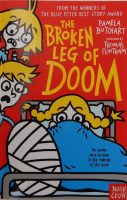
The Broken Leg of Doom
Pamela Butchart, illustrated by Thomas Flintham
Nosy Crow

This the tenth story in the hilarious series, is narrated by Maisie’s friend Izzy. Maisie has broken her leg doing some ‘extreme dancing’ and is taken to hospital.

That in itself is bad but things are about to get even worse, starting with the fact that following e-rays, Maisie is sent to ward 13 and she’s terrified of that particular number.
Enter (he’s actually already a patient), a rather strange boy Seb, who sits down beside the sleeping Maisie’s bed and starts going on about a curse. Talk about weird. But that’s only the start of the strange events in ward 13.

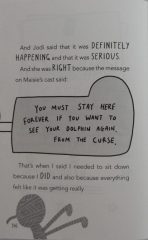
Later Seb says that the curse has now sneaked inside Maisie’s cast and is causing problems. That however isn’t all we hear of curses, but there are other strange things too: somehow the sprinklers get turned on, flooding – you can guess which ward. And what about the ’mummy’ that’s roaming around. By this time it seems that only Maisie among the children isn’t talking of THE CURSE.

Then a certain very special cuddly toy suddenly goes missing, followed not long after, by the appearance of creepy messages on Maisie’s cast.

Oh yes, there’s some weird shenanigans concerning the sandwich trolley too.

Will Maisie and her pals ever get to the bottom of all the mysterious events and break that terrible curse once and for all. It’s certainly going to need some outstanding investigative skills.

Pamela Butchart capitalises on the vivid imagination of children, allowing her group of young characters to get carried away – just take a look at their expressions in Thomas Flintham’s wacky drawings in this zany adventure. It’s assuredly one that will have both individual readers and primary class listeners laughing out loud.

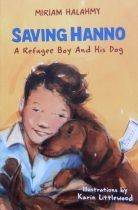
Saving Hanno

Saving Hanno
Miriam Halahmy, illustrated by Karin Littlewood
Otter-Barry Books

Rudi is a nine-year old Jewish boy who, as the story starts at the end of 1938, lives with his parents and older sister, Lotte in Frankfurt, Germany under Hitler’s rule.

When things get increasingly bad for Jewish people, Rudi’s parents take the decision to send the children to England on the Kindertransport, telling them that they will follow later on. Meanwhile Rudi and Lotte will live with an English family where they’ll be safe from the Nazis. Rudi is devastated as he won’t be able to take his beloved dachshund, Hanno with him. Amazingly though, Rudi’s family find a non-Jewish man who volunteers to take Hanno to England when he goes and then after a period of quarantine, Rudi hopes he can be reunited with his pet.
Once in England Rudi and Lotte are placed in different homes not far from one another: Rudi’s carers are kind and considerate;

not so those with whom Lotte is sent who force her to act as a maid.
After some time things in England get worse and Britain declares war on Germany. As a consequence, the children are to be evacuated to rural parts but then comes news that pets are to be put down before rationing starts. Now again, Rudi is faced with finding a way to keep Hanno safe before he relocates yet again …

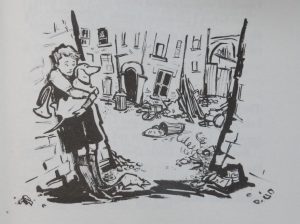
With empathetic illustrations by Karin Littlewood, this is a holocaust story with a difference, and told from Rudi’s viewpoint, it’s one that primary school age readers will certainly relate to. The author confirms in her after story note providing additional background information, that it’s based on fact. Many primary schools include WW2 as part of their history curriculum and while there are many stories about that terrible time, I would definitely advocate adding this one to the books to be shared.

Stick Boy

Stick Boy
Paul Coomey
Little Tiger

Being different is never easy, ditto starting at a new school; but when Stick Boy moved to a new town, he’d hoped that with yet another fresh start, he’d left old problems behind. Seemingly not, for on the opening pages of Paul Coomey’s story we discover the titular character being pursued on only his second day, by the second biggest bully in the entire school, Sam Devine.

Things are not looking good especially when he then meets Gretchen, another bully. The two of them taunt Stick Boy, get hold of the contents of his pockets and proceed to hurl them over a high wall, recording their nastiness to upload onto ‘Vidwire’.

Along comes Ekam and the two boys introduce themselves to one another. and Stick then demonstrates his locker-opening skill before the bell rings summoning everyone to assembly. There the headteacher announces that the opening of the new Baron Ben’s Bargain Bins Magnificent Mega Mall on Saturday will be celebrated with a concert.

Stick’s first lesson is science with Mr Jansari

where Stick meets another friendly face, Milo and discovers that everyone is excited about the prospect of a pupil from the school being chosen to sing at the Friday Factor. Things are looking up for Stick, but not for long as in double ICT, Miss Bird has it in for the newcomer from the outset.
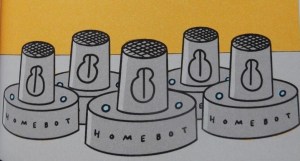
Stick survives the day and then back home learns that his dad has bought a brand new TV from Baron Ben’s Bargain Bins that comes with a free HomeBot – uh-oh!.
Right away the thing starts behaving weirdly.

The following day Stick is late for school and overhears Miss Bird speaking on her mobile and acting scared. Later the two bully girls forced him into unlocking Mr Jansari’s classroom door

and the act is recorded on Gretchen’s mobile.
From then on things just keep on getting worse and Miss Bird definitely appears to be up to something. Could there be s a connection between those Homebots with their increasingly strange behaviour

and the Mega Mall opening?

This fast-paced mystery story about coping with bullies while being two dimensional in a three dimensional, world fizzes with excitement, and the kind of humour – both visual and verbal – that should go down well with older primary readers.

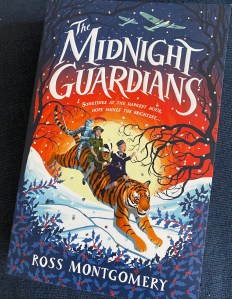
The Midnight Guardians

The Midnight Guardians
Ross Montgomery
Walker Books

I was totally gripped by this wintry tale set in WW2 right from the opening pages. Twelve-year-old Col who has recently lost his father, has been evacuated to his Aunt Claire’s. He feels totally alone, for his older sister has remained in blitz-ravaged London where she faces constant danger while helping with the war effort.

Col starts hearing voices calling to him – the same voices he heard as a younger child. They’re the voices of his imaginary (so he supposes) childhood friends – the Midnight Guardians. Step up gallant knight, King of the Rogues (small and fearless), Pendlebury, a tiger brave and noble, able to change size at will and, Mr Noakes, a gentle, scruffy old badger with a nose for finding food, who sports a waistcoat.

These three have come to help him in his quest to save his sister and telling him that he’s in mortal danger as darkness, in the form of The Midwinter King, is determined to take over the land. Thus begins a race to bomb-blitzed London, accompanied by Kindertransport refugee Ruth, a brave, strong-willed girl with her own reasons for going to the capital.

So, it’s a double battle: Col and his entourage on the side of The Green Man – against time and the forces of dark. Ross Montgomery has created a terrific cast of characters that, in addition to those already mentioned, includes bogeys, fairies and Gog and Magog(s) all of whom Col encounters in this compelling tale of hope and enchantment in a world where myth and legend, history and hardships are interwoven.

Ultimately, it’s a perfectly paced tale of strong friendship, courage and trust: hope and love versus hatred and fear.

A House for Christmas Mouse / The Lightbringers / Magnificent Mabel and the Christmas Elf

A House for Christmas Mouse
Rebecca Harry
Nosy Crow

On a snowy Christmas Eve an excited Mouse arrives at Treetop Forest in search of somewhere to call home – somewhere cosy and warm, with food and friends.

Coming upon a little rabbit outside his burrow she knows she must stop and help him light a fire within and so she does. She also stops to assist Fox in his cake making

and Bear with hanging up Christmas decorations, but having done so it’s almost sundown and Mouse still hasn’t found her new home.

Suddenly a gust of wind sends her tumbling into the deep snow and when she gets up, there before her is something that might just be the perfect place to make her home. On closer inspection it seems far from perfect though, so off she goes to search for leaves to make a bed. As she looks, who should come hurrying by but Bunny, followed soon after by Fox and then bear, each carrying something with them.

Where are they going and why?

With its wintry woodland setting and sparkly touches, Rebecca Harry’s lovely gentle tale of kindness repaid is just right for sharing with the very young this festive season.

The Lightbringers
Karin Celestine
Graffeg

This is the first of a new four book series, Tales of the Turning Year. With a combination of folklore and nature the author weaves an uplifting, hopeful story that retells an ancient renewal tale found in various parts of the world in honour of the winter solstice. Assuredly during this current covid lockdown we would all welcome a visit from The Lightbringers – small beings that gather embers and put them into their seed lanterns.

Karin explains how the seasons change as the earth breathes, with a particular focus on the increasing darkening with the approach of December 21st, the winter solstice – a turning point that heralds the spring and longer, lighter days.

Her words are simple but impactful, accompanying her atmospheric, beautifully composed photographic tableaux of the natural world populated by her felted animals, particularly the Lightbringers led by Hare – the caller. With its reassuring final, ‘The light will always return because it is guarded by small beings and they are steadfast in their dark’ this is a book to share and be cheered by in these dark days.

For new solo readers is

Magnificent Mabel and the Christmas Elf
Ruth Quayle, illustrated by Julia Christians
Nosy Crow

Mabel of Rabbit Riot fame returns to relate three further episodes in which she demonstrates her magnificence. In the first we find our young narrator in the sweetest of moods as she unearths her Christmas Elf from the box of decorations. She tries to get her classmate Edward into the Christmas spirit too but without much success; but she’s more successful in allowing her naughty little elf get her into big trouble over Christmas presents.
In the second story Mabel tries her very best to befriend a new boy and also finds out that once in a while school can be really interesting.
It’s toddler-minding that gets our young heroine into a tizzy in the final episode, and that’s after she’s declared that looking after toddlers is ‘easy and fun’. Really – Even cousin William?…

Huge entertainment from such a delightful character: Ruth Quayle really does appear to have the ability to see things from the viewpoint of six-year-olds, and Julia Christians’ black and white illustrations are a spirited delight.

The Night I Met Father Christmas

The Night I Met Father Christmas
Ben Miller, illustrated by Daniela Jaglenka Terrazzini.
Simon & Schuster Children’s Books

Jackson knows a fair bit about what happens on Christmas Eve night, as well as about that North Pole workshop, so he’s more than a little concerned when his friend suggests that the whole Father Christmas thing isn’t real. He stays up on 24th December hoping that he’ll meet the man himself and lo and behold, he does – in a rather noisy manner when a small elf-like figure clad in red tumbles into his fireplace injuring his ankle in so doing.

At first he denies his identity but Jackson eventually gets him to admit who he is. The boy asks the little character (who isn’t quite what he was expecting) a very important question: “How did you become Father Christmas?” The answer is not at all what he was anticipating. It’s the story of Torvil Christmas, an extremely rich but miserly toyshop owner that the elf recounts, 

as, having accepted the boy’s offer of help to complete his worldwide delivery round in time, the two board the sleigh and take to the air.
Cleverly weaving Jackson’s adventure into a reworking of Scrooge’s transformation in Dickens’ classic A Christmas Carol, and giving it a liberal sprinkling of magic, Ben Miller has created a sparkling seasonal, read – aloud or alone- that’s just right for the run up to the festive period. I love the additional “Christmassy fun’ pages too, as well as the wonderful black and white illustrations

by Daniela Jaglenka Terrazzini scattered throughout the telling.

Zombierella: Fairy Tales Gone Bad / Theodora Hendrix and the Monstrous League of Monsters

Zombierella: Fairy Tales Gone Bad
Joseph Coelho, illustrated by Freya Hartas
Walker Books

As a massive fan of fractured fairy tales, I couldn’t wait to read this and wow! do I love it. Told in the form of a verse novel by performance poet Joseph Coelho, it’s quite simply utterly brilliant, dark, funny and splendidly subversive to boot.

The Grimm version is the one Joseph has chosen as his starting point and right from the start he hooks readers in, holding them enthralled throughout as the plot twists and turns in unexpected ways.

We learn that our heroine has got her name because she carries her biological mother’s ashes with her in a locket. Now she is forced to live with her foul FAKE mother and her equally FAKE beautiful sisters who are living off the inheritance that’s rightfully Cinderella’s. Her one true trusted friend is her horse, Lumpkin but early in the story, he ceases to be and the poor girl has to bury him. But not before she comes upon a piece of drifting paper. It’s a flyer informing the reader of three balls on consecutive nights, on the final of which the prince will choose his bride. She assumes that said prince is moving into the old abandoned mansion atop the hill on the edge of Grimmsville.

Needless to say those FAKE sisters of hers are eager to go to the ball

but can’t abide the thought of Cinderella doing so and as well as leaving her with instructions to clean the house in their absence, they leave a trap for her at the top of the stairs. A trap that causes her demise. Enter The Fairy of Death and Cinderella becomes Zombierella, able to go to the ball, but for three nights only …

I’ll say no more on the tale but merely urge you to get hold of the book and relish every detail, gory and otherwise. Equally relishable are Freya Hartas’ illustrations that add to both the gloomy atmosphere and the humour; her use of space on the page is superb too

and make sure you look under the cover flaps.

I’m eagerly anticipating any further fairy tales Joseph chooses to turn bad with his magic pen.
More shivers and giggles in:

Theodora Hendrix and the Monstrous League of Monsters
Jordan Kopy, illustrated by Chris Jevons
Walker Books

Here’s a terrific mix of monsters, mystery, horror and humour: it all begins ‘just shy of Halloween’ in an abandoned graveyard cemetery on the edge of Appleton. There in an unmarked grave, seemingly just waiting to be discovered lies a small squalling human. And discovered it is by one George Hendrix, a zombie (along with his vampire cat, Bandit). What do they do with said baby? They take it to a mansion – occupied by the Monstrous League of Monsters (MLM) where Georgie is assured the infant will be well cared for. The carers are a group comprising a mummy, ‘Mummy’ to the infant, a vampire, a werewolf and cubs, a witch, the skeleton butler, an operatic ghost, a crow and more – I wonder …

They name the babe Theodora and surprisingly, fall for her charms, but she must be kept secret.

Full speed forward a decade and there’s Theodora thriving and loving life along with her loyal arachnid associate, a dapper tarantula named Sherman.
But then mysterious anonymous threatening letters start to arrive. Seemingly somebody or something has found out about the group and is determined to expose them and their secret to HQ. Theodora is equally determined to discover the identity of the letter writer; so too are the others.

But Theodora decides to fly solo and hatches her own plan. Can she (along with her very first human friend), solve the mystery or are her monster family members doomed to rot imprisoned in Transylvania? And what of her own fate if she succeeds? …

Told by a mysterious narrator this is a smashing story, with some laugh-out loud moments, an abundance of family love and loyalty that shows how diverse family and friendships can be.

Great for reading aloud or solo reading and made all the more fun by Chris Jevons delicious black and white illustrations

Lotta Says ‘No!’ / Lotta Makes a Mess

Lotta Says ‘No!”
Lotta Makes a Mess

Astrid Lindgren, illustrated by Mini Grey
Oxford University Press

The Astrid Lindgren reissues continue with two books starring young Lotta who is four in the first book. The episodes in the first are told from the viewpoint of her elder sister, Mary-Lou and seemingly, Lotta is a spirited child with a large personality who’s never far from trouble.

Lotta Says, ‘No!’ has nine brief chapters and in the first we see that really what Lotta wants is to make sense of the world she’s growing up in – “What’s it raining for?” she asks one wet day and later, “What’s dung for?” and her response that afternoon is to stand out in the middle of a dung heap in the pouring rain getting soaked. When asked what on earth she’s doing, she replies, “So I’ll grown and be as big as Joe and Mary-Lou.”

Other adventures in this book include a visit to the dentist for a tooth extraction; a crinkly wool incident while visiting neighbour, Mrs Berg,

a kind of honorary grandmother to Lotta and her siblings; and the occasion when Lotta adorns the tree in which they’re picnicking with pancakes. The others too are full of charm and gentle humour: Mini Grey’s black and white illustrations are really fun and highlight Lotta’s endearing nature as they do in Lotta Makes a Mess.

Now, our young protagonist has turned five and appropriately there are five stories herein, each one as convincing as the previous escapades. In the first, Lotta (having woken in a bad mood) has a disagreement with her mother over what she should wear, cutting up her itchy, scratchy sweater and decides to move out.

The second chapter sees her installed in Mrs Berg’s junk-loft where she remains until she discovers just how dark it gets at night. That’s the end of her stay forever plans and she’s more than a tad relieved when she hears her Daddy’s voice saying how unhappy her Mummy is without her – the perfect excuse to reassess her situation, the consequence of which is that what’s been a truly terrible day ends on an upbeat note.

Both books are ideal read-aloud material for pre-schoolers and those in the foundation stage who will assuredly fall under Lotta’s charms and relish her misdemeanours.