Ady and Me

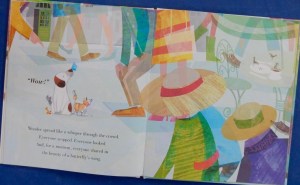
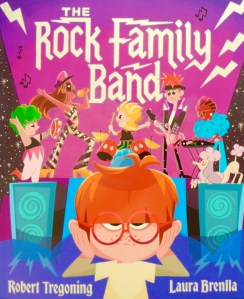
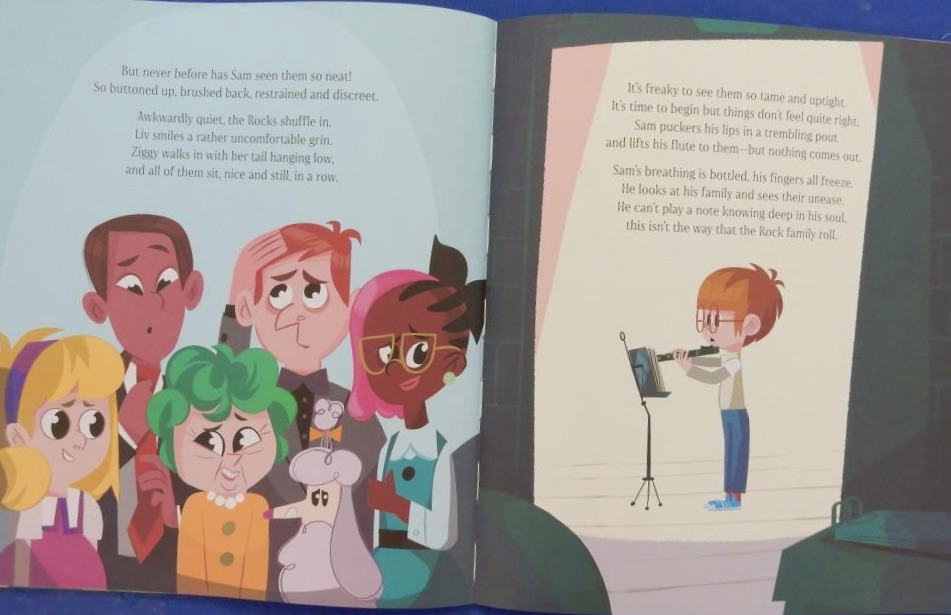
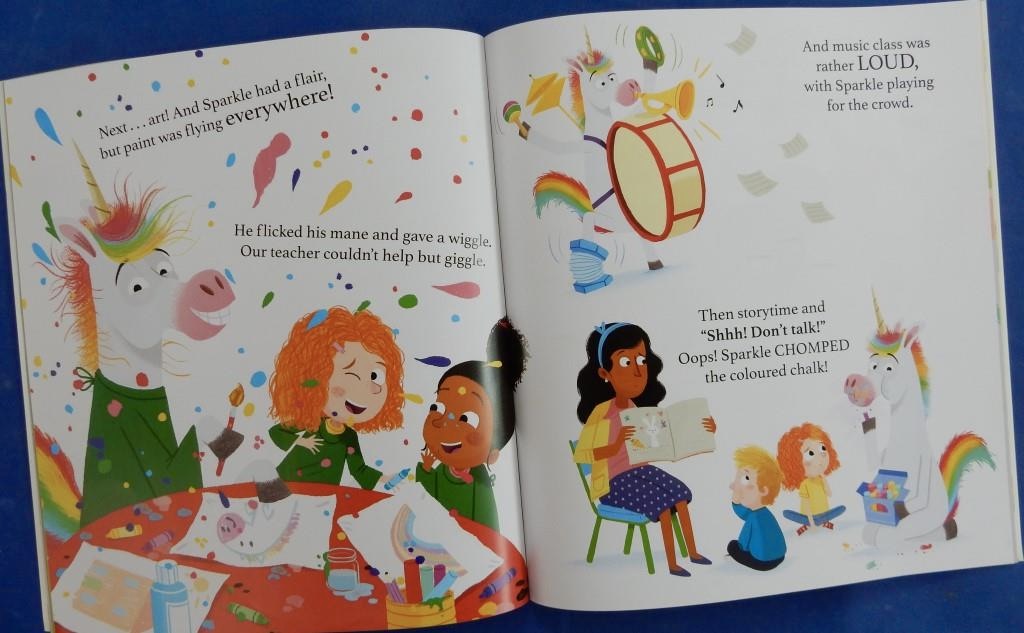
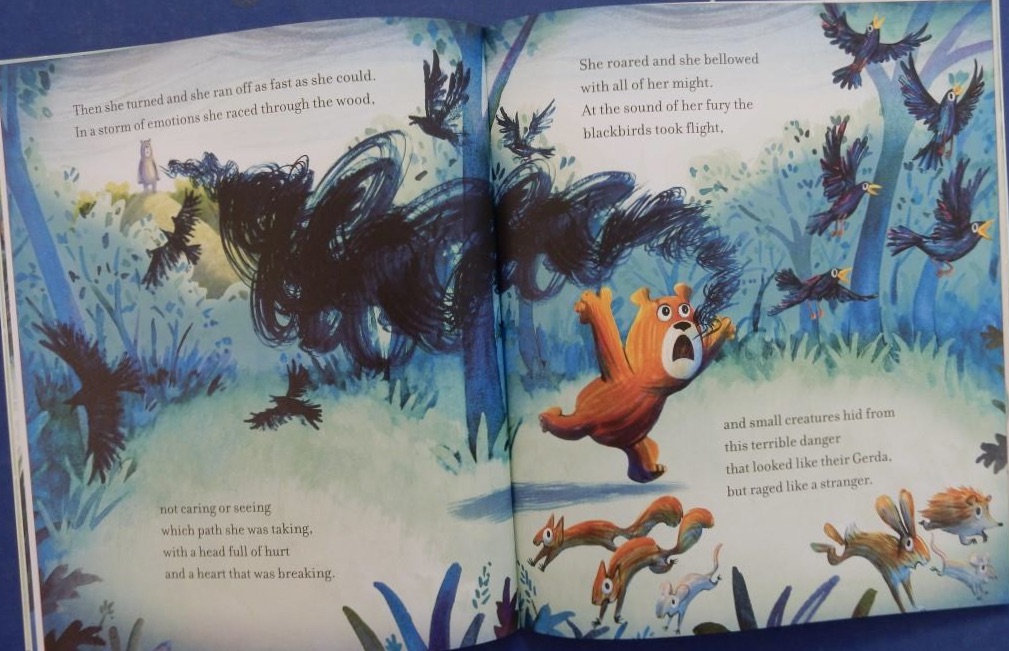
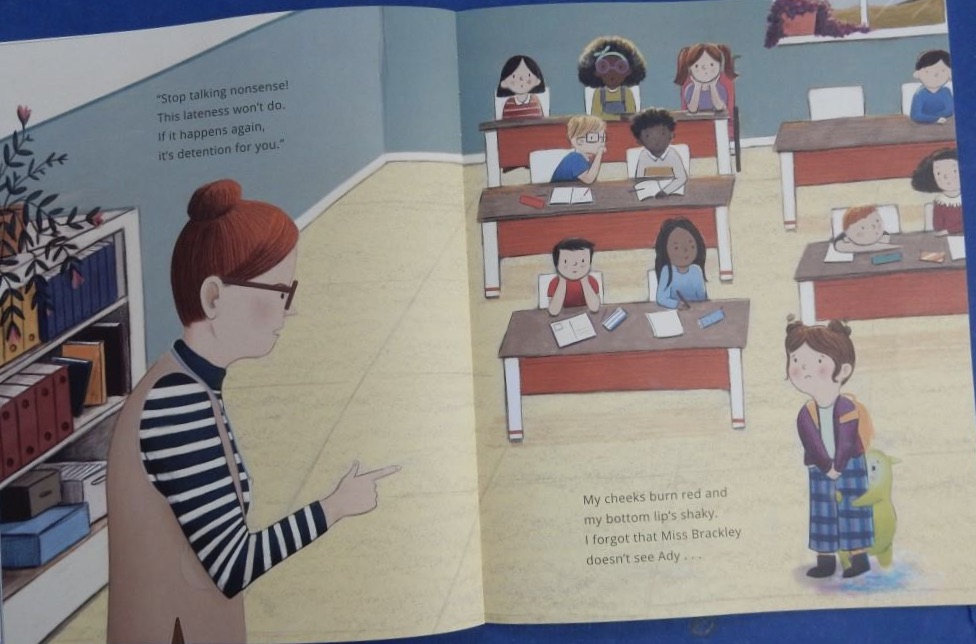
“I have a secret that lives in my brain. / I call him Ady, that’s not his name … / Doctors told Dad it’s called ADHD. / But that’s way too boring for Ady and me.” So says young Sophie at the start of this story.
We follow Sophie through a day at school as she experiences good times and bad starting with being late and her teacher’s upsetting response.

More negative responses follow when she doodles on her book during history, talks during another lesson and despite her best intentions in science, is made to sit on a table labelled ‘naughty’. (The teacher part of me is horrified at this). Then in art Sophie accidentally knocks a pot of paint on Miss Brackley’s shoes. The response to this is almost unbelievable and Sophie is taken to the head’s office. However it’s not Sophie but Miss Brackley that gets the dressing down; moreover Headteacher Grant loves Sophie’s rainbow painting and has another surprise in store for her, Ady and for readers.

Told through a rhyming text written by partners Roxanne who brings her ADHD experience and Rich who brings his neurotypical perspective to the story and Sara Rhys’ eloquent scenes of a neurodivergent girl attempting to cope in a classroom where for the teacher, only neurotypical behaviour is acceptable.
This is an important picturebook that uses a metaphor one hopes will help children (and adults) see that ADHD should be accepted and understood.

Twigs and Stones

Snake and Lizard live in a hole under a rock and like all friends they have their ups and downs with one another.

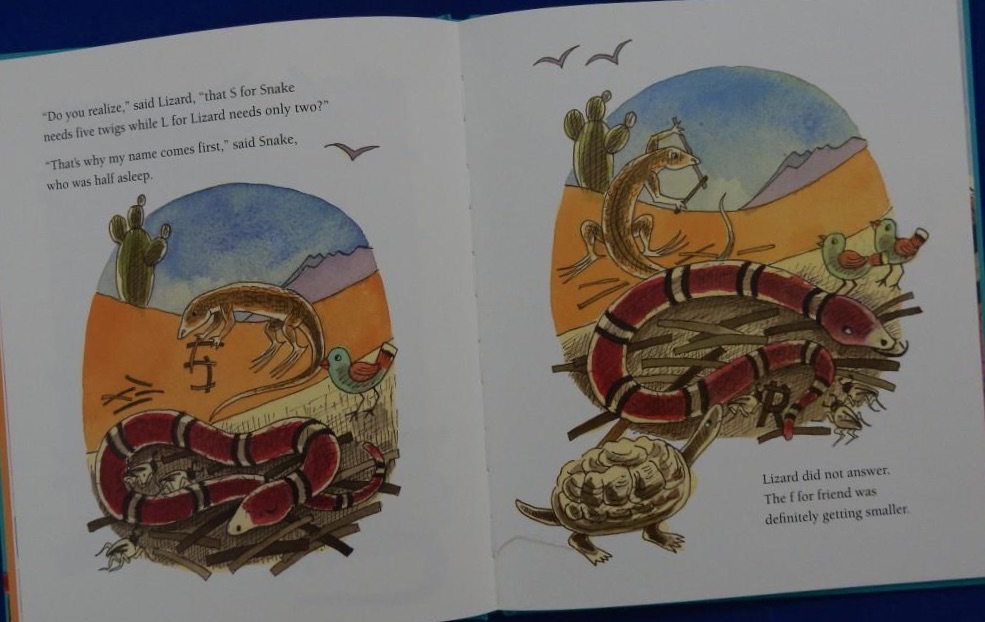
One day Lizard decides it would be good to collect twigs with which to put both their names above the entrance to their home. Off he goes to the river in search of sticks and mud. On his return he sets to work carefully arranging the sticks to form the letters; Snake is unable to assist on account of her bad eyesight. However Snake listens dozily to Lizard’s comments,

the task is completed and the names written large stand on the ledge until along come Tortoise.and Owl warning of the likely consequences of a desert wind. The wind comes, blowing down Snake’s name but then out of their hole comes Lizard to retrieve the fallen letters after which he returns to bed.

Next morning though, Snake emerges first and is furious to see that his friend has accidentally misspelt Snake.

Lizard’s way of dealing with things only makes his friend angrier and both have a most unsatisfactory day in silence.

That night it’s Snake’s turn to go out and check the names: now is her chance to teach Lizard a lesson. Fortunately though all ends well: the letters are removed and the friendship is restored.

There’s a gentle humour in both Joy Cowley’s telling and Gavin Bishop’s pen and ink and watercolour illustrations . The expressions on the faces of both Snake and Lizard are splendidly done heightening the drama throughout the squabbles, making this a great read aloud story with lots of potential for class discussion. It should certainly reassure children that friendships are important and silly incidents should be forgotten quickly.

Zizzi Moonbeam

It’s Zizzi Moonbeam’s first day as an official party planner at Fairy HQ and she’s fizzing with excitement!. Having made her way to the Party Planners floor, she’s greeted by chief party planner Elvina Glass who hands her the day’s assignments.

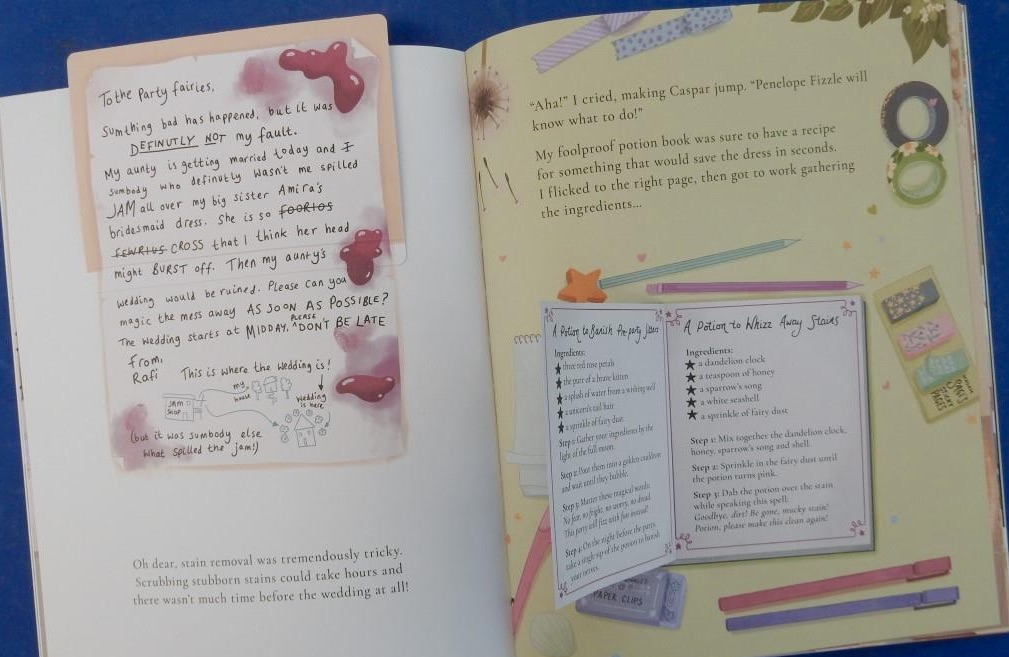
Anxious to impress, Zizzi turns down the offer of help from Caspar who is seated next to her and sets to work by herself. She wizzes to the rescue to make sure every party is successful despite there being in turn, rain on the day of a garden party, a bridesmaid’s dress spattered all over with jam

and an ice-cream shop whose owner has forgotten to send out the invitations to its grand opening.

Seemingly no problem is unsolvable when it comes to Zizzi; but just before she’s due to go home she discovers another letter. How could she have overlooked it? There’s definitely not sufficient time to solve this party problem alone. Finally Zizzi realises she needs to act on Elvira’s advice and see if one of her new friends can come to her aid and save the day. Perhaps teamwork will become dreamwork of a very special kind.

Young listeners, party fans in particular, will love Emily Hibbs’ enchanting story and Natalie Smilie’s richly detailed scenes with their letters to open, books to consult, as well as the spreads showing the outcomes of Zizzi’s magical interventions.

Moon Girl

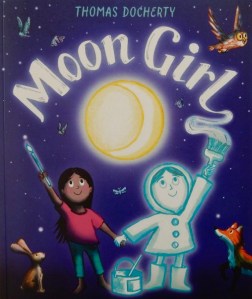
Leila loves bright colours and uses them in her painting; however she has a fear of the dark. One night as she looks out from her bedroom window at the moon in the dark sky, Leila sees what she thinks is a girl’s face peering down at her. The moon girl waves and so she waves back. Suddenly, as if by magic the bright-faced lunar girl descends earthwards landing on Leila’s windowsill. In her hand is a paintbrush. With this she starts to paint the world in a shimmering light and so begins a friendship.

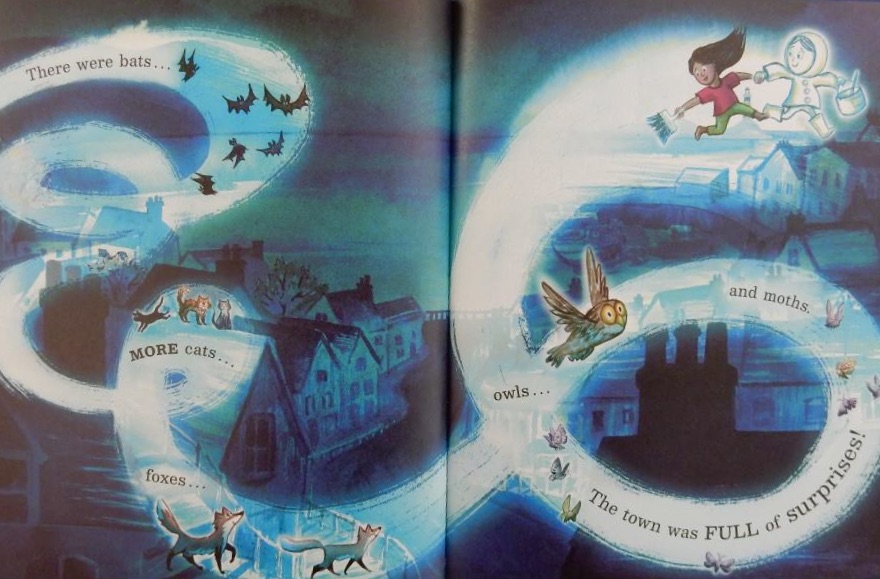
Together the two friends embark on a midnight adventure as the paintbrush held by the moon girl lights up the darkness, gradually enabling Leila to let go her fears of the dark and replace them with a sense of wonder at each new thing she discovers.

Thomas Docherty’s reassuring story conveys both verbally and visually how Leila’s friendship enables her to overcome her fears and see things with a different perspective, that of awe and wonder. Young listeners will delight in the inviting, magical atmosphere created in the beautiful illustrations of a tale that is a must for those who have their own fears of the night.

These Are My Rocks

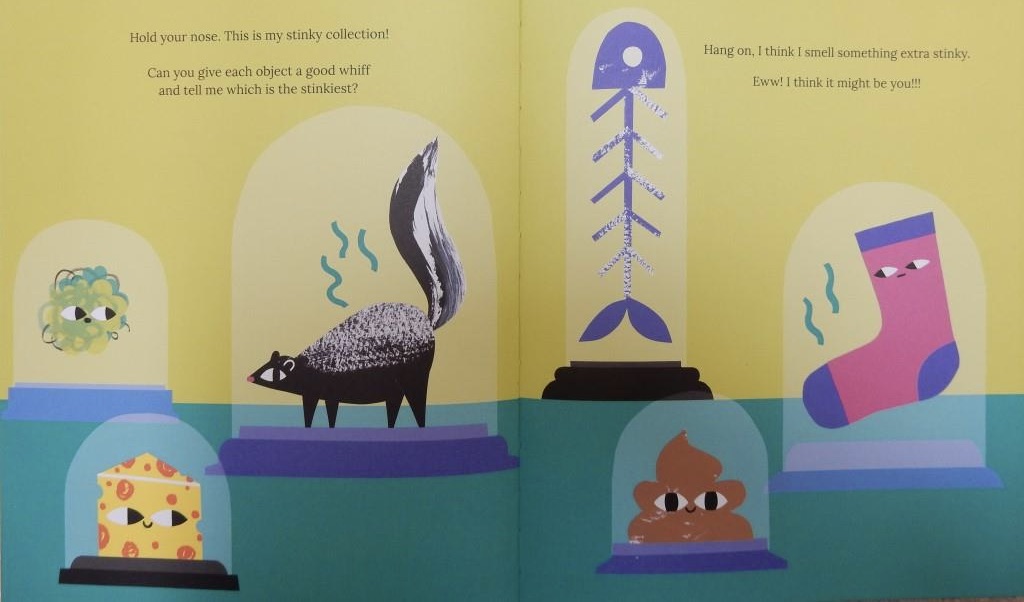
An inveterate collector of things offers would-be collectors ie readers, a tour of collections. First comes the instruction to turn on the light which serves to illuminate the narrator’s cleverly curated collection of ‘small things’. These include an ant, a paperclip, a button and an acorn. To most of these items, Bethan Woollvin has given eyes. The same is true of those in the other collections be they big (you’ll need to pause and assist in a spot of reorganisation to prevent them spilling right off the page), pointy, or prickly (the difference is known only by expert collectors), the most exciting (rocks). After which there come stinky items,

fan mail, bananas (have a joke at the ready to amuse them), and then it’s time to stop for some lunch. Each spread offers readers an opportunity to participate: you can blow away cobwebs from the prickly assemblage, find the stinkiest item in the relevant collection, sort particularly delicate objects – ‘Gently does it!’ Whoops! the teapot’s become a potential addition to the broken things collection, then grab a straying spider. Our narrator places this in the collection of things having ‘far too many legs’.

Eventually as the objects start nodding off, it’s time to turn out the light and bid everything goodnight. The last page suggests that young readers could themselves become collectors though having enjoyed Bethan Woollvin’s chatty conversational text and offbeat illustrations, one suspects little persuasion will be needed.

The Worry Bee

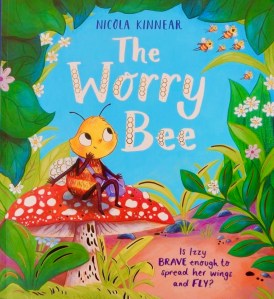
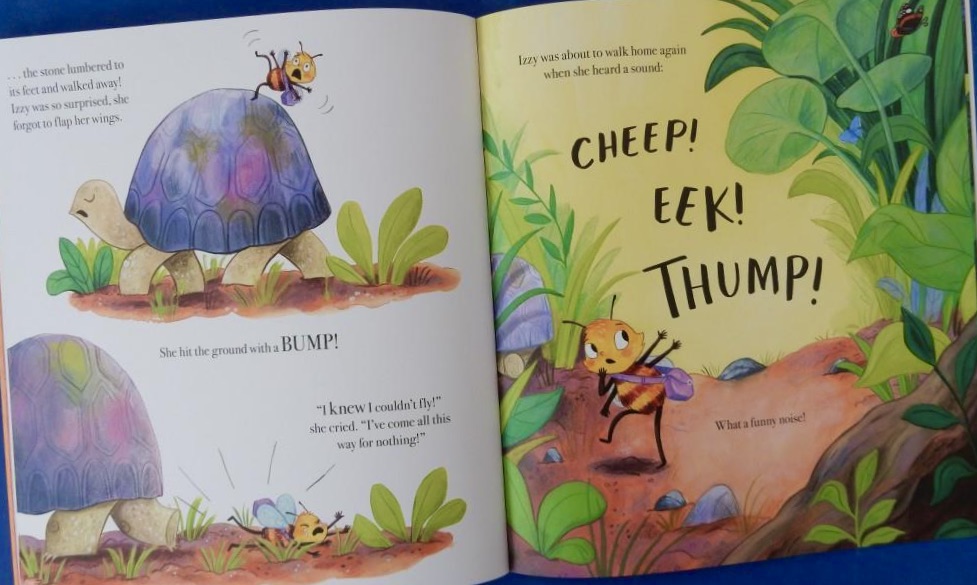
Little Izzy the bee longs to fly to the flowers with the other bees in her hive but she’s beset by ‘what if?’ worries: What if her wings aren’t strong enough ? What if she fell?’ So rather than trying to get airborne, she stays behind for a while and then starts walking, This gives her the opportunity to see interesting things on her journey. But there are disadvantages too including getting tangled in spider webs and even worse, a huge river to cross. She definitely can’t walk over that. Time to try flying, thinks Izzy but soon meets with an accident that sends her crashing to the ground.
She’s on the point of walking back to her hive but there comes a strange noise nearby. A baby bird lies flat on its back at the base of a tree. When it asks Izzy to demonstrate her flying prowess, she doesn’t know what to say, but suddenly the baby bird mentions a big fluffy thing coming towards them. Izzy realises what it is and that they need to take to the air to escape it’s clutches .After a lot of flapping … they’re flying, first stop the baby bird’s nest and then Izzy flies to join the other bees in the field of flowers..

There’s gentle humour buzzing right through Nicola’s latest story both in the words and illustrations. Young listeners will love the dramatic scenes of Izzy and how she finally overcomes her fear of flying.
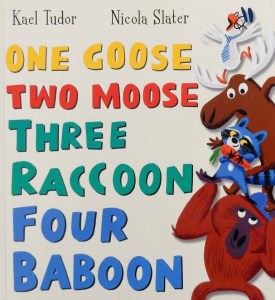
There’s No Such Thing As … Fairies / One Goose Two Moose Three Raccoon Four Baboon

These are both additions to popular series: thanks to Scholastic for sending them for review.

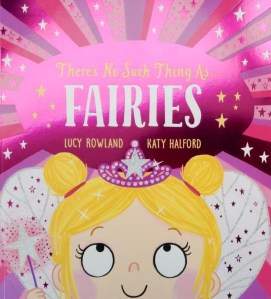
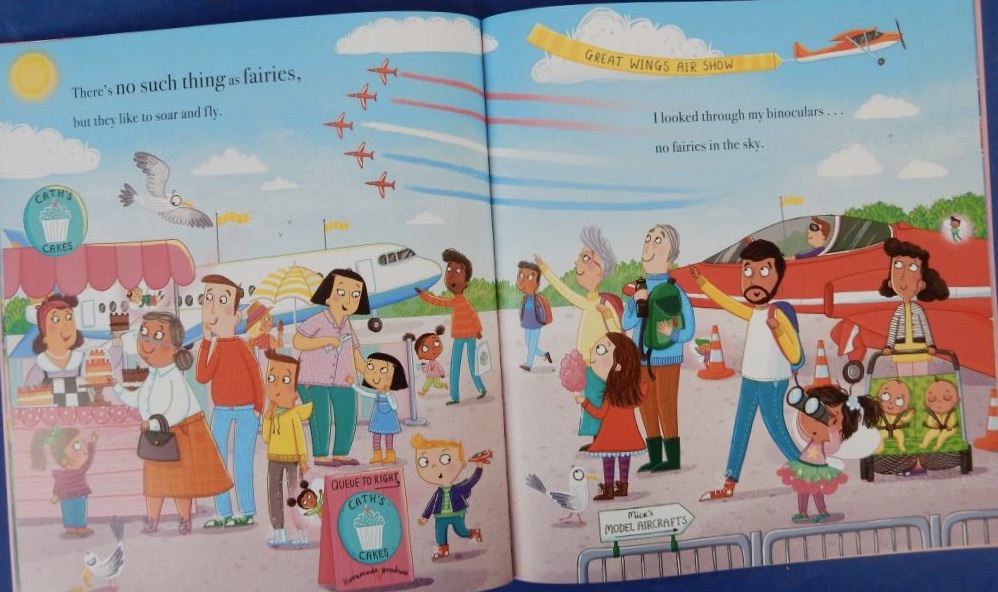
Having explored the possibilities of there being unicorns, elves, mermaids, dragons and ghosts, team Rowland and Halford turn their attention to Fairies in their latest search and find story. The young girl narrator has been told by her daddy that fairies don’t exist and she sets out to check the veracity of his assertion the very next day. First in the meadow where the family have a picnic, then the woodland stream, followed by the park, the beauty salon, the aircraft show

and the hothouse. She even checks out the dentist, the library and the theatre, after which she’s ready to agree with her dad, “There’s no such thing as fairies,” she confidently tells him, “It’s really TRUE.” Realising his little girl is upset dad lifts her up onto his shoulders and they start walking home. Suddenly a rainbow appears and …

Katy Halford’s vibrant, playful, detailed scenes wherein fairies hide in plain sight complement Lucy Rowland’s expressive, patterned rhyming narrative with its repeat refrain, making this a book that young children will find great fun and likely want to hear several times: oh how they love being in the know with the author.

Rule stickler Simon is back and once again he’s having trouble getting the animals into their proper lines. Then there’s Moose who is as eager to help as ever..
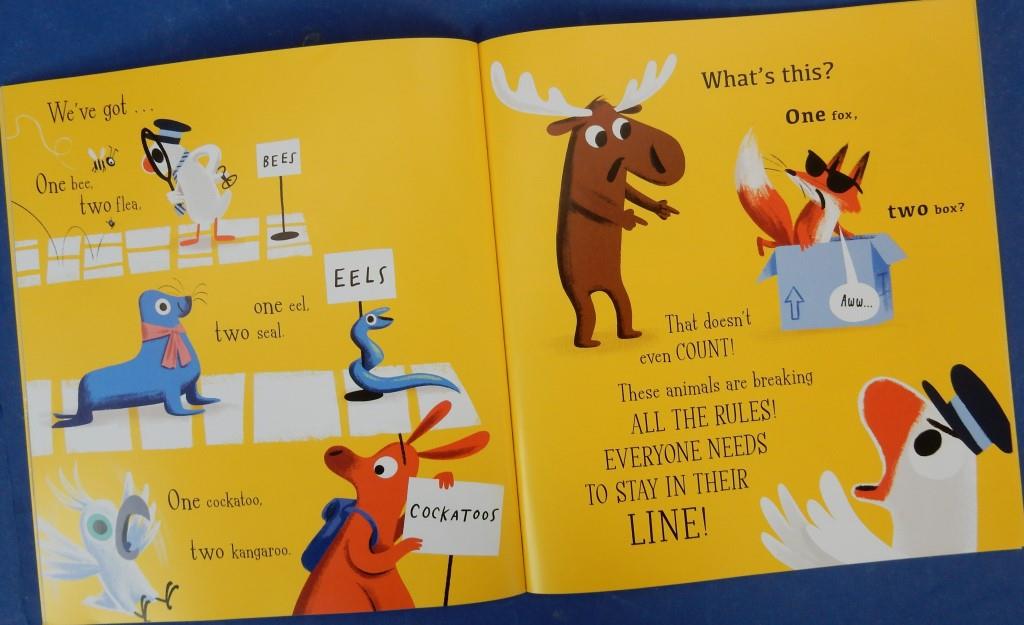
In this instance help is definitely required during an animal outing to the park for which there are three vehicles, one for the raccoons, one for the geese and the third bearing the sign Magical Moose Tours. When it’s time to reboard their respective buses is when the problem starts. There are mix-ups of raccoons and baboons, hares and bears, bees and fleas, eels and seals, a cockatoo and kangaroos; even a fox and a box – hmm!

Poor goose is going crazy with frustration and confusion. Forward steps Moose hoping to give some assistance. Can he persuade Goose that there is more than one way to do things and allow the tour to continue?

Another gigglesome delight with a wealth of possibilities for preschoolers and beyond, from author Kael and illustrator Nicola.

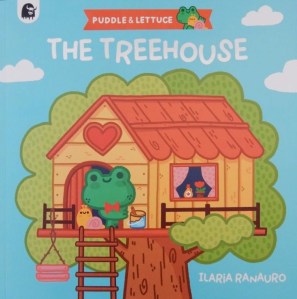
Puddle & Lettuce: The Treehouse

Meet best friends Puddle, a frog and Lettuce, a snail. Puddle’s little house beside the pond is perfect for a frog and Lettuce’s warm, cosy house on her back is perfect for a snail. They share each other’s special interests: Lettuce loves to listen to Puddle play his guitar and Puddle relishes the cakes Lettuce loves to bake.

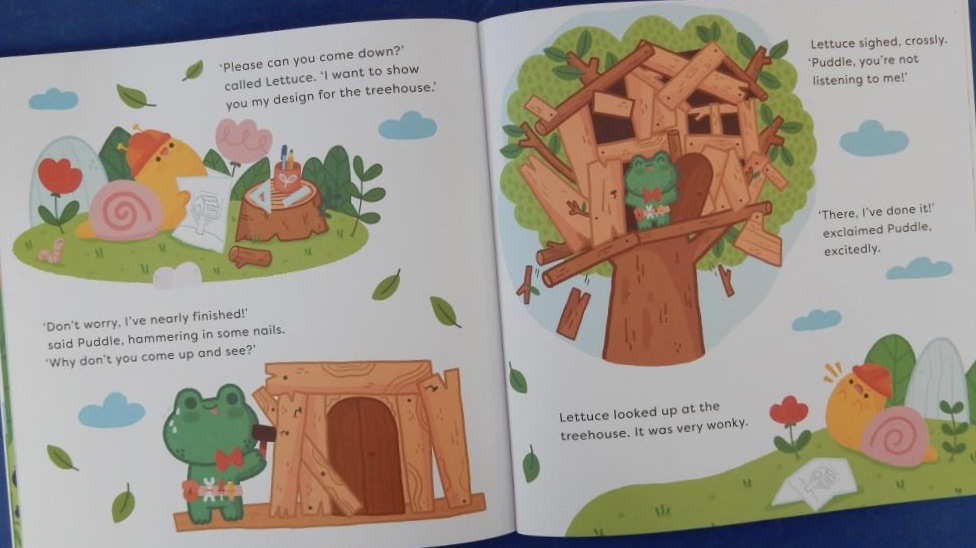
One day Lettuce pays a visit to Puddle but the latter suggests they go to Puddle’s much larger house. Suddenly they have an idea: a treehouse that is big enough to accommodate them both. However in his enthusiasm to start building Puddle dashes off to collect suitable bits of timber and doesn’t hear what his friend has said regarding the drawing of plans.

So, with the job complete Puddle excitedly calls his pal to come up and join him. The problem is the treehouse is way too far up for Lettuce to reach. A sudden realisation dawns. Can they work together and create a treehouse that is just right for them both, a place wherein they can both enjoy sharing their favourite things – pancakes especially?

With an important message about seeing things from another person’s viewpoint, this story with its endearing characters, will likely make young humans think about how they treat their own friends.

Ant Party

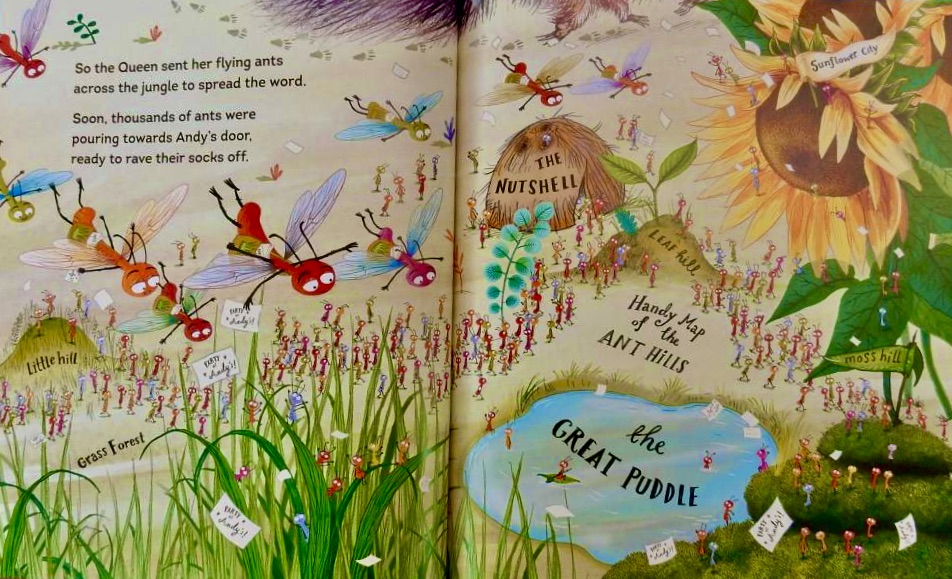
It’s Andy the ant’s birthday so he decides to throw a party – just a small affair to which only his neighbours are invited. But the neighbours haven’t any food to contribute so they invite the farmer ants. News of the party quickly spreads throughout the ant community to the worker ants, the soldier ants and the Queen. She takes it upon herself to invite residents of other ant hills nearby

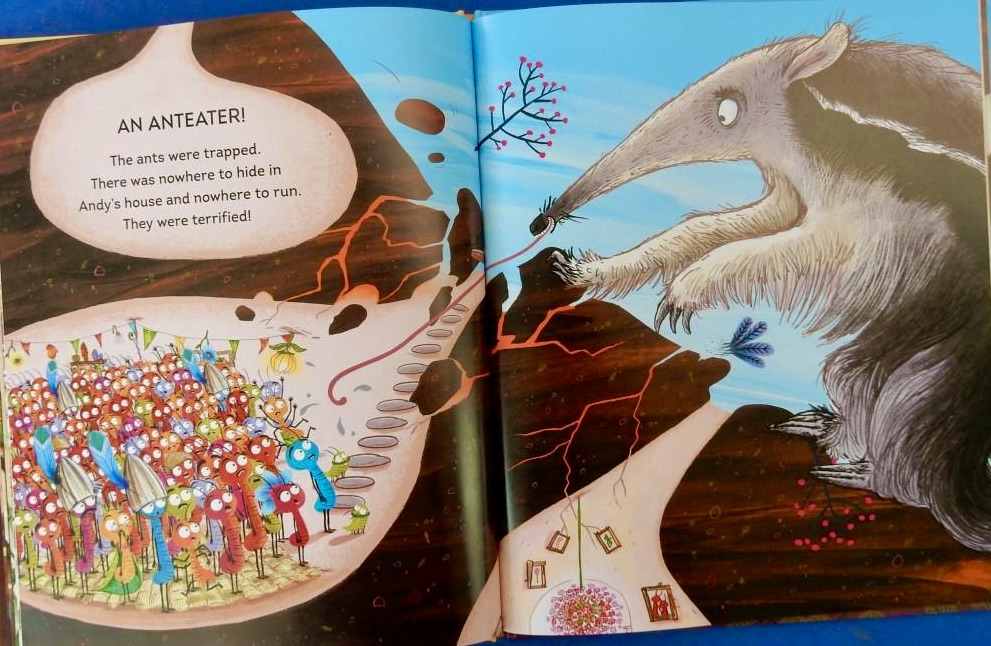
and before long there are thousands of excited ants ready for a rave. Andy finishes his preparations just as there comes a knock on his door. He can’t believe what his sees right before his eyes. In they come and immediately begin partying madly but suddenly there’s a horrifying sound that makes Andy’s house shake. It’s a gatecrasher in the form of an anteater and the ants are trapped, and terrified.

All that is except Andy who is absolutely furious. At his behest, the other ants rally round, form a conga line and the anteater gets his cum uppance. This will surely get child audiences cheering.
Having bested the intruder the ants celebrate long into the night giving Andy a terrific party, the greatest ever, despite not being exactly what the birthday ant had imagined.

Ross’s telling is thoroughly engaging and young children will adore Andy (I love his leafy apron) and the other ants, each of which Sarah Warburton manages to make different with spectacles, eyebrows, moustaches etc. Every turn of the page invites readers to linger long and enjoy all that’s going on. I’m sure this is a party children will want to go to many times over.

Oh, Carrots!

Mr Rabbit lives all alone and has grown used to so doing, occupying himself caring for his plants, keeping his place clean and reading, though at times it’s so quiet he does feel a tad lonely.

Now with the coming of spring Mr Rabbit can plant his favourite thing, carrots. It certainly keeps him busy and after 240 seeds are safely in the soil he’s more than ready for a hot drink and some relaxation. But suddenly he spots another seed in the packet. “Where were you hiding?” he asks seed 241, carefully planting it and resolving to give it a little bit of extra TLC so it doesn’t feel overlooked again. With daily watering, singing to the seeds, sunshine and loving kindness the carrots start to grow, one especially well.

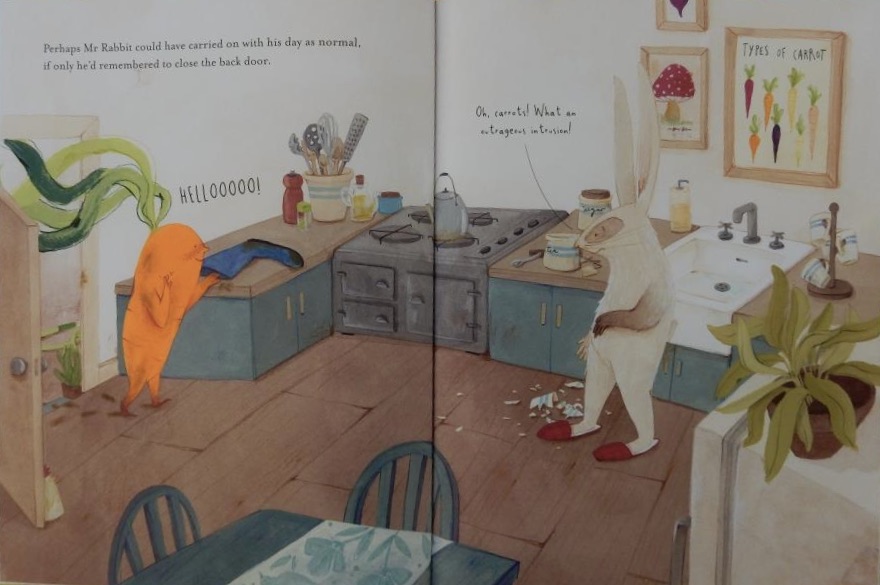
One day he notices a carrot top give a wriggle. He pulls, pulls and pulls and out pops a walking, talking carrot. “Hello Mr Rabbit” it says. ”Oh, Carrots!” comes the reply and Mr Rabbit dashes off home, forgetting to close the back door.

It soon becomes evident that Carrot just wants to be Mr Rabbit’s friend but Mr Rabbit wants his visitor to leave him alone not jump on the sofa, interfere with his record collection or rummage through his books. Carrot’s lively antics irritate Mr Rabbit who is not at all used to mischief. However during the course of the day our lupine friend gradually finds that he’s enjoying himself.

So used to being a loner, he’s never considered having somebody else around. Could it he that needs a friend after all?

Mariajo’s combination of words and pictures is a winner with its striking illustrations and text both imbued with gentle humour and wisdom. A book that celebrates the joys of making new friends and a demonstration of how a close friend can help a person learn more about themselves.

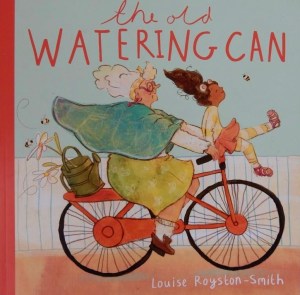
The Old Watering Can

Grandma has two watering cans, one she’s had a long time that is leaky, the other is new and somewhat ornate. Every spring and summer day she carries them both to her greenhouse at the end of the garden to water the plants. First though she goes to the tap to fill them but by the time she’s walked to the greenhouse, half the water from the old watering can has leaked out. The proud new one however is still full and likely to splash over the rim.

As a consequence only one and a half cans of water reach her greenhouse and this makes the old can feel the need to apologise for its leak. However Grandma is quick to point out the array of flowers growing on the old can’s side of the garden but not on that of the new can. She explains that she was aware of the leak, so had planted seeds only on the old can’s side and as they walked to the greenhouse they got watered. She tells her old can that she’s been able to share these flowers and make her friends and neighbours and of course, its owner. happy.

A story about accepting and celebrating your imperfections from a debut author/illustrator whose illustrations are infused with a playful energy and their charming details will bring a smile to the face of readers. Grandma is the only character mentioned in the words but there’s also a little girl, a lively dog and a bird that appear on many of the spreads – plenty of storying there.

The Playdate

This story is narrated by a little girl who accompanies her mother to the house of Henry Henriksson. On the longish journey from their flat, the girl notices a robot in a toy shop window. It’s something she’d dearly love but keeps quiet knowing that it would be way too expensive.

Henry’s mum welcomes the two and the narrator goes off to play with Henry. They play all kinds of games until Henry’s mum announces that it’s time for lunch . She asks her visitors if they’d like to join then but the girl’s mum says they have sandwiches and so they eat in separate rooms. After lunch Henry goes off to play on his computer leaving the girl to amuse herself, which she does by playing chase with the dog.

As a result she goes into a room she’s not seen before and there on the floor is a huge bag of discarded toys. Atop the pile is a robot exactly like the one in the toyshop.

After a while Henry’s mum calls the children to eat fruit together and they watch tv.
When it’s time to leave the girl’s mum suggests that Henry might like to come and play at their home sometime. “Hmm, maybe” Henry’s mum responds.

On the journey home, the little girl tells her mum that Henry is her best friend. Suddenly she remembers that there’s something she needs to confess and tearfully she takes Henry’s robot from her backpack and explains that she stole it. Mum remains calm and merely says she’ll return it the following week.
We’re not told that the girl’s mum is the cleaner for Henry’s mum and it’s evident from the illustrations that the two families live completely different kinds of lives.

Cleverly presented with the words telling one story and the illustrations showing another, this is a comment on the class divide and on our throwaway society. I envisage KS2 children (or even older) having interesting discussions after a class sharing though I’m not sure what children around the age of those in the story will make of the multi-layered book.

Ten Whizzy Racers: Chaos at Crackling Creek

This is the first in a new countdown series with a racing theme. The whizzy racers are Boo, Bolt, Bounce, Dash, Drift, Glint, Scoop, Speedy, Tricks and Zip. As the book begins they’ve all assembled in their vehicles at the start line in Fairytale Forest ready for the great Beanstalk Cup race to begin. The starting gun pops and off they go, but almost immediately there’s some thieving, out goes Drift and on go nine whizzy racers. Zip’s a kindly character and he pulls out of the race to pick up Red Riding Hood and deliver her safely to her Grandma’s house. And so the number of whizzers diminishes as all manner of accidents, alarming incidents

and other reasons for pulling out occur until only Bolt and Bounce remain in the running. Who will be first to cross the line and take the cup? One very happy racer. However, there’s another racer that is anything but happy and that, despite his shenanigans.

Timothy Knapman weaves a host of fairytale characters into his bouncy rhyming narrative including infuriated fairies, a terribly large troll and a mischievous unicorn. Each of these and lots more appear in Richard Merritt’s vibrant, action-packed scenes of the event. There’s so much to look at on each spread that little humans will be reluctant to whizz through the pages, rather they’ll want to take it slower and savour all the details.

Early Years Bookshelf: Little Dino Boo-Boos! / Bear

The little dinosaurs are a very lively lot and inevitably accidents happen: Triceratops gets a graze, Spinosaurus gets a soaking, followed by a cold, Velociraptor take tumble and bumps his paw and so on, so it’s important to know what to do when one gets hurt or doesn’t feel too good.

Through this delightful interactive board book, with its first aid kit containing a set of reusable stickers in the form of a fold-out inside the back cover, very young children can begin to learn about first aid and care in a playful way. On a first reading you may just want to point out each item and name it, but this is a book you can share over and over so your little one can learn more about each item as appropriate in addition to enjoying Jannie Ho’s humorous scenes.

A story about learning to share – maybe.
Bear is very happy with his ursine life: he loves his cookie, his book and his balloon; and he loves to sit by himself on his bench. As he sits comfortably contemplating, up comes Fox wanting to sit beside him on the bench. Wolf too wants something belonging to Bear – a delicious cookie; Rabbit wants a look at his book and Elephant asks for the balloon. Bear’s problem is that he doesn’t know how to say no to their requests

and consequently ends up with nothing. Now our ursine friend isn’t happy, he’s very, very unhappy as he sits thinking. Some while later along comes Duck with a cookie. Now we know Bear loves cookies so he requests a bite of Duck’s. I wonder how Duck will respond.

It’s important to know when to say no to others and this seemingly simple story with its wonderfully expressive, smudgy illustrations created with watercolour crayons and acrylic paints offers a good starting point for discussion with little humans.

The Only Monster

This is a story with a message about being an only child in a family and not comparing one’s family with other families.

Residing happily with her parents on Grönklebad Street, in the monster town of Bonglibod is a little monster. Then at monster school it’s the day class photos are taken. Little monsters wear their ‘bestest monster clothes’, mess their hair, leave teeth unbrushed and have bogies in their noses. The teacher calls her students in turn, instructing them to say ‘stinky cheeeese’ as they sit in front of the camera for their photo. This little monster does with a big smile.

However when the teacher announces brother and sister photos, little monster begins to feel sad

and this feeling of sadness continues right through until she’s walking home with her dad. He notices her demeanour and asks what’s wrong. She explains that everyone else – the Jooberwibblies, the Bogeynoodles, the Humplebutts, the WindyFlips and the Parps, the Dombledoofs,.the Humplejoys, the Marmaflippydoofs and all the rest have siblings, lots often. Dad acknowledges that this is so but goes on to reassures her that families should be measured by love, not numbers. Moreover, the little monster has all of those friends plus their brothers and sisters, and that is marvellous.

By the time the two reach home little monster is feeling cheerful enough to sing with her dad. However, she still has one more thing to say …

Little humans will love the final twist and all the fun vocabulary, especially the crazy monster names. They’ll love too Brendan Kearney’s superbly imagined, highly detailed illustrations.

The Tortosaurus

It’s Dot’s first day at her new school; she wants to fit in and make friends; but maybe she’ll start joining in tomorrow, she decides. Dot as you’ve likely realised already, is a person who likes taking things slowly, something her pet tortoise Monty truly understands.

In class during a discussion about pets, Jude tells everyone that he has a tortoise and Dot is on the point of saying something when Jess makes the disparaging comment that tortoises are old and slow. As a result Dot puts her hand down but is spotted by her teacher and so she announces that she has a Tortosaurus and will bring it for show and tell.

Fortunately Dot is a creative child and so she sets to work on Monty transforming him into an amazing creature that awes her classmates. Very quickly Monty becomes something of a ‘shell-ebrity’ which is not at all what he wants. Indeed he finds being in the limelight is really hard but he doesn’t want to let Dot down. After a while Monty is awarded a certificate of reptilian excellence and the stage lights make him feel all hot and bothered so he wriggles around until he’s removed every bit of his costume.

Initially Dot is angry; she grabs Monty and makes a dash for home but once there she calms down and on realising she’s forced the creature to be something he’s not, she apologises profusely.

Thereafter Dot decides it’s time to start being true to herself; gradually she comes out of her shell and makes friends with fellow tortoise owner, Jude.

This is a celebration of being one’s true self, allowing others to do likewise: and valuing them for what they are: that way real friendships based on honesty are formed and sustained. Katie Cottle’s illustrations speak volumes as we see Dot’s changing emotions throughout the story. Read at home and read in the classroom. I can imagine a lively circle time discussion resulting from a sharing with KS1 children.

A Card For My Mum

It’s the day before Mother’s Day and the shops are busy with people looking for the perfect present to bring a smile to their mum’s face. However the little girl narrator can afford only a card for her mum and although she searches high and low she cannot find a single one that has a picture that looks anything like her own mum. She who loves to wear dangly gold earrings and bangles that jangle as she mixes the dough for naan and rotis; a dark-haired mum who goes to the vegetable market clad in her silk kameez and flowing chunnie. A mum who loves bhangra dancing.

Suddenly her mum’s smiling face is there before her for real and the little girl decides that there’s only one way she can give her mum a card that is just right … Time to get creative.

It’s very important that all young readers/listeners see themselves represented both in books and also on cards. The former has improved thanks to publishers like Lantana but it’s not so where cards are concerned and this story makes youngsters stand behind the head of someone who cannot find themselves and in this instance their mum, represented. A thought-provoking book to share as widely as possible and not just around Mother’s Day.

Mr Norton’s New Hat

Horace Norton is a kind character so when he discovers one Monday morning that a mouse has taken up residence in his hat, he leaves it there and cycles off to work. On Tuesday he notices some birds have made a nest in his bicycle basket but he pedals off obligingly with both lots of tenants.. Come Wednesday there’s a squirrel asleep in one of his shoes. What does he do? The same as on the previous two days. Subsequently he decides to leave undisturbed the stoats in his satchel, and the cats curled up in his coat. By the weekend it’s evident that Horace needs some time to relax. It’s not to be, for the animals are clearly taking advantage of his good nature. Having realised a wash is out of the question, he decides to return to his bed but …

Mr Norton’s increasing frustration with his ever growing menagerie builds to a response which surprises the man himself: “Enough is Enough!’ he shouts causing the animals to scamper away. Is this the response he longed for though? Not so, for he realises how very lonely an empty silence in one’s home can be.

When the next Monday comes around, Horace finds a surprise parcel at his front door; it’s a gift from the animals and one that results in a welcome solution to his solitude.

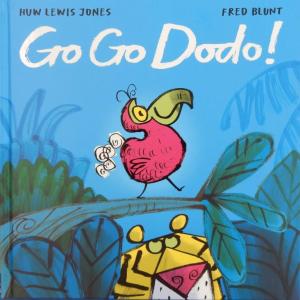
Young listeners will love Huw Lewis Jones’ zany cumulative tale with its wealth of alliteration, as well as lots of repetition to join in with. They’ll love too Corey Egbert’s scenes of the mischief-making animals and the growing mayhem they cause for their host. A smashing amalgam of words and pictures; it’s sure to be a story time winner.

Will We See A Mermaid?

Little Evie is at the beach with her parents and best friend, Dr Dino. Last on her list of things to do that day is to find a mermaid. Dad thinks she has a great imagination whereas Mum tells her she’ll need to look very carefully. So begins Evie’s ocean adventure with Dr Dino. They pack the necessary gear, then before diving deep, the two go and check the rock pools. They’re certainly full of interesting marine creatures but no mermaids.

The two build an Ocean Explorer Submarine, launch their craft into the waves and head out to sea. Dr Dino talks about the dolphins they see; then deep underwater they dive and Dr Dino informs Evie and readers about the behaviour of the anchovies and whales they spy. Unfortunately among the marine fauna are some plastic bags and the explorers are determined to prevent a turtle from eating them in mistake for jellyfish. Their bag chase sees them visiting a kelp forest

and a coral reef and diving way way down into the darkest depths until … at last, it’s mission accomplished. But have they seen any mermaids:? Maybe. …

Back on the beach, Mum and Dad help the adventurers collect rubbish left by thoughtless people and Evie offers her definition of mermaids.

This book is full of interesting information, including a gate-fold spread about marine life that will fascinate KS1 children. However, it would also work well as a straightforward story for preschoolers if the reader aloud shares only the main narrative.

The Bookshop Dog

Scamper absolutely loves his home with Paige at The Happy Tails Bookshop and can’t imagine a better place to live in the whole world. Everybody in the neighbourhood has made him feel welcome and he loves them all, Paige especially. To show his appreciation, the pooch decides to follow her example and he selects some books he thinks his friends might enjoy reading. This proves very successful: Scamper has helped all his friends

but is there a book that can put a smile on the face of the person who seems to have read every one already? His search of his friends’ abodes yields nothing suitable and it’s a down-hearted Scamper that returns to the bookshop but joy of joys …

What a delightful character is Scamper, especially in the way his observations enable him to find the right book for each person, even though it’s unlikely to be what they themselves would have chosen.
I love that reading and books are celebrated both verbally and visually at every turn of the page: listeners and readers aloud will love the wordplay and clever book titles – Mansfield Bark and Doggy Deeds of Derring Do – for instance. Claire Shorrock’s illustrations have lots of details that offer starting points for discussion and I absolutely love the exchange between Paige and Scamper near the end: “Reading takes us all on incredible journeys.” (Paige) and ‘reading is a way of coming home.’ (Scamper). So true, both.

Do Not Say These Words

Words are powerful, that is something children learn very early in their lives and once they start speaking that opens up a whole new wealth of possibilities, one of which is humour. It’s humour that author Frances Tosdevin and illustrator Rhian Wright very clearly have had great fun exploring in this splendidly silly book.

We’re in the hands of expert scientist and inventor, The Professor. She, by means of a series of words that young children already think of as a tad naughty, explains that the hilarity induced by the utterance of these words causes giggle-gas and the effect of too much of this in the air is detrimental to the environment. Indeed the world will end up zig zagging around the solar system and we humans will all fall off. The sure way to prevent such a catastrophe is by banning these words and she, aided and abetted by her trusty froggy assistants, have invented a machine that turns these world-wobbling words into harmless, unfunny ones.

The first word for the Prof’s zapping treatment is ‘BOTTOM’ and its safe replacement is in her words, the unfunny ‘FLOPPY PEACH-CHEEKS.’ – make sure you keep a straight face when you read that. next is ‘FART’.

I love the way the alternatives generated by the machine are generated through Rhian Wright’s dramatic illustrations bursting with small details. These provide a great complement to Frances Tosdevin’s terrific text, which offers opportunities for audience participation.

Share this in a classroom – it will appeal across a wide age range – and you’ll likely have the listeners going almost as berserk as the Prof’s machine as the story nears its dramatic conclusion. My partner was spluttering with laughter as we shared it..

Little Rhino Lost

As she wanders in the huge grey urban jungle that is her home city, Maya comes upon a lost baby rhinoceros. She wants to help the creature but needs to know what his home looks like. The baby rhinoceros describes a place full of green plants and trees but as they wander, nowhere looks anything like that,

so May takes the rhinoceros back home with her. She feeds him and with the help of her kind neighbours, does her best to make him feel at home.

The following morning there’s no sign of baby rhino but instead a note to her from the mother rhino thanking her for her care. Despite knowing that her little friend is safely back home she misses him and wonders if he might come a visit. To that end she sets about turning her garden into a wonderful green space and her neighbours do likewise so that the city gradually becomes somewhere a little rhino could call home.

This charming story about determination, kindness, community and environmentalism, is set in the Philippines, the author Candy Gourlay’s home country. Would that urban dwellers be they in Manila, (the city depicted in some of Jamie Bauza’s scenes) or elsewhere in the world, come together in a similar way to help make all our cities greener.

The Endless Sea

This is a heartrending story of having to leave your home and go in search of a new, safe place to live, told through the eyes of a young girl. She, her parents and sister lived in a Vietnamese village which they were forced to leave on account to being on the losing side of a war.

After a long and arduous journey walking under cover of darkness, the family eventually reached a wooden boat that was to carry them, crammed tight for four days, down a river. Then on the fifth day a fierce storm arose, the boat’s pump gave up working and the boat began sinking.

Eventually a ship reached the now rapidly sinking boat, a pallet was lowered and the family lifted to safety. The rescuing ship carried them to a refugee camp where they waited until they were flown to a new country and given a new home. Despite recalling the traumas they’ve been through, the young narrator considers how lucky her family has been

especially when a year on, they are able to celebrate New Year together, hungry no longer but hopeful and able to look forward to many more days together.

Author Chi Thai’s note at the end of the book makes it even more poignant as she writes of how she aged three and her family came to the UK as refugees, for which she is enormously grateful. She goes on to talk of the 36 million refugees there now are and reminds readers how crucial it is that they are treated with compassion. Linh Dao’s illustrations are appropriately sombre during the traumatic escape contrasting with the uplifting scenes of the family established in their new home.

A book to share widely in primary classrooms to help foster that vital compassion and understanding the author speaks of.

My Mum / Come What May

Mums do so many things for their little ones and this book is a warmly appreciative and loving way to celebrate the day to day adventures they have big and small, told from the viewpoint the little girl narrator. To a mother fixing a child’s broken toy or running through a wildflower meadow and then making a daisy chain may not seem particularly significant but to her offspring, they mean the world. So too of course, do those days at the seaside, building sandcastles, searching for shells, wave jumping and making seaweed crowns. It’s evident that the mum featured loves to encourage and participate in imaginative play; and no matter the weather,

day or night, she’s close by to make things turn out right.

Sarah Mathew’s vibrant mixed-media illustrations are a delight, full of small details for mums and small children to explore and enjoy together. With Mother’s Day approaching, perhaps after several readings, a child could be encouraged to make up their own pictorial celebration of ‘My Mum.

As this story opens Large and Small are doing some baking but it’s not going well for Small AT All. Things are getting dropped, spilled, broken and everywhere is splashed with cake ingredients.
Both cooks want to scream and shout but Large declares love for Small “come what may”. The best way to defuse the situation is to get outside into the fresh air, have a walk and maybe a little picnic in the countryside.

This gives Small an opportunity to indulge in some what ifs, imagining being in turn a roaring dinosaur,

a tiger, a buzzing stinging insect; but for each comes the response ‘I’ll love you come what may’ from Large. Bad mood or good, Large’s love is unconditional, so too is that of Small.

Some of the adults who share this with their little ones are likely to be those who enjoyed the delights of Debi’s No Matter What first published twenty five years ago.

Frank and Burt: The One Where Bert Plays Football

In this 4th tale telling of the ups and downs of the friendship between Frank (fox, who narrates) and Bert (bear) we’re treated to a soccer saga set in the park. Both characters are lovers of the game and Frank has taken it upon himself to teach his pal how to play – sometimes with disastrous results.such as the cake squishing and prickly spikes episode. However, today Bert has a new football and is anticipating scoring lots of goals. He starts with a complete miss, not only of the goal but the ball itself and lands flat on his belly.

Then just before going to assist Bert, Frank spies ace soccer player, Barbara, and the two of them have a kick about. Barbara’s showing off sends Bert’s ball high up into a tree but does she stay and assist in its recovery. No she doesn’t; that’s left to Frank. He however, having scrambled up to within a paw’s distance, gets an attack of vertigo

and also does some some quick self reflection.

Suddenly the branch bearing Frank snaps pitching him earthward, but he’s fortunate in having a best friend ready and willing to come to his rescue by providing a soft landing surface to cushion the blow. Trust Bert to save the day.

Chris’s superb colour pencil scenes exude energy, humour and pathos, perfectly capturing the changing emotions of his larger than life characters. With vital messages about friendship and decision making, this is another gem of a story featuring the utterly endearing friends.

Off they Go!

Poet / writer James Carter and illustrator James Munro have again joined forces on a natural history book, this time on the topic of animal migrations.

Through the former’s rhyming narrative and the latter’s bold, bright illustrations readers are introduced to nine migrating species. First though, there is an introduction to the concept that all creatures may undertake migration.

Whether they travel over land, through water or the sky, the selected animals undertake long, often difficult journeys. From Barn Swallows

to Monarch Butterflies, salmon to humpback whales or Christmas Island Red Crabs to humans, we learn more about the different animals and the reasons for their migrating.

Did you know that the globe skimmer dragonfly can journey up to 6,000 kilometres, travelling from India to Africa, island hopping en route to lay eggs and their offspring making the return journey? Some feat.

Included in the final narrative section, is information about animal navigations and unusual migrations making this an ideal introduction to the whole topic.

My Path

We join a little snail as it follows its path (leaving a slivery trail across the pages,) from sunrise right through to nightfall. Sometimes the little mollusc is alone, sometimes with the company of others and there are obstacles to negotiate, sometimes by going over, sometimes around or even round and round.

The journey may be smooth or rough and when it comes to a very sudden, unexpected end, if it feels like the right path, it’s the way to go. If met by another that challenges a decision, after due consideration, the snail’s decision belongs to the snail, not the challenger. However, when faced with enormous challenges, it’s okay to ask for help. Even with determination and conviction there may be what feel like dead ends but what’s important is to keep going.

Important life lessons are embedded in this story told as a recitation along with expressive illustrations that show so well the snail’s changing emotions as it responds to the variety of experiences encountered on its journey.

This is a book offering much to think about and discuss in a class circle time session with KS1 children, not least that every person’s path is special, a unique learning journey.

Little Gwen, Rescue Hen

Life is very unpleasant for the hens at the chicken farm. They’re packed tightly in cages, each day feels the same and as she’s constantly pecked by other hens, one little hen loses lots of feathers. Eventually she feels too tired to lay a single egg; but then one day, things change. She’s gently lifted, placed in a dark container and a voice tells her not to be frightened. Then she’s on the move inside the box, heading for an unknown destination.
After some time, the box is carefully put down and opened. The little hen emerges into the brightness of the outside world beyond the confines of her previous existence. There are so many new things to discover and new friends too. But one thing the little hen misses is her feathers that would have protected her from chilly winds, very hot sunshine and incessant rain.

Fortunately the providers of her new home decide to make her a warm vest to wear until her feathers grow back and they decide to call the hen little Gwen. Gwen feels nice and cosy in her new garment until she gets tangled in some twigs that unravel the stitching.

However, with her feathers gradually growing back Gwen no longer needs it. Then one day before sunrise little Gwen goes a-wandering and what an exciting day she has before snuggling down to sleep in her warm safe little chicken house. It’s there that one morning, one of her kind human rescuers discovers a special surprise in the straw. Now what could that be?

This story is a great way to introduce quite young children to animal rights issues and will stimulate lively discussion in a KS1 classroom. Carol Thompson’s illustrations speak volumes as we follow Gwen’s move from terrible conditions to those where she’s treated well and thrives.

Just One More Story

Pip and Bun are bunnies with very different predilections. Pip loves to read; Bun considers books boring and enjoys lively play. So when Pip invites Bun to read with her, he flatly refuses causing Pip to close her book with the comment, “You wouldn’t like this book anyway. It’s not for little bunnies.” Cross at being called ‘little’, Bun decides to read Pip’s book for himself so he takes it from the shelf and looks inside.

He’s astonished to discover the main character is a penguin that rides a motorbike. “Penelope Penguin, super spy!” Pip informs him. With Bun’s interest sparked, Pip starts reading more with the listener very actively engaged. After the story, Bun selects a book about a pirate princess and with Pip reading the words, Bun becomes a swashbuckling freebooter.

They spend the entire day reading stories together until there are no more books on the shelf. Pip suggests they make up their own story; this leads to a squabble with Pip remarking angrily, “Books aren’t for little bunnies.” Bun is left alone feeling very, very small, but Pip too feels. Soon they realise there’s only one way to get themselves out of this impasse: reading books together the way they were, is too good to stop because of a silly squabble.

The characters are endearingly portrayed in Sean Julian’s scenes of the furry, floral frolics. It’s good to see an acknowledgement that there are different ways to enjoy sharing a book, some of which involve being physically actively: so it was for the young bunnies, so it is for their human counterparts.

The Full Stop That Got Away

Meet Frank, he’s a full stop who loves to make up stories. One day he decides to make up a ‘nice, short, sensible’ one about a dragon. Here’s how it goes: ‘Once upon a time there was a dragon called Dee.’ End of story, so Frank tells us.

However the dragon thinks otherwise and decides to take over the story telling. Dee’s story is a about a tea party to which he invites his dragon pals. A veritable feast it proves to be with goodies galore, a never ending supply of them and that is because Frank has decided to quit.

When fire breaks out you can guess who the dragons call for to come and help. Having been sidelined, the small round entity steps up and cleverly produces some fire-extinguishing precipitation. Finally Frank has proved his point and Dee cannot help but agree.

Our external narrator makes an important comment concerning fun and sometimes allowing it to carry you away just before the book concludes.

With one larger than life main character and another of the fire-breathing kind that he brings into being, this is a very funny rhyming tale about imagination unbounded and knowing when to rein it in. Nathan Reed’s illustrations make this introduction to punctuation into deliciously dramatic dottiness.

Wrong Time Rooster

There’s excitement down on the farm when a large crate is delivered. With the animals gathered around, Farmer Tony opens the lid to reveal a rooster. Said bird wastes no time in introducing himself as Ronnie. “No more sleeping in late,” the farmer tells them but at dinnertime that evening there comes a resounding ‘COCK-A-DOOODLE-DOOO’; but Ronnie fails to crow the following morning. As a result, the animals remain fast asleep.

After a whole week of wrongly timed crowing, much to the delight of the farmyard entourage, Farmer Tony decides that he needs to have a talk with Ronnie about his efforts.

Apologetically, the rooster explains that he’s been sacked from every job he’s ever had on account of his badly timed crowing. “But nobody ever taught me how to tell the time!” he reveals. Farmer Tony’s parting comment leaves Ronnie convinced that he’ll be re-crated and moved on yet again.
However, the silent farmyard no longer feels right to the animals, nor indeed to the farmer. Rather than sending Ronnie packing, they collaborate on something much better for them all: teamwork rules and that team includes rooster, Ronnie. No more crowing at the wrong time on the farm – or make that almost never …

With rumbustious illustrations, a main character that will endear himself to listeners, its playful narrative that reads aloud well and lots of opportunities for audience participation in the COCK-A-DOODLE-DOOs and WRONG TIME ROOSTER refrains, this is a story that young children will enjoying giggling over, time and again.

Sniff! Sniff! What’s That Whiff?

This story is told in rhyme by a dinosaur that has feasted on a large portion of berries for lunch and soon detects a terrible whiff in the air around. Determined to discover the perpetrator of the bottom-burp aroma , off it goes inviting young humans to join in the search. The first to be interrogated is Pterodactyl. She proffers proof that her toot is not the horrid one that offended our dino. narrator. Nor are those made by Dippy diplodocus, Ankylosaurus,

Triceratops, the Megalodon Shark (his is exceedingly fishy) and Steggy Stegosaurus. Then comes a very strong, meaty smell: Yikes! It’s T-Rex. T-Rex gives chase but unexpectedly stops, apparently feeling exceedingly poorly on account of the stench. Our narrator empathises but a realisation suddenly dawns. That rear end purple parp cloud eruption is coming from our very own narrator’s bum and has been responsible for saving the others from becoming T-Rex’s supper.

Time for a party when feeling de-stressed, the other dinosaurs dance, stomp and relax their bum muscles releasing …


I suspect that along with unicorns and dinosaurs, poohs and pongs are young children’s favourite topic for picture books so this one of Lucy’s and Gareth’s will be a winner on two counts.

How To Walk A Whale

This fourth title in the Peculiar Pets series is narrated by a girl who takes her grandmother’s advice, thinks big and advertises for a whale to come and share her abode. Sure enough, what should appear outside the front door but a blue whale. It’s as well that Granny has a book on whale care to make matters easier. Providing a ‘happy’ environment means that the creature cannot spend more than a couple of hours on land. Then there’s the issue of diet: an abundance of krill is what’s needed and lots of exercise is vital;

but when it comes to accompanying your whale as it swims thousands of miles to find a mate and give birth; and communicating your love often, it becomes evident that as strong as that love is, what is even more important for the pet whale is to rejoin its family in the vast ocean. Of course there’s always the hope that he’ll come back to visit his human friends before too long.

As well as being vibrantly and humorously illustrated by Sarah Horne,, author Sam Wilde has included lots of facts about blue whales in the text. Did you know for example that they filter the krill through big bristles in their mouths. There’s also a final double page spread giving the ‘Top (10) blue whale facts.’
Yes, the book is humorous but it also contains an important message about the responsibilities one takes on when having a pet animal of any kind.

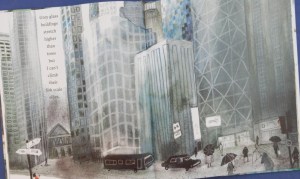
Cloud Boy

No matter how hard he tries, Bobby’s attention keeps wandering and he finds it hard to stay still. When he becomes distracted, he starts floating upwards and the more his imagination takes over, the higher he goes. His friends, his mum and his teacher try to help but there are so many things that draw his attention away from the everyday things – the colour of a bird’s song and the idea that the moon might get lonely – for instance. Bobby really does want to concentrate like his friends Jess and Nelson, to be organised like his Mum and focused like teacher, Mr Brian, but it only works very, very briefly and makes the boy very tired. His friends and family devise a plan.

However, this restraint makes him feel empty, devoid of imagination and so he cuts himself free. The result is immediately uplifting, leaving friends and family pondering upon how to get the boy down. Perhaps they should try looking at things from Bobby’s viewpoint …

This uplifting story shows the importance of understanding and valuing neurodivergence: it appears that Bobby has ADHD and author/illustrator Greg Stobbs, has drawn on his personal experience in creating the book. I love his use of pink neon to represent Bobby’s imagination.

An important story to share and discuss.

The Book is Full of Poop

Having given readers a book full of unicorns and a book full of elves, team Gareth and Nathan now offer a much more whiffy one. I suggest a clothes peg on the nose as you accompany the two child narrators on a poo hunt around town; it promises to be a ‘super-duper-poop-athon’ during which you will encounter creatures of all shapes and sizes, some imaginary, some extinct and others feathered, furry, thick and fibrous, or scaly. Of all shapes and sizes too, are the poos they deposit.

Did you know for instance that hippos poo while on the move

and sharks produce poo of a green colour?

Gareth’s rhyming narrative ends with a warning to beware of hidden poop piles and of course, whenever you conclude a walk around outside it’s wise to check the soles of your shoes.

Young humans will love the poo depositing shenanigans of the animals depicted in Mike’s amusing scenes; adult readers aloud might wish to have an air freshener close by as they share this offering with one or several children.

Let’s Play Rugby!

This interactive story is published to coincide with the Six Nations rugger tournament, which this year kicks off on 31st January. The aim herein is to help your team lift the trophy and once clad in your gear, like all players the first thing to do is some warming up exercises – jogging on the spot and star jumps – before the kick off.
Now it’s time for you to kick that ball you have in your hands right up high and it’s game on!
Wow! Some of your opponents are enormous so tackling someone with the ball can send them down really hard and win your team back that ball. Yeah!
As the story proceeds we learn more about the game of rugby – the scrum,

the line out and scoring a try, while following the instructions to shout loudly, push, rotate then shake the book, weave your finger through the defenders,

find the gap and touch the book down to score a try. Now it’s up to you to kick the conversion to win that trophy. WOOOO1 Hurrah! One last thing: lift the cup high above your head to show the crowd. What a game!

Co-authored by Irish rugger Gordon D’Arcy and writer Paul Howard, and robustly and dramatically illustrated by Ashwin Chacko, this action-packed picture book captures something of the excitement of the game. One hopes it will not only inspire young children to watch the Six Nations games but also to seek out one of the many rugby clubs that cater for primary school age children with mini-rugby sessions.

Ten-Word Tiny Tales of Love

This is former children’s laureate Joseph Coelho’s second Ten-Word Tiny Tales offering, this one having a unifying theme – love – and in an introduction, Joseph tells readers how the tiny tales came about.
Each of the tales is moving in its own special way; you will find great sadness, tender parental and sibling love, spookiness, the fantastical, the humorous and more.

Coming from all over the world, each one of the talented artists has created an equally special, very different scene, thus making every turn of the page a verbal and a visual delight.

We see enigmatic and literal interpretations as well as ambiguity: there is love for such diverse things as a bike, baby birds and a brother,

but in every case the intention is to create a world – a space of awareness – that will spark the reader’s imagination.

To facilitate this, Joseph offers some story writing prompts in the final two spreads.
Altogether a treasure trove that holds within, a wealth of possibilities for creativity both in the classroom and at home.

Coorie Doon: A Scottish Lullaby Story

This debut picture book by renowned poet, Jackie Kay, has its roots in well-known folk songs. Subtitled ‘A Scottish Lullaby Story’, the author also uses some lyrical old Scots phraseology.
The story begins with Shona – a ‘wee bit bairn’ listening to her daddy singing Coorie Doon, till she fell asleep under ‘the huge eye o’the moon. (Corrie Doon’, the author tells us after the story means ‘snuggle in tight, tuck in.’)

This ritual happens every night and sometimes the song a parent sang would be The Tiree Love Song; other times it would be “Goodnight, Irene, … / I’ll see you in my dreams.”
As young Shona sleeps, readers too enter her dream world encountering in different places, her friends her black and white cat Flo, Marley her dog, baby Serenity and more.

Then, sixty years later it’s the turn of Shona to tuck her aged dad into bed and to sing to him, “Coorie Doon, Coorie Doon, wee Daddy” before going out the back door into the night to look at and wave to the moon.

That Shona is adopted is not referred to in the narrative but in a letter to readers at the back of the book, Jackie tells us that she imagined Shona being so, and that she too was adopted as a baby.
Gorgeously illustrated by Jill Calder, her soft, warm scenes help celebrate the small, childhood rituals and how they become embedded within us, a vital part of who we are.

Opposite the title page is a QR code so readers can watch an author video, and listen to recordings by folk singers Peggy Seeger, Claire Brown and Suzanne Bonnar. A treasure of a book.

The Greedy Wolf

Once there was a wolf (a greedy one as they often are in stories) and this one had a particular penchant for fresh young goats. So when walking past Mummy Goat’s house he heard her say to her seven offspring that she was going to get their favourite food for dinner, he was determined to make the kids his next meal. His first attempt to gain entrance was by pretending to be a post person delivering a parcel. Next (with a voice change) he told the kids that he was the ice-cream man, but again the kids kept the door firmly shut.

By now desperately hungry, the wolf resorted to pretending to be a talking rose bush with a flowerpot on his head, sent by Mummy Goat to babysit.

Finally the door started to open and the wolf, feeling particularly prickly, gained entrance, rushing inside with a roar.

Did this scare the little goats? Oh no it didn’t, they were busy cooking. Now the wolf was certain that he’d finally sate his appetite. This he did but who was the more satisfied when he departed from the goats’ abode?

Timothy Knapman’s funny updated telling of the Grimm Brothers, The Wolf and the Seven Little Kids with Jean Jullien’s illustrations of the mock-scary wolf are sure to make young audiences laugh (though the story will be most appreciated by those familiar with the original version). Serve it up in a KS1 class or at home and see how it goes down.

When Fish Finger Froze

Fish Finger has a happy family life and plenty of friends at school; but then one day there appears on his classroom wall an announcement about a school disco to be held that very night. His classmates are excited but Fish Finger starts to worry straightaway. His worries increase after Miss Bag O’Spinach tells the class that they can spend the rest of the school day working on their dance moves and everything Fish Finger attempts ends in disaster.

At home after school, his siblings, Patty and Fillet, are eagerly getting ready for the evening, rummaging in Grans trunk and doing their hair. Mum notices Fish Finger looks upset and when he tells her about his bad dancing, she encourages him with some wise words about doing his own thing. The twins too are supportive and set to work giving him some tonsorial treatment before they leave.

At school, the hall is full of lights and lively movers but Fish Finger remains frozen to the spot, his feelings all tangled in his tummy as the contest is announced. Then suddenly something amazing happens: Fish Finger thaws as he shimmers and shakes across the floor, full of zest and showing surprising confidence as he follows mum’s advice and does his own thing. He’s clearly delighted and so are his friends.
When the parents arrive, Miss Bag O’Spinach realises she’s yet to present the prizes. There are a fair few including one for ‘Best Attitude’. Can you guess who gets this award?

Hearing his name called, the winner suffers a brief re-freeze but quickly warms up, thanks to his helpful classmates and a celebratory dance concludes the proceedings. Hurrah for camaraderie, empathy and especially for the character who overcame fear and bravely did his own thing.

With Michelle Robinson’s spirited rhyming text and Tom Knight’s funny illustrations that capture so well the feelings of the protagonist, this picture book is full of heart and offers a great way to get young children talking about their own feelings and emotions.

The Found Things / Guess How Much I Love You: I See Me

These are two Walker Books titles for very young children: thanks to the publishers for sending them for review.

One morning Rabbit wakes to find the sun shining brightly and decides to go for a walk. First though she needs to dress, but one of her socks is missing. The hunt all over her abode for its whereabouts sees Rabbit discovering various other items of clothing, each of which she dons,

but of the missing sock there is no sign. Rabbit decides she’ll sally forth without it, albeit looking somewhat strange. So strange in fact that when she encounters Squirrel and Mouse, they mistake her for a monster. However the two have a special surprise for their lapine friend. What could it be?

Young children will love Petr’s vibrant, mixed media illustrations with their cutaway parts and enjoy participating in the sock search. Adult sharers especially will endorse Rabbit’s parting joyful comment on the final spread. The book also offers a simple, interactive fun text for children just gaining confidence to try reading it themselves, once an adult has shared it with them.

It’s a lovely spring day and Little Nutbrown Hare and Big Nutbrown Hare are out together enjoying themselves. As they explore they play a game of I-spy. Between them they spot a butterfly, a baby bird in a nest and a tadpole wriggling around in the pond. While they gaze into the water Big Nutbrown Hare asks, “What else can you see in the pond?” I wonder what Little Nutbrown Hare’s response is? (The cover is a giveaway!)

A sweet story featuring team McBratney and Jeram’s two wonderful characters that celebrate their thirtieth anniversary appearance in Guess How Much I Love You, this year. (The Nutbrown Hares have also appeared in a couple of animated TV series of the same name.) Many of the adults who share this board book delight with their little ones will likely remember meeting the characters in the now classic original tale.

Ready Eddie Go! Dressing Up / Ready Eddie Go! Painting

In the first book, young narrator Eddie is joined at home by his two friends, Akil and Nina as they explore the contents of the dressing up box full of ready-made costumes and the materials to invent others.
Child users of this interactive book learn of Eddie’s sensory preferences and the difficulties he has when planning what he’ll wear, as well as being reassured that choosing not to dress up at all, or removing a costume when it gets uncomfortable, are also acceptable. Interwoven into the narrative are both tips to manage any challenges that might crop up such as scratchy labels (it’s not only neurodivergent people who find this unpleasant; I always remove them from jumpers etc.) and related practical ideas including finding a range of items to feel.
Once the three friends are ready, they choose to show their costumes to friends and family

and the book ends with a recap on the whole dressing up experience.
Well presented and relatable to neurodivergent youngsters, this is a very useful book.

So too in the same series is Painting. This one has a school setting and introduces children to messy play activities. Again the possibility of having an itchy label arises when the friends put on their aprons. Coming up with ideas can also be a challenge, as can dropping paint in an unintended place,

and having messy hands.
There are helpful strategies including list making to help with planning and organising, and it’s particularly good to see making ‘mistakes’ presented as normal: for any child mistakes are a vital part of the learning process Another confidence building book.

Boing!

James Carter has penned twenty four poems on the topic of bugs and minibeasts, each one bugtastiically and playfully illustrated by Neal Layton.
First come the bugs, or insects if you prefer to be more scientific. This larger section of the book comprises a few general, inclusive bug poems and then moves on to specific insects. On this occasion, two that particularly tickled my fancy are fANTastic wherein the titchy, tiny ants speak for themselves, asserting, ‘We’re stronger than / you humankind // and just as smart / we think you’ll find. // How can we lift / a giANT stick? // That’s because we’re // fANTastic!’

I have to admit that I’m a bee supporter and so was immediately was drawn to What Can It Be …? where we read of the insect bee-ing among other things, a ‘flower-lover’ , … ‘planet-aider, pollinator, super stinger, syrup-bringer’. (The super-stinger is only true of the female bees, so we read in the ‘fab fact time’ note beneath the poem.
There are also poems featuring a grasshopper, a flea (or several), a butterfly, a caterpillar, a moth, a wasp, a ladybird, a firefly; we share the details of a day in the life of a dung beetle, hear from a dragonfly, eavesdrop on a conversation between a spider and a fly, start itching as we read of bed bugs, followed by a mosquito. (Keep your insect repellant handy.)
The second section has six ‘minibeasts’poems: herein we encounter a silvery trail leaving, ‘sticky riddle’ writing snail, a millipede, a spider

and finally a ‘micro-tiny, / weeny small’ tardigrade.
A collection that’s full of fun poems, sprinkled with facts, exuberantly illustrated and well worth adding to a classroom collection or home bookshelves. I’m sure if you start reading one or two aloud, there’ll be requests for ‘MORE PLEASE!’

All the Ways I Love You

Herein are presented a dozen scenarios where mums, dads and small children are imagined having a great time together. Some scenes are of the familiar kind – a garden, exploring in the park during the autumn,

watching through the window a bird sitting on eggs in a nest, for instance. Others – floating through the sky on a little white cloud, swinging on a vine in the jungle – are more fantastical. What they all have in common though, is the love that the adult is showing to the little child in his or her care.

Helen Docherty’s soothing rhyming text with its wealth of ‘what ifs’ and Daniela Sosa’s joyous, richly coloured illustrations, make this both reassuring and an invitation to small children to use and develop their imagination – an essential part of learning.

A book to share, ponder upon and enjoy with a young child or perhaps, to give as a gift to a family with a new baby.

The Comet

Nyla loves her home by the sea from where she can count a hundred stars and has even seen a comet; but then Dad loses his job and they have to move to a city. Nothing there feels like home to the girl: it’s a grey, frenetic place and her father has to work all the time, so they no longer have feasts together, no waves lull Nyla to sleep and just seven stars appear in the sky.

Then one night, she sees a comet falling towards earth and where it lands there sprouts a glowing, growing tree.

From this wonder, she creates something that forms a connection between the old and the new, something that is able to change their new abode into something magical, something that will make her begin to feel at home in the new place.

Told from Nyla’s viewpoint, the text is spare allowing for the exquisite, richly coloured illustrations, be they double spreads, single pages

or vignettes, to convey most of the story, and the dramatic final vertical spread brilliantly emphasises the transformation that has started and one infers, will continue.

A superb, heartfelt book to share with primary children, whether or not they are concerned about having to move themselves.

Flying Eye’s production is top class with it’s immediately engaging cover, framed pictorial endpapers relating to change and matt finish to the pages and help reflect Joe Todd-Stanton at his best as he shows how creativity and the power of the imagination can fill someone with hope and can help transform an unhappy situation into something positive.

BLITZ One Family’s War

“Wow! Someone has taken a great deal of trouble over this,” commented our postman as he handed me a parcel containing this superb book. He was referring to the illustrated wrapping paper but it most definitely applies to the entire book too.

With consummate artistry, inspired by his childhood stories, Martin Impey has created a sequence of watercolour illustrations, which together with the storytelling presented from the perspective of a brother and sister, take readers through what happens to the family living at number 2 Dane Place, Bow.

We’re really given a sense of how the lives of the East End family change from before war broke out through to when two of the children were evacuated to somewhere safer; the feeling is one of instant and direct involvement with their fears, sadness

and their hopes as they carry on their daily existence in the midst of the chaos and unpredictability of the Blitz.

In addition to the family’s history there is a double spread about the impact of the Blitz on London and the rest of the country as well as extracts from letters and contemporary documents and radio broadcasts announcing the outbreak and the call for volunteers for the Dunkirk evacuation by the ‘little ships’.

With its evocative, engrossing storytelling both verbal and visual, this is a treasure of a book for individual readers, for family sharing and with my teacher’s hat on, an absolute must have for classroom exploration. It’s rich in opportunities of all kinds as I have no doubt will be the continuation of the story, Evacuees, which I eagerly await.

Kind Little Hands

Noah, new to city life, is out walking with his Grandpa when suddenly a bee falls from the sky. Noah manages to catch the little creature and looks at it closely. It’s evident that something is wrong and his Grandpa agrees. They carefully place the insect in a discarded box and head off to their apartment. There Grandpa starts putting his plan into action: the box is opened and the bee put onto a flower, but it doesn’t move. Grandpa then mixes a sugar solution and positions it beside the bee. Noah watches closely and as he waits he tells the bee what he misses since moving to the city. Is the bee sipping the sugar-water?

Grandpa finds a book about bees and their role in nature and after a while, the bee crawls across the window ledge onto Noah’s hand and then off it flies through the window. Sensing Noah’s sadness, Grandpa suggests a walk and as they’re wandering, Noah notices some children busily working. This plants an idea in the boy’s mind and he shares it with Grandpa.

The following day, seeds in hand, the two set out scattering them as they walk. Slowly, very slowly, little by little the city bursts into bloom – an insect haven no less.

Yes, it’s been done before but you can’t have too many stories about helping our precious bees to thrive and the vital role that nature can play in urban areas. This one is engaging from the start and Sally Garland’s scenes of city life and Noah’s close encounters with the bee gently expand the words on the page.

The final three pages provide information about the importance of bees and offer some practical actions we can all do to help these important insects. A percentage of the sales from this delightful book will go to Bug Life’s conservation work, so get your copy and share it with young children.

Don’t Worry, Felix

Felix is starting at a new school – ‘a BIG day’ indeed. Having rushed downstairs, hastily consumed his breakfast and donned his lucky socks, he heads out to the car. There he notices something peculiar and unexpected: floating inside the car is a red balloon. During the journey, Felix feels his heart thumping, his stomach knotting and his toes wiggling; suddenly that balloon starts getting bigger and bigger, so big in fact that he’s unable to get out of the car. A hug from Dad, does the trick and off goes Felix to his new classroom.

Come reading time, as it’s almost his turn to read out loud he gets those same thumping, twisting, wiggling feelings and that balloon grows so massive that his face is covered and he can hardly speak. At lunch time when he wants to join a soccer game, the same discomforting feelings return and the balloon prevents Felix moving.

In bed all he can think about is school and that balloon. When Dad comes to say good night he realises that all is not well with Felix who tells him about the uncomfortable feelings and the balloon blocking his actions. An understanding Dad shares his own special trick with the boy and as Felix tries it, the balloon shrinks and he falls asleep.

The next morning back comes the balloon but Dad assures him that the trick can be used at any time. Felix does the ritual three times and goes into class confident that his dad’s special trick can help alleviate his funny feelings whenever needed. He also notices another child who needs his help …

A reassuring, ultimately uplifting story about learning to cope with fear; it contains a practical routine that is worth passing on to any young child experiencing similar issues. Zoe Bennett’s illustrations show so well the changing emotions experienced by Felix and those of his empathetic Dad and are also full of fun details to enjoy.

Elves on Strike / Clementine’s Christmas

It’s Christmas Eve and trouble is brewing in Santa’s workshop. Tired of working their fingers off the toy-making elves decide to stage a walk out. This sets off a concatenation of walk outs from the reindeer-training elves, the gift wrappers, the present deliverers and the mailroom staff. With just one little elf remaining a note flutters into the workshop. Having read that it’s a special plea from the sister of a child who is very sad,

the elf takes it to show Santa and he calls a meeting of all the elves, promising to help them henceforward. Can teamwork and a touch of magic change things and make Christmas a happy and surprising time after all?

Nicola’s rhyming narrative together with Pauline Gregory’s detailed, flap-filled scenes of chaotic elf activities, the strike and what follows, make a seasonal story that shows what Christmas is really about.

With Clementine on the scene, things are sure to be lively as the pooch’s family members prepare to celebrate Christmas. The tree is bedecked with baubles and bobbly bits, and the presents stand wrapped and ready. Granny, who has been busily knitting stays up late to complete her garment but then discovers that her ball of purple wool has disappeared. “Clementine, have you seen it?” she asks. The two begin to search until to her delight, Granny finds the wool. They also find the jumbled mess they’ve created. A quick tidy leaves everything sorted out but the labels are no longer on the presents. Granny hastily deals with re-attaching them and off to bed she goes.

Come the morning however, when the family presents are opened something is definitely not right. Can the bemused recipients find a way to sort things out? And who was responsible for the muddle?

Another fun, rhyming story about the loveable dog illustrated in amusing watercolour and pencil illustrations by the author.

The Christmasaurus and the Night Before Christmas

A magical re-imagining of ’Twas the Night Before Christmas’ delivered in rhyme by Tom Fletcher and Shane Devries’ vibrant art. The story focuses on the well-meaning dinosaur Christmasaurus and his endeavours to assist Santa and his elves with their preparations for their most important night of the year. The trouble is everything the creature tries to do goes wrong. The elves do their best to make Christmasaurus feel wanted, even directing him to a large Christmas tree outside that needs decorating; however what he uses as adornments are anything but attractive.

Enough is enough: the dinosaur is left alone and miserable as the snow starts falling : can Christmas still come without him, he wonders.

Happily who should come along but Santa who changes everything. Rather than being forgotten, Christmasaurus emerges as a special helper, with self-esteem restored, a unique being that now knows that Christmas magic isn’t about perfection, rather it celebrates the unique talent that makes every individual sparkle.

With its important message about embracing difference, this uplifting tale is chock-full of that festive feel that will bring delight to young listeners and adult readers aloud at home and in the classroom. If shared with a class, make sure they have time to enjoy and explore the two gate-fold spreads.