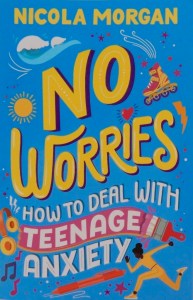
No Worries: How to deal with Teenage Anxiety

Expert on teenage well-being, Nicola Morgan has written a guide to help young people cope with anxiety, according to a survey, the most used word, so she discovered, used when talking about their health and well-being. Nicola’s advice is based upon the latest science and her formidable knowledge and understanding of what makes for a healthy and balanced teenager and she divides her latest book into three parts.

Part One is Anxiety and YOU, part two is called All About Anxiety and looks at what is happening in an anxious person’s body and brain, as well as the effects of anxiety. The third part offers Strategies and Solutions – obviously the most important section. Here you will find among other things, breathing strategies, mindfulness and meditation strategies and suggestions of practical ways to distract from worrying thoughts.

The book concludes with some anxiety experiences shared by people from their own lives and there’s a list of further resources.

Highly practical and written in a language that is both accessible and full of wisdom, this is a book I’d strongly recommend to all young people particularly if they are struggling with pressures and the resultant anxiety in their lives. Assuredly one to add to a teenager’s bookshelf; it’s packed with helpful information and advice.

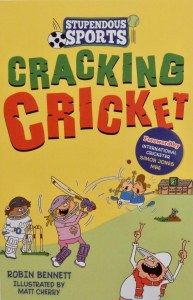
Cracking Cricket

Cracking Cricket
Robin Bennett, illustrated by Matt Cherry
Firefly Press

Written with humour and bursting with facts and advice on how to be an ace bowler, batter and fielder in any combination and much, much more.

The author begins with the history of the sport that includes some wacky theories about how it started, the favourite being that it was made up by bored shepherds some time between 1300 and 1600 – hmm! And like most of the chapters, this ends with a focus on a favourite player; there’s also one or more ‘cool quotes’ in each chapter. I particularly liked this from Stuart Broad, ‘people talk about cricket being an individual game, but I really don’t agree; everything is done in a partnership.’ and had to laugh at this said by Aussie, Greg Chappell, ‘ I can’t say I’m batting badly . I’m not batting long enough to be batting badly.’

We meet the members of a team – opening batters, the top, middle and lower orders, bowlers – fast and spin, the fielder (every team member must be one of those) and the wicket-keeper, and learn about the task of the nightwatchman (that name needs updating) and the joy of being an all-rounder.

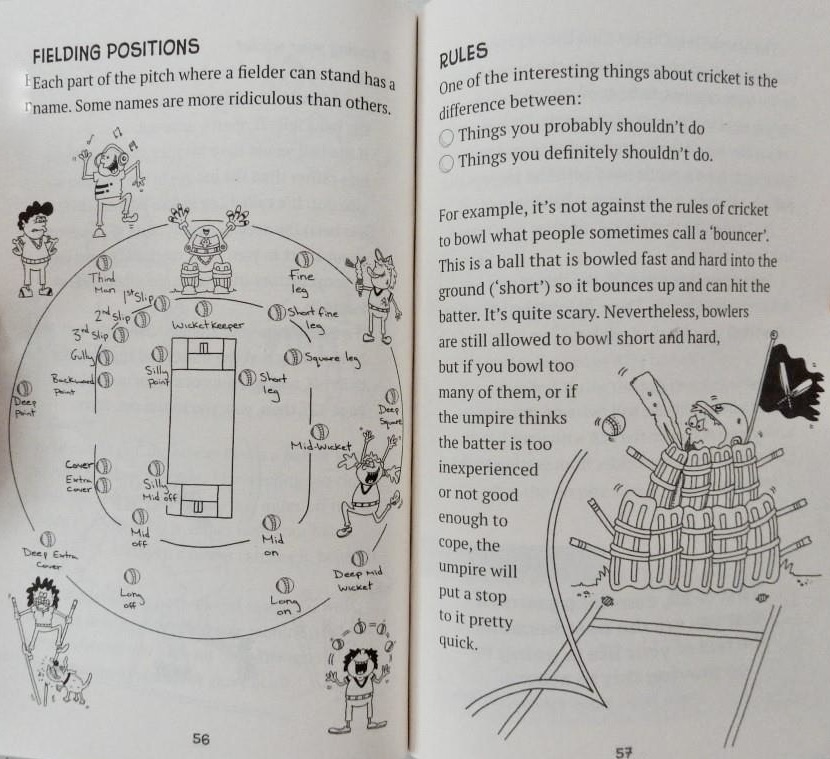
One thing I often get confused about is all the different fielding positions and illustrator Matt Cherry provides a helpful diagram of these, complete with several fielders.

There’s a chapter on skills and tactics, another on the future of the game that looks at diversity, masses of stats, plus explanations of key terms.

Wisden it isn’t, but it is a smashing little book (the 3rd in the Stupendous Sports series), for young readers be they players or not. I learned a lot despite being a keen follower of the game.

Little Chimpanzee / Little Whale / Little Monkey / Tiny Tadpole

Little Chimpanzee
Anna Brett, illustrated by Rebeca Pintos
Little Whale
Anna Brett, illustrated by Carmen Saldaña
Words & Pictures

These are the latest additions to the Really Wild Families series of fun, informative interactive books for children and adults to share.
Having introduced itself, Little Chimpanzee invites readers to spend a day exploring its African rainforest home and meeting the sociable family community comprising father, mother, older brother, aunts, uncles and cousins. The creature narrator explains how chimpanzees care for and groom each other and talks about the social structures and relationships in the group , including how they communicate with one another.There’s a spread about chimp conservation and another about the vital work of Jane Goodall and the chimps in Gombe Stream National Park.
The narrative is followed by a quiz and a craft activity. A charming, effective way for young children to find out about our nearest relative, while gently reminding them of the importance of caring for creatures in the wild; vibrantly illustrated with gentle humour.

The Little Whale of the title introduces itself and the rest of its pod of humpback whales and readers join their annual journey from warm waters to search for the cold waters of the Antarctic Ocean where there’s plenty of food. On the way we learn about how the creatures move, their external features, breathing, breeding, diet and feeding,

possible predators and whale song.
Following the story are the usual factual spread, a look at conservation, a craft activity, a quiz and we meet Migaloo, a albino humpback that lives off the Queensland coast of Australia. Carmen Saldana’s underwater illustrations are beautiful and really add to the book’s appeal.

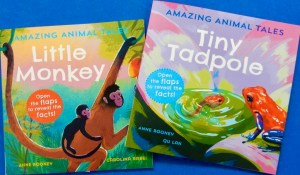
Narrative works really well as a means of transmitting information to young children and these are additions to the Amazing Animal Tales series that also successfully use this approach along with straightforward facts found beneath the flaps.

Little Monkey
illustrated by Caroline Rabei
Tiny Tadpole
illustrated by Qu Lan
both written by Anne Rooney
Oxford Children’s Books

Little Monkey is a spider monkey and we first encounter him high in the rainforest treetops clinging round his mother’s tummy as she moves from branch to branch. Lifting the full-page flap reveals two pages of information and a simple question to further engage listeners.
As the story continues there is information about feeding, what this entails.and how it changes as he becomes more independent, an independence that makes him want to go off exploring by himself.

Anne Rooney’s way of presenting the information is appealing and perfectly pitched for an Early Years audience, the special skill being the combination of the two styles, with Caroline Rabei’s delightful illustrations containing just the right amount of detail.

The Tiny Tadpole also lives in the rainforest but further south than the monkey family. Herein we follow the transformation from tadpoles hatching out of the protective jelly eggs and the growth and changes that ensue in their habits and in the care provided by the mother frog,

until the tiny black dot has become a froglet. This one is illustrated using a rich colour palette by Qu Lan and every picture is bursting with life.

Curious Creatures Talking Together

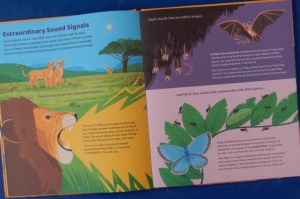
It’s common knowledge that humans spend a considerable amount of time communicating with one another in various ways, mostly though not always using words, but less well known is that all manner of animals communicate wordlessly by means of movements, sounds and smells.

In this latest Curious Creatures book, Zoe Armstrong presents in her relatable style, some of the ways this happens in the animal kingdom. Many times I’ve stood in Bushy Park and watched what the two hikers in the highlands of Scotland are witnessing: two stags roaring, stamping and bellowing. This happens during the mating season when males compete for females and one wants to prove himself stronger. Having described their mode of communication, the author briefly compares their actions with ways we humans might sort out a disagreement. I especially like this feature, which is part of each section.

The next couple of spreads present examples of other creatures that communicate by means of visual signals, the peacock spider being one. I love the description of the male’s dance vibrations as ‘rumble rumps’ ‘crunch rolls’ and ‘grind-revs’. 

The book continues with spreads each focussing on in turn, sound signals, 

chemical ‘smelly’ signals, tactile or ‘touching messages’. There’s also a spread on ways some domesticated animals communicate with humans and finally comes a reminder that if we pay close attention to signals from animals, we can discover what they want, need and perhaps, feel, and thus develop empathy with them, which should emphasise the importance of protecting the world’s fauna and treating them with respect.

Anja Sušanj’s vibrant illustrations augment the text and will help to entice children into exploring the information. A worthwhile addition to primary class collections and libraries.

The Story of Conservation

The Story of Conservation
Catherine Barr and Steve Williams, illustrated by Amy Husband
Frances Lincoln Children’s Books

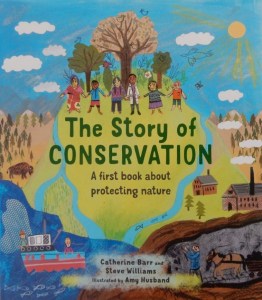
Catherine Barr and Steve Williams present an overview of the interaction of humans with planet earth. They take readers on a journey from prehistoric times to the present, highlighting the changes in people’s habits, the ways nature has been harmed, the natural resources used, and the ways people have worked to counter those changes to protect nature, citing Rachel Carson’s work as key when it came to the use of chemicals on crops in North America.

As well as highlighting the importance of changing global habits, the book also gives examples
of problems that different countries are facing – the consuming of ‘wild-caught’ meat in some parts of Africa being one, and the displacement of indigenous people.

Along with scientists’ attempts to stall the onslaught of global warming and pollution, the book discusses protests and attempts at conservation solutions.

Amy Husband’s gently humorous illustrations and the integral timeline show how human life has changed, and the way we use natural resources has evolved over time as practices like hunting and farming have altered the way we live. All of this should help children to develop their understanding of climate change globally and hopefully accept the authors’ final challenge to join in and make a difference.

A terrific introduction to the most pressing issue currently facing us all; this is a book to share and discuss in primary classrooms, and this, one hopes, will galvanise children into taking action.

The Ocean Gardener

The Ocean Gardener
Clara Anganuzzi
Little Tiger

The author/illustrator of this book was raised in the Seychelles where this tale is set.
Ayla and her mum’s beautiful island home is surrounded by a coral reef and one morning while out swimming with her mum, Ayla notices that as she goes further out, something is wrong: the colours of the coral are faded and the fish are disappearing.

The girl is upset and asks her mum why these things are happening. Surely it can’t be too late to save this wonderful part of the ocean’s eco-system.

Fortunately, Mum, a marine biologist, has a plan and the very next day she and Ayla start working bringing tiny pieces of coral from the sea into their home and so begins operation coral reef rescue. It’s a lengthy process and eventually after some time Mum decides the coral growths are ready to return to the ocean and they create their ocean garden.

That place is Ayla’s destination each day for what feels like forever; she tends to the coral and awaits the return of the fish until at last …

Clara Anganuzzi’s gorgeous illustrations capture so well the beauty of the coral reef and at the same time present the highly complex issue of global warming in a positive manner that will appeal to young readers, while also offering hope that the work of marine biologists such as Chloé Pozas, whom we meet after the story in a spread giving more information about coral nurseries, can restore these precious parts of our oceans’ ecosystems.

Please Don’t Bite Me!

Please Don’t Bite Me!
Nazzy Pakpour and Owen Davey
Flying Eye Books

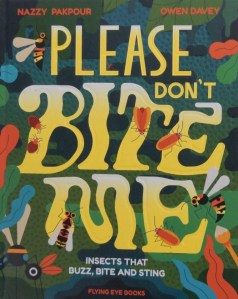
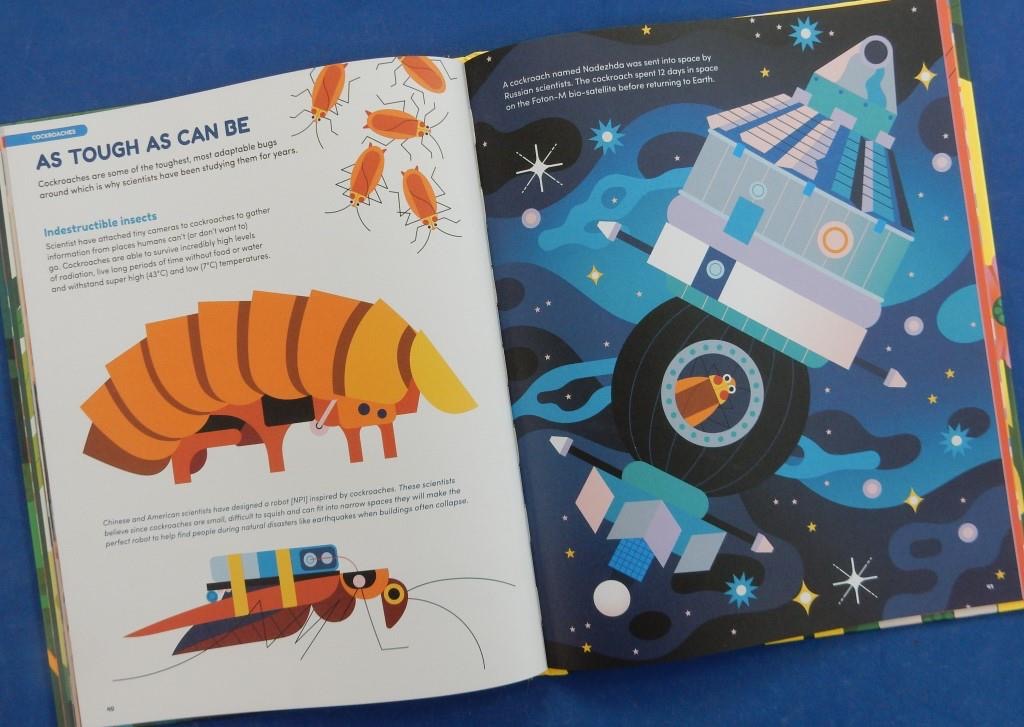
With a partner who can’t walk more than twenty metres without stopping to examine the vegetation for insects in various stages of metamorphosis – complete or incomplete – Nazzy Parker explains the difference – I was I suppose, predisposed to be interested in the contents of this book. It introduces readers to six varieties of insect pests, mosquitoes, lice, wasps, cockroaches, fleas and bedbugs; the very names, excluding wasps, make me want to squirm.

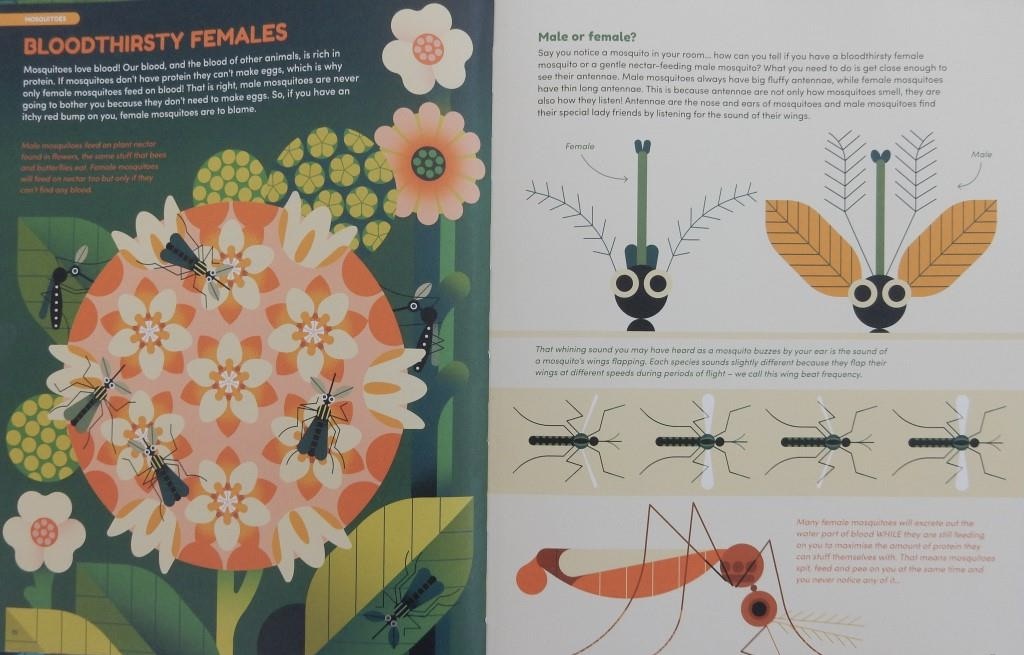
Pakpour starts by defining insects and the scientists who study them after which three or more spreads are devoted to each of the aforementioned pests. She describes their appearance including the difference between males and females, their impact on humans and how they find us, their habitat – I was intrigued to discover that mosquitoes are found everywhere except Antarctica and Iceland where it’s too cold for them to survive, and that it’s only the females that bite.

We also read about their habits and their development from egg to adult. Mosquitoes, wasps, and fleas undergo ‘complete’ ie four stage metamorphosis, whereas lice, cockroaches and bedbugs have a three stage, or incomplete metamorphosis.

Can you believe that there are more than 5,000 different kinds of lice, each kind being specific to the kind of animal it feeds on. Those that feed on humans spit saliva that can take as much as thirty days for us to develop an allergic response to. Weirdly though the very mention of a child in one of my classes having headlice has always made me start itching round my hairline straight away.

As for cockroaches, I will never forget the sight of an enormous one crawling across the pillow of our room in one of Jaipur’s five-star luxury palace hotels; it certainly didn’t get a five star review from me despite the fact that so we are reminded herein, the creatures don’t actually feed on human blood.

The author provides lots of fascinating snippets of information including that Chinese and American scientists have designed a robot inspired by cockroaches and that Russian scientists sent a cockroach into space for twelve days on a bio-satellite.

Probably though what is most important is the role of various insects in the world’s ecosystem; this is assigned the book’s final paragraph.

Owen Davey’s stylised, stylish illustrations work really well with biologist, Nazzy Pakpour’s text. Not the first book one would go to for general information about insects but a thoroughly engrossing one nonetheless.

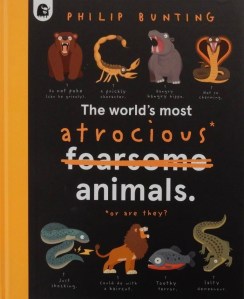
The World’s Most Atrocious Animals

The World’s Most Atrocious Animals
Philip Bunting
Happy Yak

In the third of this fact-filled series Philip Bunting introduces readers to over fifty of the scariest creatures in the natural world, each of which is given both its Latin name and amusing Bunting tag. Thus the death stalker scorpion or Leiurus quinquestriatus is also Lethalus landlobstrous – very appropriate since a sting from this North African nasty can be excruciatingly painful and can cause anaphylaxis.

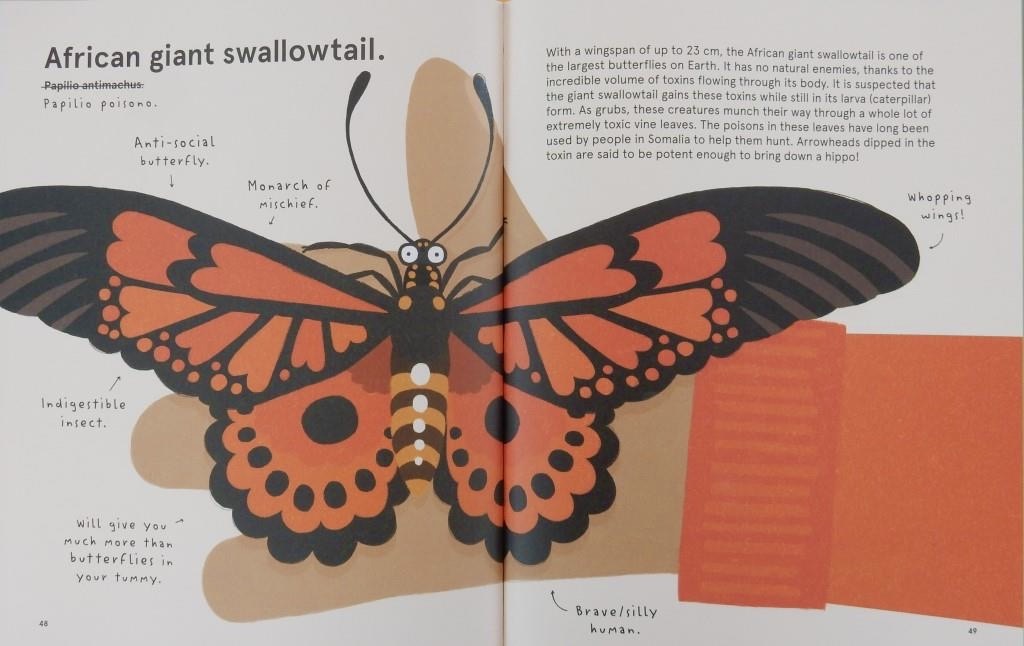
In similar fashion to the previous titles, the author uses a plethora of puns, some of which will really make you laugh (or groan depending on your mood): a group of orcas ‘sing together to form an orcastra’ and the African amphibian Trichobatrachus robustus – hairy frog to you and me – is ‘known to kermit hideous crimes’ and an encounter with an African giant swallowtail ‘will give you more than butterflies in your tummy’ – that is on account of the vast volume of toxins that flow through its body.

Moreover, should you find yourself paddling on the shores around Madagascar, Mauritius or other countries located in the Indian Ocean, be very sure not to set foot near a geography cone snail; the potent venom of this predatory mollusc could, if the nasty creature chose to inject you, finish you for good since there’s no known antivenom. No wonder that so we read, the beast has ‘shelled out extra for. a fancy pattern’.

Maintaining a good balance between humour and straightforward information, along with large, striking illustrations, Philip Bunting covers a wide range of animals of the truly scary sort. Anyone with an interest in animals, especially of the atrocious or fearsome kind, will love this book; it’s a great addition to The World’s Most …. Animals’ series.

How To Spacewalk / Wind: Discovering Air In Motion

How To Spacewalk
Kathryn D. Sullivan and Michael J. Rosen
Walker Books (in collaboration with MIT Kids Press)

In 1984, Kathryn Sullivan became the first woman to walk in space: in this book, illustrated with photographs and Rosen’s ink and pastel images, she shares her story.
As a child in the 1950s, Kathryn developed an interest in science early on but like other girls, she wasn’t encouraged to follow her interest. However, with determination and perseverance she studied geology and became an oceanographer, eventually applying to join NASA’s astronaut programme for which she was accepted, as well as receiving an offer to explore the ocean depths in a submarine. She chose the first option.

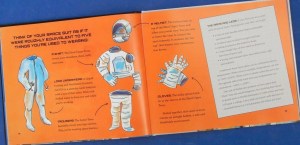
From then on the author addresses readers as though they are participants in her training as an astronaut. What is it like to do a spacewalk? How do you use cutting-edge equipment? What does it feel like to wear and carry out experiments in a hugely heavy space suit? – space armour as it’s called here.

What about experiencing weightlessness?. Will I suddenly feel scared?

A large amount of fascinating factual information is presented, but alongside this we share an empowering account of a woman fulfilling her dreams; it’s one that will surely encourage child readers to live the ‘life you invent’ – to reach for the stars, whatever that means for them.

Wind: Discovering Air In Motion
Olga Fadeeva
Eerdmans Books for Young Readers

Translated from the original Russian by Lena Traer, this book poses and explores eighteen wind- related questions, devoting a double page spread to each question, with illustrations by the author.
The responses to the first – Where does wind come from? are somewhat playful; for instance ‘Maybe there are giants… / who blow air with all their might?’ and ‘Or maybe the wind comes from the wings of a large bird?’.

However from there on the tone changes and What is wind? is answered with a scientific explanation ‘Wind is the horizontal movement of air over the surface of the Earth’ … The author then interweaves information on meteorology, biology, ecology, history, even venturing into outer space, so there’s plenty to keep readers interested.

Each double spread is distinctively designed and the richly textured illustrations are strikingly executed using acrylics, collage and digital media.

Included in several scenes are a little girl, sometimes accompanied by her grandfather and one assumes the questions are coming from the child.

Created with the help of a meteorologist, this exploration of my least favourite element is engaging and absorbing: I would recommend adding the book to primary school collections.

Animal Explorers: Ivy the Bug Hunter

Animal Explorers: Ivy the Bug Hunter
Sharon Rentta
Alison Green Books

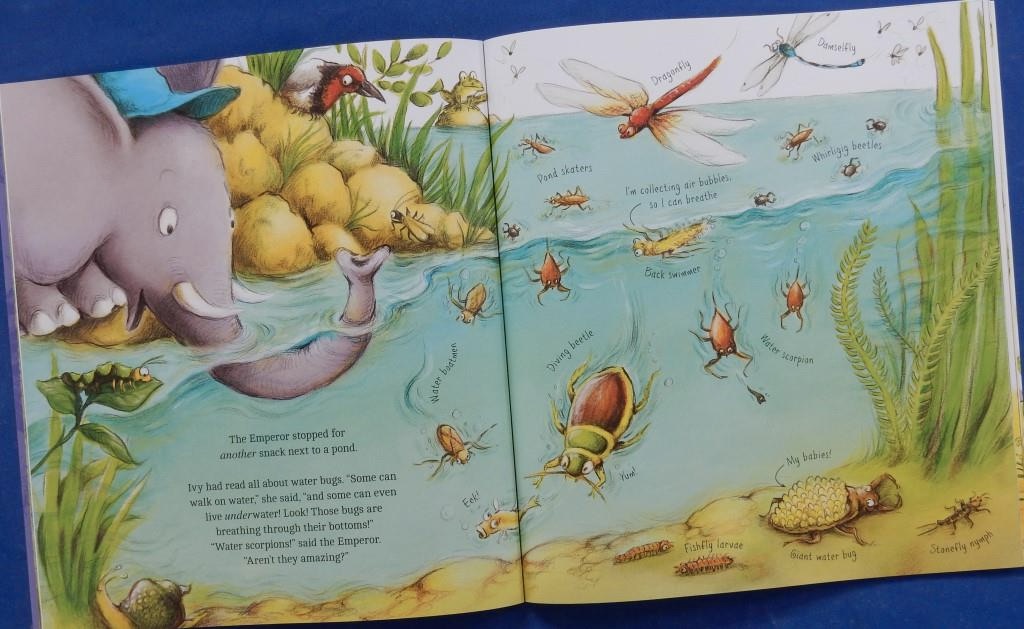
Meet Ivy the elephant, a hater of bugs, or rather that is early in the day when she’s trying to enjoy her picnic. However, thanks to an encounter with Emperor Swallowtail caterpillar, by the evening she’s telling her mum that she loves bugs and wants to be a bug hunter. So Mum agrees to let Ivy accompany her new caterpillar pal on a bug safari.

Next morning Ivy is up early to assemble her equipment and a tasty picnic (for herself); the caterpillar sates his appetite by munching on leaves en route. They see various kinds of bug houses, up high and down low as well as a huge termite nest, then at Emperor’s next snack stop beside a pond, they watch all sorts of aquatic bugs.

As the safari stops continue, Ivy learns about camouflage, drawing in her notebook, some examples of bugs that disguise themselves ,and also comments that her companion has shed his skin four times. At nightfall as the fireflies glow in the sky, Emperor Swallowtail is exceedingly sleepy and informing Ivy how proud he is of her, says that she must continue without him hereafter, then promptly falls asleep.

The following morning Ivy can’t see a sign of the Emperor but there is a ‘funny brown thing stuck to a branch’. Savvy children will likely know what that is but not Ivy. However, remembering Emperor’s last words, she continues her bug hunt, has the occasional set-back but makes lots of exciting discoveries,

though still she wonders if she’ll ever see her friend again. Then one afternoon, to her delight something makes her sneeze: I wonder what that could be.

Sharon Rentta’s vibrant, gently humorous scenes of the safari are a delight to pore over and she has included brief biographies of famous real life bug hunters at the end, as well as a page showing the life cycle of the Emperor Swallowtail.

This is science writing for the young in a highly accessible, absorbing and fun form.

What Will I Discover? / The Stars

These are both Greystone Kids titles – thanks to the publisher for sending them for review

What Will I Discover?
Tanya Lloyd Kyi and Rachel Qiuqi

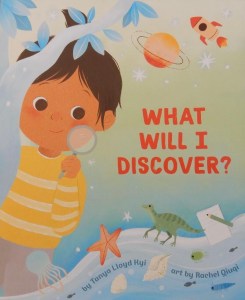
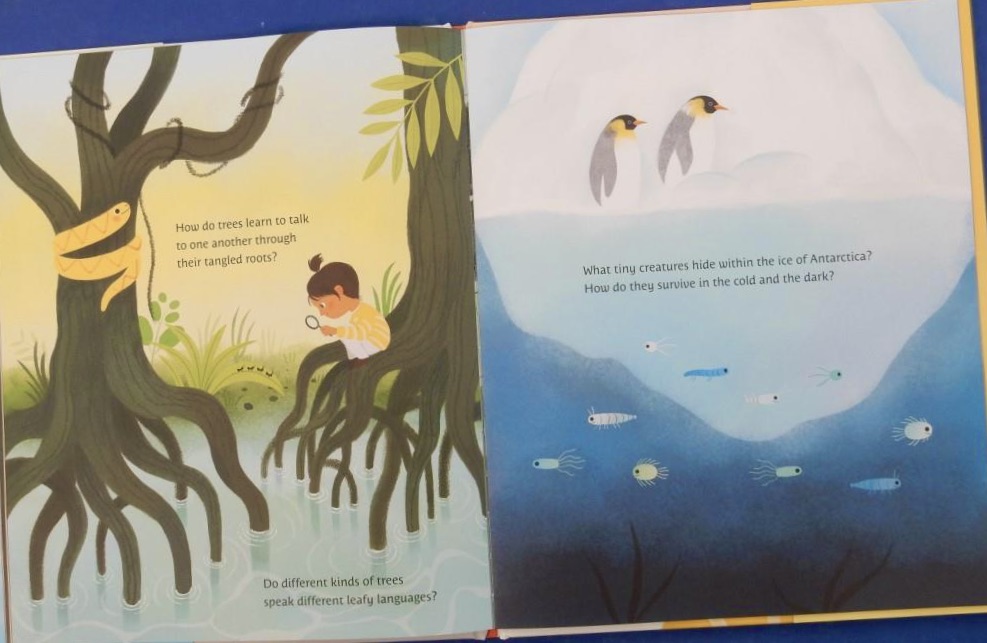
‘Sometimes I think scientists know everything about the world’ muses the girl narrator of this book. She goes on to mention several examples of some of what they have discovered: that otters tie themselves to kelp to prevent them floating off during sleep, that the feet of sea stars are tubular; that macaws have bony tongues to help crack hard shells and glass frogs have see through skin to help them hide. She also talks of fossil evidence, looks afar out into space and within the human brain where nerve cells communicate with one another. But even so, our narrator has some yet unanswered questions: why does every humpback whale sing a different song? How many bits of rock bounce and collide in a sandstorm? How do trees learn to communicate through their roots; what tiny creatures hide in the ice of Antarctica and how do they manage to survive?

Then closer to home, ‘How do ideas pop into my head?’ and finally her biggest question of all – that of the title, which is one only she can answer.

The last page asks readers to search back through the book’s pages for 10 tiny images and, enthusiastically underwrites ‘investigating, inventing, or creating’ as necessary qualities for scientists, concluding that despite extensive research in all STEAM areas, we humans still have so much to learn.
Tanya Lloyd Kyi offers an open invitation for young readers be they at home or in the classroom: always be curious and look for answers. This is underscored through Rachel Qiuqi’s alluring scenes including those of seascapes, the jungle, the desert, flora and fauna, dinosaurs, outer space and neurons within the brain.
Narrative non-fiction recommended for KS1 learners.

Also likely to appeal to readers with inquiring minds is

The Stars
Jacques Goldstyn (translated by Helen Mister)

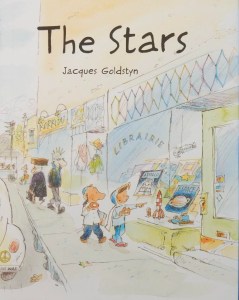
Set in Montreal, this story introduces Yakov who acts as the book’s narrator. he’s the older brother of three sisters who he has to take to the park every day when he’d much prefer to be reading about space. Into space is somewhere he aspires to go one day in the future; meanwhile he constructs rocket ships from empty packaging, His father is against his aspirations but his mother is more encouraging. 

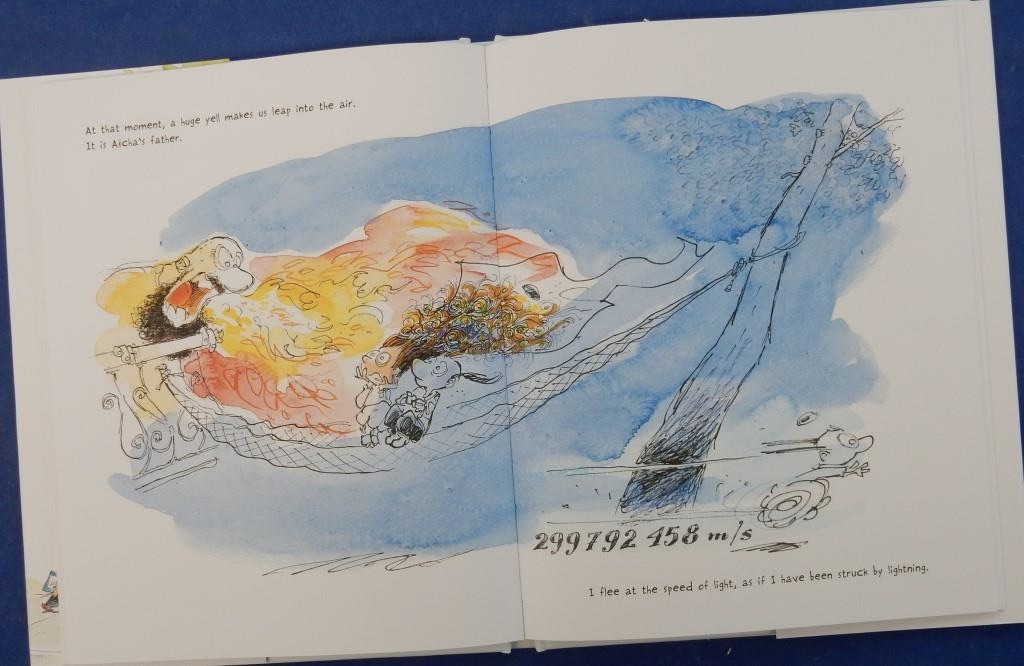
One day at the park Yakov meets a girl, Aisha, reading about space while supposedly minding her siblings. It turns out that she and her family have just moved close to where Yakov’s family live. With a shared interest the two become great friends and spend time star gazing together. Both fathers are far from happy and even erect a wall between their two homes to prevent Yakov and Aisha from meeting.

Years pass and Yakov becomes a scientist working at NASA. One day he attends a big international astronomy conference and guess who is also attending. Since then they’ve not been apart.

Author/illustrator Jacques Goldstyn presents a fair amount of information in telling this story of two young people who, against the odds, pursue their passionate interest in the stars and the universe.

How the Sea Came to Be

How the Sea Came to Be
Jennifer Berne and Amanda Hall
Eerdmans Books for Young Readers

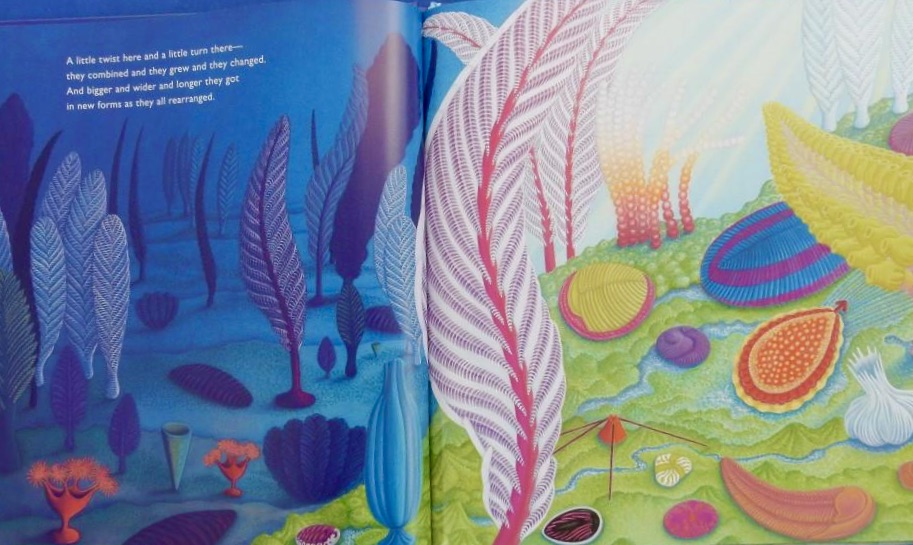
Jennifer Berne divides her rich poetic account into three parts: The Birth of the Sea, The Birth of Life and All That the Sea Came To Be, covering geology, oceanography, biology and evolution over 4.5 billion years – an enthralling journey indeed, especially when set alongside Amanda Hall’s show-stopping mixed media illustrations. The layout of every spread is a joy to explore.

The verbal imagery grips from the outset: ‘Volcanoes exploded from inside the Earth. / They blazed and they blasted and boomed. / And comets and asteroids crashed out of the sky, icy and rocky they zoomed.’

Having presented nature’s violence in storms and volcanic eruptions, the author and artist present the emergence of microscopic life forms – ‘smaller than small, and adrift in the seas,’ that gradually combined and changed into new 

and larger forms: ‘frilled creatures that wiggled and crawled’ as well as drifting, squishing jellyfish with their thread-like tentacles and then came the worm – a creature that ‘points as it squirms’.

Eventually we reach the multi-layered aquatic zones of the present time 

and then slowly return to the surface encountering a wealth of amazing marine flora and fauna to land at last on the shores of now, where people are exploring the rock pools.

Scientifically accurate throughout and written in almost faultless rhyme, there are no labels but it’s not difficult to locate the creatures named if you look carefully. Moreover, those who want to dive deeper can use the additional resources at the end of the book.

Totally immersive and with a wide appeal, this is a book for any collection.

Bees & Beetles / Not Just Another Book about Farm Animals / Not Just Another Book about Things That Mooove

Bees & Beetles
Nia Gould and Molly Littleboy
Little Tiger

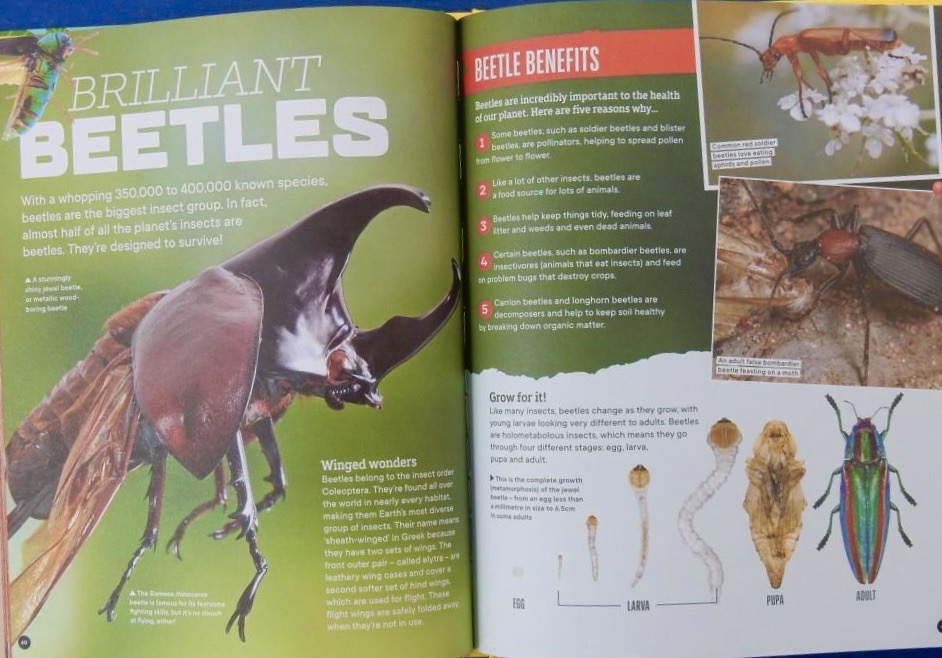
A surprising amount of information about bugs, in easily digestible portions, is found on the pages of this sturdy, split page ‘flip-flap’ book, the second in a series for the very young.

Children will enjoy being able to change the scenes by flipping the cut portions of the alternate pages to create a different but related scene for first ants, the second showing the inside of a nest; 

then spiders – the start and finish of a web. Following this, youngsters will encounter several different creepy crawlies – dragonflies, grasshoppers, beetles, fireflies and ladybirds on and among flowers in a meadow; transforming the habitat they’ll discover snails and slugs, earwigs, centipedes and below ground level, wriggling earthworms. Bees come next and finally various caterpillars and butterflies.

A useful book to support a minibeasts theme; one that is frequently explored by foundation stage learners.

Presenting information to young children in an entirely different, but equally effective way are

Not Just Another Book about Farm Animals
Not Just Another Book about Things That Mooove

Noodle Juice, illustrated by Jake McDonald
Noodle Juice

In the first the author offers facts in mouth- watering morsels about farms, and their livestock in a humorous style, with contributions from the animal residents along the way. There are spreads featuring hens, pigs, horses, sheep, cows, turkeys, ducks, geese, goats and even llamas. Did you know that you can tell whether a turkey is male or female by examining its poo?

Jokes abound – these are as likely to appeal to adults as the intended young audience and Jake McDonald’s illustrations are suitably comical.

The same is true in the second book that begins by giving a simple definition of transport and goes on to present spreads on myriad modes of moving from place to place. The information is presented by a cow narrator that seems to have a penchant for puns. Here’s an example. 

Readers will encounter feet (as in walking), boats, cycles, trains, cars, buses, trucks, planes, helicopters and rockets all of which have bovine drivers or pilots.

The busy final spread of both books asks ‘Can you find …’ In the farm book, readers have to try and spot the farmer; in the transport book there’s an elephant to locate.

Wacky fun for fact fanatics.

Live Like A Roman

Live Like A Roman
Claire Saunders, illustrated by Ruth Hickson
Button Books

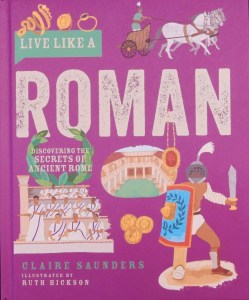
Do you know a primary child who is studying Ancient Rome or the Romans, has an interest in ancient history or just wants to find out more about life in Roman times, then this a book for them especially.

In addition to a wealth of information on a wide range of topics starting with Who were the Romans?, there are a number of practical activities for children to try. For instance alongside the facts about maths including Roman numerals, there are instructions for making an abacus. Having read the spread about childhood and family life, children can try making their own set of knucklebones and then play a game with them. Or what about making a wax tablet similar to those used by Roman children instead of the expensive papyrus paper. What really astonished me was to read that only about half of all Roman children made it to their tenth birthday.

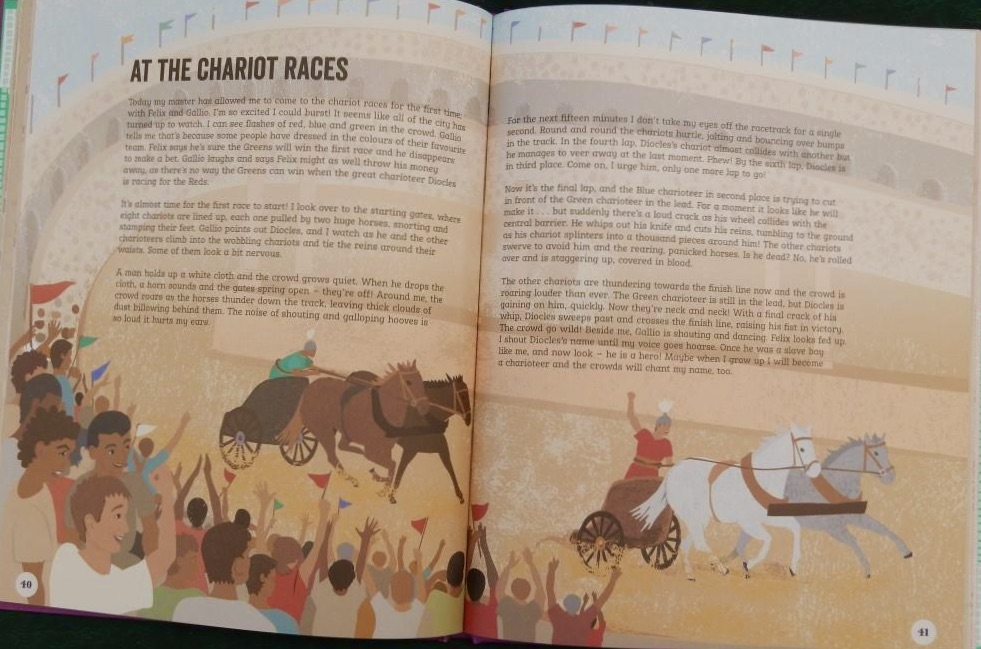
We meet a fictional child named Tito, a slave, who appears at various places in the book; we join him at the chariot races,

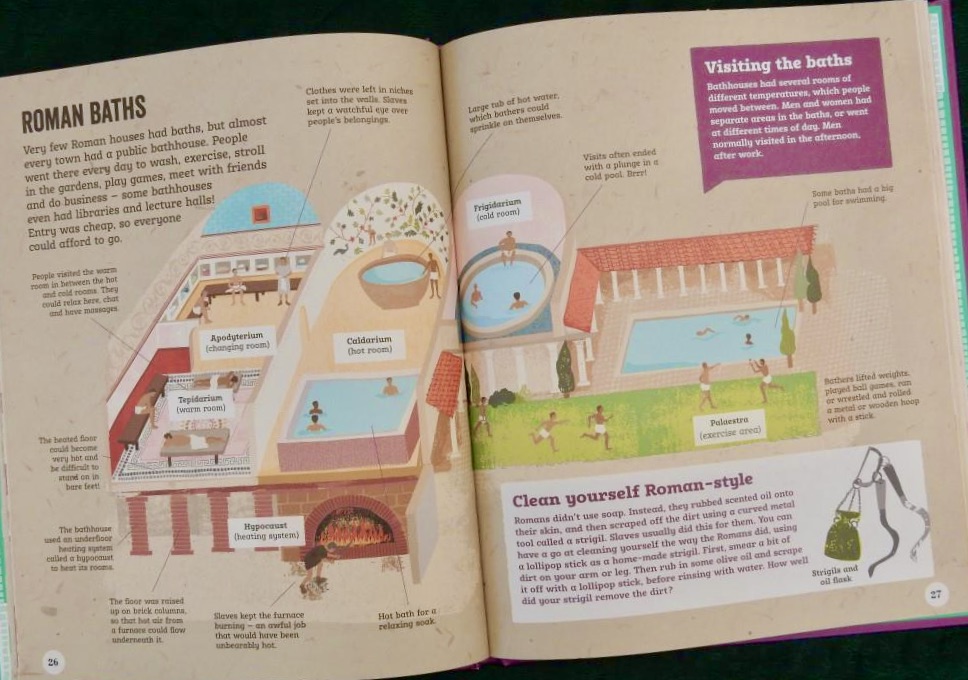
when he accompanies his master to the bathhouse and at the banquet his master hosts especially for an important guest.

The Romans are famous for their public baths, some of which are still in use today, but I’m not sure I’d want to try the Roman means of cleaning my skin by making a tool – a strigil – similar to those they used. The author suggests using oil and a lollipop stick.

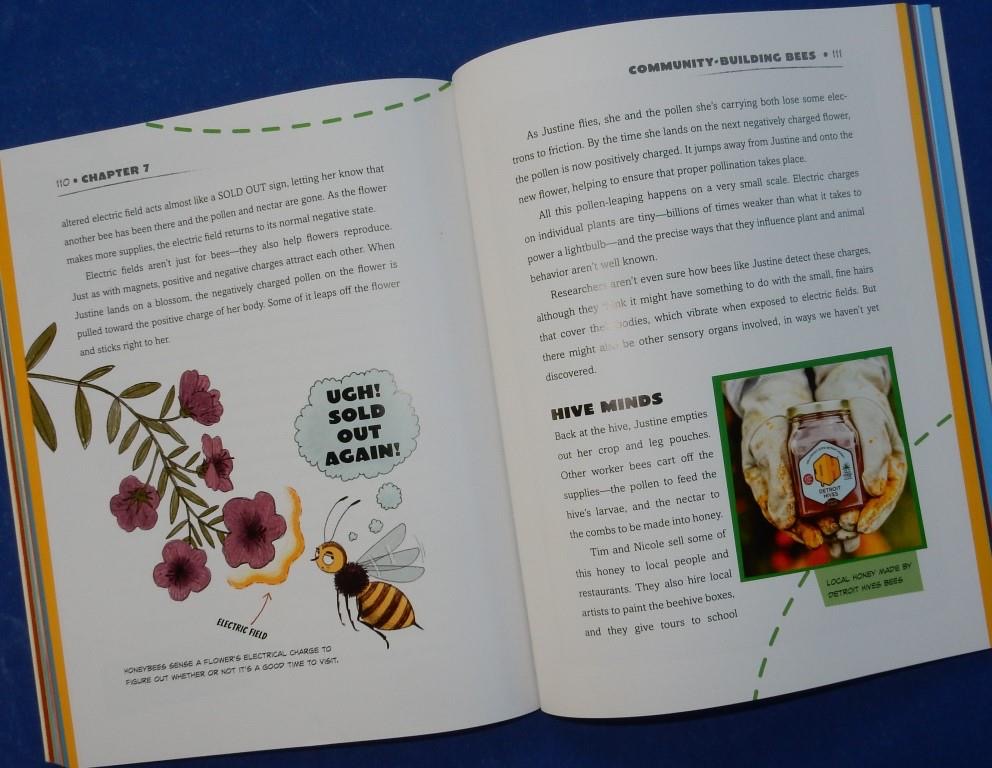
Three double spreads are given to in turn food and drink, banquets and roman recipes; the honey cake sounds pretty tasty especially as instead of sugar, the Romans used runny honey; indeed honey was used in lots of recipes.

The final spread before the glossary poses the question: Could You Have Lived Like A Roman? This reviewer would not have survived long in a school: there were no opportunities for creativity and rote learning was the norm. However, the author appreciates the importance of creativity for today’s young readers and asks them to invent three new Roman gods or goddesses for things that are important to them and to give them names.

Ruth Hickson brings all this and much more to life in her detailed illustrations, large and small, helping to make this an altogether fascinating book for individual or primary classroom use.

Matilda Meets the Universe

Matilda Meets the Universe
Dom Conlon, illustrated by Heidi Cannon
uclan publishing

The ambitious Matilda returns, as effervescent as ever, and again she will impress readers with her intelligence, confidence and skill at providing in-depth expositions of scientific subjects.

Penned in the form of an interior monologue notebook, Matilda sets out to discover whether life exists on other planets. ‘… finding alien life is going to be difficult. Finding out HOW difficult is what I’m ALL about though so BRING.IT.ON.’ she writes, going on to tell us that one reason for keeping her journal is that it helps her get things straight in her head. So true.

She writes about topics such as the Big Bang, the electromagnetic spectrum and ways of communication, mentioning ground breaking work of such scientists as Georges Lemaître, James Clerk Maxwell, Jocelyn Bell Burnell, Sir William Herschel, Frank Drake and his equation (new to me) and Albert Einstein. I love the way she talks about the Goldilocks Zone.

Helping Matilda in her research are members of her family – her dad, mum,

younger brother and her friend Kareem, not to mention a lot of snacks of various kinds. However possibly THE most important thing she learns is much closer to home, something about herself and the way she has been treating her little brother: ‘I need to stop calling him my little brother or HE WHO SHALL NOT BE NAMED. He is called Harry and I realise that when he’s hanging around, he’s only trying to learn how to communicate with me. … I need to learn how to listen. Then moving out from that ‘I’m looking around this little planet of ours and wondering if we couldn’t all benefit from learning to talk to one another in a better way.’ Wise words indeed. As is her decision to make the most of all the experiences earth has to offer.

It’s amazing how much information is packed into the pages of this book but Matilda has an infectious enthusiasm for her explorations and humour permeates her writing, helping to make it more accessible. So too do Heidi Cannon’s illustrations and diagrams, which appear at every turn of the page. There’s also a glossary at the end.

Highly recommended for curious children whether or not they have a special interest in STEM subjects.

Everything You Know About Sharks Is Wrong

Everything You Know About Sharks Is Wrong
Dr Nick Crumpton, illustrated by Gavin Scott
Nosy Crow

Having set the record straight about dinosaurs and minibeasts, Dr Nick Crumpton has (along with illustrator Gavin Scott) turned his attention to the oceans and in particular, sharks. Writing in an entertaining style he discredits many of the shark-related myths that have grown up over time and it’s likely they have the worst reputation of all living creatures. Remember those dogfish you studied in zoology at school back in the day? They are related to sharks, both being elasmobranchs.(cartilaginous fish).

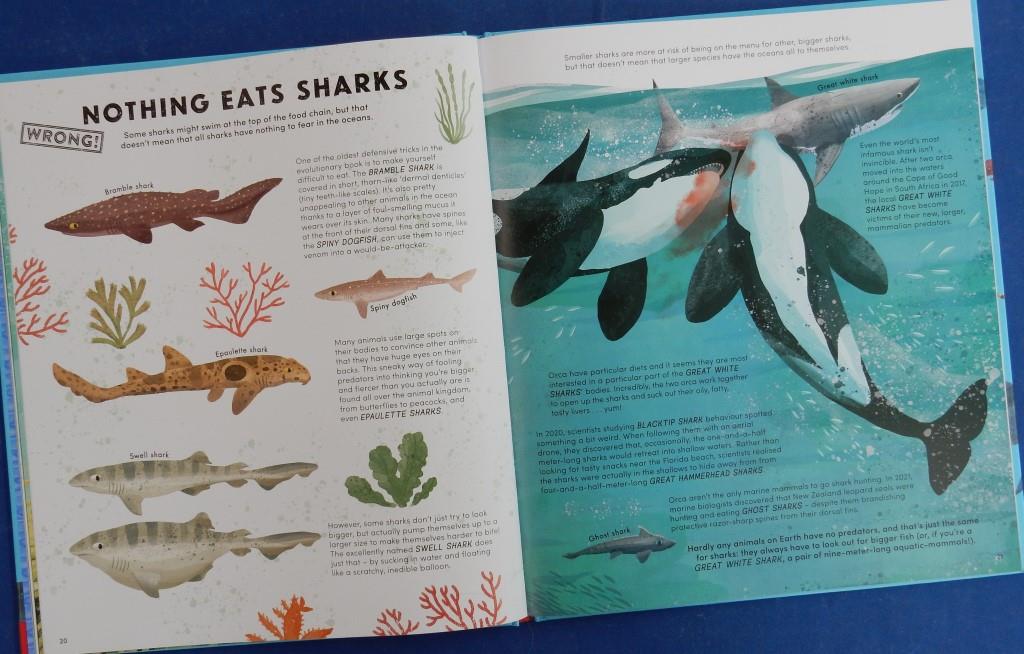
Assuredly sharks are predatory creatures but do they kill lots of people? Worldwide sharks killed 11 people in 2021 but cows killed 22 people and that was just in the USA and snakes were responsible for the deaths of 50,000 people worldwide: the numbers speak for themselves. On the other hand, we read, humans kill 100 million sharks and rays each year and sharks are unable to replace those lost quickly enough, so actually a number of species are at risk.

What about those fearsome-looking sharp pointy teeth all sharks have. No they don’t, at least not all of them: different sharks have different sorts of teeth, which help them eat a wide range of food by piercing, slicing or crushing their prey. Did you know that all sharks’ skin is made from millions of tiny teeth and whale sharks even have teeth on their eyes. Moreover, these ‘dermal denticles’ each have elements – dentine, a pulp cavity containing blood and nerves and an enamel covering – similar to our own teeth. Knowledge about how these v-shaped denticles work has led scientists and technologists to develop swimsuits that enable swimmers who wear them to move faster through the water.

Amazingly the prey of Cookie Cutter Sharks are much larger than their predators; these sharks don’t hunt, rather they lure their fleshy prey to them. There’s a whole spread on how various sharks hunt: filter feeding whale sharks don’t bite, instead they open their mouths and swim straight into clouds of microscopic planktonic organisms. On the other hand, some of the smaller sharks might end up as food for other, much larger sharks, and recently there have been reports of orca whales eating sharks.

An absolute wealth of fascinating information is packed into the pages of this book and Gavin Scott has done a terrific job with the illustrations. The mystery, power and beauty of these amazing creatures and the underwater world they inhabit are spectacularly portrayed in his scientifically accurate paintings.

Primary readers (and beyond) with an interest in biology will find this absorbing.

We’ve Got This!

We’ve Got This!
Rashmi Sirdeshpande with EmpathyLab, illustrated by Juliana Eigner
Words & Pictures

One of the most important life skills children need to develop is empathy and this book is intended to help them do that. How exciting it is to have a book emphasising the power of reading to boost empathy and to read this in Sir Michael Morpurgo’s foreword: ‘ Books and stories to me are the key to empathy and understanding everyone. They are the pathway to understanding people as individuals. Read books. Enjoy books. And, most of all, learn from books.’

Readers of this particular book will assuredly do so. Empathy, we read at the outset is a ’real superpower’ and herein youngsters are offered a six-step process that uses case studies, empathy exercises and activities, to supercharge their empathy. Participating along with readers on this exciting journey are members of the Sharma family – mum Shivaji and her children, Isha and Rahul.

There are pieces by a number of well-known authors – Cressida Cowell, Malorie Blackman, Jacqueline Wilson, Sue Cheung (aka Sue Pickford), Jen Carney, Manon Steffan Ros, Ben Davis, Patrice Lawrence, Nadia Shireen,

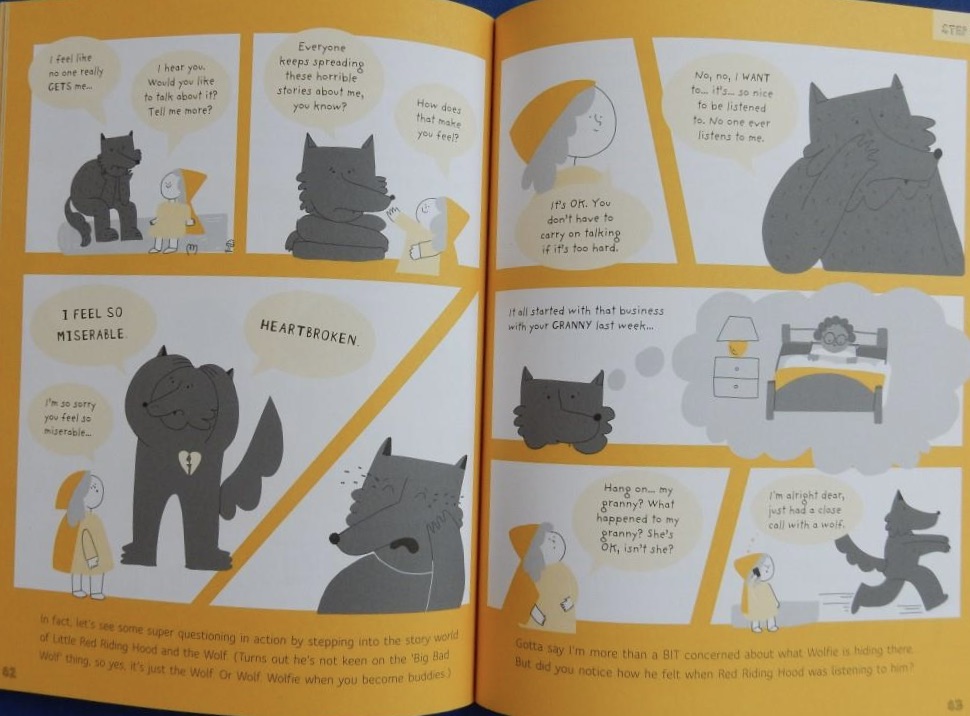
Abigail Balfe, Dom Conlon, SF Said and Joseph Coelho, all of whom are affiliated with EmpathyLab. And there are examples from books by other writers in the fourth step Learn to Recognise Emotions, where one of the ideas is to be an emotions detective as you read. From the next section, I love this example of ‘super questioning between Little Red Riding Hood and the Wolf.

The text is chatty and child-friendly, and Juliana Eigner’s inclusive, often gently humorous illustrations are engaging. (Further resources are listed at the back of the book.)

A must for all KS2 school children, classroom collections and I think lots of adults would do well to read it too.

Round and Round Goes Mother Nature

Round and Round Goes Mother Nature
Gabby Dawnay and Margaux Samson Abadie
Wide Eyed Editions

The circles of life keep on turning and change is part and parcel of all life, happening constantly around us in the world; it’s in the turning of the season, sometimes it’s as rapid as a hatching egg, sometimes it’s as slow as an imperceptibly growing or diminishing mountain. This gorgeously illustrated book, divided into four sections – Animals, 

Plants & Fungi, then moving beyond biology, Earth and finally, Space – presents forty eight life cycles, starting with the fleeting appearance of a mayfly and ending with a black hole: a massive scope indeed.

Readers will be fascinated at some of the details, for instance the male seahorse carries the eggs deposited by the female in a special sack in his abdomen, which then acts rather like the womb of a female mammal. Imagine being a female rattlesnake; such creatures are ready to have babies around the age of four and will continue mating and giving birth every two years for the rest of its life up to twenty five years; that’s an awful lot of snakelets.

I was astonished to read that it’s possible for the peanut-sized seed from a lotus flower to remain dormant for decades and one has survived for two thousand years.

There is a fair bit of written information for each life cycle and the illustrations show such close attention to fine detail that you will want to spend time looking carefully at each spread.

Recommended for both home and classroom use; this will keep a child engrossed for hours.

50 Words About Nature: Animals, 50 Words About Nature: Bugs / I Want To Be A Lion, I Want To Be A Monkey

These are all books for very young children, – thanks to the publisher Oxford Children’s Books for sending them for review.

50 Words About Nature: Animals
50 Words About Nature: Bugs

Lily Holland and Debbie Powell

As an advocate for using the correct scientific terminology with young children I was excited to see this pair of books – the first two in the new series 50 Words About Nature – doing just that.
Animals takes a look at the whole of the animal kingdom – mammals, fish, reptiles, amphibians, birds, insects and molluscs giving examples of each including a tiger, alligator, dolphin, frog, beetle and octopus, in the process defining such words as carnivoreherbivore, vertebrates, invertebrates, primates, habitat, zoologists and extinct.

In similar fashion Bugs explores first insects, then arachnids and next returning to insects, focuses on several different beetles, including some like fireflies that are nocturnal. There’s a spread featuring nocturnal moths, another looking at pollinatorsand the final one introduces entomologists. Terms used include exoskeleton, antennae, proboscis, metamorphosis, arthropods,

elytra, carapace and telson. I don’t think I met those last three until I started studying biology at secondary school. However in my experience, small children love big words, will assimilate these in context herein and enjoy impressing adults by using such terms as bioluminescence and pollinators.

Integrated into the text, Debbie Powell’s illustrations are both arresting and realistic.

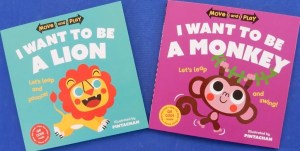
I Want To Be A Lion
I Want To Be A Monkey

Pintachan and Katie Woolley

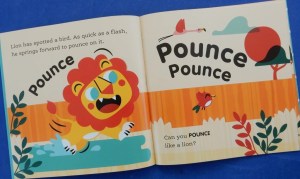
It’s time to move with two additions to Pintachan and Katie Woolley’s Move and Play series for the very young. Get your little ones, be they at home or in an early years setting, pouncing, 

creeping, rolling, running, hiding away and yawning like a lion. If you’re at home cut out the mask, add string and your child will be even more lion-like especially if they also start with a few very loud roars.

Alternatively they might prefer to emulate a monkey; in which case the starting sound is ‘Ooo-ooo-ah! after which comes the more active scampering, rolling scratching, munching (bananas of course), climbing , swinging, leaping all of which can be combined into a lively monkey dance. What are you waiting for? …

Stuck for ideas? Scan the QR code inside the front covers. Pintachan’s bright art work and the engaging texts support the development of children’s imagination and their physical development, but above all they are fun.

A Child Like You / People Power: Peaceful Protests that Changed the World

A Child Like You
Na’ima B. Robert and Nadine Kaadan
Otter-Barry Books

Beautifully illustrated and presented, speaking directly in a sensitive, heartfelt manner to young readers, author Na’ima and illustrator Nadine celebrate the four children featured, whose actions will surely act as a rallying cry for all children, showing that no matter what, there is always hope.

Inspired by young campaigners and activists, Greta Thunberg, Yusra Maardini, Marley Dias 

and Iqbal Masih, the book highlights the issues of climate change, the refugee crisis, the under representation of black girls in children’s stories, child labour and enforced slavery. 

These four youngsters show the way that other children too – children like them – can also be the change, make the change happen and inspire others to make changes, to speak out strongly on behalf of the dispossessed and the oppressed – to stand up for human rights and make our world a better place for everyone.

A book for all KS1 classrooms.

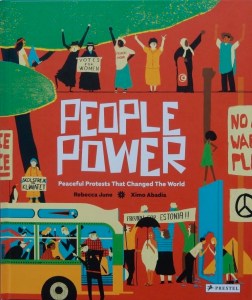
People Power: Peaceful Protests that Changed the World
Rebecca June, illustrated by Ximo Abadia
Prestel

Rebecca June and Ximo Abadia provide readers with a close up look at thirteen revolutionary movements that protested peacefully in various parts of the world, allocating two spreads to each one.

It’s amazing to think that in the UK women have had the vote for less than a century; ‘Votes for Women’ was the battle cry of the women’s suffrage movement on a march through the streets of London one rainy, wintry day in 1907 in what became known as the Mud March; but it took more than twenty years of protesting to achieve their goal.

It was women too, who campaigned peacefully by surrounding the US airbase in the English countryside where nuclear cruise missiles were stored. Their actions were an inspiration to anti-nuclear movements throughout the world.

There are examples of people power from other continents such as the Montgomery Bus Boycott where in 1955, Rosa Parks refused to give up her seat to a white woman and the boycott, which lasted a year, forced the city to change its rules on racial segregation on its buses. Sadly racial discrimination is still with us, both in the USA and throughout the world; hence the necessity for the Black Lives Matter demonstrations prompted by the unlawful killing of the African American, George Floyd by a police officer.

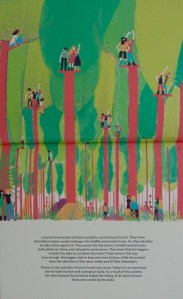
Environmental activists too have a place in this book with Greta Thunberg and her Fridays For Future movement involving young people; but new to me are the ‘Defenders of Pureora Forest’ whose protests against deforestation of this New Zealand tropical rainforest, an important site in Maori culture, saved the forest and led to the ending of felling by the New Zealand Government of all native forests owned by the state.

These and the other movements featured are described in Rebecca June’s straightforward, engaging but never preachy text, and Ximo Abadia’s stylised, often arresting illustrations, both of which convey the message that peaceful protest can effect change, every single voice matters and nobody is too young to start getting involved to make the future better for all of us; what’s needed is optimism, determination and a strong sense of hope.

An important book for primary classrooms everywhere.

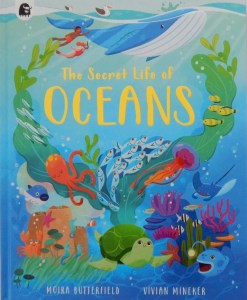
The Secret Life of Oceans

The Secret Life of Oceans
Moira Butterfield and Vivian Lineker
Happy Yak

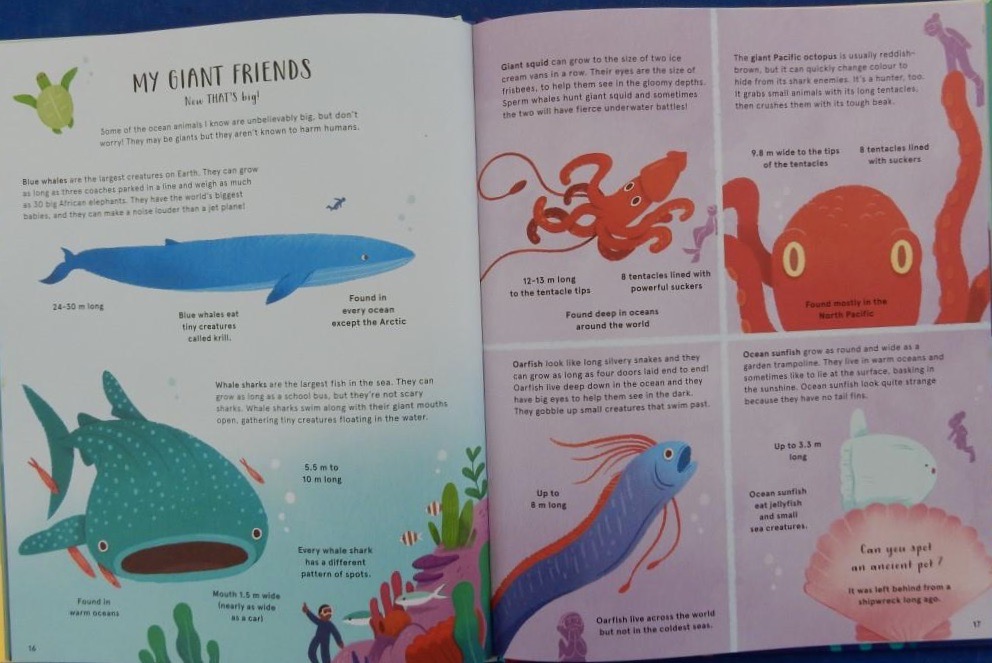
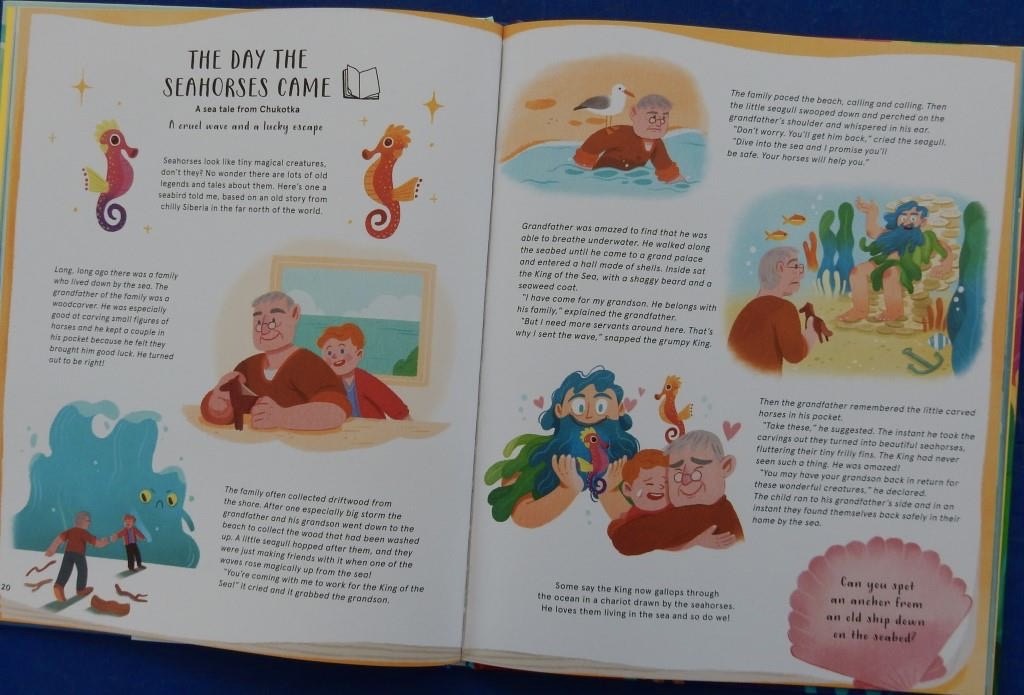
In this book, which is a mix of science and traditional stories from various parts of the world, we’re in the company of Tia the green turtle, famous for her swimming prowess and beautiful shell. Having introduced herself and told the story of how she was born, Tia takes readers on an exploration of some of the secrets of marine flora and fauna starting with those relating to sea turtles like herself and other turtles that live in the world’s various oceans (there’s a map showing these).

Diving down through the zones of the ocean all the way to the abyss, we encounter marine inhabitants large and small from giant squids and blue whales

to microscopic zooplankton and phytoplankton and sea-horses, to mention just a few.

Other topics are included such as ways of communicating – did you know that bottlenose dolphins each have their own unique whistle sound or that blue whales make low rumbling sounds that can travel as far as 3200 km through the water? There’s a look at the ocean’s gardens, the chilly, slippery stormy spots formed of ice and snow, an encounter with fearsome creatures with ferocious-looking teeth. And, we find out something about ocean currents, some special coastal features, what it’s like living and working by, and with, the sea.

Many of the spreads have a ‘can you spot’ feature to encourage younger readers to use their powers of observation. The two final spreads are devoted to the endangerment of turtles and what we humans can do to help them. There are also five traditional stories from various parts of the world.

With bright, bold illustrations infused with humour, and a thoughtfully presented, engaging text, this is enjoyable learning for primary children.

Animal FACTopia!

Animal FACTopia!
Julie Beer, illustrated by Andy Smith
Britannica Books

You never quite know where your inquisitiveness might take you in this engaging and informative book. And you’ll assuredly find yourself laughing at some of the zaniest zoological facts you encounter, every one of which is verified by Encyclopaedia Britannica and every fact is linked to the next. Herein you will encounter – one way or another – creatures scaly, feathery, furry, silky smooth, from the microscopic to the massive, some friendly and others downright dangerous.

You will discover something about skin shedding spiny mice of the African kind, whistling walruses, purple-blooded peanut worms, blue-tonged skinks and lots more – weird and wonderful animals assuredly.

Coincidentally I came upon examples of bioluminescence three times in a single day: the first in this book:’ microscopic male crustaceans called ostracods vomit glowing mucus’ to attract partners.

Then the topic was mentioned in a David Attenborough programme I watched in the evening as well as in the novel I am currently enjoying.

Were you aware that certain monkeys floss their teeth with bird feathers? I wasn’t; nor did I know that ghost crabs have teeth in their stomachs to facilitate digestion or that Western painted turtles are able to hold their breath for four months. Amazing!
With a mix of photographs and Andy Smith’s cartoonish illustrations this will surely satisfy curious KS2 readers and entertain a great many adults too I suspect.

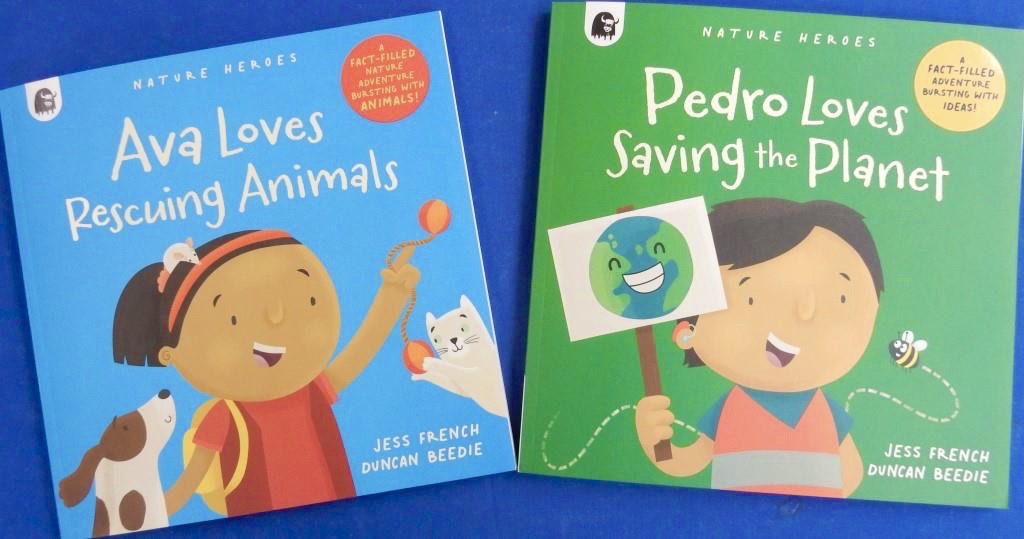
Ava Loves Rescuing Animals / Pedro Loves Saving the Planet

Ava Loves Rescuing Animals
Pedro Loves Saving the Planet

Jess French and Duncan Beedie
Happy Yak

These are additions to the Nature Heroes series where the focus is on a group of friends who love nature and being outdoors: essentially each one is a fact-filled picture book story.

In the first we meet Ava who lives with her grandparents They run an animal rescue centre that provides a temporary home for all kinds of animals, be they pets or wild creatures, large or small.
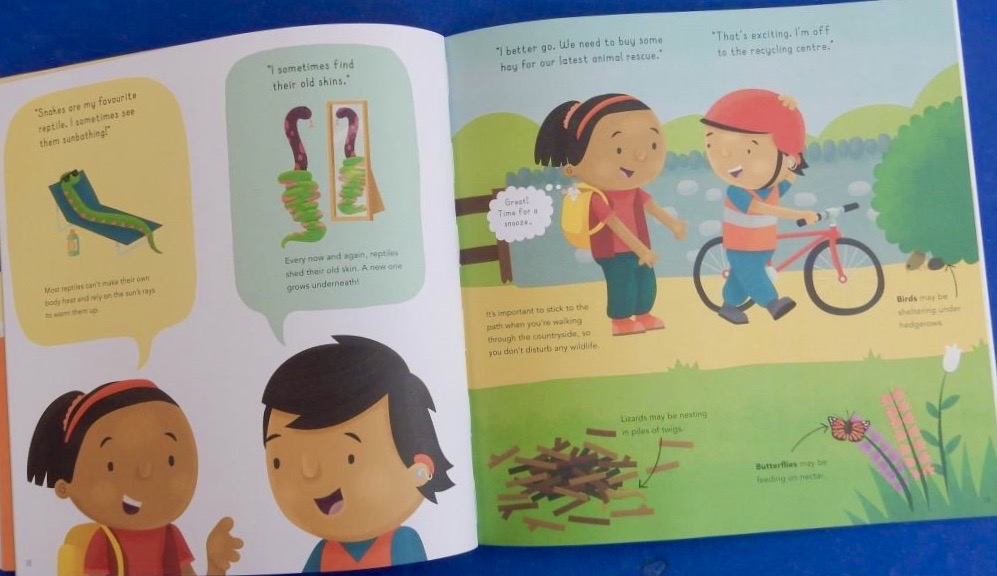
Accompanied by a tiny white mouse, Ava takes a walk around the centre and its environs as they head to the pet shop to buy hay for the animals soon to be cared for by her grandparents. On the way Ava stops at a pond containing frogs and lots of frogspawn and gives readers information on a frog’s life cycle and introduces some other amphibians.
We follow Ava on her ‘adventure’ during which she meets Pedro, the narrator of the next book,

and a lizard that narrowly escapes being run over by his cycle wheels. The entire walk turns into a fascinating learning journey for readers as they are introduced to various mammals – some of them record breakers, and find out about basic animal groups, ecosystems, habitats and more. Ava also meets another friend, Billy, who narrated Billy Loves Birds. Finally we discover the identity of the creatures that have just arrived at the rescue centre during their absence.

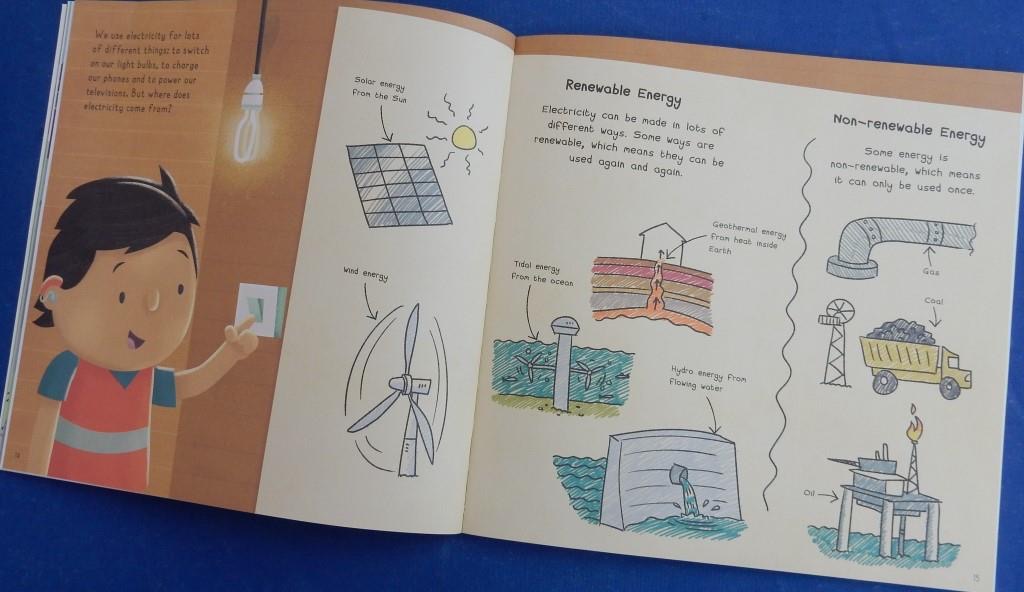
Pedro is an eco-warrior and in Pedro Loves Saving the Planet he and his older brother spend a day in the eco club’s new cabin. They choose to walk to their destination and encounter others who are using planet-friendly means of transport. Then once inside the cabin Pedro talks about renewable and non-renewable energy,

ways of saving water, points out that the cabin is built from sustainable materials, which leads on to a presentation of the 7 Rs (things that everyone should always keep in mind)) and other vital topics such as how to grow your own food, composting, the importance of trees, how to save energy at home, and the joys of being outside in green places.

Both books are illustrated by Duncan Beedie whose amusing art work underscores naturalist/vet Jess French’s informative, enjoyable texts. It’s never too early for young children to start learning about the importance of environmental care and the impact their actions have, both now and for the future. These books are spot on for foundation stage and KS1 class collections.

Migrants / What Is War?

Migrants
What Is War?

Eduard Altarriba
Button Books

Both of these books are, sadly, hugely topical right now.

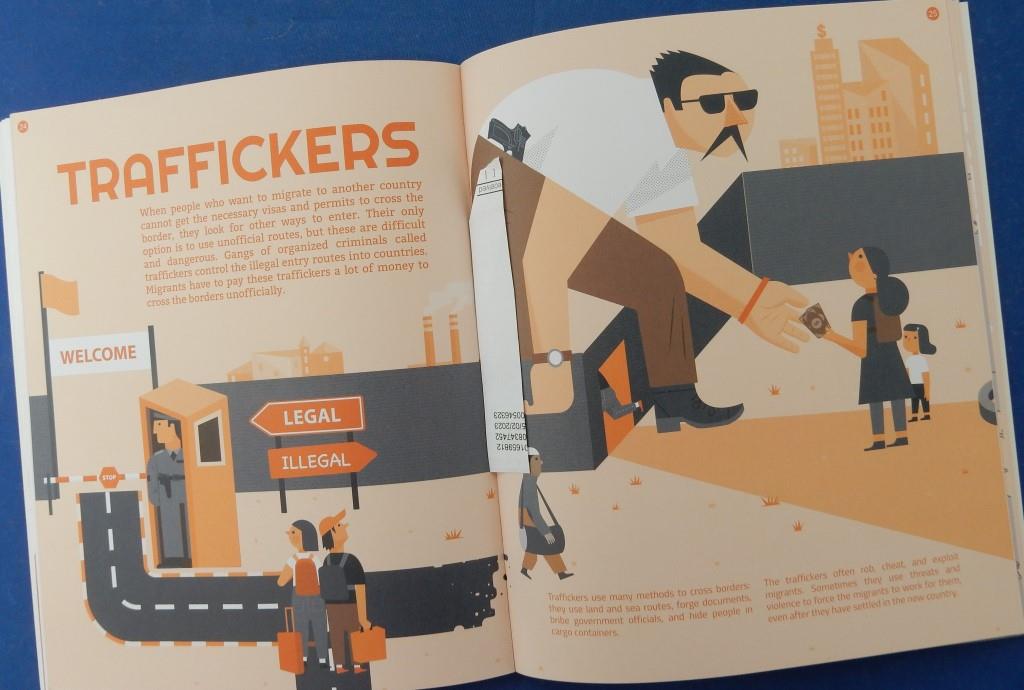
In Migrants, this sometimes emotive subject is explored in a matter of fact and dispassionate way. Eduard Altarriba explains that people have always been on the move since early humans migrated out of Africa to Europe and Asia more than a million years ago. He looks at borders between countries and why they exist, passports and visas that are required to cross them, how some countries colonised and created others, and discusses the reasons why migration might take place.

There is an excellent map showing the main migrant routes used in the last thirty five years. For some people it proves impossible to obtain the documents needed to cross borders so they have no option but to use often dangerous, unofficial routes and this leaves them open to exploitation by criminal gangs of traffickers.

The author covers the topic thoroughly yet succinctly, posing questions and answering them, progressing logically from one explanation to the next, with just the right amount of detail for older KS2 readers,

The same is true of What Is War? which is equally well-designed and illustrated. Altarriba’s approach is non-partisan and he explains that conflict between two clashing viewpoints, if unresolved through diplomacy or politics, may lead to violence and war. Disputes might be about borders or between different ethnicities, social or political groups within a country, in defence of national interests or historical grievances.

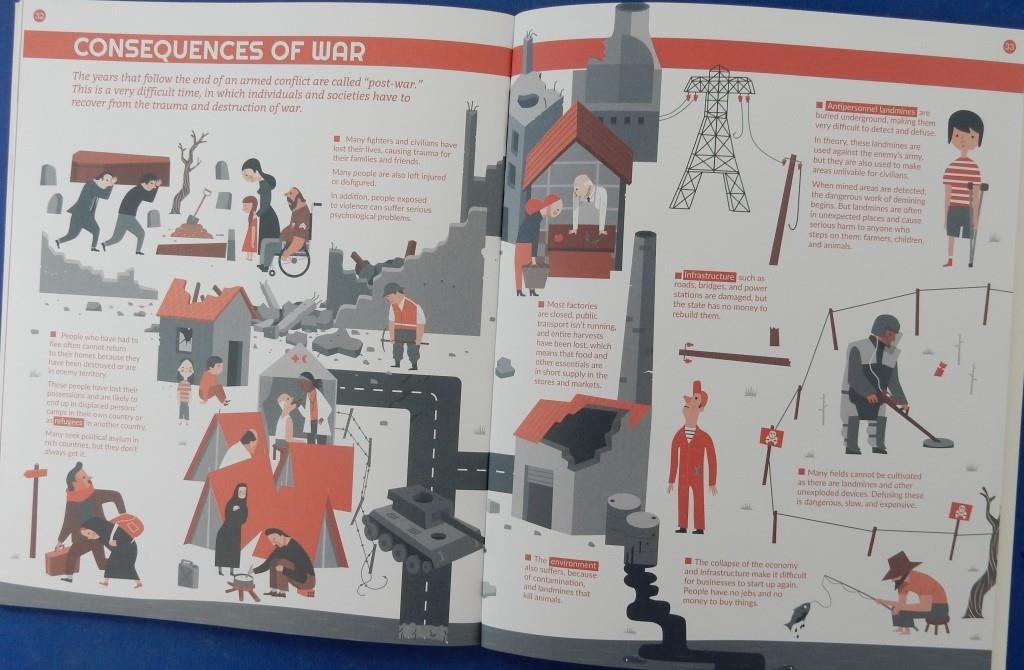
There are spreads about the principal actors involved, both national and international, the power brokers, the weapons and technology deployed. There’s a timeline stretching from ‘warring’ Neolithic hunters to the 20th century, a look at the types of war and the concept of a ‘just war’, a spread explores how a war might end and peace and mediation. This is followed by a brief look at the consequences of war both on individuals and societies.

The book concludes with three case studies: North Korea, the war in Syria and the war in Ukraine. War is a topic that, from questions they ask, worries many primary children, some of whom currently have Syrian and Ukrainian classmates.

I would strongly recommend adding both titles to upper primary class collections.

The Time Machine Next Door: Explorers and Milkshakes and The Time Machine Next Door: Scientists and Stripy Socks

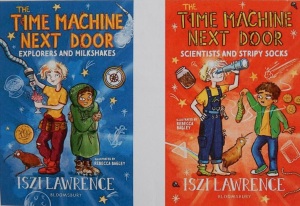
The Time Machine Next Door: Explorers and Milkshakes
The Time Machine Next Door: Scientists and Stripy Socks

Iszi Lawrence, illustrated by Rebecca Bagley
Bloomsbury Education

These are the first of a new series of historical adventures for younger primary readers.
Explorers and Milkshakes begins with the announcement that Sunil is in BIG trouble. We soon find out that while at home alone he’s accidentally broken a prized gramophone record of his grandfather’s and needs to fix it at top speed before his parents discover what has happened.

It just so happens that next door lives the eccentric Alex, owner and inventor of a time machine: could this Boring Machine or BM as she calls it, provide a highly unusual solution to the boy’s problem?

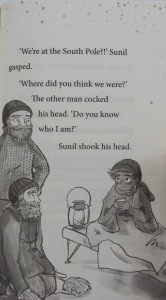
Before you can say ‘belly button’ Sunil finds himself on a hair-raising trip during which he encounters the likes of famous astronaut Neil Armstrong, and then visiting Antarctica and meeting Ernest Shackleton and some of his fellow explorers (plus a cat) stranded as they head for the South Pole. BRRR!

All of this happens while Sunil is trying his utmost to steer clear of the strange Mr Shaykes and kiwi companion.

In Scientists and Stripy Socks, Mr Shaykes announces that his Interesting Machine is in need of repair and if Alex doesn’t fix it for him, the milkshake cafe will ‘go bust’. But then his mention of Charles Darwin arouses Sunil’s interest and off he sets on another time-travelling caper. He learns a considerable amount about earthworms thanks to Charles, as he asks Sunil to call him when they take tea together.

He also temporarily loses his toe when he meets physicist Isaac Newton; in fact he briefly loses several body parts in this adventure. The final part of this book includes a discussion with astronomer Caroline Herschel; but with Alex’s time machine increasingly unpredictable, will our intrepid adventurer get back before Sunil’s mum and dad come home?

Giggles aplenty await when you read these two wacky stories as well as a considerable amount of information. Iszi Lawrence offers an unusual and very entertaining way to introduce readers to famous people from history. Adding to the fun are Rebecca Bagley’s black and white illustrations.

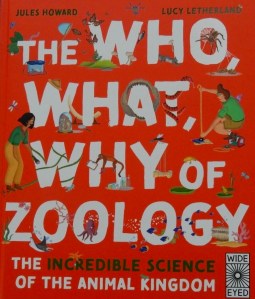
The Who, What, Why of Zoology

The Who, What, Why of Zoology
Jules Howard and Lucy Letherland
Wide Eyed Editions

For youngsters with a budding interest in the study of animals ie zoology – this is for you, whether or not you have aspirations to become a zoologist.

The author starts by defining zoology and explaining what zoologists do and then takes a quick look back over the past hundred or so years at how the work of zoologists has changed with the help of ever-developing technology.

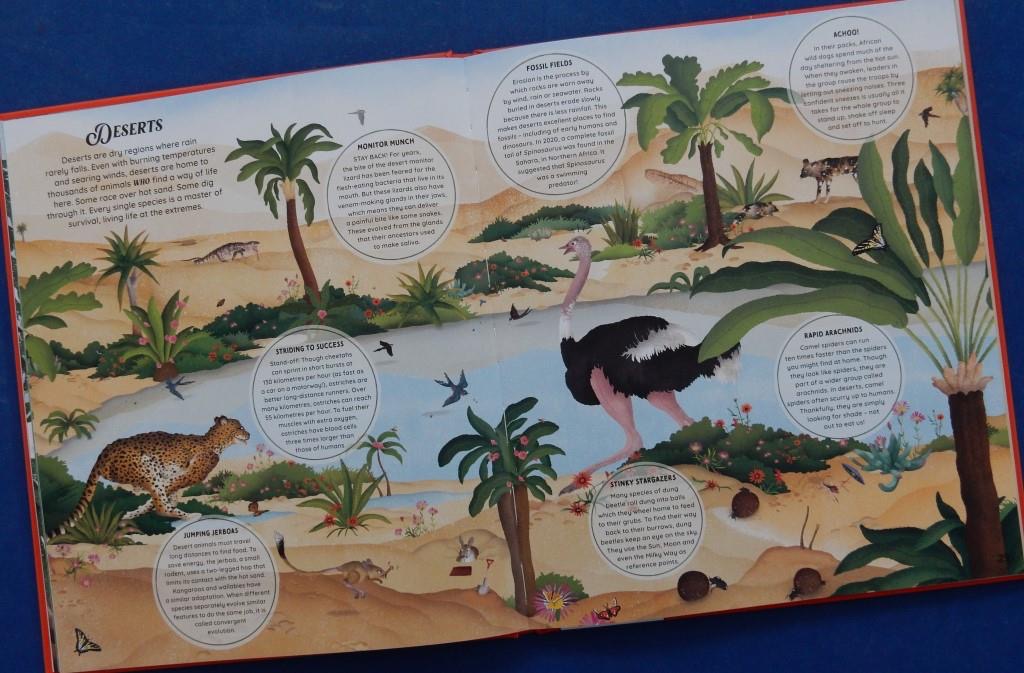
Readers then join the scientists working in the field and visit different biomes around the world and this is where the book differs from the many others about environmental regions in that it provides an insight into the role played by zoologists in the world today.

We start with temperate forests, then take a we look at tropical rainforests, deserts,

grasslands including savannahs, the tundra, and then dive down to underwater reefs and beyond, to the ocean floor.

For each region, the book explores the kind of terrain, introduces some of the animals who live there, provides some interesting facts related to those animals, and looks at the work zoologists do in that region, and how they go about it.

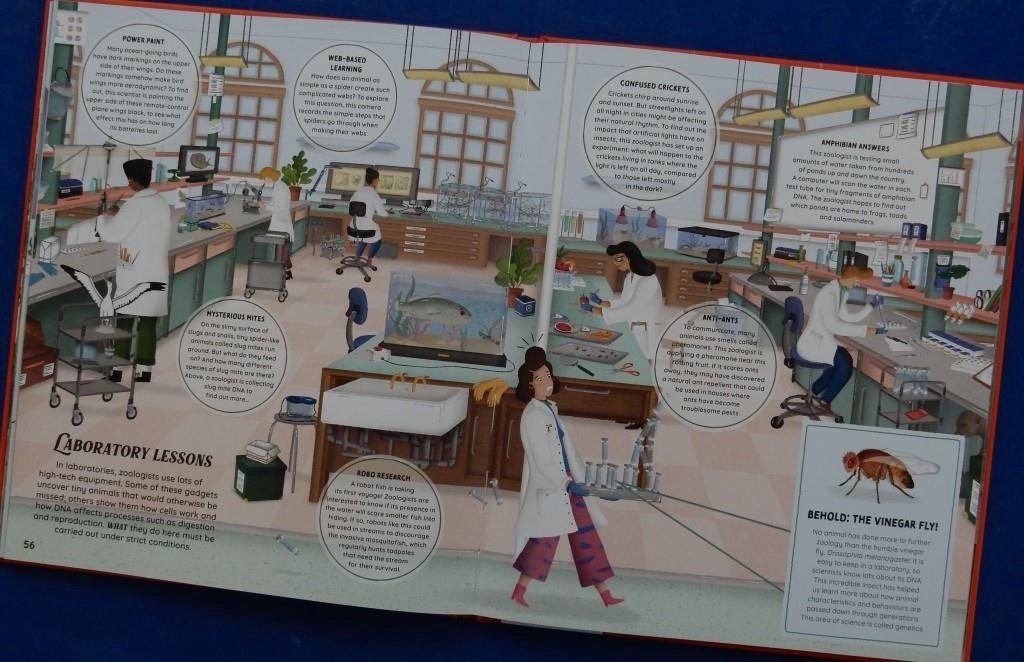
After all the exploring we return to the laboratories to see zoologists working not in the field but using high-tech equipment to further their research.

We also find out about the role museums, zoos and aquariums play in the area of zoology. Throughout Lucy Netherland’s illustrations illuminate the text and also offer gentle humorous touches in each spread.

The book ends with a reminder that zoology is for everyone and, with quotes from some of today’s great zoologists, offers pointers in how young readers can start out on their own zoological adventures.

Fascinating, informative and pitched just right for older primary readers and above.

Wanna See A Penguin? / The Lost Leopard

Wanna See A Penguin?
Simon Philip and Ian Smith
Oxford Children’s Books

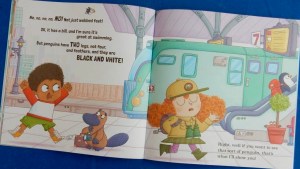
A self-declared penguin expert and friend search the city for penguins; they see all kinds of black and white creatures striped ones, furry ones,

animals with fins, horned ones, ones with hooves, four-legged animals and others but none of the eight fit all the penguin criteria. Is there actually a penguin anywhere around?

Yes indeed and that is what makes this book such fun. Hiding in plain sight in every scene is the animal the friends seek. Young listeners will love searching the pages to find its whereabouts as well as guessing the identity of the partially shown animal on each spread and laughing at the misidentifications of the so called penguin pundit.

The author’s manner of telling is gently humorous – the ending a hoot – and Ian Smith’s delightfully droll illustrations include lots of amusing details.
There’s a fact file after the story presenting a paragraph each on the zebra, puffin, duck-billed platypus, monkey, orca, goat and dog that appear in the story.,

The Lost Leopard
Jonny Marx and Xuan Le
Little Tiger

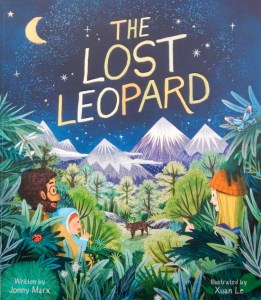
We join Flora and Fauna (dubbed the ‘world’s greatest explorers) and their baby, Bud, on their search for the elusive clouded leopard.

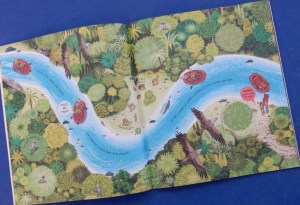
Their journey takes them to various habitats along a river,

over foothills and up the Himalayan mountains, through forests and jungles and a rainforest; even down into caves. Needless to say there’s an awful lot of mud and not everywhere is accessible by road so their quest involves a lot of walking; walking through rain and snow, strong swirly winds and scorching heat until they finally arrive at a tropical forest location.

During their travels they encounter a wealth of amazing wildlife including yaks, langur monkeys, Bengal tigers,Indian elephants,

a King cobra, all labelled. Truly an epic journey but do they find what they have been searching for? Baby Bud has certainly learned a lot and so will youngsters who explore this exciting book.

Xuan Le’s vibrant detailed illustrations, which include lift the flap sections, cutaway pages, die cut surprises and a gate fold, extend Jonny Marx’s engaging, informative text making this a book that is probably best shared with an individual child or small group as there is so much to explore on every spread. Individual, more confident young solo readers will also love embarking on the adventure with Flora, Fauna and little Bud.

Who Owns the Woods? / Above and Below: Sea and Shore

Here are two recent picture books about the natural world from Little Tiger – thanks to the publishers for sending them for review.

Who Owns the Woods?
Emily Hibbs and Jess Mason

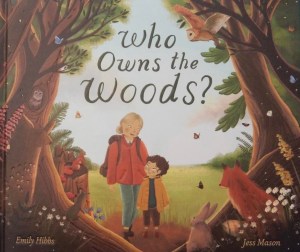
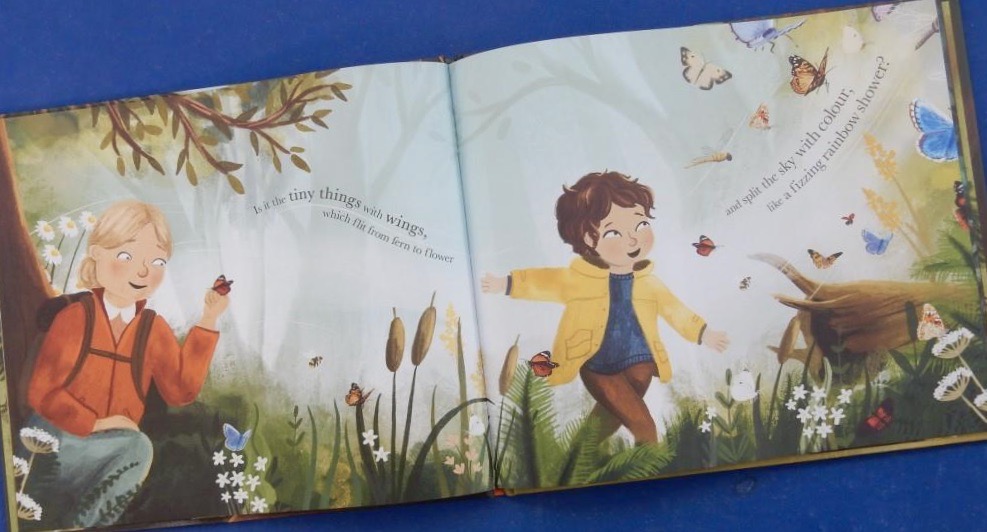
A boy and his grandma go exploring in the woods and as they walk, the child asks ‘who owns’ various natural things. Could it be one of the tiny animals they stop to observe – the spiders spinning their webs perhaps, or the butterflies with their beautifully patterned wings. 

Perhaps the woods belong to the magnificent stag, a fox or … maybe the boy himself is the owner of all those magnificent trees.

Not so, says his wise grandma; nobody can claim ownership of this particular area of woodland forest with its wealth of awe-inspiring flora and fauna; it is there for the enjoyment of every single person and moreover, as the boy himself confirms, it needs to be shown respect and treated with care.

What is needed is stewardship not ownership; that is the key message in this book beautifully illustrated by Jess Mason. Her scenes truly evoke the magic and tranquility of these special places. I really like the way the branches of the trees speak to readers serving to re-inforce the all important theme of Emily’s Hibb’s text.

Above and Below: Sea and Shore
Harriet Evans and Hannah Bailey

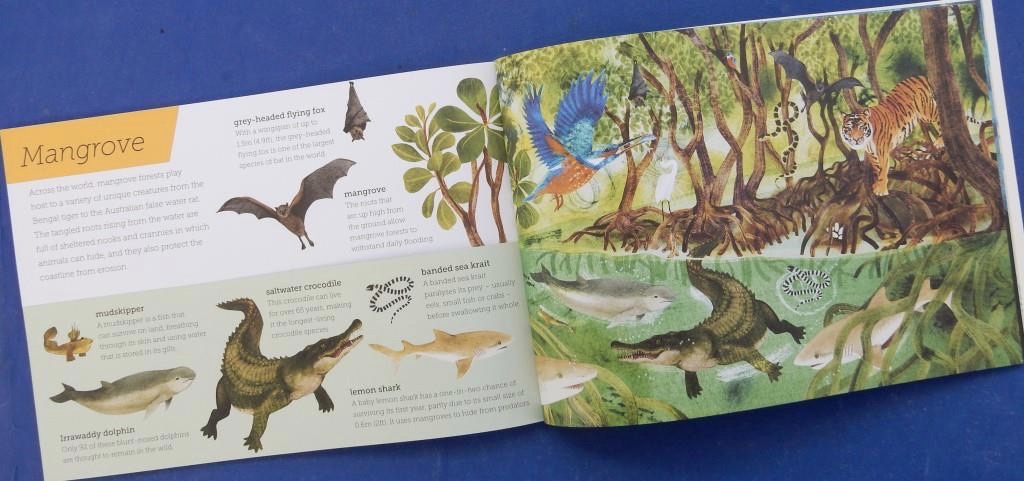
Now published in paperback, this is one of an excellent spilt page, lift-the-flap natural history series; it explores ocean habitats below and above the waves taking readers to such locations as the coastline, a sub-aquatic kelp forest, polar oceans and an estuary. There’s a visit to a tropical shore, a coral reef, a mangrove swamp and more.

The information comes in bite-sized portions making it accessible to EYFS and KS1 audiences. Children will be fascinated to discover that for instance, a lobster tastes with its legs and has teeth in its stomach and that in the forests of a mangrove swamp is a grey-headed flying fox with a wingspan of 1.5 metres, making it one of the world’s largest bat species.

The spilt pages work well providing as the title indicates, above and below views of the locations featured, each being beautifully illustrated with lots of detail: there’s so much to see.

This is a book that celebrates the natural world and gives a real sense of the sheer diversity of life in our oceans and rivers and on our shores.

Super Small / The Versatile Reptile

Super Small
Tiffany Stone and Ashley Spires
Greystone Kids

You may be surprised to learn that some of the world’s smallest creatures have awesome superpowers.

The minute oribatid mite can lift more than 1,000 times its own weight. The pygmy seahorses are so good at camouflage that scientists only discovered them accidentally when they brought some coral into a lab to study; then there’s the bee hummingbird that’s able to fly backwards and upside-down – clever stuff!

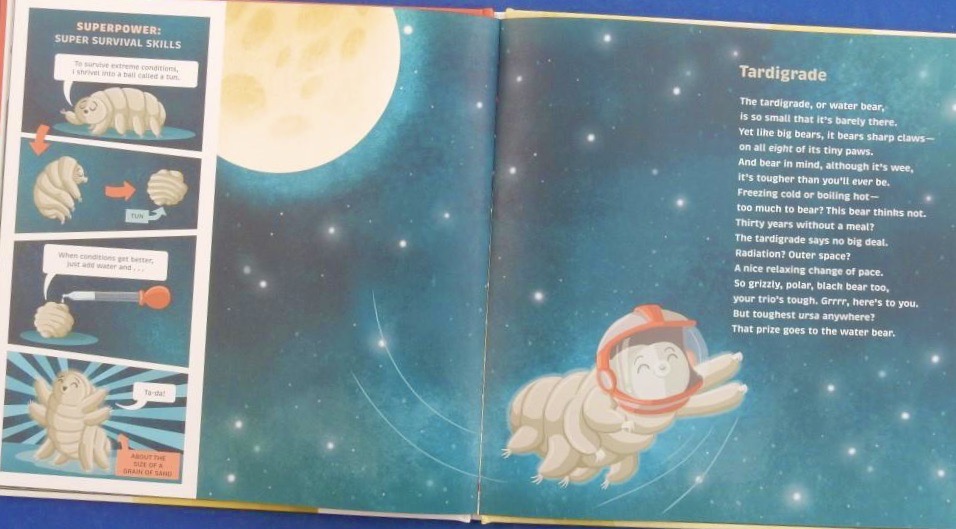
Did you know that wood frogs are able to survive harsh winter conditions as ‘frogsicles’ – they stop breathing, their hearts stop beating and their bodies make a kind of protective antifreeze and as for those teeny tiny tardigrades, here’s what author Tiffany Stone has to say about them: ‘The tardigrade, or water bear, / is so small that its barely there. / … And bear in mind, although it’s wee, / it’s tougher that you’ll ever be. / Freezing cold or boiling hot— / too much to bear? This bear thinks not.’

Ashley Spires uses her artistic superpower to illustrate each featured creature, making every miniature marvel appear super-confident; and to accompany her poetic descriptions Tiffany Stone provides some side-notes in the form of animal monologues (or dialogue) presented in comic strip style side panels. This is a book that will appeal to animal enthusiasts especially.

So will:

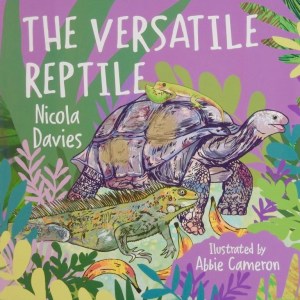
The Versatile Reptile
Nicola Davies and Abbie Cameron
Graffeg

In this addition to the rhyming series in which Nicola Davies presents a look at various animal types, we meet some reptiles.

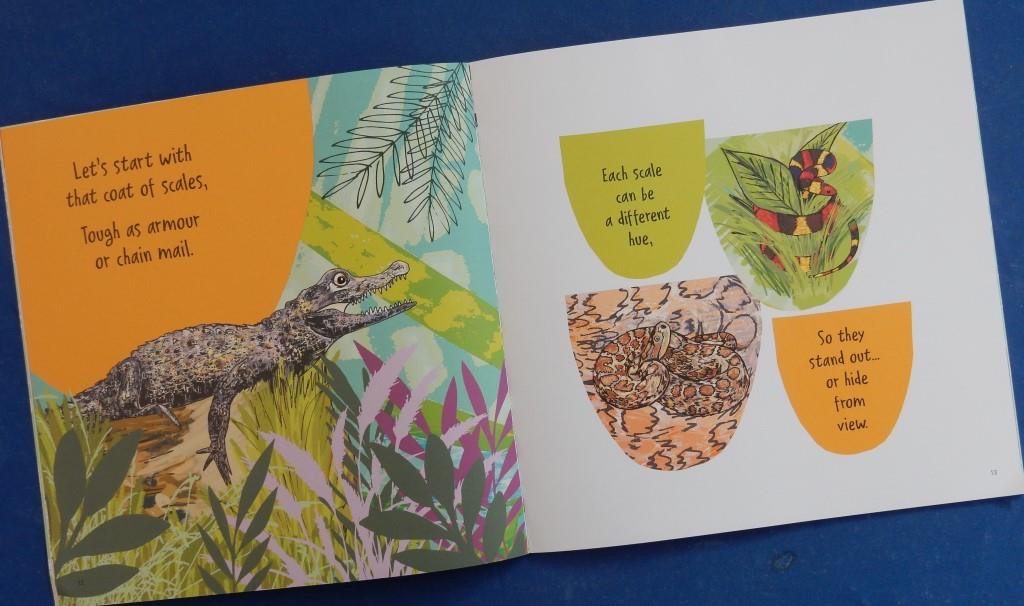
Reptiles are found in many different parts of the world as the young adventurer in this book discovers in her search. These scaly creatures might be jungle dwellers, live in desert places or swim in the seas among the seaweed, and can vary in size from massive to minute and from endearing to downright grim and ghastly. 

One thing the entire reptile group can claim though, is versatility. 

Abbie Cameron’s accurately detailed, close-up illustrations really drive that point home to readers who will one hopes enjoy coming face to face with such fascinating creatures. This reviewer certainly did.

Perfectly pitched for KS1 readers.

A Little Dose of Nature / Look What I Found: On the Farm

A Little Dose of Nature
Dr. Alison Greenwood and Anneli Bray
Ivy Kids

Written by psychologist, Dr Alison Greenwood who has set up a charity called Dose of Nature, this book as the cover says, suggests ‘outdoor fun to help happiness bloom’. To improve mental health and wellbeing, twenty five activities are suggested for children (and adults), all to be done outside in the natural world, well away from the distractions of social media, computer games etc.

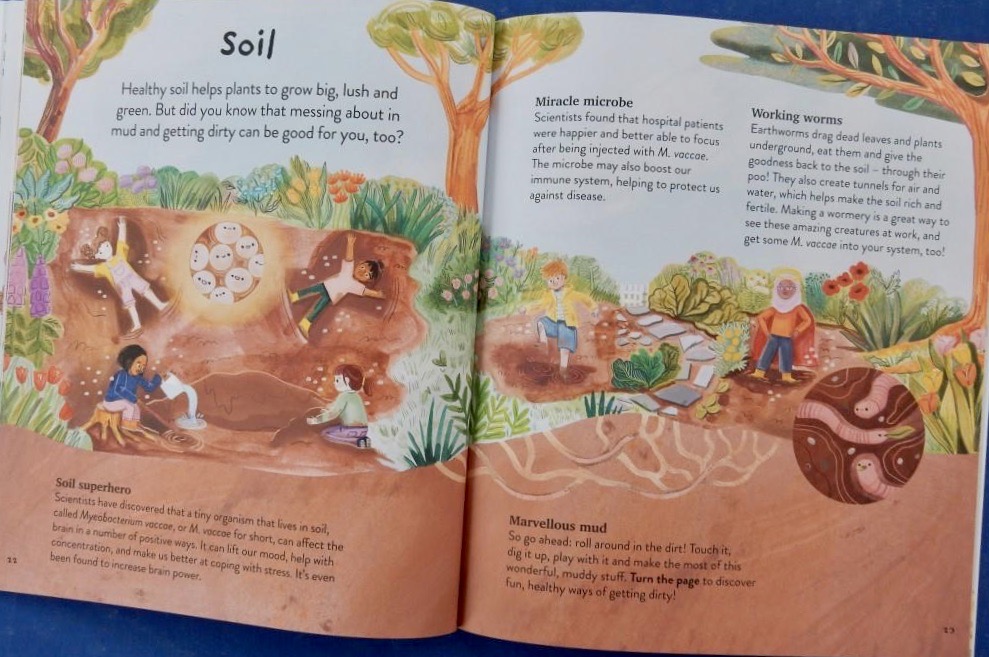
First though the author states that nature has five active ingredients that are of benefit to humans; these will give us more energy, improve concentration and sleep, help us to relax, and to be in a better mood. These include fractal patterns, nature’s sounds, phytoncides (natural chemicals), soil bacteria and sunlight. I expect some of these science terms will be unfamiliar to younger children and Alison pitches her explanations at just the right level. The book has five main sections, entitled Nature’s Fractals, The Science of Sounds, Fresh Air, Soil

and Soak Up the Sunshine!

Who could fail to connect with nature as they collect and arrange natural objects to create a mandala – in my experience children love to do this.

The same is true of getting messy by sculpting animals using sludgy mud or running around barefoot in a muddy patch and then comparing the experience with walking barefoot on grass.

Brilliant for forest school and outdoor science. I love that Alison’s final words include paragraphs on awe and what she calls ‘wow moments’.
Anneli Bray’s detailed illustrations are an inclusive delight and certainly make this particular book stand out from others on the theme of appreciating the great outdoors..

Look What I Found: On the Farm
Moira Butterfield and Jesús Verona
Nosy Crow

Bursting with information, this is the third title in a series published in collaboration with the National Trust.
Readers join the three young adventurers on a new expedition one spring day as they investigate their surroundings while following the path through the fields. Each in turn exclaims in the rhyming narrative, “Look what I found!”

excitedly showing the others and readers the discovery, be it animal related, such as a tuft of sheep’s wool or a feather, or plant-related like the fluffy head of dandelion seeds.


Another engaging mix of story, non-fiction and search-and-find, illustrated by Jesús Verona whose scenes of the natural world, both the close-ups and landscapes are immersive.

Recommended for family bookshelves and KS1 class collections, especially if you want to encourage children to get outside and explore their surroundings.

Baby Owl

Baby Owl
Anne Rooney and Qu Lan
Oxford Children’s Books

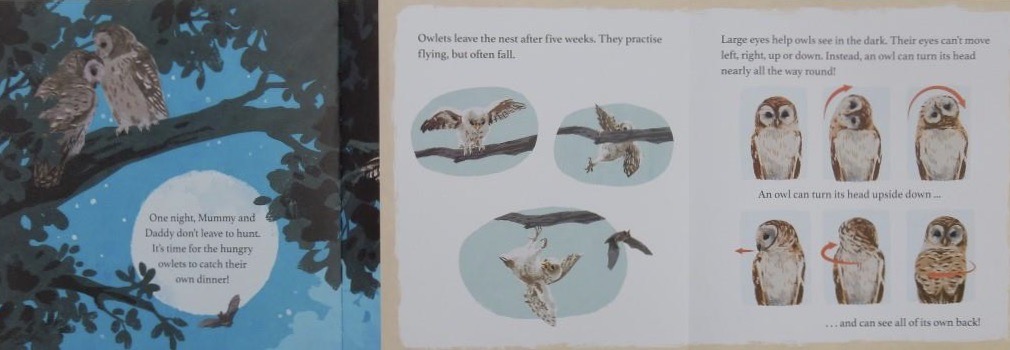
The adorable-looking white fluffy owlet that emerges from an egg, the Baby Owl featured in this book doesn’t stay like that for long. With Daddy owl’s hunting and feeding regime, the owlets soon outgrow the nest, venturing out onto the tree branches. Baby Owl however, isn’t quite ready to catch his own insects. He ends up on the forest floor in a heap and has to climb all the way back to the nest by means of his sharp beak and claws.

Soon though, the owl parents leave their little ones to hunt for their own dinner and off goes Baby Owl in search of food.

Flying is fun, he decides and eventually with mouse in beak, back he goes to show his parents his prey. After consuming same, he settles down and falls asleep warmed by the rising sun..

As with previous titles in the series, young children will absorb quite a bit of information from the well-written narrative but characteristic of the Amazing Animal Tales are the flaps beneath which additional facts are presented as well as occasional questions, which add to the book’s interactive nature. In this one, youngsters will learn that an owl can turn its head nearly all the way round and can see all of its own back. Beautifully illustrated throughout, this is certainly one to add to early years collections.

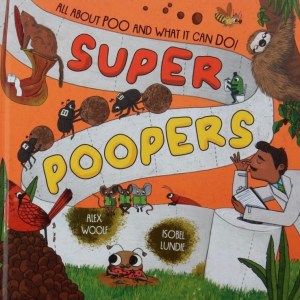
Super Poopers

Super Poopers
Alex Woolf and Isobel Lundie
Little Tiger

The topic of poo almost invariably raises interest in young readers and this book will surely do so with its humorous approach to those often whiffy bodily emanations. Before you turn your nose up though, consider this statement that concludes the author’s introduction: ‘In short, there seems to be no end to human and animal ingenuity when it comes to finding uses for poo’.
A fair bit of ingenuity is also presented between the covers of this collaboration between author Alex Woolf and illustrator Isobel Lundie.

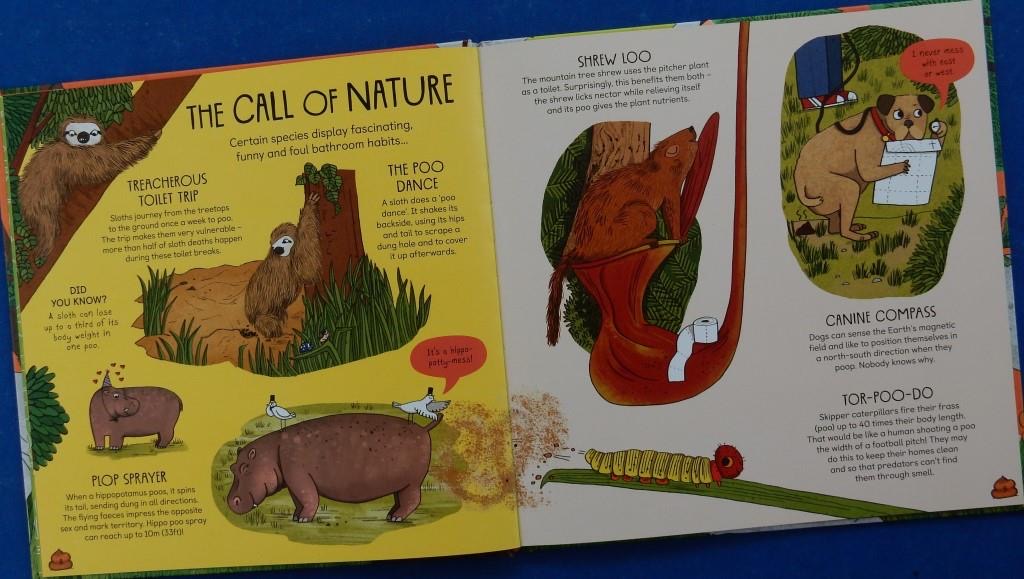
They start by presenting a handful or two of the weirdest facts about creatures and their poop. Did you know for instance that a hippopotamus whirls its tail while pooing. The result being flying faeces (sometimes reaching as high as 10 metres) that can be used to mark their territory and to show off to the opposite sex. 

Imagine being a pitcher plant in the vicinity of a mountain tree shrew; said animals use pitcher plants as toilets, which is of mutual benefit: the plant receives nutrients in the poo and the shrew licks the plant’s nectar.

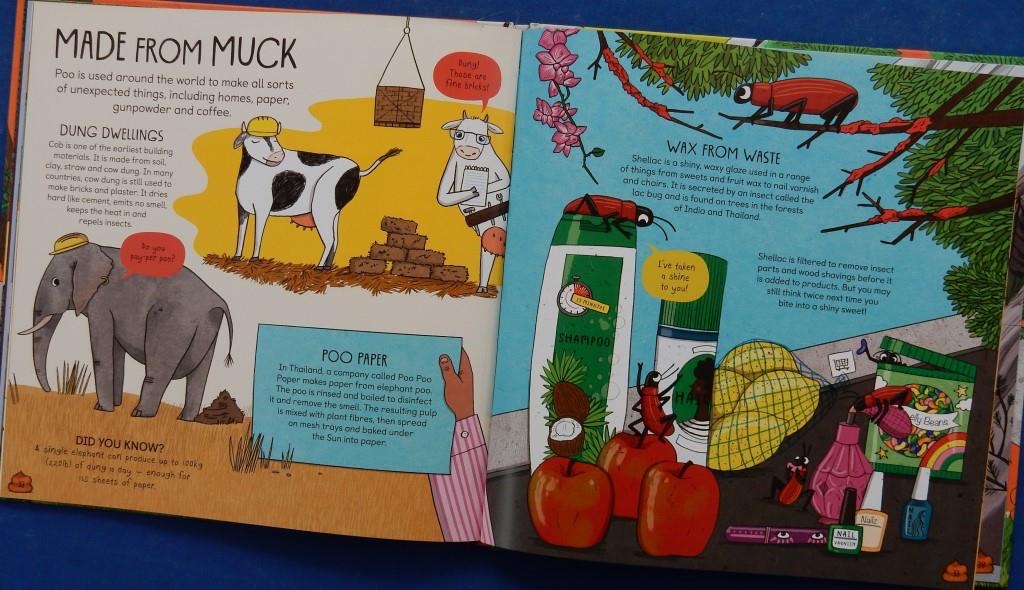
Child readers may well be aware that poo makes a fantastic fertiliser – there’s a spread on that topic herein – but how many are aware of some of the things it can be used to make. For instance there’s a company in Thailand aptly named Poo Poo Paper that uses elephant poo to make paper. Of course, the pong is removed during a process of boiling that also disinfects the pulp before it’s mixed with plant fibres, spread on mesh trays and left to bake in the sun. The result is paper. Apparently one elephant’s daily dung dump is sufficient for over 100 sheets of paper. 

There’s also a luxury coffee that uses beans collected from the poo of Asian palm civets and it’s said to cost way, way more than your usual cup of coffee. I don’t think I’ll be trying that though.

Covering twelve topics in all, Alex Woolf’s playful, punning text is both fascinating – yes really – and full of amazing information and includes such topics as diverse as ancient fossilised faeces and what it can teach us, and ways poo can or might be utilised to produce power for heating, lighting and even vehicle fuel. In keeping with the tone of the verbal content, Isobel Lundie’s bright, detailed visuals are appropriately amusing and the resulting combination is sure to produce giggles aplenty in readers.

Meet The Weather

Meet the Weather
Caryl Hart and Bethan Woollvin
Bloomsbury Children’s Books

Team Hart and Woollvin follow their introductions to the planets and the oceans with an opportunity for young children to go adventuring a third time and find out about different kinds of weather. Meet the Weather sees a little girl and her canine companion soaring through the sky in a magical hot air balloon. On their journey they’ll meet shape-shifting clouds, wild whooping whooshing winds, lightning along with booming thunder, a destructive tornado that twirls and whirls sending everything in its path skywards. 

Then there’s the cold murky fog with its damp greyness; 

the snow that can transform the land into a carpet of white, the radiant sunshine that makes the world joyful; the vital rain to refresh the natural world and help it grow, and finally perhaps most beautiful of all, a glorious rainbow where the sun meets the raindrops.

Young children will love copying the various onomatopoeic sounds Caryl includes in her rhyming text and enjoy exploring the land- and sky-scapes presented in Bethan’s dramatic, vividly coloured illustrations in this book which provides a subtle STEM lesson woven into a fun story.

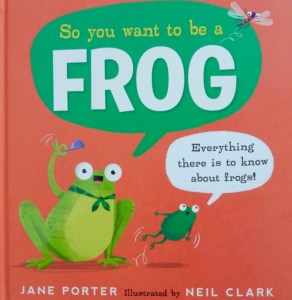
So You Want to be a Frog

So You Want to Be a Frog
Jane Porter and Neil Clark
Walker Books

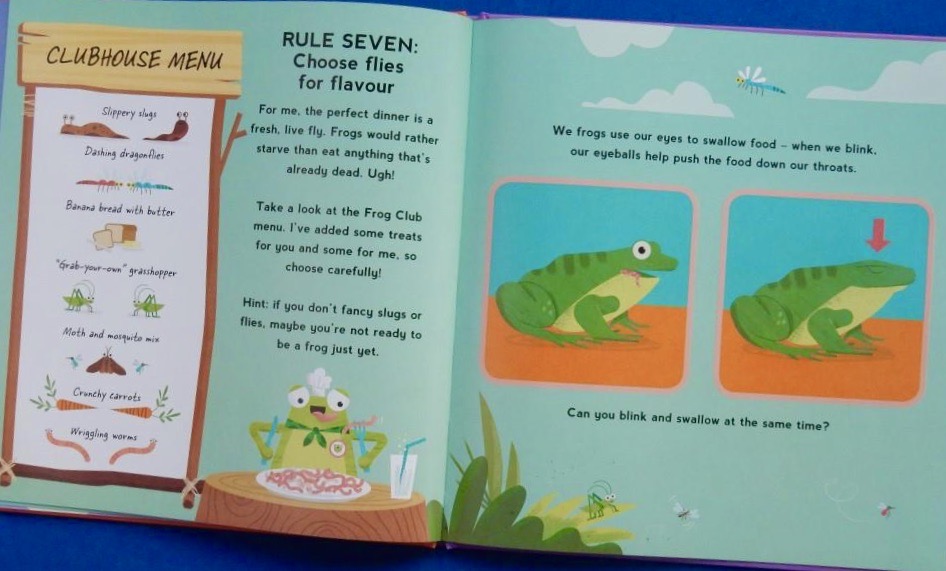
In her follow-up to So You Want to Be an Owl, author Jane Porter presents what it takes to be a frog. Should you decide to give it a try, you may be surprised to learn that it requires a considerable number of skills; so says Frog Club leader, Fabio Frog. Happily he is on hand to provide support and information via a set of rules..

First off, (remember there are several stages in your life-cycle) you will need to work on your wriggling. Then, once you’ve lost that tail, jumping is an important way of moving and your tongue becomes a vital part of your anatomy – it’s very useful for catching flies. Did you know, that should you manage to catch a fly, your eyeballs will push the food down your throat? Although if slugs are more appealing, they’re another live option (no self-respecting frog would eat anything already dead).

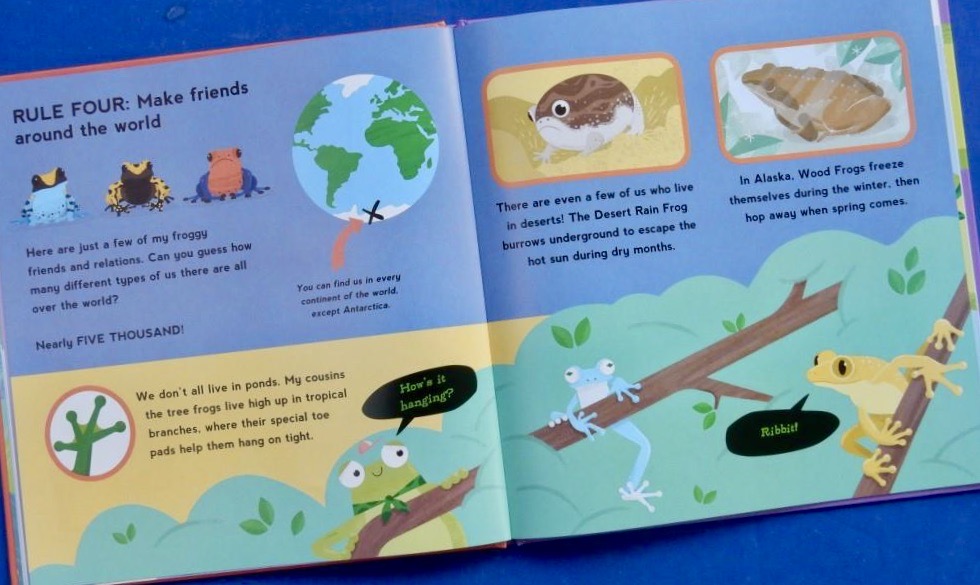
You’ll also need to be able both to breathe underwater (there’s a fuzzy-looking Hairy Frog’ that has hairs to help) and ‘drink through your skin’.

Colour is another consideration – not all frogs are green like Fabio, although there are a fair few green species in various parts of the world. Others though don’t even live in ponds: a few are desert dwellers, others high in the branches of tropical trees.

Quite a number are poisonous too, so beware.

As always Jane Porter’s love of nature shines through in her writing, which is highly engaging and fun for young readers. Cleverly integrated with the text are Neil Clark’s amusing, detailed illustrations. A considerable amount of verbal and visual information is to be found between the pages of this non-fiction picture book. One last word or several: croaking and ribbiting are not the only froggy sounds, but to discover other possibilities, you’ll need to get your own front limbs on a copy of Jane and Neil’s book.

Scientists in the Wild: Galápagos

Scientists in the Wild: Galápagos
Helen Scales and Rômolo D’Hipólito
Flying Eye Books

Along with a team of seven scientists from around the world who have a variety of special interests and expertise, readers are invited aboard the research ship, Sula, the aim being to study the flora and fauna of the Galápagos Islands, especially those unique to the archipelago.

Their tasks will include counting penguins: high numbers indicate that the population is healthy, What they find on this first stop is that nearly half the penguins they see are juveniles; this is good for it means the adults are breeding well.

The next job, after measuring a tiger shark is to attach a satellite tag to the creature and then track its movements. On the same island is a cove: a good stopping point for some underwater filming of the sea lions with a focus on what fish they’re eating.
The islands are home to a large variety of iguana species, one of which is very rare and the team stop off on one to count the endangered Pink land iguanas. Much, much tinier are the microscopic phyto- and zooplankton that play a crucial part in feeding the marine life around the islands.

The richness of the subaquatic flora and fauna attracts huge animals to the Galápagos to feed including sperm whales and one of the team wants to try and discover what it is these whales are communicating to one another.

It’s impossible to mention all the team investigates in a short review but readers find out about such topics as climatic conditions, a successful breeding programme of almost extinct Espania tortoises; there are spreads about Darwin and how the islands inspired his On the Origin of Species; the underwater volcanoes and their ‘mysterious’ ecosystems; and the final spread presents on going work in the Galápagos islands.

Helen Scales, herself a marine biologist, writes in an engaging manner, holding the reader’s interest throughout. I was excited to find the spread on Blue-footed boobies having loved Rob Biddulph’s picture book that starred the bird.

Stylish, detailed illustrations by Rômolo D’Hipólito play an equal part in conveying the science and keeping readers absorbed.


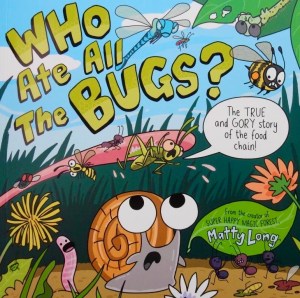
Who Ate All The Bugs?

Who Ate All The Bugs?
Matty Long
Oxford Children’s Books

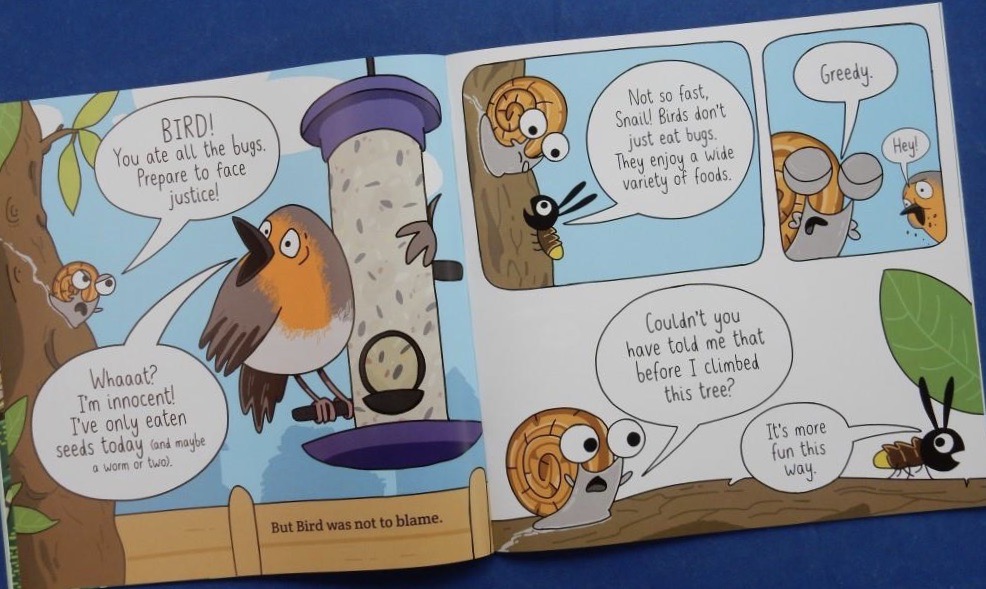
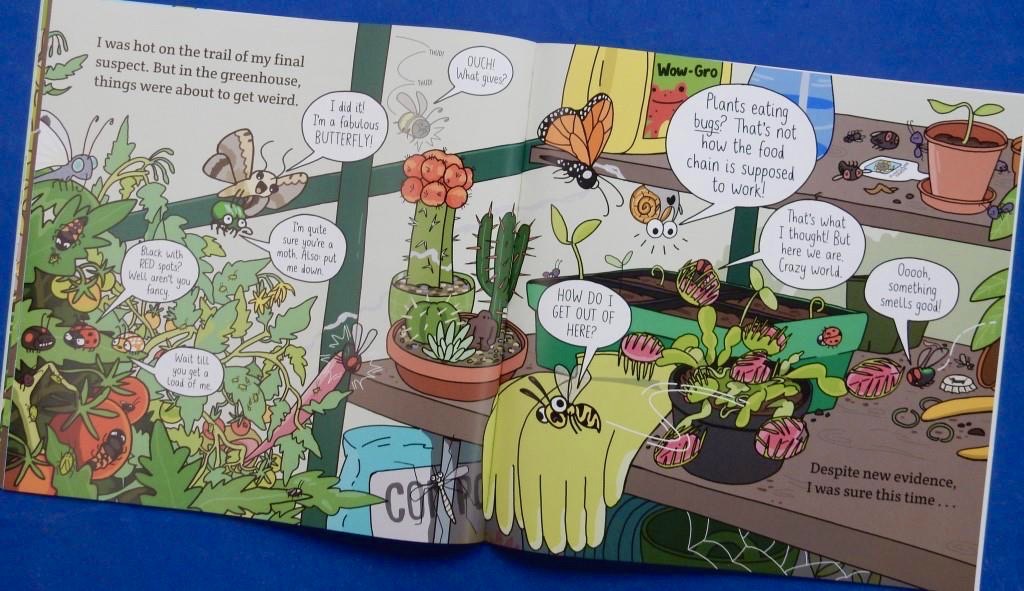
Doing something rather different, though still in his trademark zany style, Matty Long, creator of the Super Happy Magic Forest series takes a look at the food chain, courtesy of his minibeast narrator, Snail. The mollusc is on the trail of a dastardly killer and is determined to track down whoever is destroying bugs all over the place and bring them to justice. No help is forthcoming from any of her buggy companions so she just has to go it alone.

Bird is quick to proclaim his innocence

so Snail moves on, stopping off in the cabbage patch for a bit of sustenance and to question the bugs she finds there.

Eschewing Grasshopper’s advice to “let it go’ she creeps through the grass to accuse her next suspect, Snake. Wrong again! However Snail isn’t giving up that easily so she heads next to the greenhouse to confront her final suspect.

The arachnid isn’t guilty though, so should Snail finally take notice of Glow-worm’s insistence that “You can’t fight the food chain.” Time for some serious thinking on Snail’s part.

That’s not quite the end of this scientific story but is it perhaps the end of our justice-seeker? She might just have found out the hard way … Try asking a certain amphibian.

A slice of scientific learning served up in a deliciously funny manner that will surely have both children and adults chortling. Make that two slices – the final double spread provides additional buggy facts and the bug hunt activity page will likely send youngsters back to the start to track down the minibeasts in various stages of their life cycles. For this adult reviewer Who Ate All The Bugs is perhaps my favourite of Matty’s picture books so far.

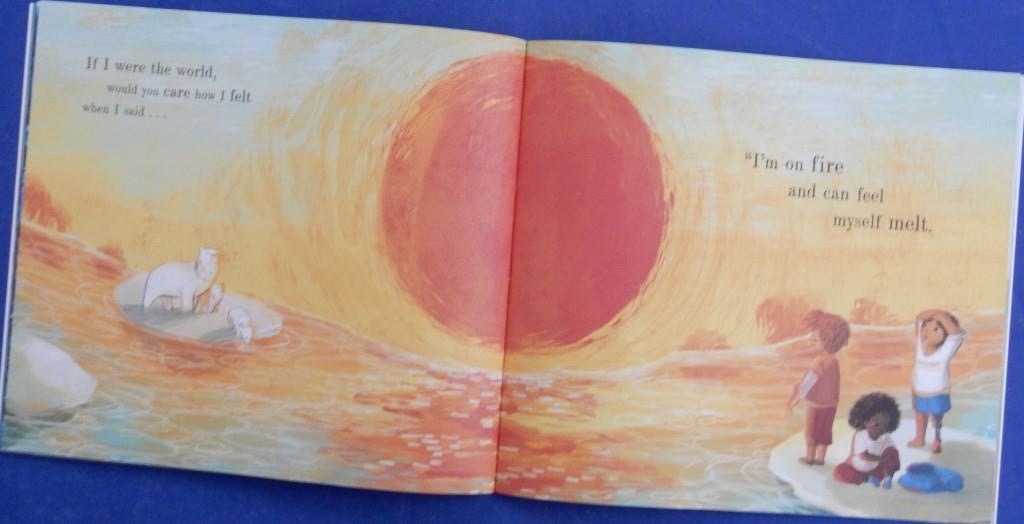
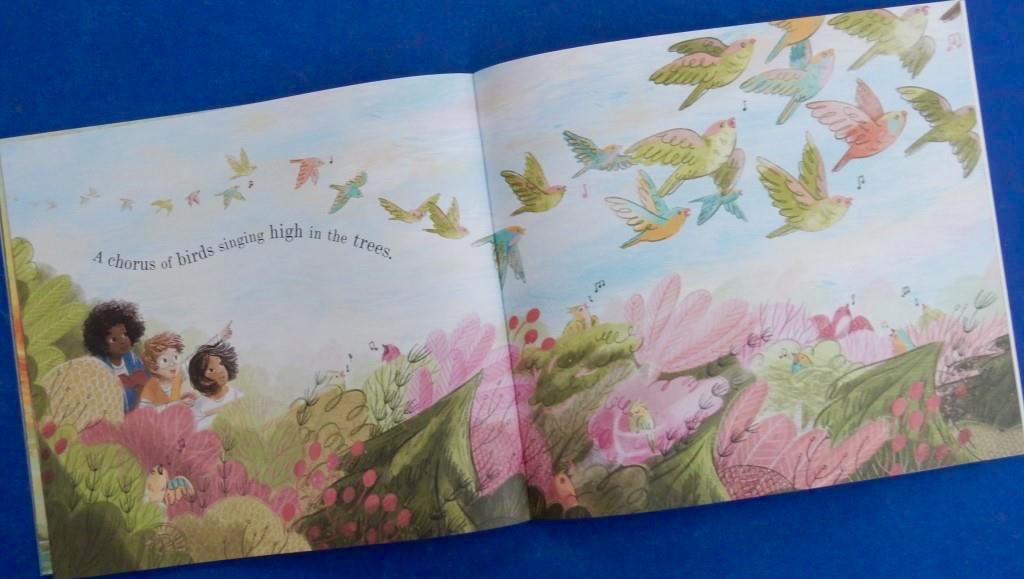
If I Were The World

If I Were The World
Mark Sperring and Natelle Quek
Bloomsbury Publishing

By making it sound personal this book really gets across the crucial messages about our precious environment and climate change. Written in rhyme and using ‘If I were the world’ repeatedly to introduce topics including plastic pollution, the toxicity of fossil fuel gases, the loss of animal species for various reasons, over-fishing of the oceans and catastrophe-causing climate change Mark Sperring presents the harmful things we are doing to our planet.

Then comes a rallying cry, “It’s time to take ACTION! We must do ALL WE CAN!” and the focus shifts to what can be done by each and every one of us to heal the damage. Things like recycling our waste, stopping deforestation, the greening of cities by planting seeds really can make a difference. Either we do so or the harm will definitely be irrevocable.

Natelle Quek uses three children to champion the environmental cause showing them first witnessing the harms mentioned in the words and then participating in the actions called for. Her illustrations are powerful and arresting, causing the reader to stop and look carefully at the wealth of detail included in each one

and in so doing extending the already impactful text. A smashing book both to share in primary classrooms and with individuals at home.

Darwin’s Super-Pooping Worm Spectacular

Darwin’s Super-Pooping Worm Spectacular
Polly Owen and Gwen Millward
Wide Eyed Editions

Charles Darwin is famous for his contribution to the understanding of evolutionary biology in particular his ‘On the Origin of Species’ but I wonder how many people are aware of his intense fascination with earthworms and the work he did on that topic.

Darwin was convinced that these little creatures were under-rated by the scientists of the Victorian era, many of whom considered them mere pests. So, he set about discovering their ‘superpower’. He tested their eyesight; but realised that worms don’t have eyes, then, their hearing – no ears either. What he found was that rather than eyes and ears, earthworms possess receptors in their skin that can sense not only light and dark but also vibrations.

In addition they could sense the smell of foods they liked but none of these could he really rate as a superpower.

However, Darwin’s abiding interest led him to chance upon the lowly earthworm’s superpower. Their poo helps make soil healthier but he only managed to persuade people after he’d paid a visit to Stonehenge and then received some ‘poo help’ from friends in various parts of the world. Eventually he described them as ‘nature’s plough’ and at last the people at his presentation began to take notice of what Darwin was saying: these worms feed all the plants humans depend upon.

This is such an entertaining way to introduce child readers to the methodical manner in which Darwin conducted his experiments. I really enjoyed the inclusion of a bespectacled worm’s viewpoint on Darwin’s experiments as will youngsters. Polly’s text has the perfect complement in Gwen Millward’s engaging illustrations.

(The final spread gives facts about earthworms in general and includes mention of the Earthworm Society and links to relevant websites) Absorbing and fun, this is science writing for children at its best.

Celebrate With Me!

Celebrate With Me!
ed. Laura Gladwin, illustrated by Dawn M. Cardona
Magic Cat

Twenty five creative people including chefs, artists, storytellers and designers from various parts of the world, have a double spread in which to present their favourite festival. Each person provides an introduction telling what makes their chosen festival special for them. Some festivals have a fixed date and others vary each year and the book starts with New Year’s Day and closes with New Year’s Eve. It introduces readers to some of the less frequently mentioned festivals and celebrations as well as presenting some that are well-known including Diwali, Eid-Al-Fitr and Easter. I had not come across Juneteenth before reading baker and food justice advocate, Michael Platt’s spread on the celebration.

Since food is such an important festival component, every one includes a recipe (to be used under adult supervision) – some are sweet, others savoury – as well as an art/craft activity, a story, song, game or something else that for each presenter, is part and parcel of their personal way of celebrating.

The book concludes with a look at some birthday traditions around the world and a spread suggesting readers ask those they know some festival related questions.

Diversity is key in this invitingly illustrated book. It’s a great way to learn about a variety of cultures and to help readers feel connected to the cycle of the year and to other people.

5 Minute Nature Stories

5 Minute Nature Stories
Gabby Dawnay, illustrated by Mona K
Magic Cat

Nine lyrically written stories about various key topics demonstrate the interconnectedness of the natural world. Starting with The Mystery of Mushrooms, poet and science writer Gabby Dawnay presents first a story and then the key facts about each of her chosen subjects. Her mushroom story begins with the distribution of spores scattered by the wind across the forest floor where, in the moss they start to create a network that grows and spreads underground until up pop a cluster of little mushrooms ready to start the cycle over again.

Making links with the underground mycelium by means of a partnership called mutualism, are the roots of the trees that also form an invisible subterranean web, we learn of in The Wood Wide Web.

Next to make an appearance is a group of Red Deer that forage on the fruits, bark and foliage of the woodland terrain that gives them a protective environment. These majestic creatures sing The song of the Deer, the chorus of which is, “This forest is ours / and together we’re strong. / In the meadows we roam, / in the woods we belong!”

Meanwhile, high up in the branches is a nest upon which sits an adult starling, until that is, three baby birds hatch from their eggs. Thereafter Mama Bird flies off to seek worms in response to their call for food. That she will do until some months later, they are ready to fend for themselves. Then comes The Flight of the Starlings as this story is called.

Other tales are of the metamorphosis of frogs, the amazing seven year long ‘feast’ of the stag beetle, the honeybee’s dance, photosynthesis as seen through the eyes of a little grey rabbit and finally, we encounter the tiger moth that uses moonlight to orientate and guide her nocturnal flight to find a mate – it’s called transverse orientation.

Each story is illustrated by Mona K whose natural world scenes are an appealing mix of realism and anthropomorphism. A lovely book to share.

Detector Dogs, Dynamite Dolphins and More Animals with Super Sensory Powers

Detector Dogs, Dynamite Dolphins and More Animals with Super Sensory Powers
Christina Couch and Cara Giaimo, illustrated by Daniel Duncan
Walker Books (MIT Kids Press)

This fascinating book introduces animals large and small, each one having been selected because it has the ability to perform a specific task such as testing treated water, or has a special highly developed sense.

There are eight main topics, one per chapter and readers are also given briefer notes on many others. First we learn of a dog named Eba, trained to help a human killer whale biologist track endangered orcas. Eba is ‘possibly the only dog in the world trained to sniff killer whale poop’. Then there’s Cynthia, a ferret living underground in Leicester. One of fifty, their task is to help humans run cables through ‘skinny underground pipes and replacing pipes when they break.’ This they do by means of their whiskers.

Rosita is a goat – a risk abatement goat – one of a herd that climb over the rocky hills of Southern California, eating dried-out bushes, grasses and other dried-out plants, thus removing fuel sources for small fires which could get out of control, as well as creating paths that are helpful for human firefighters coming to put out flames.


Did you know that since 2002 researchers working on the ICARUS project have used tracking tags placed on thousands of animals the world over and monitored from space as a means of predicting earthquakes. One such is a cow named Bertha in Italy; in 2016 she was able to sense an imminent earthquake.

Each chapter is followed by a related ‘activity’ for children to try out. These include simple guided experiments to test their abilities to for instance follow a scent trail or use echolocation.

All the creatures mentioned help their human co-workers tackle real-world problems like pollution and global warming but sometimes there are ethical considerations and the authors don’t overlook these.

In addition to the colour photos, Daniel Duncan provides some gently humorous illustrations;

and the source notes and bibliography are excellent. Altogether an engaging and enlightening book.

Whose Tracks in the Snow?

Whose Tracks in the Snow?
Alexandra Milton
Boxer Books

‘Look! Look! / Tracks in the snow!’ is the cry on each alternate spread in this gorgeously illustrated book that introduces readers first to the footprints and then having described the chief characteristics of the prints, ‘Tracks like hearts, Tracks in two lines’, asks them to guess who left those marks, ‘by the snow-covered pines?’

The black smudgy marks each time are a close facsimile of what children would see in the natural world and a small glimpse of a part of each animal provides an additional clue, in this instance, the dark brown tip of a lighter brown tail. The page turn reveals the answer—‘A shy red deer’—and some information about the creature depicted in all its glory.

The rhyming text with its repeat refrain is a joy to read aloud, the descriptions of the tracks are superb ‘Tracks with lines, / Tracks like a kite’ are those of a waddling wild duck,

‘Tracks like diamonds …’ refer to those made by the bushy-tailed fox’, but it is Alexandra Milton’s exquisite collage illustrations at every turn of the page that are the real show stoppers. Just look closely at the snow with its variations in colour and small portions of shading. Six animals, six landscapes and each a joy to behold.

What a wonderful way to entice youngsters out into the woods on a snowy day for some track-spotting. (The back endpapers show life size tracks of the six animals – pheasant, duck, fox, hare, deer and squirrel.)

My First Book of Electromagnetism

My First Book of Electromagnetism
Eduard Altarriba and Sheddad Kaid-Salah Ferron
Button Books

In their usual stellar way author Sheddad Kaid-Salah Ferron and illustrator Eduard Altarriba present another STEM topic – that of electromagnetism, broken down into bite-sized portions suitable for primary readers.

In our modern world it’s almost impossible to think of many things that work without either electricity or magnetism but what actually are these physical phenomena and how do they work together? Furthermore, what do these things have to do with light? These and many other questions are explored in this fascinating book.

To relate the story of electromagnetism and our developing understanding of it, the author takes us way back to circa 600BCE to when Thales of Miletus’s first experiment with magnetic attraction when by rubbing a small piece of amber on some fur, he noticed a strange force that could attract small pieces of straw. Moving on we encounter Benjamin Franklin, an 18th century American scientist who worked on the idea of electrical charge in his experiments.

Until the work of Ørsted and of Ampère people thought electricity and magnetism were unrelated; those two experimented during the latter part of the 18th and first half of the 19th century.

That brings us right through to Michael Faraday and James Clerk Maxwell unifying the fields of magnetism and electricity to develop the theory of electromagnetism. Because of Faraday’s poor background, what was his original idea was left to Maxwell to write the four famous basic equations describing all electric and magnetic phenomena.

At intervals during this exciting account, readers can pause and do some experiments for themselves. These include making an electroscope to test for electric charge, creating a homemade battery and constructing a working motor.

It’s not simple science that’s described herein but it’s made accessible, engaging and exciting for children, and is presented in a way that will help them understand. Using his design background, Eduard has created enticing illustrations and helpful info-graphics to complement the text.

Recommended for budding scientists either at home or in school.

Little Elephant / Little Platypus

Little Elephant
Anna Brett and Carmen Saldaña
Little Platypus
Anna Brett and Rebeca Pintos
QED

In the first of these additions to the Really Wild Families series, Anna Brett takes readers to the African Savannah, home to Little Elephant (our narrator) and family to spend a day with the elephant herd comprising fifteen elephants, almost all of which are female, the oldest and most knowledgeable being Grandma. The youngest member of the herd is a two day old cousin of the narrator.

We see how the elephants search for and eat their food, meet some of the other animal inhabitants of the savannah and then head for the watering hole to drink and have some fun too, all under the watchful eye of Grandma.

It’s she that sounds the trumpet alarm call warning of a lion in the vicinity: time for the adult elephants to form a protective circle around the calves until the danger is over. There’s information about the role of tusks, ways of communicating and more, until at sundown, members of the herd stop to rest for the night.

Following the simple narrative are some additional elephant facts, information about elephant conservation, a case study and some activities. Carmen Saldaña illustrates this one, supporting the information well.

Belonging to a much smaller family (a mother and her two young ones) and living tucked away in a burrow on a riverbank in eastern Australia is Little Platypus, a nocturnal animal. It’s Little Platypus’s voice that tells readers about platypuses’ physical features, habits and habitat, reproduction and how they are born,

what they eat and how they survive. Males such as Little Platypus have a spur on each back leg that is able to release venom in dangerous situations.
Again Anna Brett’s manner of presenting the information is well pitched for young children and Rebeca Pintos’s illustrations are beautifully executed, playful and alluring. The backmatter is similar to the previous book though platypus related.
Like the elephant title, the few photos are especially useful as both illustrators have made their animals look rather more endearing than realistic.

A Dinosaur A Day

A Dinosaur A Day
Miranda Smith, illustrated by Jenny Wren, Juan Calle, Xuan Le, Max Rambaldi and Olga Baumert
Red Shed

Imagine being able to encounter a different dinosaur, or other prehistoric animal, every day for a whole year. That’s what you can do if you plunge into this prehistoric extravaganza. Herein, after a general introductory spread, you will meet all your favourites such as the fearsome Tyrannosaurus, the club-tailed Ankylosaurus and the plant-eating Triceratops and Diplodocus. You’ll also encounter a great many unfamiliar creatures, some of which have only recently been discovered: I have to admit the majority were new names to me.

One such is Aquilops, one of the beaked dinosaurs. It was a herbivore about the size of a cat with a skull smaller than the hand of a human. Another small herbivore was the Nqwebasaurus (found in what is now Southern Africa) Amazingly so we read, ‘fossils have been found with gastroliths in the stomach – stones it swallowed to help grind up tough plant food,’

As well as dividing the contents by months, the author also uses dinosaur groups – examples are: ‘some of the smallest’, ‘duck-billed dinosaurs’, ‘horn-faced dinosaurs’ and ‘largest of them all’. Surprising to me was that all those included here were herbivorous. One such Antarctosaurus never chewed its food, rather it swallowed plants whole.

Key facts for each dinosaur featured include the period it lived, the family it belonged to, diet, length, weight anywhere remains have been found; and there is also a brief paragraph giving key information ; and helpfully, the backmatter includes a pronunciation guide.

If you have a dinosaur fanatic or a budding palaeontologist in your family then you should definitely get a copy of this book. It’s also one to add to school collections: I envisage it being in much demand especially with KS2 readers.

Ballet Kids

Ballet Kids
Holly Sterling
Walker Books

Before the title page we meet a small boy holding up a doll dressed in ballet attire, who introduces himself thus, ‘I’m Thomas, and I want to be a ballet kid.’

He then goes on to share with readers in a straightforward manner, the events of a ballet class day. Having dressed up warm as befits the snowy day and packed his ballet shoes, off he goes to the dance studio clutching mum’s hand. He introduces us to each of the friends he meets on the way, all of whom are heading to the class too.
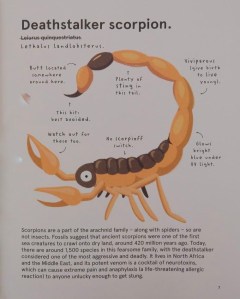
Once there, with their ballet shoes on, the children start their lesson. Thomas takes readers through the warm up, and the various moves, describing the exercises,

defining ballet terms, while speech bubbles provide comments from the young participants. Mr Elliot, their teacher is enormously encouraging as are the children one to another and then with Christmas approaching, the pupils choose outfits and thus, roles for the winter show, a performance of The Nutcracker. Thomas picks out what he thinks is the most wonderful costume he’s ever seen. “You’re the Sugar Plum Fairy”, Mr Elliot tells him and puts on the music for him to dance. When it’s time to leave Thomas has started feeling butterflies in his tummy but they’re soon allayed by his teacher’s words, “Just listen and move with the music, the magic will come from within.” And it most certainly does …
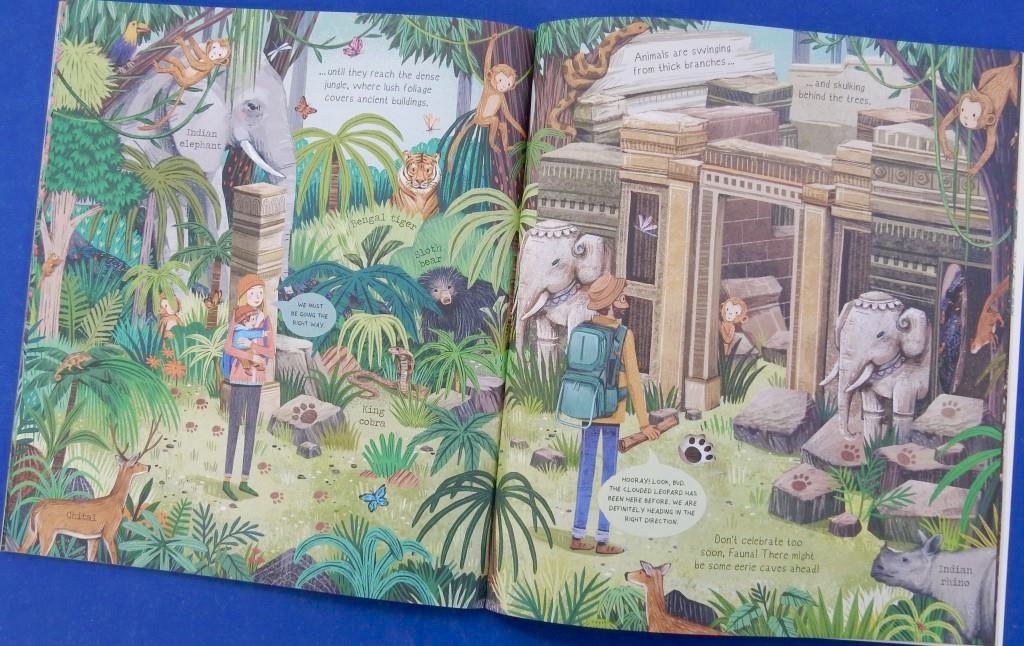
In her inclusive illustrations, Holly Sterling captures that magic and the sheer joy of the young dancers both in their class and as they perform the winter show. Young audiences will surely be swept up in that enchantment, especially the aspiring dancers among them.

History’s Biggest Show-Offs

History’s Biggest Show-Offs
Andy Seed, illustrated by Sam Caldwell
Happy Yak

What is it about some people that makes them want to show off about their achievements? Have you ever wondered who the biggest braggers of all time might be? If so then Andy Seed has done the work for you, presenting in his lighthearted style, the flashiest boasters in the history of humankind.

The book is divided into three main parts entitled People in Charge, People Who Think Up Stuff and People Who Create Things; however if readers prefer they can look instead at different time periods: ancient (c.6000 BCE to 500 CE), post-classical (c.500-1500 CE), early modern (c1500 – 1800 CE) and modern (c. 1800 to the present).

We’re introduced to eleven rulers, five of whom were women. These include Hatshepsut, an ancient Egyptian pharaoh, Tarabai who at just twenty five, took over the leadership of the Marathas after the death of her husband and proceeded to show off her military skills to overcome the Mughals; and Christina of Sweden, she who was super-brainy and loved to read. Among the men was Mansu Musa who when on Haj, took 12, 000 servants each with a bag of gold to give away en route to Mecca.

Those with a scientific or technological bent include the first ever computer programmer, Ada Lovelace

and Ynes Mexia, an intrepid plant collector from the early 20th C who discovered 500 new species and had fifty plants named after her. Having studied at Brunel University, I have to mention the ace engineer, Isambard Kingdom Brunel who, with help from his father, built the first ever tunnel beneath a river (The Thames) and who sadly died before his exceedingly costly Clifton Suspension Bridge was finished.
Finally come the creative types: Ustad Ahmad Lahori was asked by Shah Jahan to create a building in memory of his beloved wife Mumtaz and that’s how the magnificent Taj Mahal came to be. Another show-off architect Antoni Gaudi is famous for Barcelona’s still unfinished Sagrada Familia.

There’s a wealth of bling too, as Andy Seed’s humorous writing brings all these and more back to life and he’s even included some quizzes to ramp up the fun. Talking of fun, Sam Caldwell’s zany illustrations certainly add more of that in abundance: even the timeline will make readers giggle.

Black Swans

Black Swans
Laurel van der Linde and Sawyer Cloud
Sunbird Books

The six brilliant Black ballet dancers almost leap right off the pages of this show-stoppingly illustrated, narrative non-fiction book.

First we are introduced to Essie Marie Dorsey who although she never made it as a ballet dancer herself on account of her colour, made sure that others could by opening her own dance school in Philadelphia – The Essie Marie Dorsey School of Dancing; and to get Black parents to enrol their children, she went knocking on their doors asking them to send their offspring as pupils and so they did.

Next is Arthur Mitchell; such was his skill at ballet, that he attracted the attention of George Balanchine, artistic director of New York City Ballet and was invited to join the company, eventually becoming the first Black principal dancer. Even then it wasn’t plain sailing for in 1957 an audience deemed it unacceptable for a Black man to dance with a white woman. Some twelve years later using his own money, Arthur co-founded the Dance Theatre of Harlem ballet company.

Christian Holder moved to England aged seven with his family, then later attended the New York High School of Performing Arts. His talent was noted by the choreographer Robert Joffrey and as principal dancer, he had to face racial prejudice but it was his partner, not Christian who was replaced.

Dwight Rhoden too was held back on account of his skin colour, but as a choreographer went on to cofound Complexions Contemporary Ballet.

Last come two women, Misty Copeland who in 2015 became the first Black ballerina to be Principal Dancer of American Ballet Theatre and finally Michaela DePrince who when a very young orphan in Sierra Leone saw a magazine picture of a ballerina.

When she was adopted by a family from New Jersey she went on to become a star dancer of Boston Ballet.

Ground breakers all and each of these dance lovers achieved greatness by overcoming obstacles through self belief, determination and of course, amazing talent.

A lovely book to inspire youngsters to follow their dreams, whether or not that involves dance.

Baby Polar Bear

Baby Polar Bear
Anne Rooney and Qu Lan
Oxford Children’s Books

In this latest of the Amazing Animal series, we follow a recently born Baby Polar Bear cub and her twin as they take their first forays away from the Arctic den their mother has built. They’re a playful pair and both stay close to Mummy Bear as they frolic in the thick snow.

One morning their mother leads them away from the den on a long journey across the icy terrain. The little ones take care not to stray too far away in case of wolves.

Eventually they reach the sea and the cubs delight in chasing the birds and Baby Bear takes a tumble into the chilly water. Brrrrr! After some splashing for a while, it’s time for the cubs to snuggle up together under the star-filled sky. All this is told in the narrative part of the text while facts about the bears are found beneath the gate-fold flaps of this cleverly designed book.

The illustrations are gorgeous and Anne Rooney’s engaging text with its interactive element, is pitched perfectly for the intended young audience; to add to fun, there’s also a Bonaparte’s gull to find on every spread.

A book I’d strongly recommend for both home and class use.

Africana: an encyclopedia of an amazing continent

Africana: an encyclopedia of an amazing continent
Kim Chakanetsa, illustrated by Mayowa Alabi
Wide Eyed Editions

For this large format book, author and broadcast journalist, Kim Chakanetsa, divides the African continent (the second largest in the world) into five regions – north, east, central, west, and southern – the following topics being covered in each region: a timeline of important dates, people and culture, 

wildlife and landscapes, famous people (change makers and superstars), and snapshots of interesting facts. There’s also a final section called ‘Global Africa’. Even before starting to read about the five regions, readers are confronted with some uncomfortable facts about the slave trade and its continuing impact upon descendants of African slaves in such places as the US where they are still living with the consequences of slavery even today.

However, there is a great deal to celebrate, not least the wonderful landscapes, 

animals and cultures and those important change-makers. Let me just mention a few of those: first my all time hero, Nelson Mandela who spend 27 years in prison and is now thought of as the father of South Africa’s democracy. From Western Africa there’s award-winning author Chimamanda Ngozi Adichie, most famous for Half a Yellow Sun, Egyptian author Naguib Mahfouz, singer-songwriter Miriam Makeba, another campaigner against the apartheid system in South Africa.

Strikingly illustrated, highly informative -also included are words of wisdom from various countries, flags and with an excellent glossary – this is a great introduction to a vast continent presented in an accessible way. A book for classrooms, families and libraries.