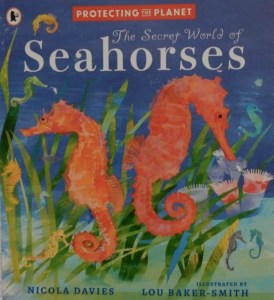
Protecting the Planet: The Secret World of Seahorses

This immersive addition to the Protecting the Planet series is written in an accessible narrative style by zoologist,, Nicola Davies with impressive mixed media illustrations by Lou Baker Smith.

I’m fortunate to have seen live seahorses off the coast of Kerala but I doubt many readers of this book will have been so lucky as to see these graceful, fascinating, almost magical creatures. This is due in part to the 70+ million that are caught annually by humans who then make them into pills and potions or items such as key-rings to sell them as trinkets. Others of them meanwhile become the victims of pollution and dragnets. It’s still not too late however, to save these wonderful animals from becoming extinct: readers will discover how seahorses have adapted to their environment through movement and by means of camouflage and diet changes.

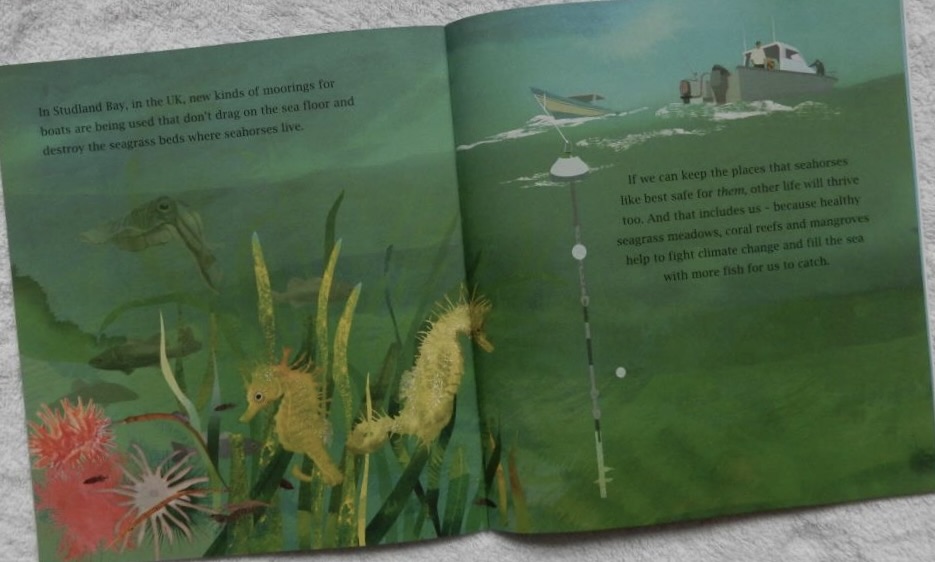
Furthermore on the positive side, they’ll read of innovative conservation schemes in the UK,

and in Malaysia and Cambodia to protect seahorse habitats.

Did you know that seahorses perform a ritual dance? You can discover why from the book and what makes paternal seahorses unique in the animal kingdom.

Certainly worth adding to family bookshelves and KS2 class collections; make sure children’s attention is drawn to the final spread ‘Seahorses and Climate Change’.

Dinosaur Dynasty

Countless children are dinosaur obsessed becoming so from an early age. Doubtless they will be thrilled to discover this amazing book from mega publishers Big Picture Press.

Author/illustrator Jack Tite’s Dinosaur Dynasty is quality non-fiction presented in a child-friendly, informative manner. He takes us back to the prehistoric world hundreds of millions of years ago to the Mesozoic Era when the planet was ruled by dinosaurs. This era comprising the Triassic, Jurassic and Cretaceous periods lasted 186 million years with the world changing constantly., the Triassic period beginning with the extinction of some 90% of living things including the ancestors of dinosaurs termed archosaurs. However, it’s thought that the earliest dinosaurs arrived about 240 millions years ago in the Middle Triassic period and these co-existed with the archosaurs.

Jack introduces us to an amazing selection of creatures from the terrifying Tyrannosaurus to the tiny super fast predator Compsognathus that was about the size of a chicken and had very sharp teeth and claws.

Dinosaurs are not the author’s only focus; we meet creatures that lived in the oceans such as the Mosasaurs that ranged between one and seventeen metres in length and had snake-like bodies and paddle-like flippers: imagine meeting a large one face to face. What a magnificent menagerie and we’ve not yet arrived at the Cretaceous Period.

So fast forward and discover one of the largest dinosaurs with its incredible armour, Ankylosaurus.

I wouldn’t fancy being thwacked by that ‘wrecking ball’ of a tail. Surely every bit as fascinating as the creatures of mythology are these prehistoric beasties.

With some richly textured, big fold-out scenes to excite youngsters this is a thoroughly immersive, fascinating book featuring some awe-inspiring, hugely diverse creatures and their habitats.

Ming the Panda

When a young child is unable to sleep, Mama tells a story about a very special panda who brought love and hope to millions of people. It’s the real-life story of Ming, the first baby Giant Panda to be brought to London Zoo in 1938, who became a wartime symbol of courage and hope. The little panda began its life in the mountains of China. As she grew in size, she also grew in bravery and one day she began a journey that took her all the way to London Zoo. There she was looked after by a kindly zookeeper – his very first panda – that he named Ming (a Chinese name that means Brightness).

People came from near and far to visit the panda and they even wrote her messages and sang to her. One very special visitor was a young princess, who later became Queen Elizabeth. Ming’s fame spread all around the world but then war broke out and bombs fell on London. Despite this, brave Ming helped those who visited her until one day, transported in her mind to the snowy Chinese mountains. she died. However, her memory continued to act as a shining light bringing hope to the people.

Ming’s inspiration also brought hope at worrying times to the little child hearing her story and it is to be hoped to other children who need help to be resilient whatever trouble they face.

Jake Hope’s sensitively told narrative – a story within a story – reads aloud well and together with Yu Rong’s beautiful illustrations, a combination of Chinese folk art paper-cutting and pencil drawing, make this a child-friendly way to start discussing issues such as war and animals being kept in captivity.

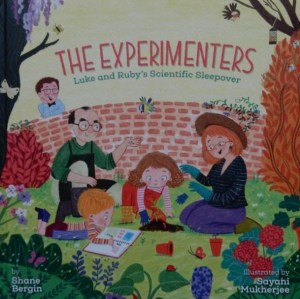
The Experimenters: Luke and Ruby’s Scientific Sleepover

It’s the half-term holiday and Luke and Ruby are excited to be spending the week at their grandparents’ home, which is full of amazing treasures. Both grandparents had been scientists: Grandad studied animals and Nanny studied outer space, “We did all sorts of experiments along the way,” Grandad tells the siblings. Nanny explains the basics of scientific experiments and immediately the siblings are eager to start . There follow eight chapters that present different science topics the children do, the first being observations of birds in the garden.

Next they explore floating and sinking with a variety of objects when they are asked to predict first and then test, and a question from Ruby prompts Grandad to bring up density and how it makes something float or sink.

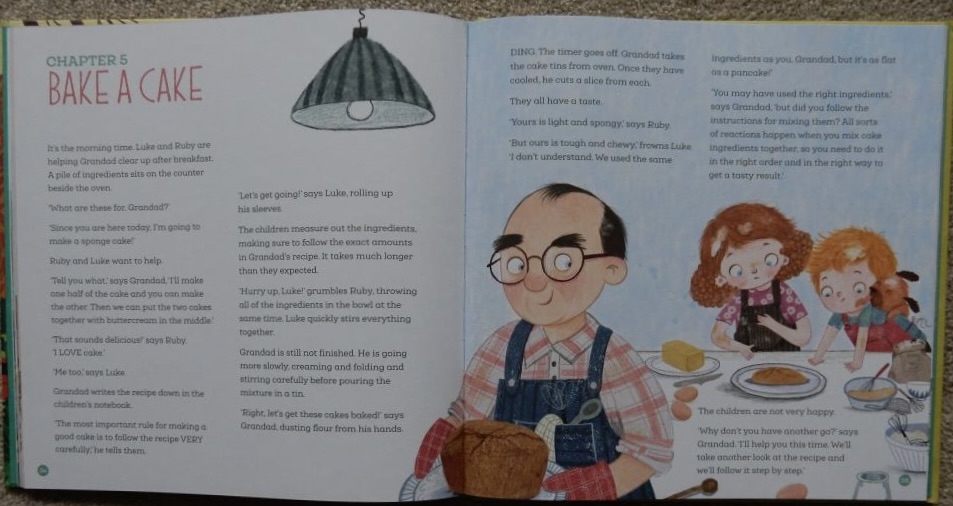
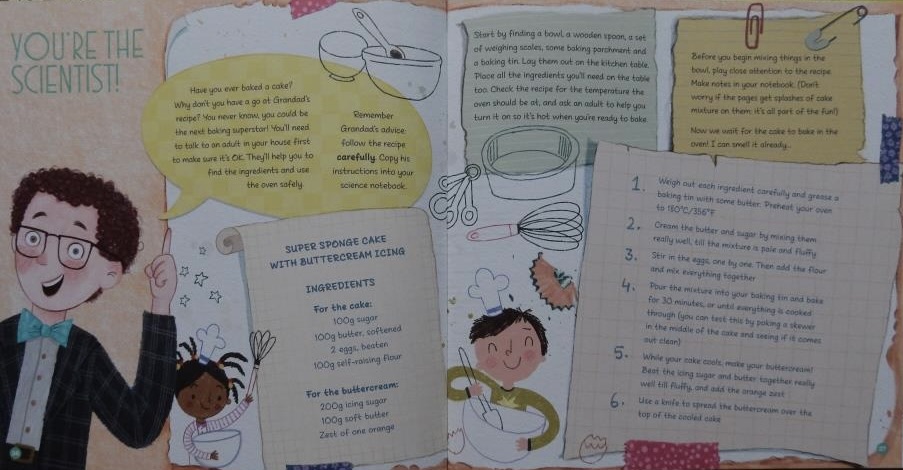
Thereafter they look at ways of making music; make telephones from two paper cups and some string, make and bake a sponge cake;

test reaction times; closely observe minibeasts and finally, plant some seeds in pots to take home so that they can watch them grow.

Throughout it’s evident that the children are thoroughly enjoying themselves; the grandparents in turn offer encouragement and sometimes make a suggestion but they never force, rather they allow the siblings to work things out for themselves.

Inserted into each experiment are pages called “You’re the Scientist’ wherein Dr Shane Bergin asks readers to do some scientific thinking too.

This is a fun, playful way of encouraging young children to be science learners and Sayani Mukherjee’s illustrations certainly show the characters enjoying their investigations.

One to add to both home and KS1 class collections.

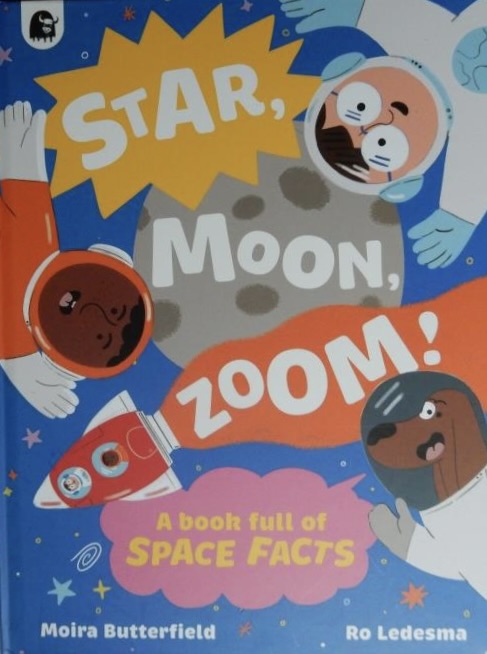
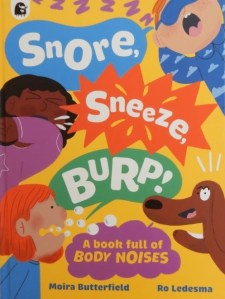
Snore, Sneeze, Burp!

Body emanations, be they sounds or smells often feature in books; this one focuses on the former. In the company of some children and Charlie, a ‘brainy’ dog, readers will discover why we humans (and other animals) are sometimes noisy by accident.

In addition to the titular burps, snores and sneezes, several other sounds are discussed. I had to laugh when I read that the scientific term for the gurgling noises caused by muscles moving food and liquid through the stomach and intestines is borborygmi.

As well as those snorty snores lots of people make when they’re asleep, sometimes a person might talk in their sleep. Children, we read, sleep talk more often than adults.
Hiccups are particularly annoying especially when they seem to start for no apparent reason and none of the cures suggested work for me. Apparently hundreds of years ago elves were blamed for hiccups in England.

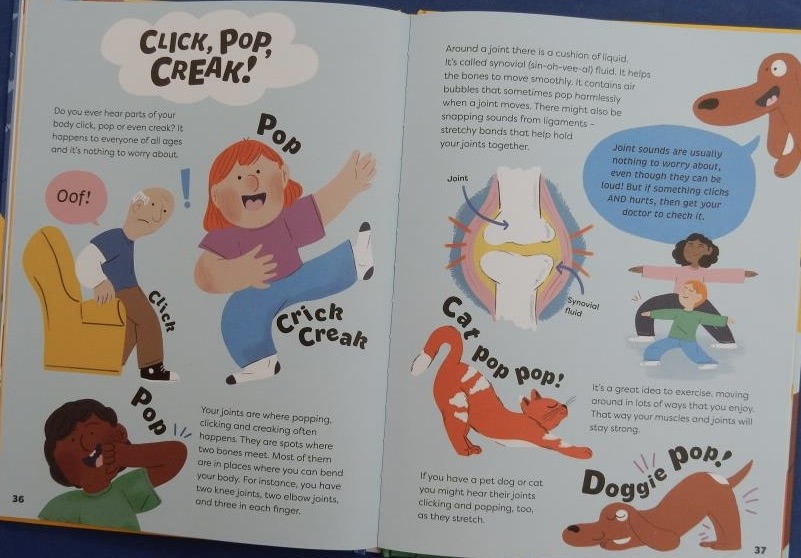
Other spreads explore those clicks, creaks and pops that various joints in our bodies might make;

sounds a doctor may explore with a stethoscope; deliberate noises we make to convey a message such as clapping to show appreciation; ‘shushing’ to indicate to ‘be quiet’ and finally comes what is deemed the best sound of all – laughing. The book ends with some suggestions about how to be a ‘body noise hero’.

Moira Butterfield has a special skill: when writing for primary age children, especially those in KS1, she includes lots of facts but the style she adopts makes it seem as though she is talking directly to readers. There’s often a gentle humour that engages children from the outset and Ro Ledesma captures that gentle humour in her bright, colourful illustrations.

The Week Junior Guide to the Environment

Environmental issues seem to be at the forefront of everyone’s agenda with global warming being the burning concern and conflicting views being held by the world’s politicians and scientists. With the prospect of the voting age for children in England being lowered to sixteen, the publication of this book aimed at KS2 readers by Dr Sai Pathmanathan, a science education consultant is a timely one. Herein children are told at the outset not to panic, rather they should look for ways that they as individuals can take action.

First though they need to know something of the science behind climate change, which is the subject of the first chapter. Nine further chapters follow covering the weather and natural disasters, pollution, biodiversity, the interconnectedness of the health of all living things, food and farming, leisure and entertainment, fast fashion, travel and finally money and power.

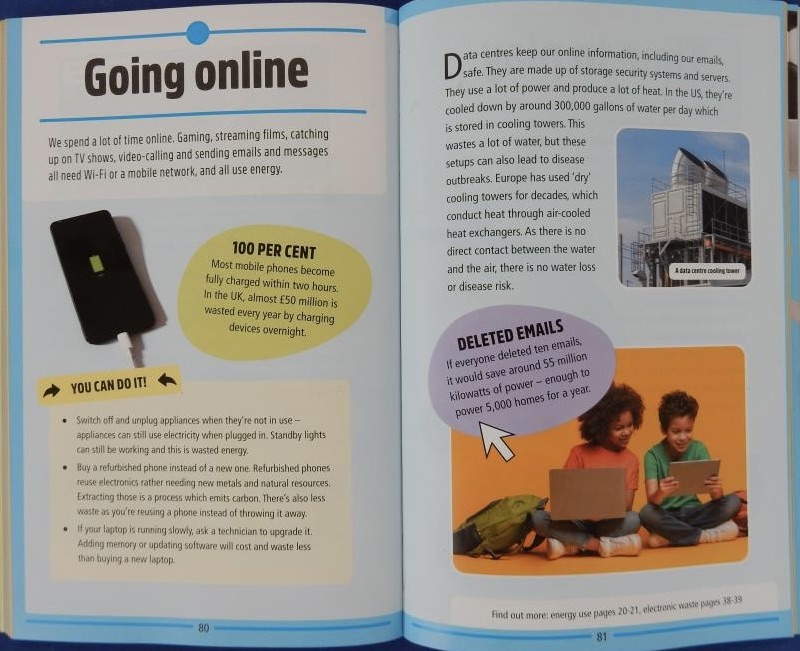
Yes, there is a fair amount of cutting edge science information, but what I like most are the practical suggestions that anybody can adopt. For instance we’re told that the majority of mobiles become fully charged within two hours so if you’re guilty, stop leaving yours to charge overnight: in the UK alone nearly £50 million is wasted each year by overnight charging.

How many emails have you got stored on your mobile that you’ll never read again? If we all deleted just ten emails that would save 55 million kilowatts of power – sufficient to power five thousand homes for a year.

Then what about fast fashion? It’s appalling to discover that three out of five fast fashion items end in landfill within just a year: try charity shops instead is the suggestion. In addition, buy clothes made from sustainable materials that you’ll get a lot of wear out of; buy from shops rather than ordering lots on line, keeping just one item and sending the rest back; and definitely avoid anything with glitter.

Greta Thunberg isn’t the only young activist you’ll meet herein. Among others is Marinel Samoa Ubaido who lived through Typhoon Haiyan, a campaigner for bans on single-use plastics and the reduction of carbon emissions; she has successfully taken the biggest polluters in the Philippines to court.

A smashing little book that should be on every family bookshelf and in every class collection: think of the difference a whole class or school taking action could make.

Score Like A Striker

Have you ever imagined yourself scoring the vital goal in the soccer World Cup final, if the answer’s yes, this first title in the author’s Football Skills series is likely to be the ideal book for you; it’s written by Ben Lyttleton, a former soccer scout, now broadcaster, football club co-owner and penalty coach.

The author showcases and analyses the techniques used by brilliant goal-scorers such as Lionel Messi, Harry Kane and Chloe Kelly (she who scored the winning penalty against Spain in a thrilling penalty shootout which secured England the UEFA Women’s Championship a few days back); showing readers what is necessary to become a shining star on the pitch. First you need to love the game for its own sake, but in addition to skill, a great deal of practice, dogged determination and resilience are necessary; so too is a willingness to learn from your own mistakes.

The chapters are kept short, the facts are punchy, there’s humour in the writing and the illustrations are detailed, so whether readers want to sharpen their footie skills or just read yet more about their favourite sport, then they should get hold of a copy.

Up Close and Incredible: Dinosaurs

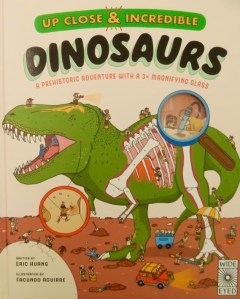
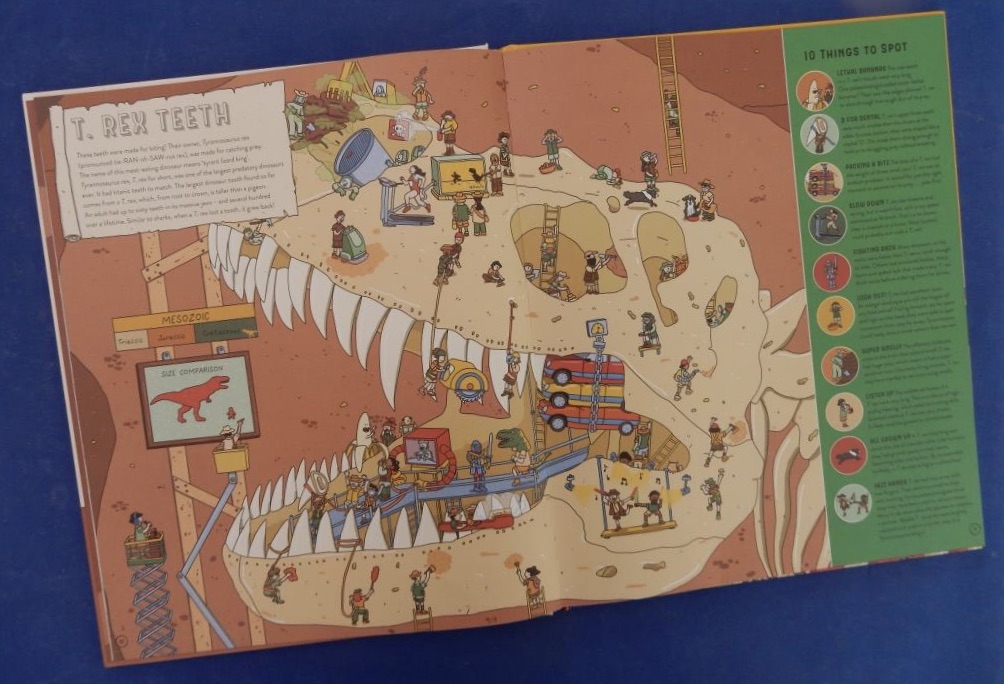
Dinosaur fans will delight in joining a team of tiny, diverse palaeontologists in this interactive investigation. First though you’ll need to release the 3x magnifying glass from the cover and grab whatever tools you think necessary – dental probes and rock hammers for instance – and you’re ready to explore an array of dinosaurs both living and fossilised. You’ll look inside and out: Huang lists the details of ten significant anatomical features to spot on each spread starting with a T.Rex’s head and jawbone. Therein you’ll find what the author calls the ‘lethal bananas’ (very long side teeth) in its mouth; just right to slice through the tough skin of its prey.

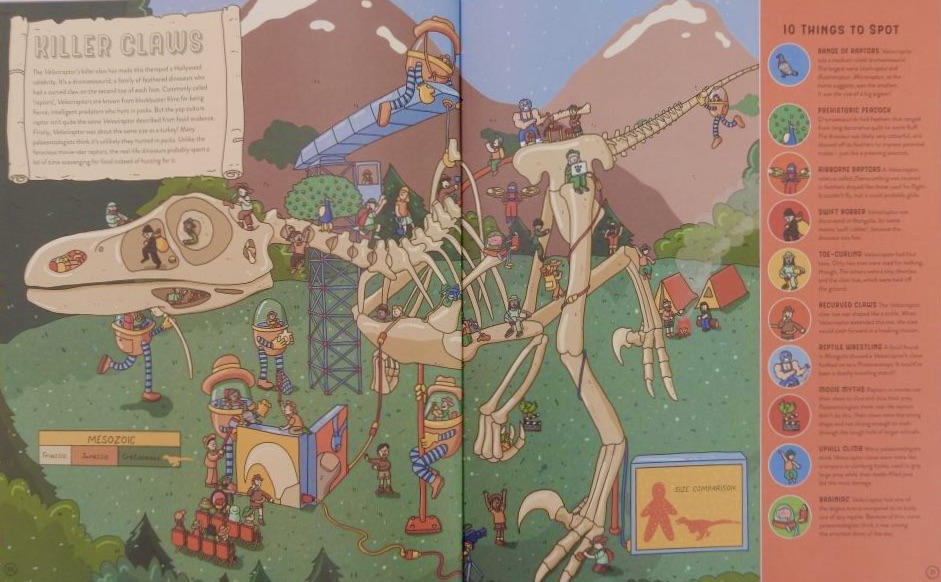
If feet are more your interest then head to the spreads with claws in the title. Thereon you’ll encounter both the claw bones – unguals to be more scientific – of Therizinosaurus; these were the longest of any animal ever. Then there are the ‘killer claws’ of Velociraptors (the second toe on each foot and they’re curved like a sickle). Look out for the other kinds of toes a velociraptor had too.

Well known dinos are of course featured, as is Archaeopteryx with its bird-like features, but unless you’re an expert you may well come across a new name. I’d never heard of Parasaurolophus, (one of the duck-billed dinosaurs) before reading this book

A scientific search-and-find adventure bursting with facts and visual jokes, gently humorous but also included are timelines, a size comparison spread and a glossary.

Aguirre’s zany illustrations are full of hilarious details that readers will want to return to over and over again

The Lost Book of Undersea Adventure

This begins with the author inspired by his grandmother’s stories, embarking on a quest to find the legendary sea nomads of the Coral Triangle. Five days later something terrifying happens. Having stumbled upon their dangerous cargo it’s the intention of three smugglers to silence him by killing him. He’s tossed from the ferry and struggles to stay afloat until eventually he reaches land – a deserted island. Utterly alone and initially exceedingly frightened, but having found his journal and pencils, he decides to start the journal he’d promised his siblings he’d write. He also puts his survival skills to the test and after a couple of days, he’s made a camp, a hammock, fishing spear and found a way to make fire.
A couple of weeks later he sees that the island is split into two and that something leaps from the water in the middle of the lagoon – a ray perhaps. Not long after he notices a moving light reflected on the water: it’s time to investigate. The following day having finished building a raft it’s time to go. But the waters are extremely dangerous and the next thing he knows is that he’s in a stilt house. Woken by voices and three pairs of staring eyes, they’re not smugglers but children, the adventurer realises.

Prepare to be transported to distant seas and a coral reef with incredible marine life,

discover ancient legends of sea spirits, face unimaginable perils and meet with some amazing people in this exhilarating story of survival and friendship.

Utterly engrossing, the book is presented in the form of an artist’s journal/log with diagrams, close-ups of marine creatures and more.

Live Like A Tudor

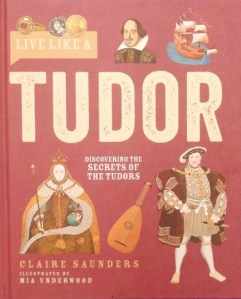
Primary age readers with an interest in history can step back in time, at the invitation of eleven year old Mary who lives with her family in an English manor house and has a sister who is a maid of honour to Queen Elizabeth 1st.

The latest in the ‘Live Like A … ‘ series covers a wealth of topics including the jobs people did, family life and childhood, education (the poorest children were not even taught at home but had to work instead), religion, trade and exploration when the seeds of the transatlantic slave trade were sewn.

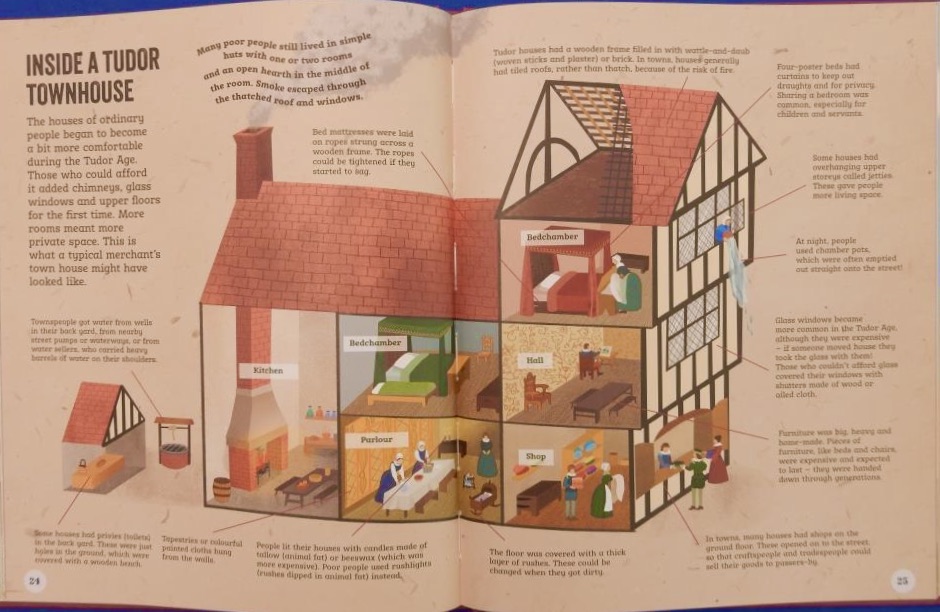
There are spreads on a typical Tudor village, a look at a townhouse both inside and out,

health and medicine, crime and punishment, games, sports and entertainment and fashion as worn by workers and nobles. In Elizabethan England, those who were able to a afford it wore a ruff and so doing was a sign that you were sewn sufficiently wealthy not to have to undertake any hard physical tasks and had servants to look after your ruffs, some of which were very elaborate. One of the craft activities in the book gives step by step instructions to make a ruff and matching cuffs.

Did you know that England’s first theatre was built in 1576 in London and was soon followed by others including the Globe Theatre where William Shakespeare’s play were performed?

Tudor Christmases were celebrated across twelve days and readers can join young Mary and her family and discover what they might have done.

The final spread asks “Could you have lived like a Tudor? and the author poses several questions to discuss. There’s also a glossary.

An engaging book that helps bring the era to life; it’s worth adding to to KS2 class collections, and to home bookshelves if you have a child interested in the past.

Shoot For the Stars

Both empowering and full of information, this is written by double Paralympic gold medallist and five times world champion in archery, Danielle Brown MBE. She hopes to encourage girls from around twelve years old on to keep participating in sport instead of dropping out of physical activities, which often coincides with the onset of puberty when among other things, girls start menstruating and they sometimes see this as a barrier to sporting activity.

This and other perceived barriers are discussed in a matter of fact manner, be it feelings of discomfort in school PE kit, ideas of body image or worries about controlling one’s temper when one’s performance is adversely affected by hormones. It’s particularly good to see the spread featuring Chinese swimmer, Fu Yuanhui, who openly discussed the impact of starting her period on her performance at the 2016 Rio Olympics.

The dress code of bikini bottoms for women’s beach volleyball was not altered until 2021 when he Norwegian team took action by wearing shorts instead. They were fined for so doing but public outrage precipitated the change. It was not until 2023 that the all whites rules for underwear for women players at the Wimbledon Tennis Championships was changed.

A stand was also taken by Kulsoom Abdullah, a weightlifter. She was invited to compete in the national championships, but against her religious beliefs, wasn’t allowed to cover her limbs or to wear a hijab, so she didn’t participate. However she did take her story to the media with them behind her to the International Weightlifting Federation. The outcome was that the rule was changed and so Kulsoom represented Pakistan that year at the World Championships.

Accepting feedback and applying what you’ve been told is vital for making progress and improving in any sport, and indeed other aspects of life and a chapter is devoted that topic: all those who brief biographies are included must certainly have done that.

I was listening to a discussion on the radio this morning about the increased number of people who are over weight and how this can lead to ill-health. Food was the subject under discussion but I couldn’t help thinking that being physically active is equally important and Danielle’s book encourages readers to do just that whether or not they end up going further and becoming sporting competitors.

Illustrations by Jayde Perkin and Filigrana de Ideas and colour photos of renowned women sports stars add to the enjoyment of the book.

A Natural History of Bums

If you’ve been to Margate (Kent) in the last three or four years then you’re probably aware of its most unusual and popular tourist attraction, the award winning Crab Museum.. As well as giving visitors an insight into the lives of crabs, it also examines vital topics such as climate change and evolutionary history and it does all these things with humour. This same humour is present in this book written by one of the museum’s co-directors, Bertie Williams aided and abetted by illustrator Inga Ziemele and two crab narrators that act as guides for readers, taking us from the ancient patooties of around 800 million years ago to the mud chutes of modern times.

Having cleared up the matter of the role bums play, the author moves to the tricky question ‘But what is a bum?’ and thereafter that vital word evolution crops up and we leap into the bum Time Vortex at the invitation of the crab duo and are taken on a fascinating journey from bumbles’ prehistory through the many billions of years of life on Earth, following the changing shapes and functions of patooties. Said patooties are, we read, ‘pretty recent inventions and as the narrators retrace the 560ish million year story through to the present ‘Age of the Anus’ heaps of fascinating snippets emerge.

One some readers may be familiar with is that a wombat uses the plates of bone in its bum to protect itself from predators and a wombat’s poos emerge from said bum in cubes, and – wait for it – ‘in relation to body size, humans have the ‘biggest bums on Earth. Moreover, ‘if a blue whale was shrunk down to the size of a human, the human would win in a big booty bum-off.” Plus, human bums allow us to walk on two legs, thanks to the muscles found in our bum cheeks.

As you’ve probably gathered, animals have a vast variety of bottoms but possibly none so interesting as the human one; it makes the glowing bum of a fungus gnat pale into insignificance.

This is bound to be a winner.

Food For All

We all – humans and creatures large and small – need food of some sort in order to live. Some, including lots of humans eat other animals, some eat plants and some eat fish and other sea creatures. Interestingly, as the extraterrestrial creature that comments on various pages informs us, the largest creature on planet earth – the blue whale – eats krill, one of the tiniest. It’s not the only being that makes thought-provoking comments from time time time; so too do various animals and humans of different ages.

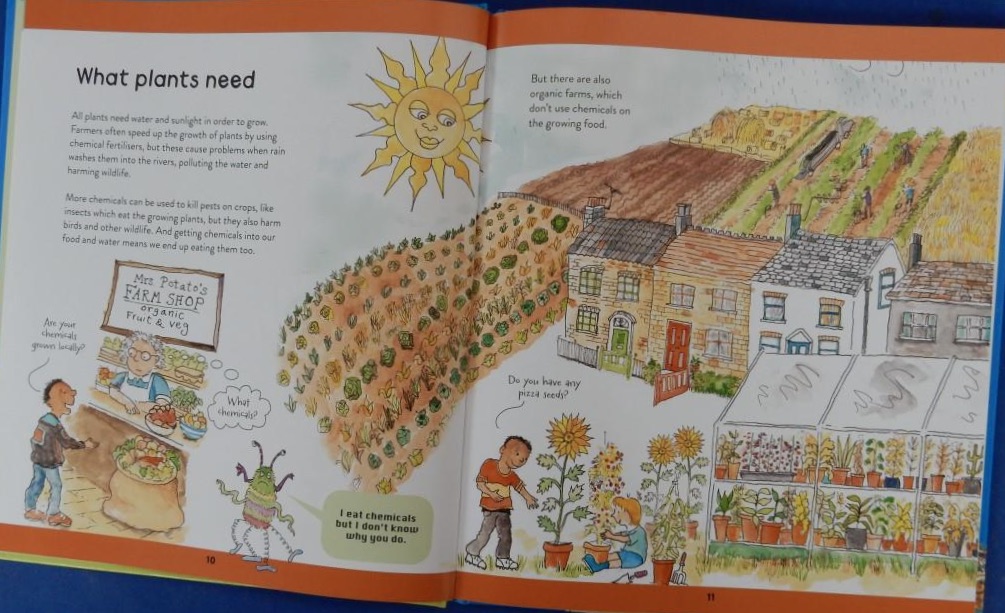
Almost twenty aspects of food and feeding are explored starting with growing food for both human consumption and for animals. This is followed by a look at what plants require to grow and the topic of chemicals is mentioned – their uses and the harm they cause.

There’s a spread about harvest and a look at associated festivals in various parts of India.
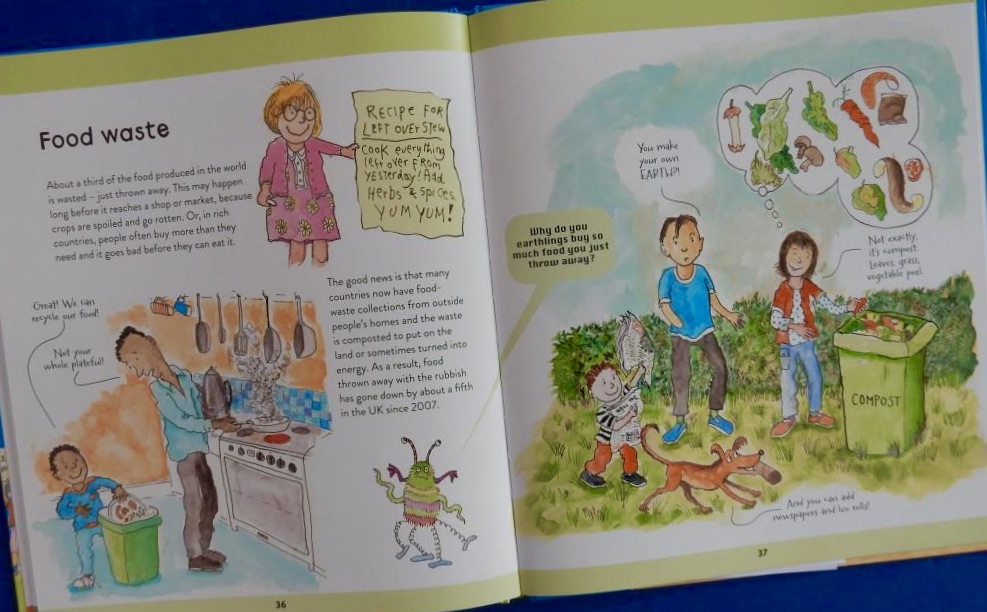
For me the most distressing fact is that despite there being more than enough food in the world for everyone, starvation still abounds and even in rich countries like the USA and Great Britain, there are many people who need to regularly rely on food banks. Equally shocking is that there is an awful lot of food wastage.

But, as we read, there are things that all of us can do.

Mary Hoffman’s engaging style makes a wealth of information easily digestible for primary age readers and Ros Asquith’s droll illustrations help keep the tone of the whole book light and inviting. A thought-provoking book that offers a wealth of discussion topics.

I’m Building A Nest

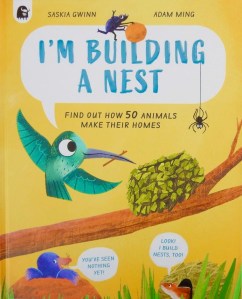
Author Saskia Gwinn entrusts Bird to act as our guide in this journey to discover how other creatures build their homes.. We meet more than fifty large and small : can any of them surprise Bird and show that their home is best?

First Bird visits other nest builders including a stork that reuses its stick nest year after year, a trumpeter swan that builds a nest on a beaver’s floating lodge and a red-headed woodpecker that pecks a hole in a tree trunk.

Next to be investigated are spiders. these eight-legged arachnids make webs for a variety of purposes. The garden web spider’s web is an insect trap; the golden diving bell spider weaves a web under water to trap air then uses it as a submarine and the crab spider makes a balloon of silken threads that float on the wind, enabling it to find a new home. Is Bird impressed by these? Well yes, but not persuaded.

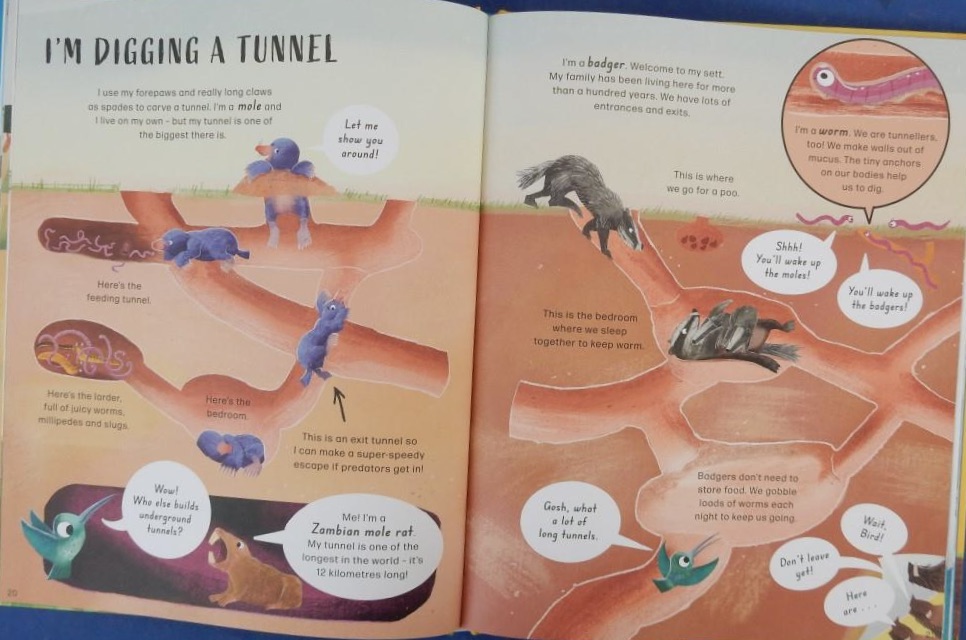
Do you know which animal’s home has a feeding tunnel, a larder and a bedroom as well as a super-speedy escape tunnel? It’s a mole, one of the tunnellers we meet.


These are just some of the places of residence Bird discovers, but at the end of a long learning journey, there’s been a change of heart in our feathered escort. It concludes, ’Every home is best for the clever creature that made it.’

Curious young readers will enjoy discovering the wealth of animal homes on our planet and be amused by the speech bubbles and Adam Ming’s playful illustrations.

Messi Mania

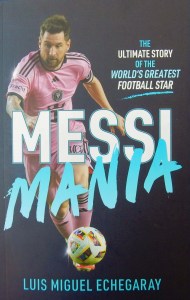
Lionel Messi is a soccer superstar, of that there is no doubt. I was astonished to hear that one of my young relations had spend £12 of his pocket money to buy a single card about him. He certainly is infected with Messi Mania.

In this book sports presenter/journalist, Luis Miguel Echegaray, pays tribute to the player many consider the greatest of all time. Rather than presenting a chronological account he weaves into a kind of patchwork tale, significant elements of Massi’s life.

Starting with his arrival in the USA, he then goes back in time to his birth and early life in Rosario, Argentina, and forward to October 2024 when he was playing for Inter Miami and the team were knocked out in the first round of the MLS playoffs. In relation to this Echegaray writes this ‘And here’s the biggest message of all that we have learned from Messi’s entire journey. When you fall, that’s when you’re at your strongest because you have the chance to get up and try again. And that’s the true meaning of character.’ A powerful message to everyone, no matter what their walk of life. Moreover it’s not merely Messi’s hard work and soccer prowess that make him so special; it’s also his friendships and what he’s done and continues to do for others, all of which are included herein.

We hear what other soccer stars think of him, his style of play, there’s an interview between the author and Messi and more.

A legend indeed who, thanks in no small way to his devoted grandmother and father, overcame challenges in his boyhood including a growth hormone deficiency.

The penultimate paragraph in the book contains vital messages for all young people and he ends thus: ‘Little Leo is actually in all of us, just waiting for the glorious moment to shine,’

Will We See A Mermaid?

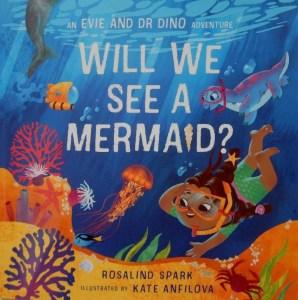
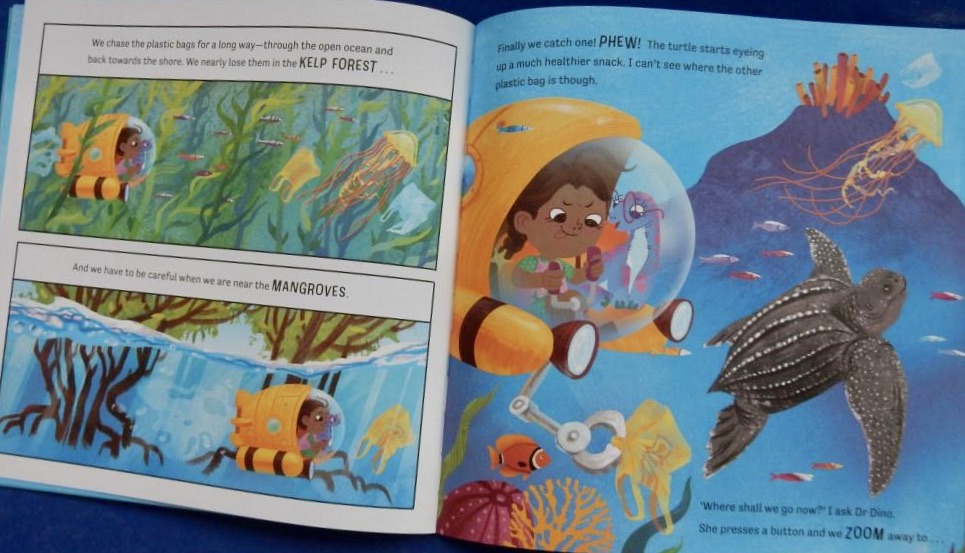
Little Evie is at the beach with her parents and best friend, Dr Dino. Last on her list of things to do that day is to find a mermaid. Dad thinks she has a great imagination whereas Mum tells her she’ll need to look very carefully. So begins Evie’s ocean adventure with Dr Dino. They pack the necessary gear, then before diving deep, the two go and check the rock pools. They’re certainly full of interesting marine creatures but no mermaids.

The two build an Ocean Explorer Submarine, launch their craft into the waves and head out to sea. Dr Dino talks about the dolphins they see; then deep underwater they dive and Dr Dino informs Evie and readers about the behaviour of the anchovies and whales they spy. Unfortunately among the marine fauna are some plastic bags and the explorers are determined to prevent a turtle from eating them in mistake for jellyfish. Their bag chase sees them visiting a kelp forest

and a coral reef and diving way way down into the darkest depths until … at last, it’s mission accomplished. But have they seen any mermaids:? Maybe. …

Back on the beach, Mum and Dad help the adventurers collect rubbish left by thoughtless people and Evie offers her definition of mermaids.

This book is full of interesting information, including a gate-fold spread about marine life that will fascinate KS1 children. However, it would also work well as a straightforward story for preschoolers if the reader aloud shares only the main narrative.

Don’t Squish A Slug

Following his general introduction, author, zoologist and wildlife presenter, Yussef Rafik, divides his bug information under five headings, Masters of Disguise, Amazing Evolution, Daring Defence, Record Breakers and All Sorts of Relationships (some of which are parasitic). The world of minibeasts is truly amazing, albeit on occasion pretty gruesome, so get ready to dive in.

Have you ever wondered why the owl butterfly is so called; indeed were you aware there was such creature? It has earned itself the title ‘Master of Mimicry’ on account of the way the detailed fake eyes on the underwings look so like an owl’s eyes they act as a superb deterrent for potential predators.

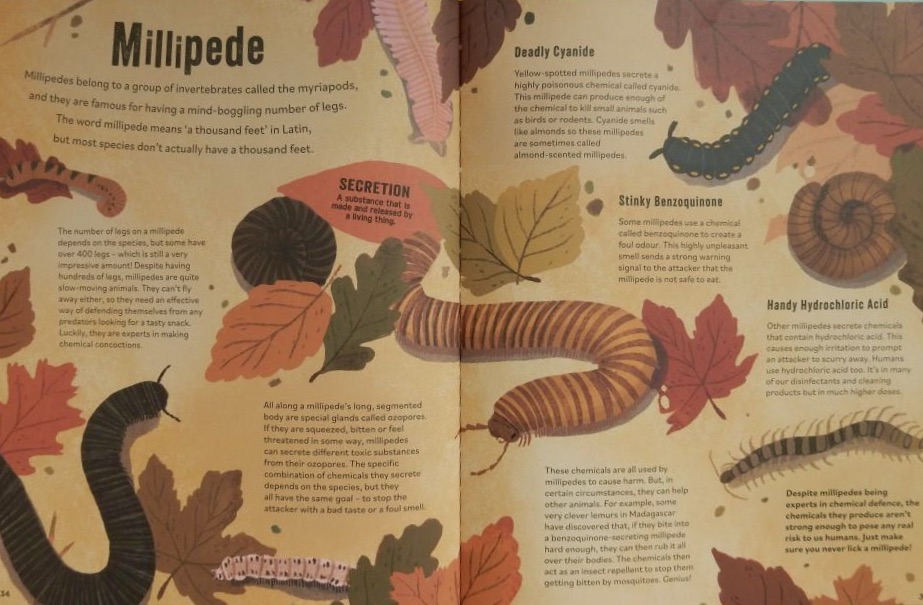
I was fascinated to learn that millipedes have special glands called ozogpores from which they secrete poisonous substances. The yellow-spotted kind secrete the highly toxic chemical cyanide in sufficient quantity to kill rodents or birds. Other kinds use the malodorous benzoquinone, which warns attackers not to eat them. Under certain circumstances though, these chemicals can be of help to other animals, an example being the lemurs in Madagascar. They’ve found out that if they bite a benzoquinone-secreting millipede sufficiently hard, then rub it over their bodies, the chemical acts as a mosquito repellent.

Every bug is either allocated a double spread or single page that includes a superbly detailed illustration the creature in its natural habitat along with the information that is just the right amount for KS2 readers. The author’s knowledge and enthusiasm shine through his text, indeed in his introduction he writes, ’It’s really important that we have empathy for bugs. We should appreciate what they do for our planet and learn to love living alongside them.’

Riley Samels’ illustrations are an ideal complement for the text, detailed but not overly so, and there’s a final glossary and index. Thoroughly recommended for school collections and for budding minibeast zoologists.
Off they Go!

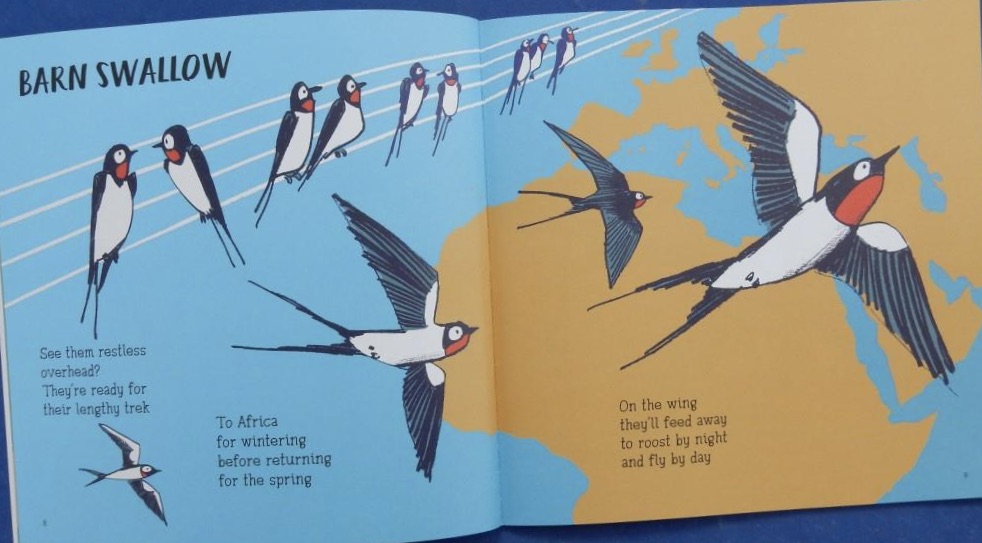
Poet / writer James Carter and illustrator James Munro have again joined forces on a natural history book, this time on the topic of animal migrations.

Through the former’s rhyming narrative and the latter’s bold, bright illustrations readers are introduced to nine migrating species. First though, there is an introduction to the concept that all creatures may undertake migration.

Whether they travel over land, through water or the sky, the selected animals undertake long, often difficult journeys. From Barn Swallows

to Monarch Butterflies, salmon to humpback whales or Christmas Island Red Crabs to humans, we learn more about the different animals and the reasons for their migrating.

Did you know that the globe skimmer dragonfly can journey up to 6,000 kilometres, travelling from India to Africa, island hopping en route to lay eggs and their offspring making the return journey? Some feat.

Included in the final narrative section, is information about animal navigations and unusual migrations making this an ideal introduction to the whole topic.

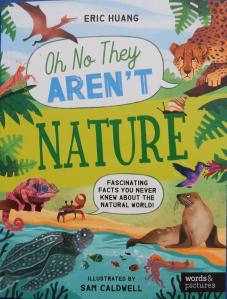
Oh No They Aren’t: Nature

Playful in approach it may be, but there’s a wealth of information about the natural world to be found in this book.

Following his introduction the author adopts his tongue-in-cheek question and answer style replete with pantomime-like ‘Oh no they aren’t!,’ ‘Oh no they weren’t!’ ‘Oh no they don’t’ interjections, in the book’s six thematic sections. These are in order, Prehistoric Life, Green Planet, Under the Sea, Creepy-Crawlies, Predator and Prey and High Fliers.

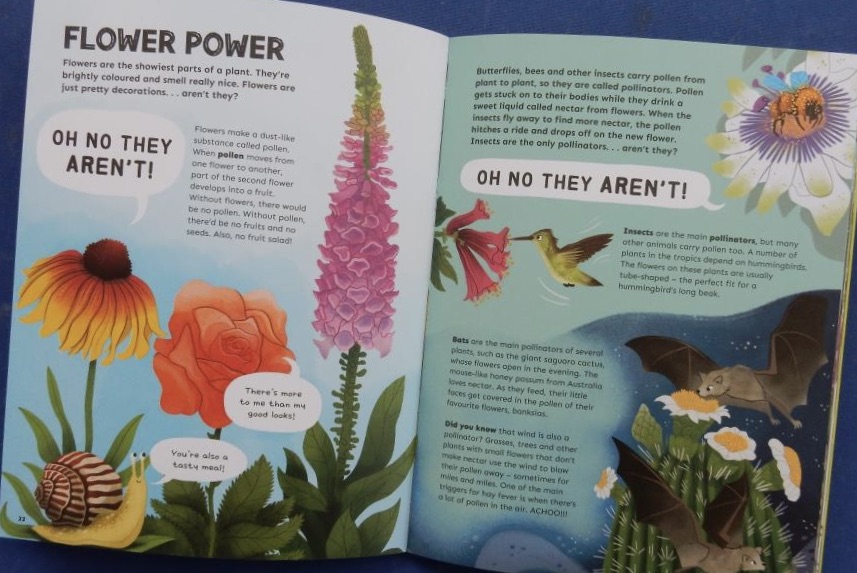
In Green Planet we read, ‘Flowers are just pretty decorations … aren’t they?’ followed by the rejoinder ‘OH NO THEY AREN’T!’ and an explanation of pollination and its importance.

Then in Predator and Prey we meet several sharks – all of which are fearsome predators aren’t they? Actually no: the whale shark – the largest shark in the world – is a gentle giant. Moreover, if you thought all sharks are very big, that’s wrong too: dwarf lantern sharks are only about the size of a mobile phone. Now that I didn’t know.

Sam Caldwell’s humorous illustrations match the jaunty style of the writing and the book concludes with a useful illustrated geological timeline and a glossary.
A thoroughly engaging addition to the Oh No’ series that will be lapped up by those with a preference for reading factual books rather than fiction.

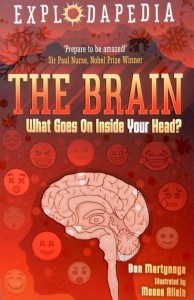
Explodapedia: The Brain

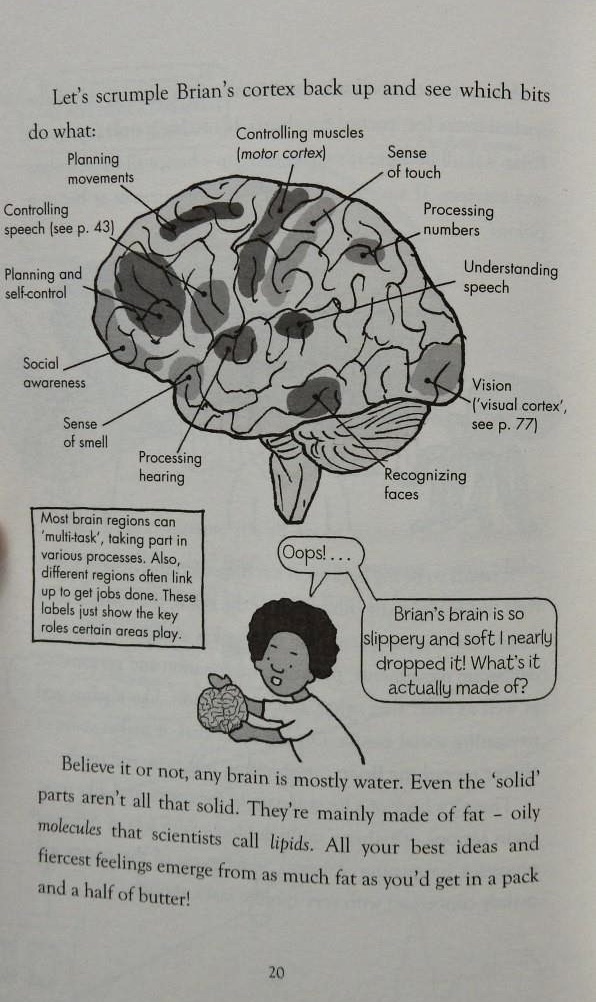
This is the fifth in the excellent Explodapedia series by neuroscientist and writer, Ben Martynoga and illustrator/cartoonist, Moose Allain. These two are aided by a talking octopus – a creature with nine brains and a rather high opinion of itself – and a human boy, Brian who allows his brain to be removed temporarily and used as an exemplar. Brian’s brain is unique but in common with other people’s is made mostly of water and has 180 billion microscopic brain cells. In order to show how a human brain works, readers are then shown inside Brian’s where there are neurons – the information carriers – and glia which work with the neurons, thus keeping the brain going. A fully-grown brain contains around 86 billion neurons and about the same number of glia, linked it’s estimated, by 600 trillion synapses.

The next chapter introduces some of the scientists who came up with ground-breaking ideas about brain functioning starting way back with doctor and scientist, Hippocrates who lived in ancient Greece around 400 BCE. We also learn of contributions made by Galen, (Rome 170 CE), Vesalius (1540 CE), Descartes (Paris 1640 CE) famous among other things for his ‘Cogito ergo sum’ – I think, therefore I am. Moving nearer to the present time comes the mind-reading done by Dr Thomas Oxley and team who inserted a brain-computer interface (BCI) close to the motor cortex of the cerebral cortex that controls movement. This enabled a patient with motor neuron disease to operate his computer by mind control instead of his hands, which he was unable to move. How amazing is that.

Rather than discussing the remaining seven chapters I’ll just say they explore in order, What brains are for, illusion or reality wherein is an outline of an experiment that had participants plunging their hands into painfully cold iced water with some being told to swear aloud when their hands started hurting and the rest told to stay quiet. Apparently the former felt less pain because swearing can trigger the production of natural ‘painkiller’ chemicals within the brain – fascinating. Then come how brains change from infancy to old age, all the different ‘yous’ inside your head, the conundrum of consciousness and how it affects decision making. The penultimate chapter looks at differences in people’s brains and includes developmental conditions – neurodivergence, depression, anxiety disorders and addiction. The brains of other animals is the topic of the last chapter and the book concludes with a look to what 2075 might have to offer; there’s also a very useful glossary.

Once again Ben Martynoga demonstrates his brilliance at taking key concepts and making them accessible, fascinating and entertaining. Matching the author’s quirky, witty style are Moose Allain’s illustrations, making this book even more readable with a wealth of speech bubbles as well as clear diagrams. Expand your mind: join them on a journey of wonder and discovery.

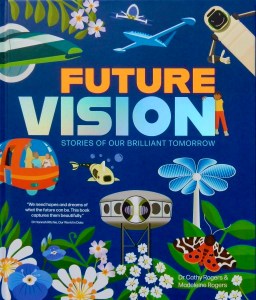
Future Vision

Herein with 12 year-old Kit and friends as guides, children are transported to the year 2070, to a world that has been transformed by sustainability, technology and global collaboration. A world wherein as the author says in her introduction, it’s hoped that ‘most countries have come together to solve some of the most pressing problems.’ A world with less poverty, better health, a greener and cleaner world with more kindness and happiness. Who wouldn’t wish that could be so?

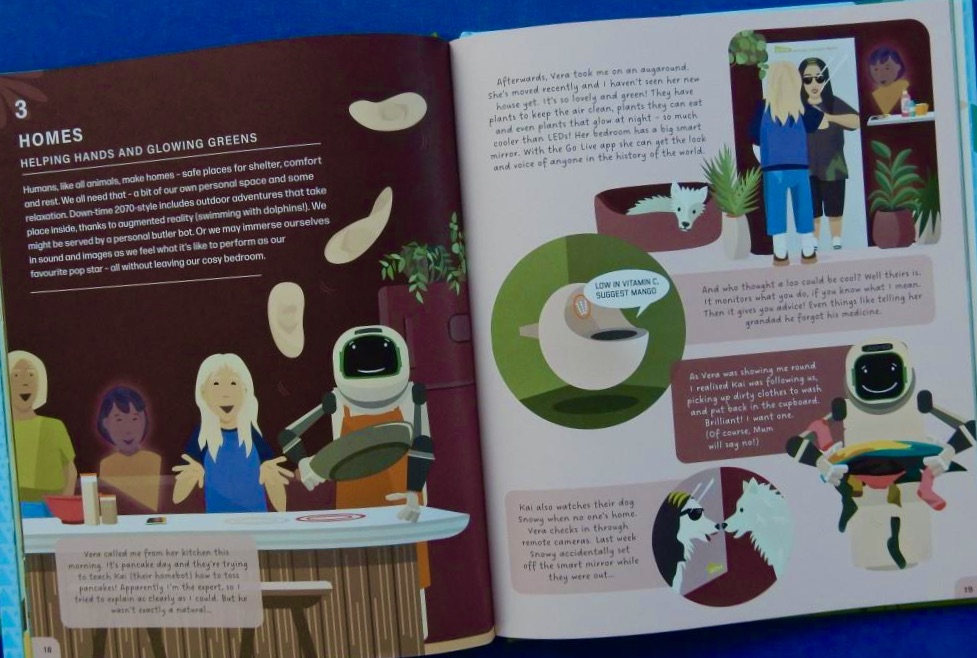
Factors that contributed to the changes include no petrol and diesel cars, affordable public transport everywhere powered by the extremely cheap electricity and otherwise almost traffic-free cities. There’s been a great deal of re-wilding, meaning that people are able to enjoy the beauties of a thriving natural world.
Homes too are eco-friendly with plenty of house plants, bots to assist with, or carry out, many household chores – imagine having a homebot to collect up all your dirty clothes for washing and then once clean, return them to the appropriate cupboard.

And of course all energy used at home or elsewhere is clean, green energy.

Health and Wellbeing, is an important topic. On the journey, it’s evident that life has improved for all and people usually live long, healthy lives until one hundred or thereabouts. How this has been achieved is discussed; so too is the interconnectedness of health and happiness.

Other topics presented are oceans, food and nutrition, space and democracy. The author feels strongly that optimism about the future, not only about people’s own lives, but about the world as a whole is important and she talks of ‘realistic optimism’. Finally she invites readers to think about their own vision of the future. This is where I see that the imagination is vital, for no scientific discoveries could have been made without the power of the imagination. Who would have expected forty years ago what could be done with a hand-held mobile phone for instance, but it all began with somebody’s creative thought.

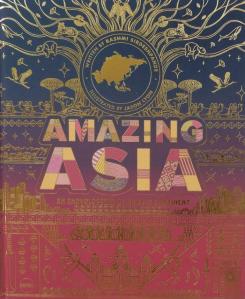
Amazing Asia

In this large format book, author Rashmi Sirdeshpande explores the world’s largest and with over 4.7 billion people, most populated continent, Asia.

With its powerful illustrations, excellent design and engaging and informative text, the book begins with an introduction to the continent, its countries, a map and a list of fascinating facts for each Asian country.
The massive continent is then split into five geographic regions: West Asia, South Asia, North and Central Asia, East Asia and Southeast Asia though within these each country has its own distinct identity.
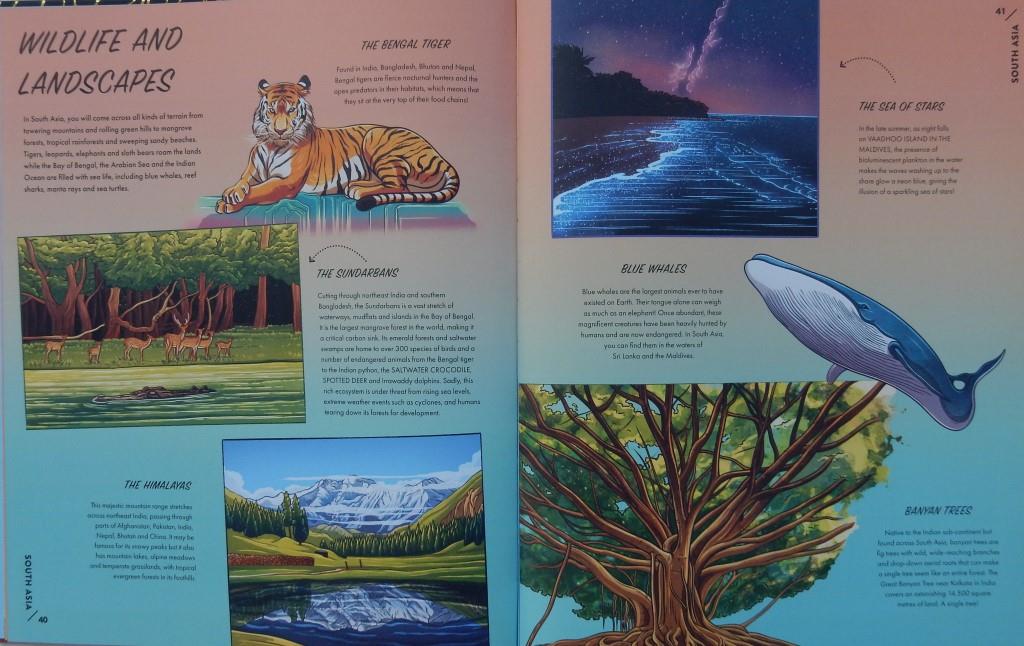
For each region there is a time line, a spotlight on some change makers , superstars and other historical tidbits, a look at people and cultures, wildlife and landscapes,

spectacular sights and at the present and future possibilities.

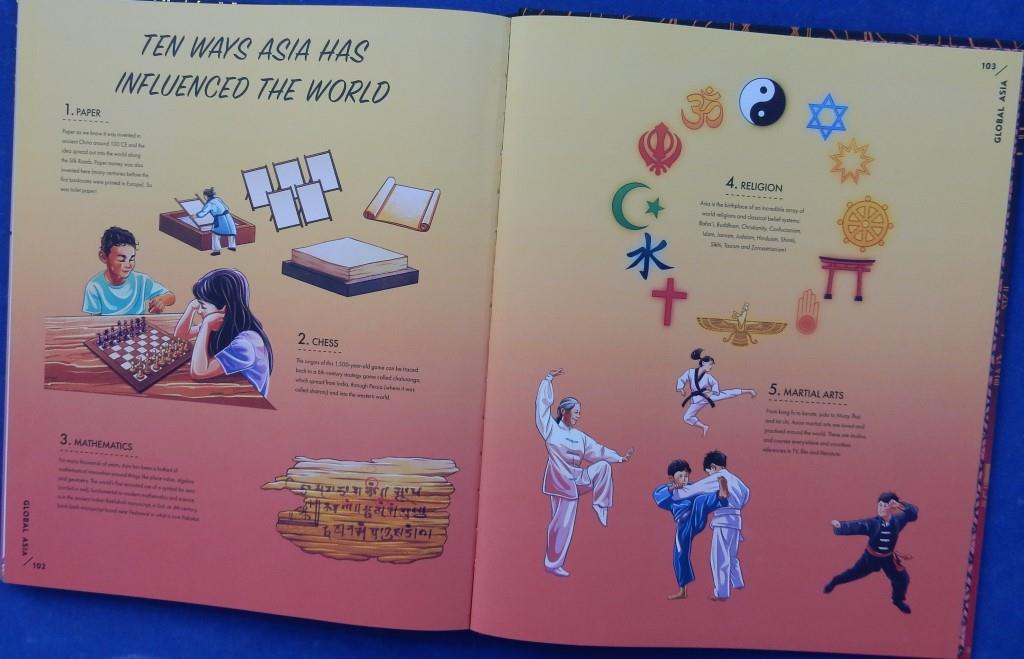
After the regions comes a section with a large map, entitled Global Asia with a focus on indentured labour, causes of migration and the contribution of Asian immigrants to their new homelands such as Australia.
Two final spreads present ways in which Asia has influenced the world

and backmatter comprises a glossary and index.

Rashmi’s writing is sure to keep young readers interested as she includes such topics as K-pop, manga and martial arts as well as mentioning colonialism, Tibet and Taiwan as disputed territories, the Israel/Palestine and Russia/Ukraine conflicts with sensitivity. She certainly presents with aplomb the rich tapestry that is Asia. Jason Lyon’s illustrations really help bring the written content to life and with its wealth of starting points for further exploration, I’d thoroughly recommend this book both for home browsing and classroom use.

100 Ways to Save the Planet

Engaging readers from the outset with his ‘superhero footprint’ suggestion, Tom Jordan provides a wealth of ways children can reduce their carbon footprint. starting with cutting out meat from their diet or if that’s too big a leap then reducing the amount eaten with fewer meat-consuming days per week and encouraging other family members to do likewise. To that end, related topics are suggested on later spreads; for instance growing your own vegetables.

I wonder how many people don’t ensure they’ve turned the taps off properly after showering or bathing, or brush their teeth with the water running: saving water isn’t hard, it just needs a bit of thought. Some of that bathwater you do use can then be used to give your ‘pet dragon’ a drink, (ie a Dracaena houseplant) – another cleverly linked suggestion.

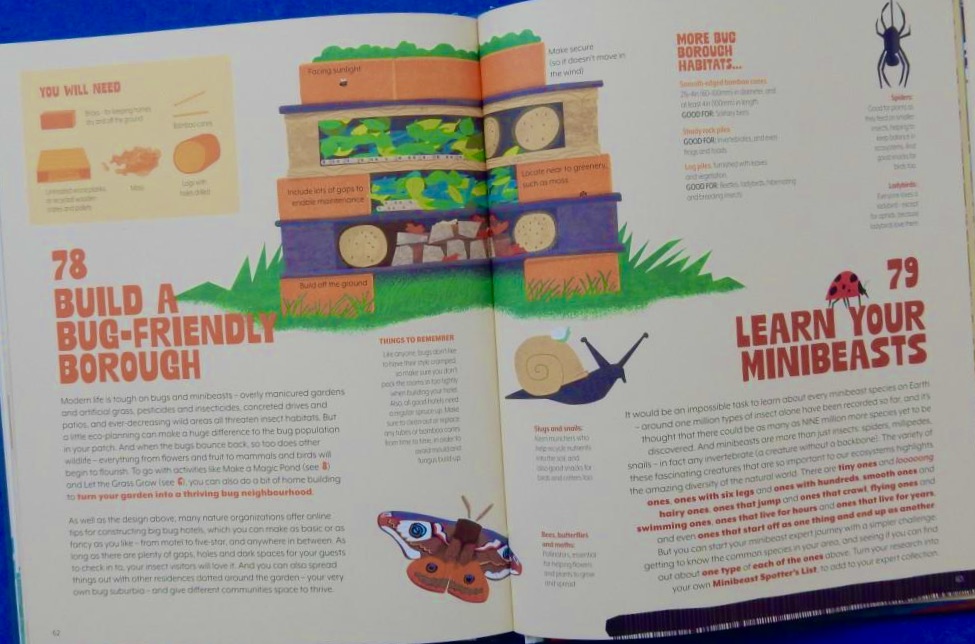
I’ve noticed many primary schools and children’s playgrounds have already constructed bug-friendly ‘hotels’ with the help of youngsters, but there’s still a way to go. Why not take the ‘Build a bug-friendly borough’ suggestion literally and with adult assistance, encourage all schools in your area to do likewise.

Reduce, repair, recycle, reuse: these are key practical words for anybody looking to tread more lightly on our planet. There are plenty of ideas to implement these actions and it matters not whether children can actually read the book for themselves. With its enticing, clear illustrations by Joshua Rice and interesting facts, this is an invaluable handbook for any family, primary or even secondary classroom: think of all the environmental superheroes it could inspire.

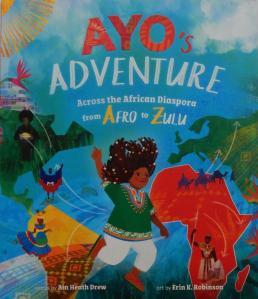
Ayo’s Adventure

Ayo is having difficulty falling asleep until he picks up an alphabet book that inspires a dreamy adventure across the African diaspora and in so doing he experiences a wealth of creativity from the diverse cultures whose heritage he shares.

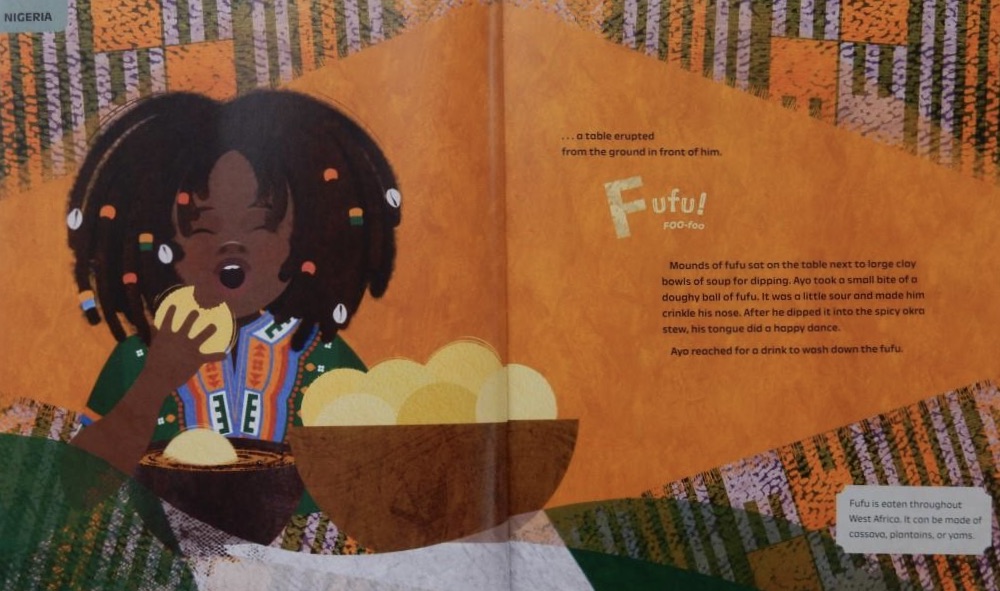
He listens to calypso music then receives a lesson on how to play and beat on a steel band drum, tucks into some Nigerian fufu made from pounded cassava, plantain and yams,

visits a store in Ghana selling kente cloths, joins some women dancing the samba in Brazil and much more. he even travels to New York’s 1980s Bronx where hip-hop developed and tries some moves.

Alphabetically arranged, A is for Afro, B for Braids, E is for Ebony and so on with each stop having a short description and locational listing. There are also spreads at the end of the book exploring connections between the nations, cultures and traditions.

Joyful, inspiring and illuminating, vibrantly illustrated, and well worth adding to primary school collections. Ayo means ‘Great Joy in Yoruba’ the boy reminds his mother excitedly on waking. Let’s hope the book brings joy to child readers.

From the same publisher for the very young, is one of a board books series:

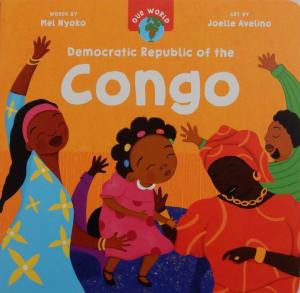
Democratic Republic of the Congo by Mel Nyoko and Joelle Avelino that introduces some key words as little ones follow a small child and family through ‘a day in the DR Congo’.

Politics

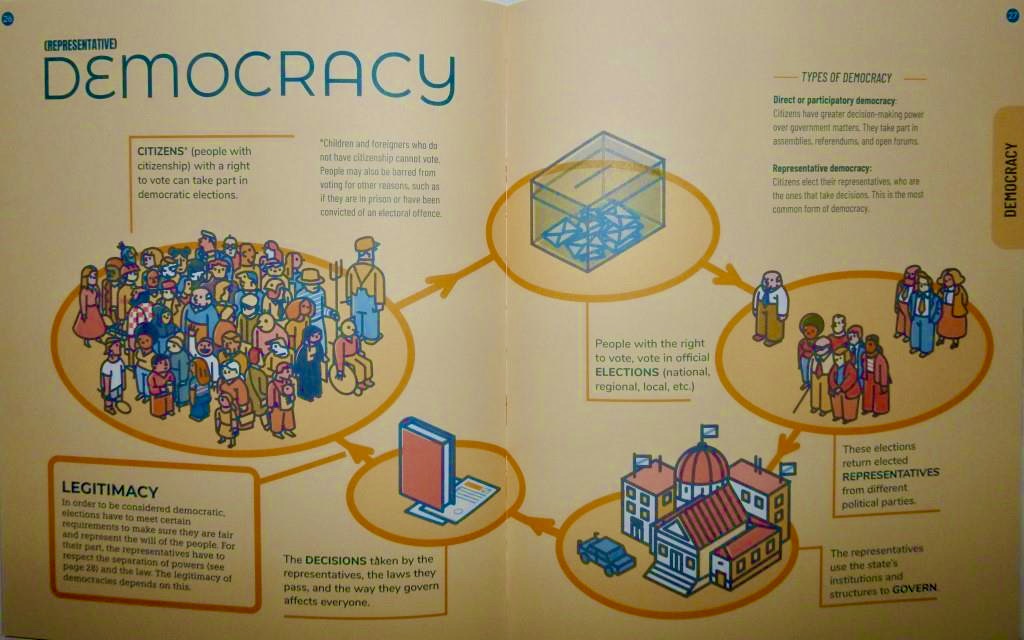
In the latest of this excellent series, Eduard Altarriba guides readers through what can often be a confusing topic and not only for younger readers. Questions including What is power? Who has it and how do communities govern themselves? are explained in a step-by-step manner. There’s also a look at the origins of political thought, democracy

and forms of government going right back to Ancient Greece. What is democracy, what is the best form of government and how does a government operate are also covered, as is what are the responsibilities of a government, left and right politics, majority governments and coalitions

Corruption and Populism too are discussed and the book poses a What would you do question on the final spread. Readers are asked to don the hat of mayor of a town where a multinational company wants to build a factory on land very near the river.

Clearly and concisely presented using infographics and diagrams this is an illuminating introduction to a vital topic relating to how the world works for Y6 readers and beyond, adults included. Teachers will find class discussion topics aplenty here too.

My First Book of Evolution

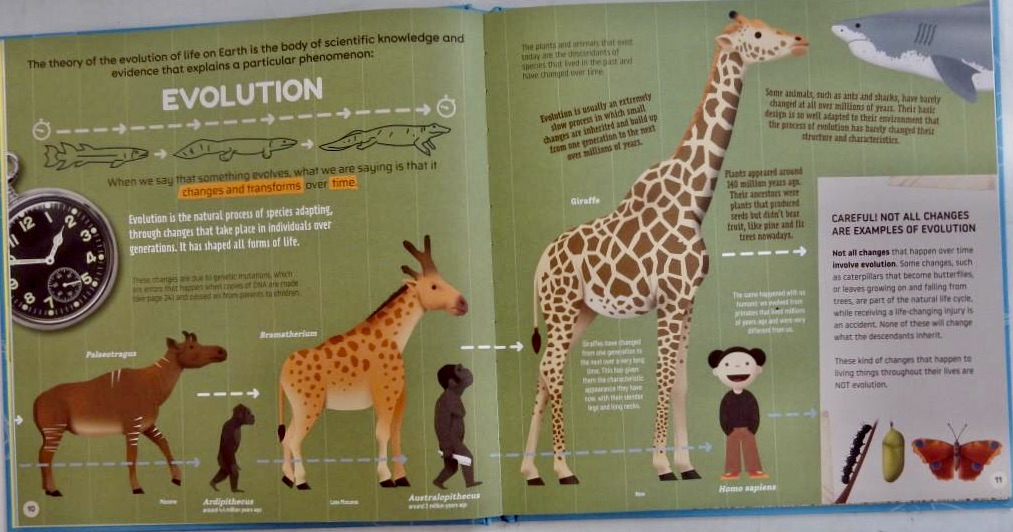
The stellar pair, author Sheddad Kaid-Salah Ferrón and illustrator Eduard Altarriba present another important STEM topic – how all life came to exist.

Starting close to home, there are pages that look at both the family tree and the tree of life, the latter being defined as ‘the family tree of all living things that have ever lived on Earth.’ Then comes a spread on species comprising a definition and examples, mentioning that the definition doesn’t actually apply to everything in the natural world, including many bacteria.

Evolution itself is presented next

followed by the process of natural selection wherein it’s explained its connection with evolution using giraffes as examples. Charles Darwin is mentioned here and the voyage of the Beagle, Dawin’s observations and his ‘The Origin of Species’ are the subjects of two double spreads.

Heredity, Gregor Mendel and genetics including mutations are also explored; there’s a look at LUCA (the ancestral organism all living things are descended from) and the book ends on future possibilities.

Exciting and accessible, this is a great starter book for budding scientists at home or school, as well as adults who may not have learned about the topic previously.

Wonderful Words That Tell A Tale

Presented by word wizard Tom Read Wilson, this is another collection, alphabetically organised, of fascinating facts and anecdotal stories related to everyday words. There are four words for every letter of the alphabet and each starts with an amusing ‘star word’ poem/story after which come a definition, information about its origin, meaning and etymology.

Did you know for example that astronauts wore nappies during take off and space walks as it’s impossible to go to the loo, so instead they use what are called MAGs (Maximum Absorbency Garments).

What about those jeans you love to wear: the word denim is a contraction of ‘serge of Nimes’( a French city), serge being a heavy fabric from which lumberjacks’ workwear was made. I loved discovering this palindromic phrase – palindromes need not be single words, we’re told – is made up of seven words – ‘Murder for a jar of red rum’.

Assuredly a book to encourage children to enjoy language and words for their own sake as well as showing how the English language has evolved and continues to do so. Have a copy in your classroom collection: youngsters can have fun reading it, enjoy the humour in Ian Morris’s illustrations, then go home and impress their parents and siblings with what they’ve discovered.

Totally Chaotic History: Roman Britain Gets Rowdy

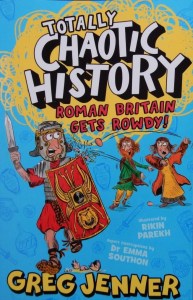
Greg Jennings is a sure winner when it comes to bringing historical information to primary age children. Here, as with the previous book in this series, he is joined by an expert in the period, in this instance Dr Emma Southon whose discussions with the author, their banter and especially the Accuracy Alarm interjections add to the entertainment value for readers. These alarms introduce the important idea that information relating to history cannot be assumed to be fully accurate, certainty and historical accounts are often open for debate.

Now most people know that Gaius Julius Caesar was the first ever Roman to land on the shores of Britain (Britannia as the Romans called it). However, less know that he came and went, then returned a year later in 54 BCE and even that wasn’t a great success as invasions go. Indeed it wasn’t until the arrival on the scene of Emperor Claudius (who took just sixteen days to out perform Caesar), that despite the valiant efforts of Caractacus, Britain was largely conquered, though that took a few years.

The whistle stop ride through Roman Britain continues with the murder of Emperor Claudius by his wife, the rebellion of Queen Boudica who is eventually defeated in the Battle of Watling Street, the construction of Hadrian’s Hall (122CE),

the crowning of Constantine the Great, who then in 313CE makes Christianity legal in the Roman Empire, all the way through to 409CE when the Romans left Britain for ever.

Your brain will probably be in a spin by the time you reach the end of this book but you’ll have had a great deal of fun along the way and learned (or in my case re-learned) a fair bit of ancient history too. Rikin Parekh makes the book even more enjoyable with his zany cartoon-style illustrations.

One that KS2 readers will battle over I suspect.

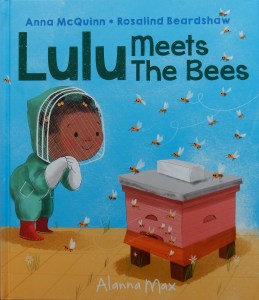
Lulu Meets The Bees

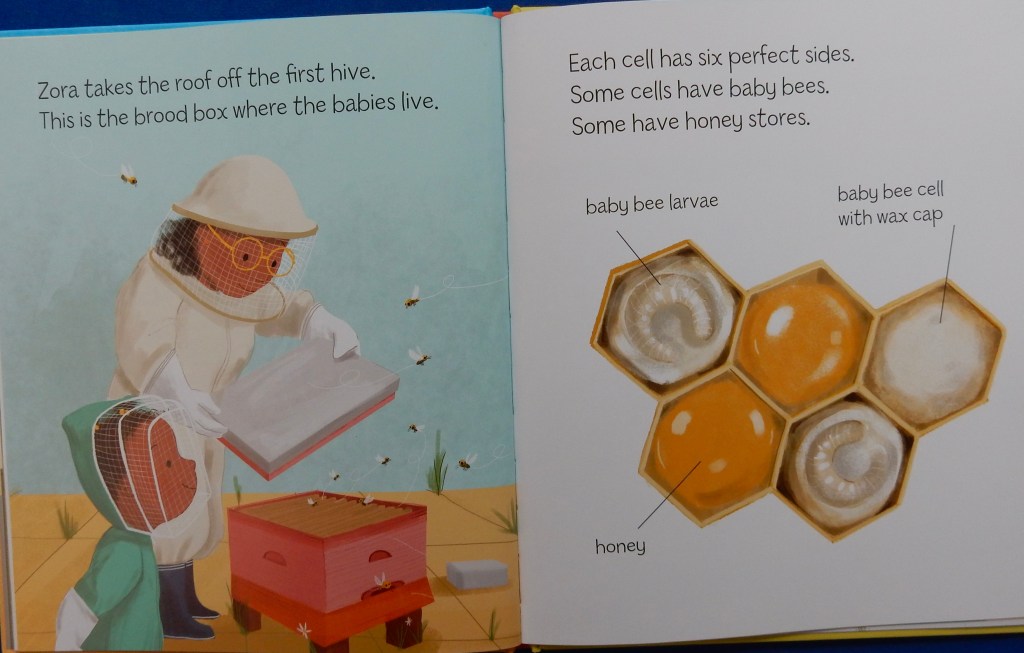
Full of curiosity, young Lulu is excited when she accompanies her mum to visit her friend, a beekeeper who lives in the city. As the adults chat Lulu carefully observes the bees foraging for food among the flowers. They then go up onto the roof of her home where Zora has her hives and there watch the worker bees returning having collected nectar and pollen. Then because Lulu is to go right up close to the baby bees when Zora shows her inside the hives, Lulu has to put on a special protective suit after which Zora lights a smoker to make it easier to work with her bees. Inside the brood box are the baby bees and Lulu is fascinated by the contents of the cells

Zora also shows Lulu the queen bee and next they move on to a hive atop which is a ‘super’, a compartment wherein the bees store extra honey.

A treat is in store when Lulu tastes some of the delicious honey from Zora’s bees and so inspired is the little girl by all she’s seen and heard that she asks Zora how she too can help bees. Being Lulu, she begins creating her own bee-friendly wild place as soon as she gets back home.

A lovely way for young children to learn some basic information about bees, Anna McQuinn’s text together with Rosalind Beardshaw’s scenes of the visit to a beekeeper are an example of narrative non-fiction for preschool children at its best.

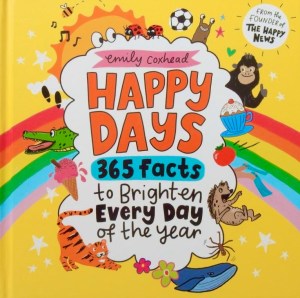
Happy Days: 365 Facts to Brighten Every Day of the Year

A few years ago, Emily Coxhead had a mission: to sprinkle a tiny bit of happiness all over the planet. To that end she launched a quarterly newspaper, The Happy News. Now comes this book aimed primarily at young children. Starting on 1st January, there are 366 fun facts, each one vibrantly illustrated by Rachel Suzanne. Some feature animals, others plants, and there are also facts relating to humans in various parts of the world.

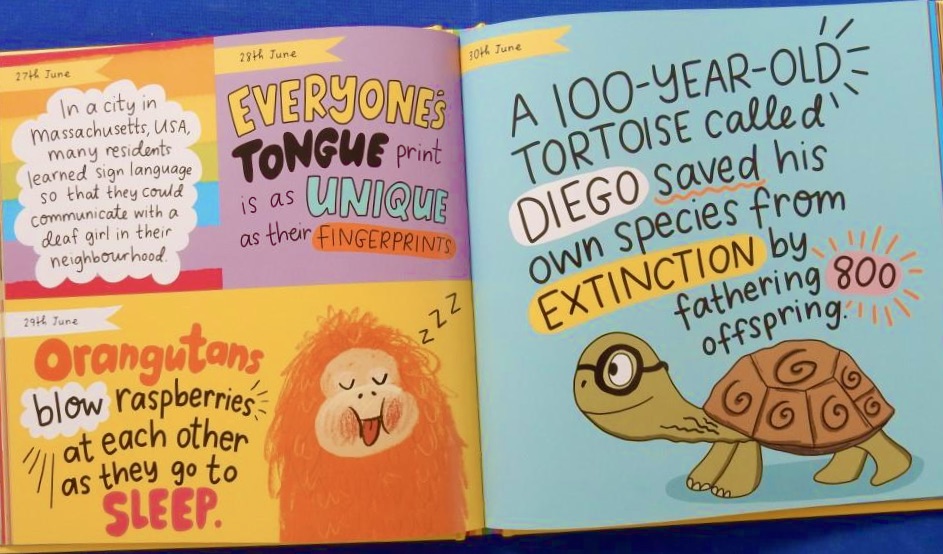
You can either follow the pattern of the book, discovering a new fact each day, or perhaps start by looking at birthday dates of friends and relations. No matter how you read it, you’re certain to discover new facts. Did you know for instance that a group of pugs is called a grumble or that a 100-year old tortoise, Diego by name, saved his species from extinction by fathering 800 offspring. Wow!

I wonder how big a newly hatched tortoise is: a newborn koala, so we read, is the size of a 2 pence coin.

Prepare to be astonished, puzzled and amused as you turn the pages of this chunky book. I was puzzled to discover that elephants can hear better with one foot off the ground and surprised to read playing music to plants helps them grow faster and that lemons float but limes sink. I guess that’s to do with density. A fun, gently educative read that goes on giving.

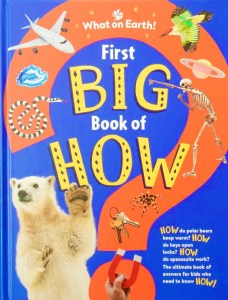
First Big Book of How

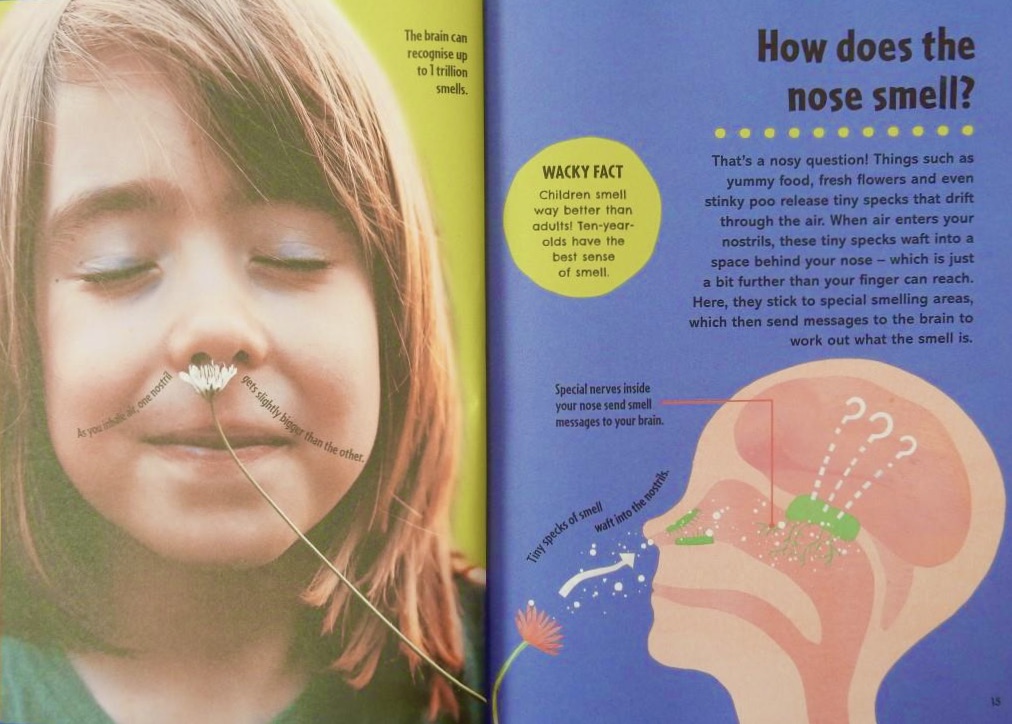
After ‘Why’ questions I think those beginning ‘How’ are probably the most often asked by young children. Author Sally Sykes, together with Saranne Taylor have divided the wealth of How questions in this bumper book into six sections, the first being The Body. The fifteen questions posed are engagingly and succinctly answered the first being ‘How does hair grow?’ A double page spread is allocated to each question, much of the space being taken by a striking illustration or photograph into which has been placed a ‘wacky fact’ and a relevant small labelled, close-up diagram. This section also addresses how each of the senses works – did you know that children smell better than adults, with ten year olds having the best sense of smell?

Then come respiration, circulation and the heart, bone growth, digestion, the growth of an unborn baby, the relationship between exercise and good health, catching a cold and more.

The other sections are in turn Machines & Buildings, Wild Animals, Bugs & Creepy Crawlies, Earth and finally, Space. In addition each part has a ‘Wow! What’s that? spread that zooms right in with a photograph as well as two ‘Tell me how … Now!’ spread, the latter briefly answering additional questions.

One to add to family bookshelves and Foundation Stage/ KS1 class collections.

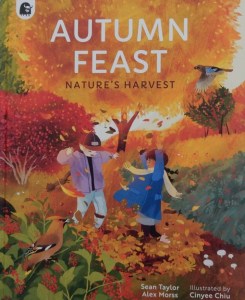
Autumn Feast

This autumnal offering completes the seasonal series by the same team that created Winter Sleep, Busy Spring and Wild Summer. Both Sean and Alex are great communicators when it comes to writing for children and again this one is perfectly pitched for its intended audience.

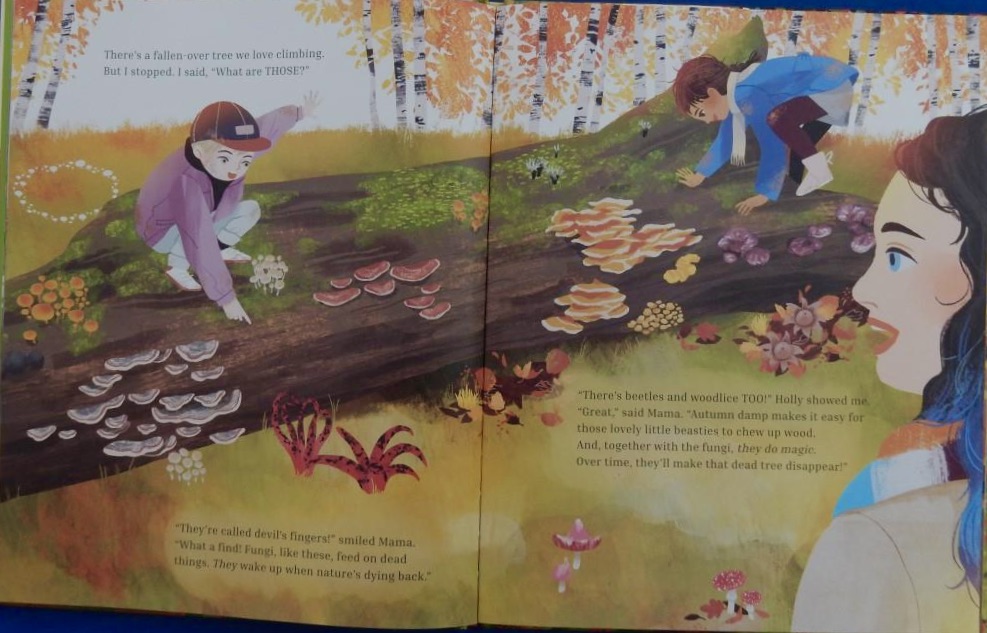
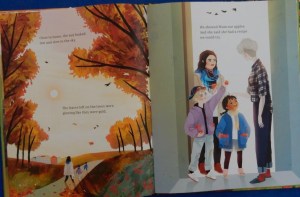
The narrative is set on a bright, chilly autumn morning and Mama suggests the children accompany her on a walk in the nearby park. Somewhat reluctantly in the first instance they wrap up and off they go into the windy street where leaves are blowing every which way. Cheered by the opportunity to romp in the fallen ones Holly and her narrator sibling are ready to embrace the wealth of sights and sounds that surround them. All the while Mama – a nature brainbox – as the young narrator calls her, gently gives the youngsters information about the various plants and animals they come upon: it was a wood mouse that had nibbled at the hazelnuts and has left tooth marks she’s able to identify and some unusual devil’s fingers fungi they see beside a fallen tree.

Having observed minibeasts down low and birds high above, they stop for a while to collect fallen apples before returning home. There excitedly they show Mum the apples

and the four of them chat, bake and consume delicious apple flapjacks together.

All this and more is shown in Cinyee Chiu’s vibrantly coloured detailed scenes.

Following the narrative, the text changes to a more conventional non-fiction style, posing and answering ‘What is Autumn?’ on one spread, after which are a spread on plants, another on animals, one entitled ‘Rotters’ and there’s a final page giving some ways children can help wildlife during the autumn months.

Science Is Lit: Crazy Chemistry and Epic Experiments

TikTok sensation, Emanuel Wallace, aka Big Manny, is on a mission: he wants to make chemistry as accessible and fun as possible for children. In this book comprising eight chapters, he presents twenty experiments with differing degrees of challenge from ‘Simple’ to what he calls “Big Science’. First though is an introduction in which there are definitions of what chemistry is as well as brief paragraphs defining elements, atoms and molecules. These are followed by a zanily illustrated look at key elements oxygen, hydrogen, carbon, sodium and chlorine. with portraits by Subi Bosa.

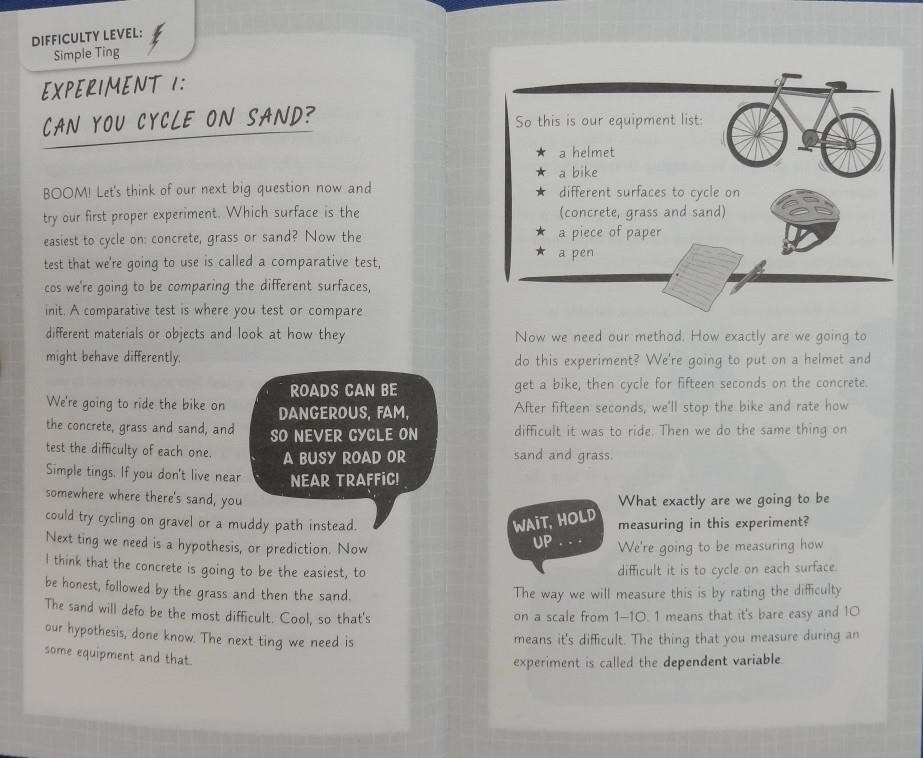
The first chapter starts by introducing readers to the way to approach and carry out an experiment with safety rules and the scientific principles of conducting any experimemnt. Then comes experiment one itself – a comparative test to determine which of three surfaces – sand, grass or concrete – is easiest to cycle on.

The hypothesis (you always need one of these) is that concrete will be easiest, then grass and the hardest will be sand. Now off you go on the bike testing each surface. After this comes the write up: method, results, conclusion and an evaluation.

I won’t go into detail about the other experiments other than to add that I never knew there was a way of turning milk into plastic before reading how to do so in chapter 7. The book concludes with some fun questions, a quiz and a final glossary.

Had I been taught by Big Manny when I was studying O-level and A-level chemistry I certainly would not have been bored like I was back in the day.

The Wild Outside

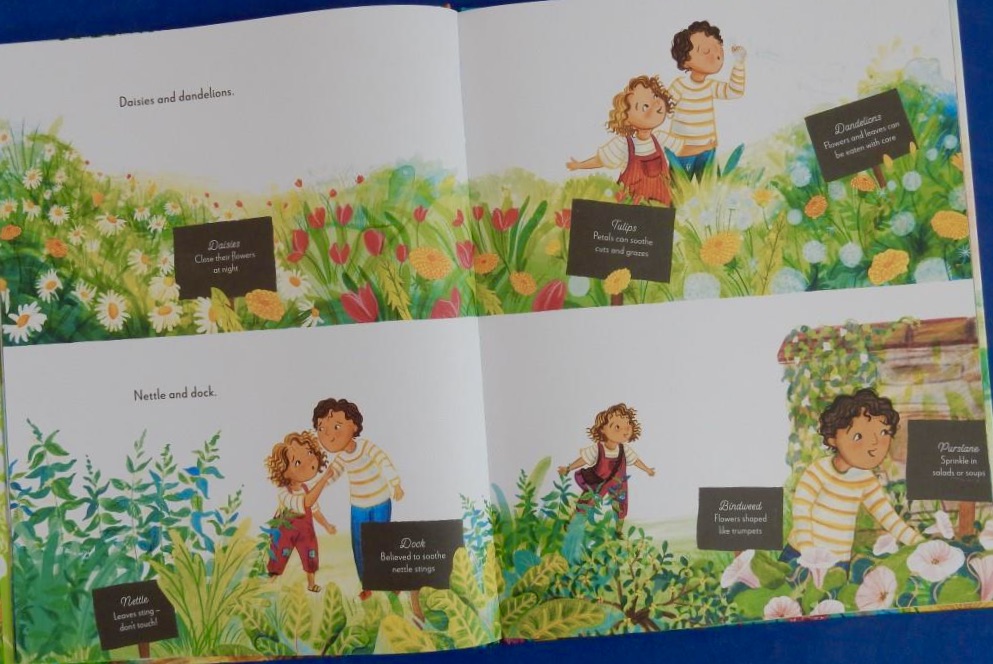
There’s nothing little Tulip likes better than to be outside exploring. She observes carefully the flora and fauna using all her senses and never stops asking questions to increase her knowledge. Then she comes upon a trail of muddy footprints on the path and a sign saying Nature Trail. Written in chalk in various places are labels naming lots of the plants, some she’s already familiar with, but lots that are new to her.

Who can possibly have made this trail, she wonders as she catches sight of somebody’s back retreating. Having filled her pockets with flowers and catkins, Tulip and her elder sibling return home and on the doorstep is a parcel with Tulip’s name on and inside is an illustrated botanical guide and a note encouraging her to keep on exploring.

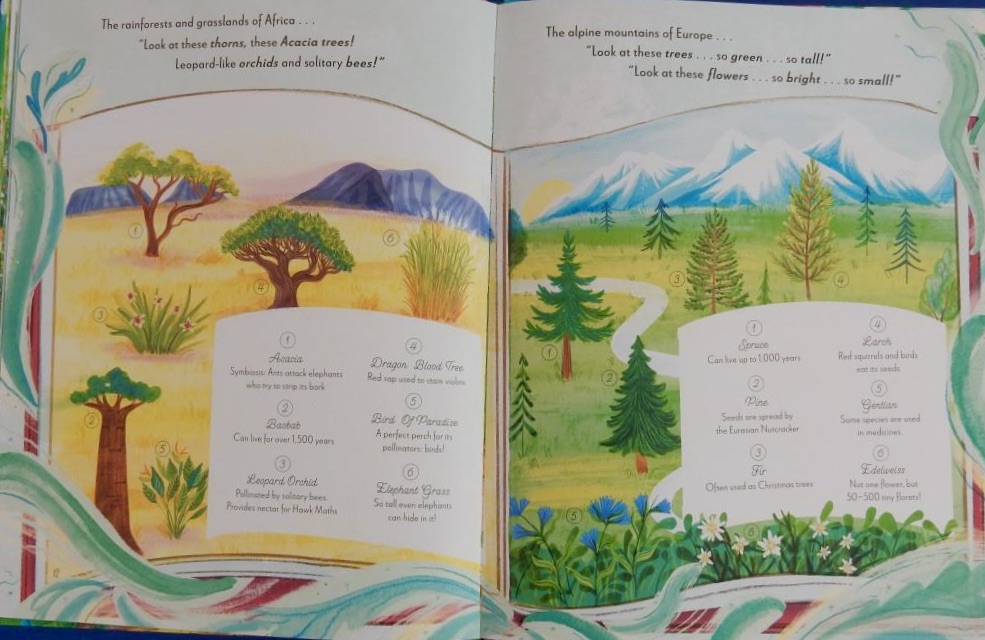
On opening the book, Tulip is excited to find lots of plants and trees she recognises and is inspired to do some labelled drawings. This keeps her engaged until bedtime when she falls asleep wondering where the following day’s explorations will take her. However, come the morning it’s raining hard and so she further explores her book instead, visiting Asian mangroves and forests, the deserts and plains of Australia, African rainforests and grasslands, mountainous regions of Europe,

the North American tundra region, various South American habitats and the cold Antarctic deserts. A clever device this for introducing to readers habitats the world over.

The following day the sun returns but rain has washed away the chalk markings of the trail. However someone has created a new one: who could that be? Tulip chalks a list of plants from the trail, leaving question marks for some she can’t name. On her return walk she discovers somebody else has written the names of those plants and left a trail of footprints. Who could it be? Tulip is delighted to discover the identity of her fellow nature lover and she makes a very special floral thank you using the contents of her pockets and bag.

A smashing way of encouraging young children to emulate Tulip and become natural history enthusiasts. The vibrant illustrations show the abundance of flora Tulip encounters as she explores and the labels are accompanied by brief captions with additional information about each plant. A wonderful combination of story and non-fiction.

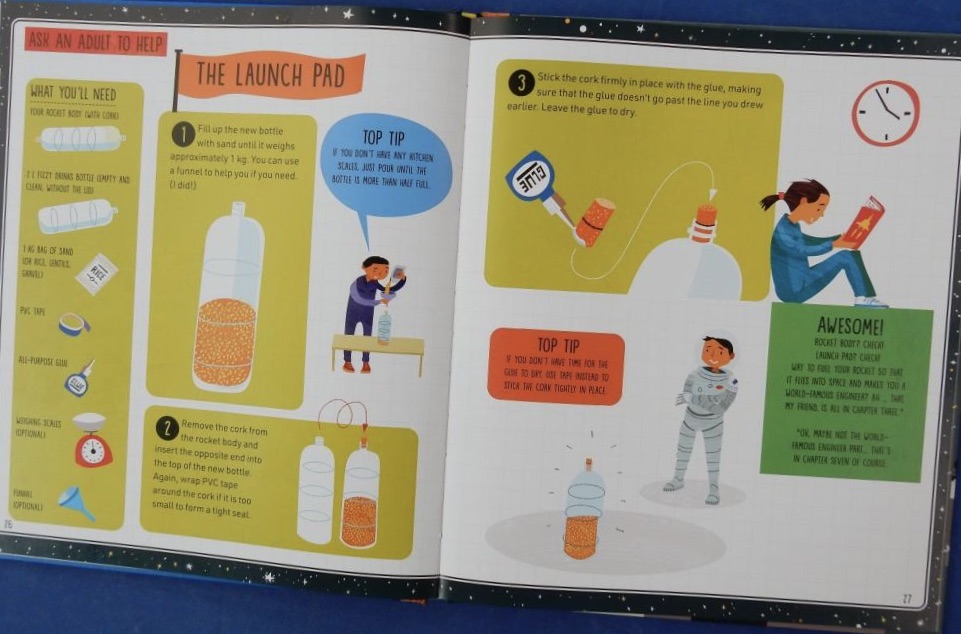
How To Build a Rocket

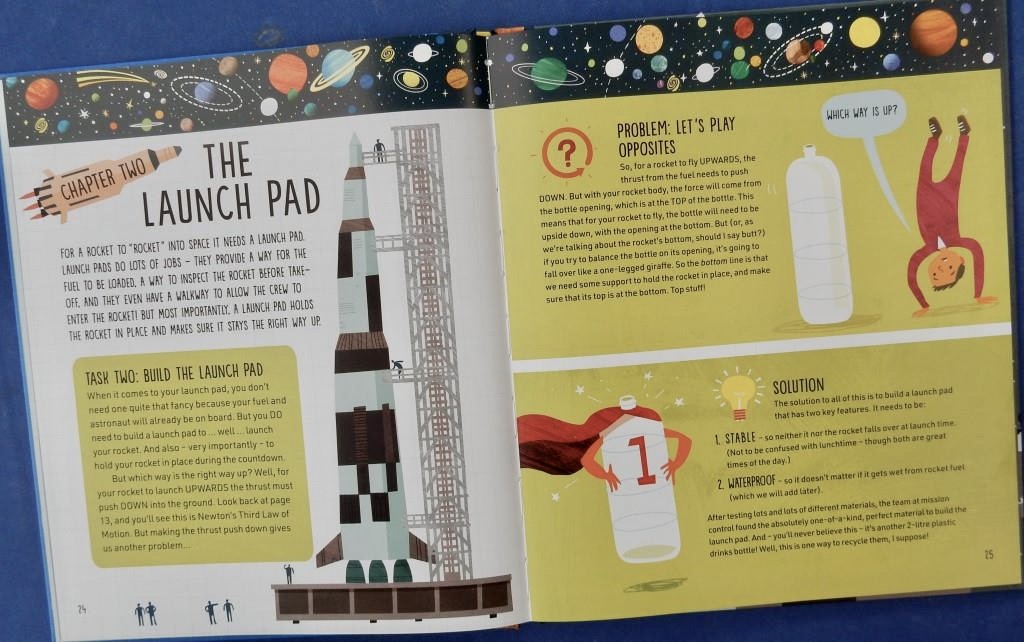
Following How to Build a Racing Car comes another step-by-step guide, to building a rocket, this time. However, this book is much more than a series of instructions; there’s a wealth of information about space-related topics such as an introduction to Isaac Newton and his laws of motion. This is followed by spreads wherein readers meet the various people who work on a rocket and at its launch base. These people then have a related chapter, the first being The Rocket Body wherein both the science behind a real rocket and the making of the model’s body are clearly presented in prose and graphics. Included too is an ’ask an adult’ directive.

Chapter two entitled The Launch Pad is similarly structured and includes some helpful tips.

The next stage is choosing The Fuel (that needed for the model is a mixture of bicarbonate of soda and vinegar). Once the fuel is prepared, it’s time to don your gear, including eye protection, grab an adult head outside to a clear space and prepare for Countdown to launch. Hopefully this is a success but as an integral part of any engineering process, it’s now the Testing and Tweaking should be done. Maybe the addition of fins would make for a better launch; or could an alteration to the weight of your machine improve its flight? Then of course, Personalisation will ensure your rocket is unique. Some designs are offered but why not try creating your own. After all this get ready for the final Blast Off1

What a terrific way to spend time during the summer break and what an amazing amount children who embark on this project will learn.

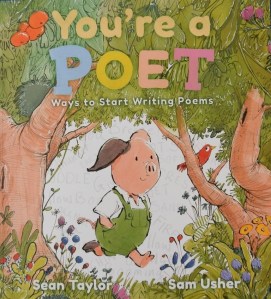
You’re a Poet

In a clever amalgam of story and non-fiction, author Sean Taylor has created a guide full of poetry-writing tips. There are five short stories starring Piglet, his family and friends, each of which shows children a different way to write a poem.

The first, Piglet … You’re a Poet starts with mum and Piglet in happy mood out walking along a puddly track towards a hill. Piglet, stops, picks up a large stone and drops it into a puddle causing a word-splash. ‘Sunshiny, earthy, wet, fresh, splashing puddle, ‘ says Piglet. Piglet has just created a poem, his mum tells him. This special happening reoccurs as they continue their walk, which culminates in the dizzy delights expressed as the two of them roly-poly down the hill and Mum’s confirmation that her son is a poet. Integral to Sean’s narrative is a demonstration of how to make a Puddle Poem and there are two spreads after the tale with a helpful lesson and ‘writing secrets’ aimed at children.

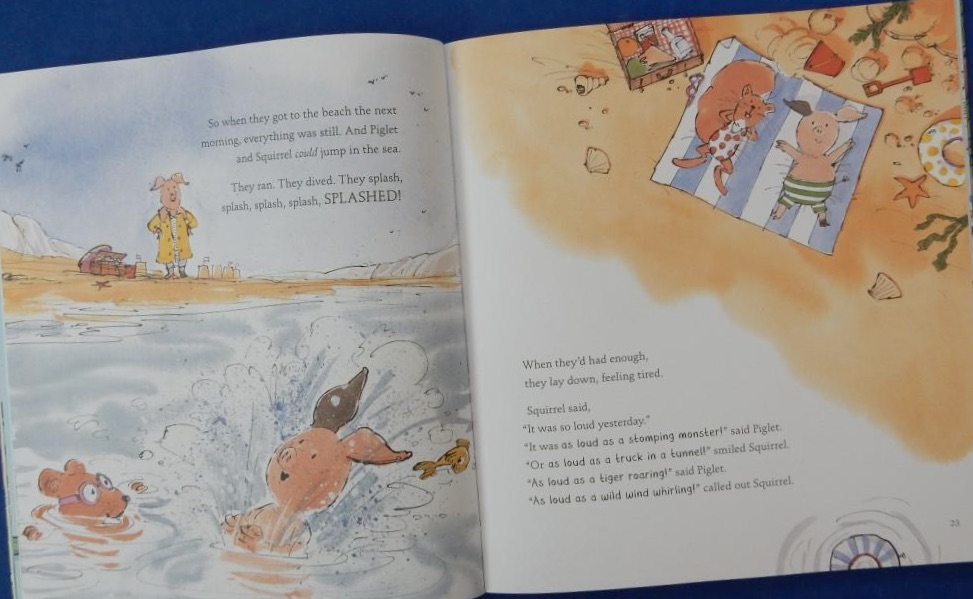
Of the remaining four stories, the second As Loud As Thunder Booming, introduces figurative language in the form of similes during a seaside family holiday on which Piglet’s pal Squirrel accompanies them.

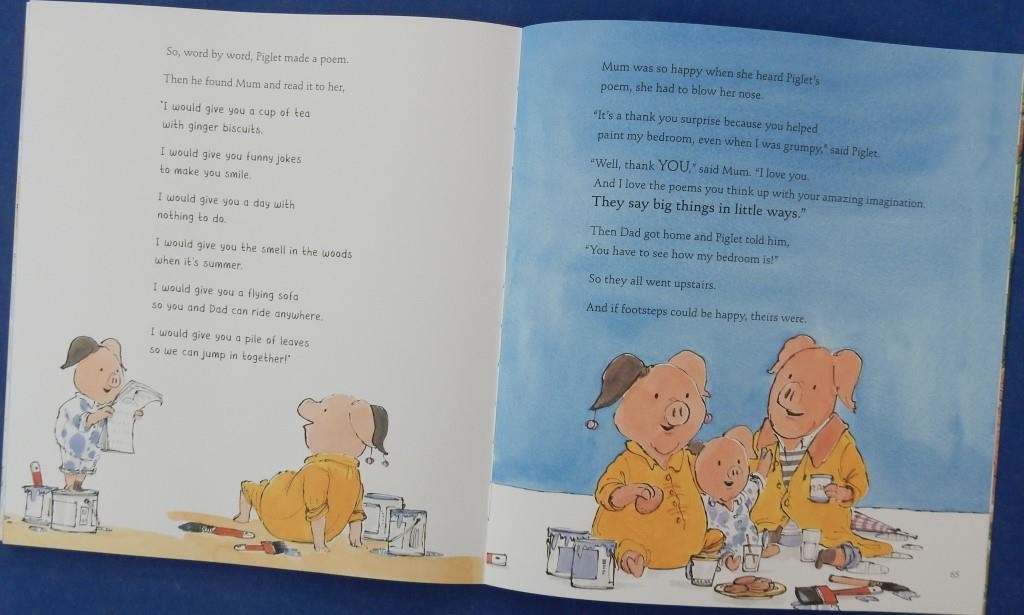
The Breeze Is My Friend sees Piglet and Squirrel getting a soaking but not before the former has invented a descriptive poem about the seemingly playful breeze. The next tale has Piglet and Squirrel sharing a swing, the to-ing and fro-ing of which gives rise to Piglet’s ‘If I Was a Tree’ poem. Finally, on a day of rain showers Piglet invents an ‘I Would Give You’ poem especially for his Mum while the two paint his bedroom walls together; it’s his special way of saying thank-you to her and she in turn compliments Piglet on his ‘amazing imagination’.

With its compelling narrative, writing possibilities and Sam Usher’s playful and dramatic watercolour illustrations that instantly endear the story characters to readers/llisteners, the message ‘poetry writing is fun’ comes across loud and clear. An inspiring, must have book for foundation stage and KS1 classes.

Wildlife in the Balance / Factology: Oceans

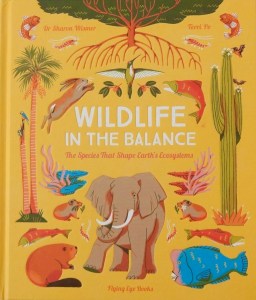
In this latest Flying Eye natural history offering author Dr Sharon Wismer introduces readers to the concept of keystone species and their impact upon various ecosystems.

There are introductory spreads explaining ecosystems, food chains and webs, and outlining the work of Professor Robert Paine whose experiments along the Washington State coastline in the 1960s demonstrated how the removal of a top predator from rock pools resulted in the collapse of the biodiversity of the ecosystem. He identified the ochre sea star as top predator and keystone species responsible for the biodiversity of the rock pools.

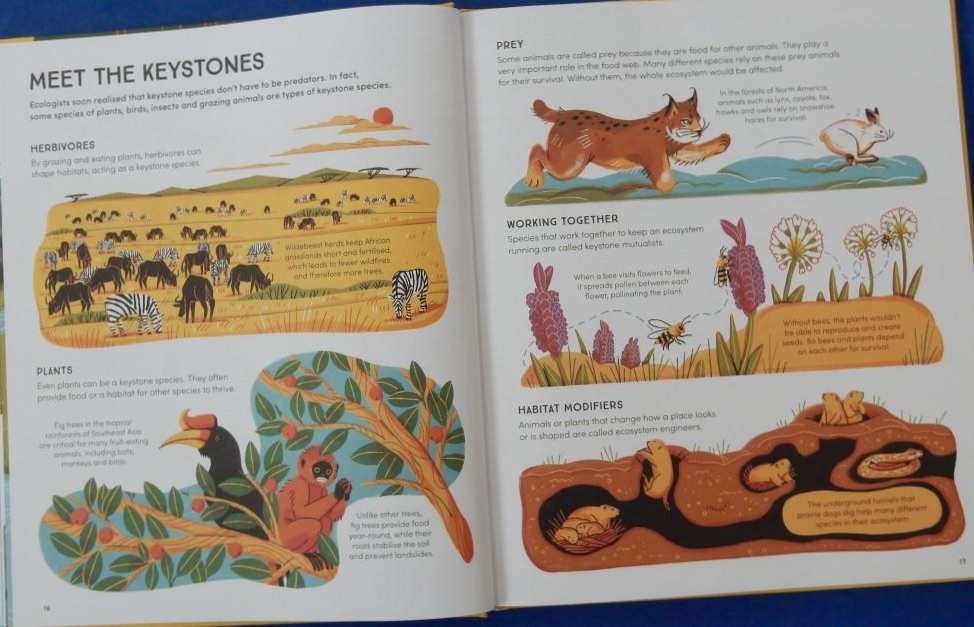
We learn that apex predators are not the only keystone species: herbivores, plants, prey, insects and habitat modifiers can also be keystone species maintaining the ecosystem in which they live.

Readers are then introduced to a dozen keystone species across the globe’s five major biomes: aquatic, desert,

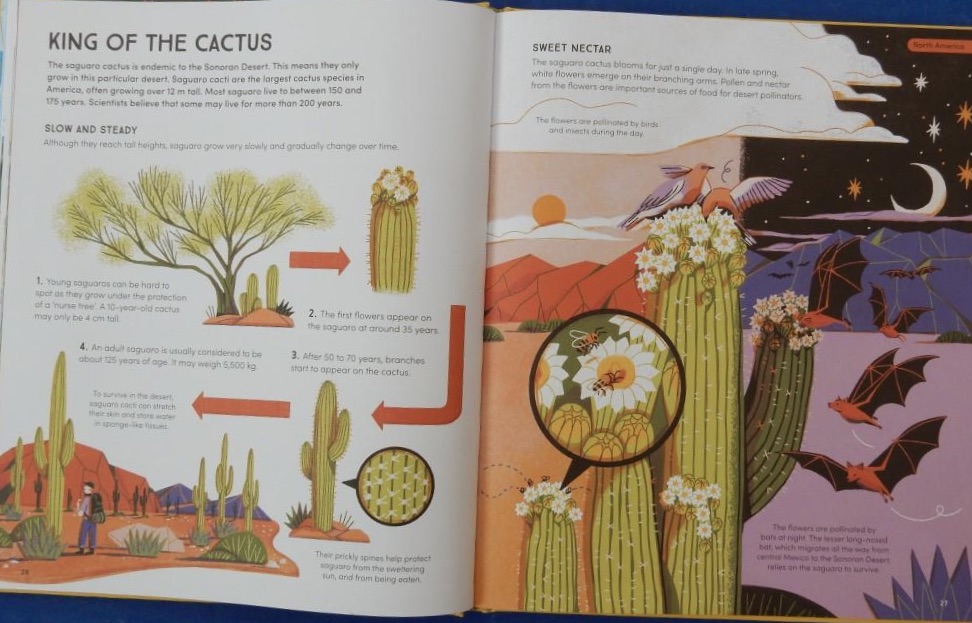
grassland, forest, and finally, tundra. These include salmon, the saguaro cactus, European rabbits of the Iberian peninsular, green-backed fire crown hummingbirds and krill.
Terri Po’s illustrations of the landscapes, flora and fauna are at once stylish, arresting and informative and expand and make accessible, the considerable scientific information conveyed by Sharon Wismer in her text, which concludes with a spread on how humans can help these vital keystone species. Backmatter comprises a glossary and index.
Altogether a fascinating book for KS2 readers and beyond..

For readers with a particular interest in the underwater worlds or for reference in a cross-curricular ocean topic is:

This highly visual book presents a wealth of facts about the ocean and its flora and fauna. In addition there is information on various topics such as the history of exploration and how people navigated their ships, subaquatic exploration of the ocean depths in the hope of finding treasure among the sunken wrecks.

Readers visit coral reefs and submarine volcanoes, see some of the wonderful deep-sea fishes and other creatures – giant squids, anglerfish, blowfish and the spooky-looking barrel eye fish and the fang tooth fish that has the largest teeth of any ocean species, find out how tides work, why the sea is salty and discover how tides and currents work. There’s a gallery of deep-sea deities and a spread introducing marine monsters such as the Kraken and a look at some of the horrendous outcomes of marine pollution

All this and much more, so imagine yourself into a submersible and take the plunge..

Secret Factopia!

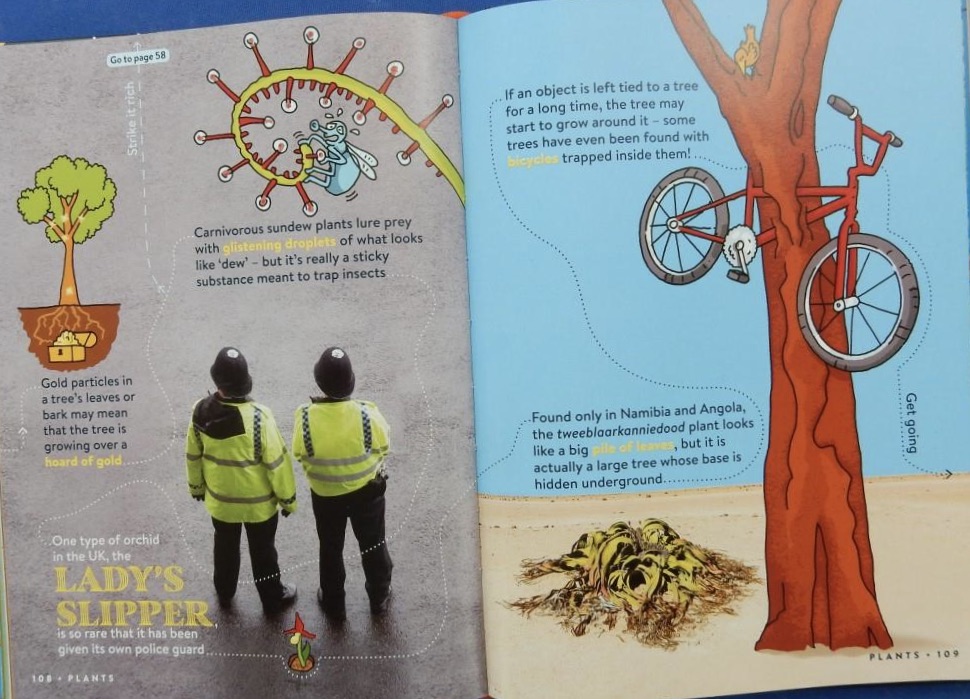
You never know where you might end up when you open this book. Readers will discover all kinds of weird, wonderful and sometimes downright disgusting facts as they explore the various trails presented in this latest Factopia extravaganza. With 400 mysterious facts trails to follow, there are revelations of secrets relating to a whole gamut of topics from fashion to forensics, creepy crawlies to camouflage and cryptography, and toilets to theme parks, all in bite-sized chunks.

Did you know that the spiky tropical durian fruit has a powerful smell that is said to resemble sweaty socks and rotten onions? I think I’ll pass on that one despite its nutritional value.

This, like the previous six titles in the series, acts as a great springboard to further research on topics that capture a reader’s interest. I found myself looking several things up as I worked my way through the pages, including that about clothing with hidden solar panels that can charge a phone battery and the reference to a lady slipper orchid so rare that it’s given its own police guard.

This is one of the spreads that integrates photography and Andy Smith’s (often comical) art. Another is that where a photograph of a place in China where 1437 people participated in the largest ever hide-and-seek game has numerous faces peeping out. Readers will surely enjoy seeing how many they can count.

Back matter includes an index, and a list of information sources. Fun and immersive; it certainly deserves a place in primary school collections.

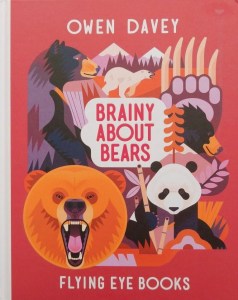
Brainy About Bears

This is the ninth in Owen Davey’s deservedly popular non-fiction animal series. At the start is an overview that mentions there are eight distinct bear species and possibly around fifty subspecies from various parts of the world from Arctic regions and tundra to tropical jungles.

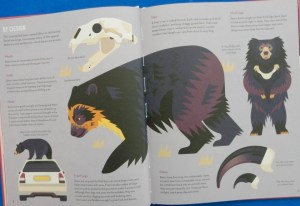
Featured in By Design, the spectacled bear, native of South America, is so-named for its facial markings, has an immensely powerful bite, sharp, fang-like canine teeth, good eyesight and sense of hearing but mostly explore the world through their excellent sense of smell, which so we read, is over 2,000 times better than a human’s. Did you know that bears are able to smell a bar of chocolate stashed away in a locked car? Hopefully they can’t use their long claws to pick car locks but stick to using them for purposes such as digging, climbing, fighting and catching prey.

Amazingly, the earliest modern bears -the dawn bears – lived about 23 to 5.3 million years ago whereas modern day humans have been around less that 1,000,000 years.

With regard to movement, bears normally walk on all four legs, all have the capacity to outrun Olympic sprinters, use their claws to climb trees for such purposes as finding food, escaping enemies or perhaps hibernating. They are also able to swim and like being in water, polar bears being the best swimmers; this last fact you will discover on the And the Award Goes To spread.

When it comes to nutrition, almost all bears tend to eat anything depending on what is available, not so giant pandas, which stick almost exclusively to bamboo, the result being they are now classed as a vulnerable species as few areas have sufficient bamboo to satisfy their needs.
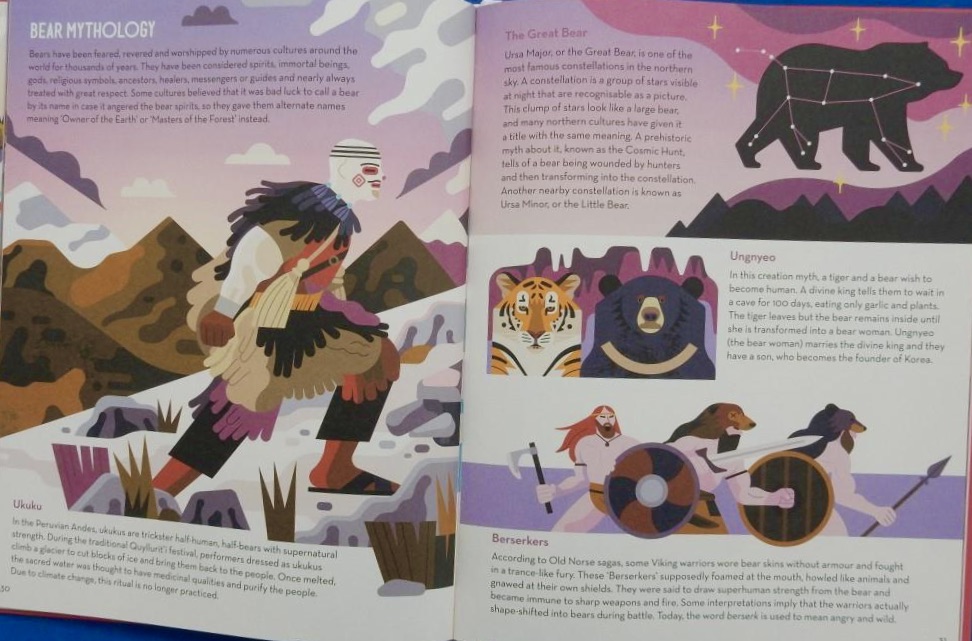
Bears feature in the mythology of many cultures around the world and have been thought of as such diverse things as healers, spirits, religious symbols and guides.

The final spread mentions giant pandas and polar bears as reminders to readers. of the damage we humans do to the planet and the hope of giving greater priority to the protection of bears and their habitats in the future.

Characteristic of this series is the vast amount of facts presented in a well organised, lively and entertaining manner. The information level is spot on for primary school readers and the illustrations are as always, superb.

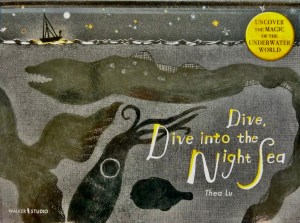
Dive, Dive into the Night Sea

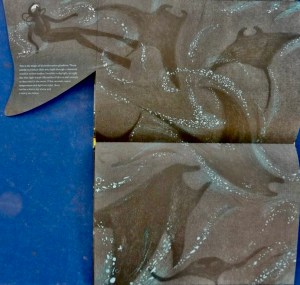
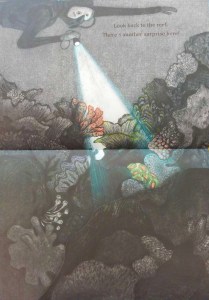
This book has such an alluring cover illustration that you immediately feel you want to join the diver/narrator and plunge into the depths of the night sea. If you choose to do so, you will be rewarded by a fascinating and awe-inspiring undersea journey. Each spread (they open horizontally) reveals something different: the first being the coral reef where small fish including triggerfish and batfish are able to find safety in its cracks and crevices. The narrator likens the reef to an underwater hotel where such fish can hide from potential nocturnal predators.

The beam of the narrator’s torch attracts a wealth of creatures from plankton, the tiniest organisms in the sea, to some gigantic ones such as the scary-looking but harmless Manta rays. However, turning off the torch enables the diver and readers to see the bioluminescent plankton, described as ‘a constellation of stars’.


A return to the reef brings another surprise in the form of fluorescent corals; these are revealed only when the diver’s special blue/ultraviolet torch light is shone on the reef after dark.

Clever use of scale allows us to appreciate the size of the creatures in relation to the diver and the use of flaps allows for two levels of text: a larger font offers a text that will is essentially an interesting story to share with young children, whilst hidden beneath the flaps presented in a smaller font is more detailed information about the fascinating night sea. Did you know that sperm whales usually keep half of their brain awake when they sleep; this is termed unihemispheric sleep? This helps them to control their breathing,

Inspiring awe and wonder aplenty, this is a smashing, cleverly designed book to have in a Foundation Stage/Key Stage 1 classroom.

Betsy Buglove and the Brave Butterfly / Watch Them Grow!

Nature lover Betsy Buglove, she who saved the bees, returns for a new adventure. It begins as she and her best friend Stan are in the garden and a bee buzzes along with an urgent message about a butterfly that needs their help. They follow the bee next door and there discover the juice cups they left on the grass earlier and inside one a butterfly is trapped in the sticky dregs.

Having successfully extricated the butterfly, its wings soon dry and off it flies.

Shortly after a cry comes from Betsy’s dad. The leaves of his vegetables and flowers have been badly nibbled. Off goes Dad to get his bug spray leaving Betsy examining a thistle plant in the grass. Thereon, with the aid of her magnifying glass, she sees lots of caterpillars munching away its leaves. Caterpillars she and Stan soon find out, belong to the butterfly they’d rescued earlier on.

Can they persuade Betsy’s dad to leave a patch of thistle and other weeds for the caterpillars? Fortunately they can; but what happens thereafter?

Will it be another case of mission accomplished for team Betsy and Stan?

With Catherine’s jaunty rhythmic text where the rhyme doesn’t falter and Lucy’s scenes containing an abundance of flora and minibeasts, this is a book that’s just right for sharing with young nature enthusiasts, as well as to encourage those less keen (happily I’ve only ever encountered a few,) to find out what they’re missing. Everyone can do their bit to help insects.
At both ends of the book are fact pages about butterflies.

Author James Carter and artist James Munro have joined forces to present the life cycles of nine different animals starting with the Emperor Dragonfly and concluding with a human. Before these is an introductory poem inviting readers to ‘Watch them grow!’. Following the featured animals are a spread about baby animals names – young children will be amused to learn that it’s not only cows whose babies are called calves: so too are those of six other animals. And, the term hatchling can be applied to baby crocodiles, turtles, tadpoles and newts in addition to baby birds.
Then comes some straightforward information about axolotls; (these, unlike other amphibians never become adult; instead they retain their gills and remain in the water); and a paragraph explaining that male seahorses give birth to babies (fries, hundreds of them)

as well as some facts about parenting in emperor penguins, Australian marsupials and others.
All this James Munro has captured in his playful illustrations, each of which is a combination of reality and fun.

Beasts From the Deep

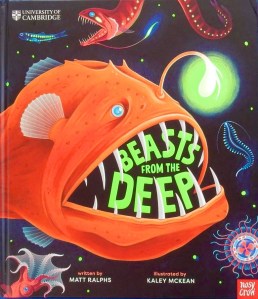
Many of the marine creatures featured in this large format book look like the stuff of nightmares, as you turn the pages that take readers through the five ocean layers. So take the plunge if you dare, down, down first into the twilight zone – a bright and busy area that gives a home to all manner of weird and wonderful creatures – some of the scariest of all. There’s the Atlantic Wolffish, possibly the size of a bath if fully grown, with sharp protruding teeth (hence the name) and a clever natural ‘antifreeze’ protein that allows the blood to flow even in the chilly waters of its North Atlantic home.

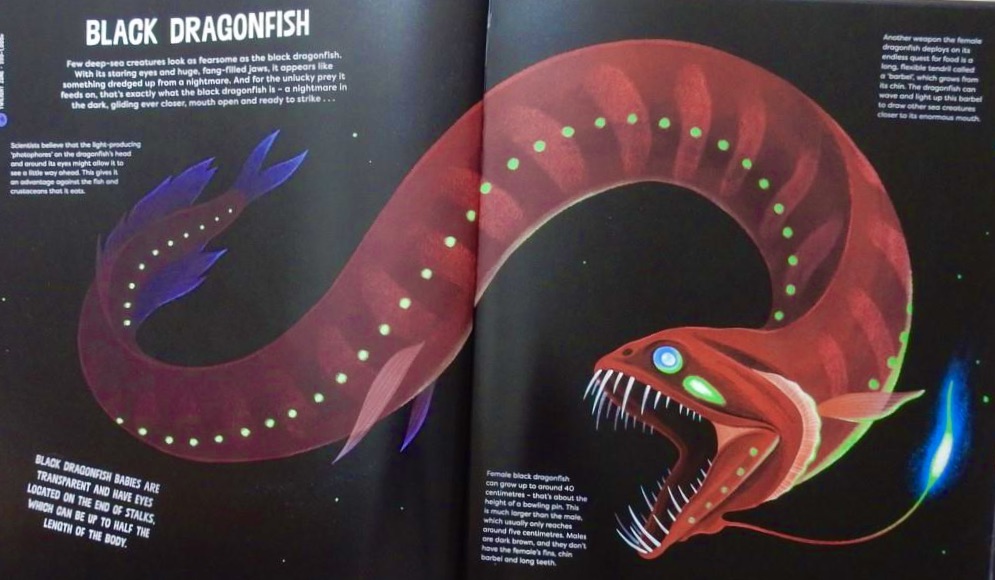
Equally alarming, perhaps even more so, is the black dragonfish. In addition to those horrific teeth, the female beasties use a barbel – long flexible tendril that protrudes from the chin and when lit up can attract potential prey towards its mouth.

With no sunlight penetrating, the midnight zone (1,000 – 4,000 metres) is one of constant dark save for the flashes from bioluminescent creatures. This zone is rich in different species of sharks including Greenland sharks that can live to be 500 years old; as well as some of the weirdest-looking monsters you could imagine, or rather couldn’t. There’s a fish – the Fangtooth -with teeth so long it cannot close its mouth.
I think I’d rather face some of those jellies that pulse, flash and glow in show-stopping colours like the Bloody-Belly Comb Jelly or the Halitrephes Jellyfish, both of which inhabit the midnight zone.

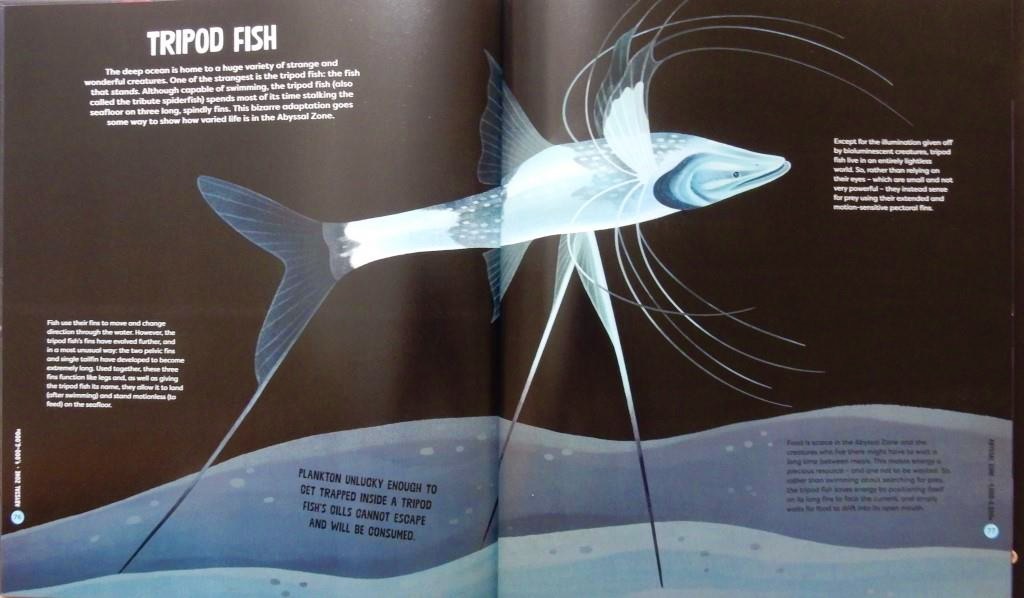
Dive even deeper and there’s the aptly named abyssal zone where the complete absence of light means it has no plant life. There are thought to be various creatures that have adapted themselves to survive, so we read ‘crushing pressure and near-freezing darkness.’ One is the Tripod fish that is able to stand on the seafloor using its specially evolved fins.

A monstrous menagerie indeed exists in our ocean waters, with new kinds of creatures being discovered all the time.

Kaley McKean’s awesome artwork and Matt Ralphs’ captivating text, created with input from biologists from the University of Cambridge, will certainly astonish and inspire young would-be marine biologists and other people fascinated by a largely unexplored world.

Does A Bear Wash Its Hair?

In this sequel to Does a Monkey get Grumpy? author Moira Butterfield turns her attention to animals’ daily routines. You may well be surprised to read that many animals – certainly the fifteen featured in this book – devote a considerable amount of their time doing the same things we humans do, although they don’t go about them in the same way. They are nonetheless, creatures of habit.

Whereas we humans normally use soap and water to keep ourselves clean, brown bears lick their fur, slurping up whatever is attached to it, sometimes tasty bugs, so they get a reward as well as a wash. Certain fish including green moray eels visit coral reef cleaning stations where cleaner wrasse nibble off unwanted bugs and flaking scales: a win/win process.

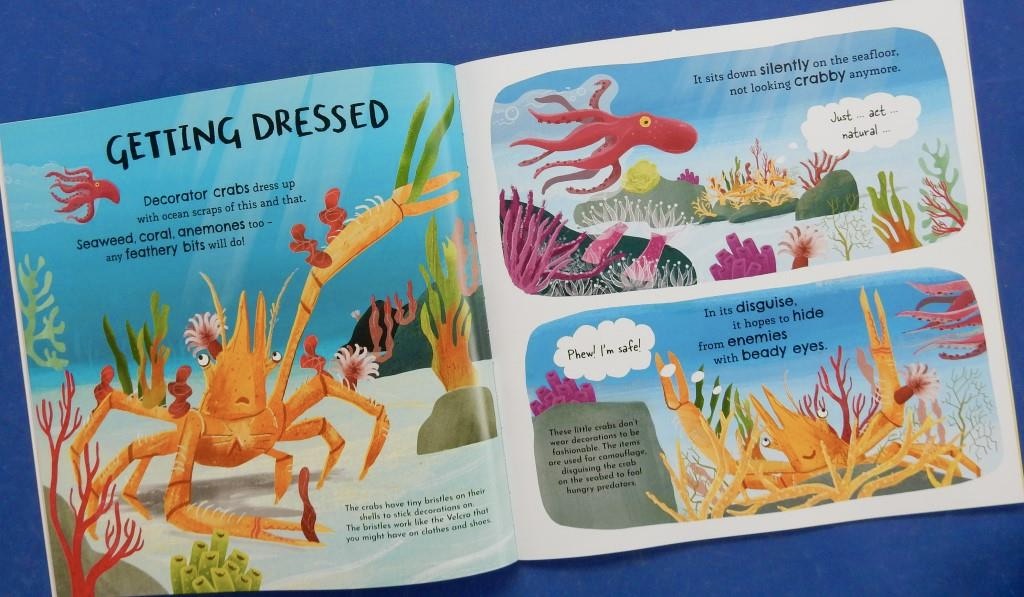
Did you know that decorator crabs dress themselves up with bits and pieces from the ocean, these they stick onto tiny bristles on their shells, the intention being that so disguised they won’t be easily preyed upon by hungry enemies.

Young readers will be amused to discover that young meerkats have lessons – hunting lessons where they learn how to bite off a scorpion’s sting. Before swallowing a scorpion though, they roll it in the sand to rub off any poison.

Poo is a topic that seems to fascinate most young children and I suspect they will laugh at the thought of a sloth descending from its tree once a week to take a ‘big poo’ excreting a third of its body weight. Having made a poo pile, sloths then need to bury it to prevent enemies discovering where they live.

Tidying,

co-operating, making friends, teeth cleaning, eating meals and sleeping are habitually done by animals of various kinds.

All these are described in Moira’s bouncy rhythmic text (with additional factual snippets) and illustrated in Adam Ming’s amusing scenes making this a really fun way of teaching children the many similarities between humans and other animals..

Ranger Hamza’s Eco Quest / Brown Bears

It’s great to be back in the company of Ranger Hamza and here he takes three children and readers on an important learning journey to discover how nature’s everyday heroes from the smallest seed to the tallest tree play a crucial role in our ecosystem, and how we also have a vital role to play. It’s not difficult and Ranger Hamza explains in straightforward steps some ways to help the planet, starting with the making of a mini water butt.
I loved the adjectives used to describe lichen, of which there are three types. In addition to providing food and shelter to tiny creatures, lichen acts as an indicator of the air quality in an area: lots of lichen indicates the likelihood of low pollution, so next time you walk with children keep a watch too see how much is growing.

One thing virtually everybody will notice is dandelions; rather that pulling them up (even from your garden), leave a place where some can grow. In so doing you will be helping several kinds of insects. I know from experience that children love to plant sunflower seeds and watch them grow: this is a great way to provide food for birds, so long as you keep the heads, let them dry out and then put them somewhere birds can access.
These are just some of the suggestions in this thoroughly engaging, inclusive book. It’s never too soon to start teaching children about ways they can help nature thrive so I suggest adding a copy to your family bookshelves, and foundation stage/ KS1 teachers, you need one in your classroom: it offers an abundance of forest school activities.
Another highly effective narrative non-fiction book is

Set in Alaska, USA, this tells the story of a mother brown bear and her two cubs, one male, one female that we follow through a year in the forest. Therein lie dangers aplenty so, almost as soon as they are born, the mother bear starts teaching her offspring survival skills in order that they will be able to live and thrive alone in the wilderness.
The cubs learn to climb, to leave scents to inform other bears where they’ve been and to remove bugs from their skin. It’s dangerous for bears to stay too long in locations where people have left discarded food, as this can endanger both humans and the bears that have followed their noses. Much better is picking berries and foraging for nuts in the meadows and forest areas, which is what the cubs do come the autumn to build up a layer of fat to help protect them through the winter when hibernation prevents them from eating.

Come the snowfall, mother bear builds a new den wherein they will all spend the winter, in the warmth trapped by the tree branches covering the tunnel’s entrance.
After a whole seven months the mother wakens as do the cubs, the light hurting their eyes after so long. Then it’s out into the melting snow to start feeding again and come the summer part of their food will be salmon that have come to lay eggs in the gravelly rivers. Danger isn’t over however; indeed it comes in the form of a massive, very hungry male brown bear; but thanks to the cubs’ climbing skills and their mother’s warning sounds, the three remain safe and as autumn approaches again, the male cub will leave his family and go in search of a new home
Beautifully illustrated and captivatingly written, (with paragraphs of additional information to enjoy either during or after reading the main narrative), this is perfectly pitched for KS1 children.

Explodapedia: Rewild

The latest topic biologist and neuroscientist Ben Martynoga turns his attention to in this cracking non-fiction series is that of rewilding. In the glossary, the author defines rewilding thus: ‘giving ecosystems the help and space they need to grow more biodiverse, resilient and able to look after themselves, and us too.’  There’s no doubt our planet is in a diversity crisis but, taking a positive stance, in his witty style, the author accentuates hope for the possibilities that rewilding offers.

Presenting such topics as the rules and intricacies of ecosystems and food chains, how the release of predatory wolves in Yellowstone National Park in Montana created opportunities for wildlife to thrive at every level so that with denser tree cover, healthier rivers and wetter habitats, the entire park has become more resilient if the climate crisis continues to escalate; as well as the way trees share and work together.

There’s even a plan by two biologists, Eriona Hysolli and George Church to use preserved mammoth DNA to create what they term, ‘mammophants’ to help tackle the biodiversity crisis. 

With a plethora of illustrations that have amusing speech bubbles, and an author whose love for his subject is electrifying, every spread is filled with accessible scientific information. This is an urgent rallying cry for individuals and environmental decision makers the world over. A powerful read indeed.    


Words, Words and More Words

Baby Bee has to get safely to the hive and needs the help of little humans to do so. The same is true of some other baby minibeasts: baby ladybird wants help getting to a home log,; baby snail resides in a flower pot; and baby worm also needs guidance back home. There are plenty of things relating to the natural world to spot on each journey and each can only be completed with the help of a small human hand to guide the moving disc that depicts the named baby. Interactive fun that gives little children a sense of autonomy as well as delight at the brightly coloured spreads, each of which has the route on the recto and small, labelled images on the verso.

Little ones can learn and read more than three hundred words with friends Pip and Posy in this large format book. Its ten spreads have different themes each with flaps to lift and a multitude of labelled images both in and surrounding the scenes, the first being Garden Games. Here we see Pip busy planting seeds and Posy ready to entertain visitors by playing some musical instruments.
Next comes At the Shops where we find customer Posy, clutching a coin to buy a new toy. Sunny Seaside is the third destination and the two friends are enjoying a beach visit. Back at Posy’s Happy Home, Pip arrives bringing her a birthday present.

Christmas, Snow, Bubbles, Night Night follow and the final spread Learn with Pip and Posy presents colours, seasons, numbers (to 10)basic 2D shapes, and four examples of opposites.
Offering lots of potential for discussion, as well as vocabulary building and honing their visual skills, there’s a wealth of toddler learning possibilities between the sturdy covers of this book.

Also helping to enhance young children’s vocabulary are recent titles in a popular series:

In Our Bodies children can take the plunge and have a day at the swimming pool where they can learn a wealth of body-related words from the brain to bones and senses to growing.
Coding presents basic language such as commands, sequencing, chain reaction and inputs and outputs. Both books feature a diverse cast of child characters, are engaging both visually and verbally and are worth adding to home shelves or collections in early years settings.
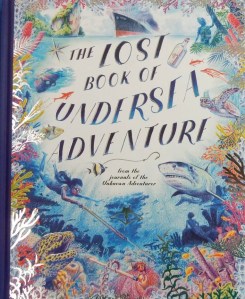
Totally Chaotic History: Ancient Egypt Gets Unruly! / Be A Scribe!

Speaking directly to his audience using a chatty present tense style, writer, Horrible Histories consultant and presenter of the hit BBC history podcast ‘You’re dead to me’, takes readers on an action-packed, chaotic romp through the whole of Ancient Egyptian history. In this enterprise as he navigates this messy world, he’s aided and abetted by Egyptologist, Dr Campbell Price, curator of Egypt and Sudan at Manchester Museum with interjections in the margin, myth busters and ‘accuracy alarms’ that sometimes challenge Greg’s ‘facts’. Adding to the humour of the text and the reader’s enjoyment and perhaps understanding, are Rikin Parekh’s comical illustrations on every spread.

There’s a brief introduction and timeline, after which we are taken on a whistle-stop chronological tour of the key events in Ancient Egyptian history. Then follow short chapters devoted to important figures such as pharaohs and Alexander the Great (he with a mega ego), as well as other topics you would expect such as mummification and hieroglyphics; we also pay a visit to “Doctor Peseshet’s medical school to see how they treated such problems as toothache, headaches and tummy troubles.

This cracker of a book will be of huge appeal to children who are interested in history in general and Ancient Egypt especially. For KS2 readers I recommend adding it to home, classroom and library bookshelves. With Roman Britain Gets Rowdy! coming in October, this promises to be a brilliant series.

With nothing much to do during the covid-19 pandemic, Michael Hoffen, a teenager in New York spent his time learning about Ancient Egypt and with valuable help from Dr Jen Thum, an Egyptologist and curator at the Harvard Art Museums, and teacher and mentor Dr Christian Casey, a postdoc at the Freie Universität Berlin. During regular meetings over the course of three and a half years, under the guidance of Dr Casey, Michael translated a work of ancient Egyptian literature, called ‘The Satire of the Trades’ and inspired by all he learned, he wrote the book, together with Dr Jen Thum.

The narrative tells how a father, Khety, takes his son, Pepe, up the river Nile to a distant school so he can learn to read and write with the possibility of then being hired as a scribe in the royal court. The author uses photos of over a hundred real ancient Egyptian artefacts to help with the telling, giving readers fascinating information on such topics as the kinds of work people did and how this affects their lives – eighteen jobs are each given a detailed double spread.

In addition there’s a wealth of wisdom including such advice as ‘If you leave school at lunchtime and wander about in the street’s someone will punish you.’ The physical punishment of children was common in ancient Egyptian society.

Superbly produced, this is a book to add to primary collections and with the connection made to modern life throughout, it should appeal to history lovers as well as those studying ancient Egypt as a class history topic.
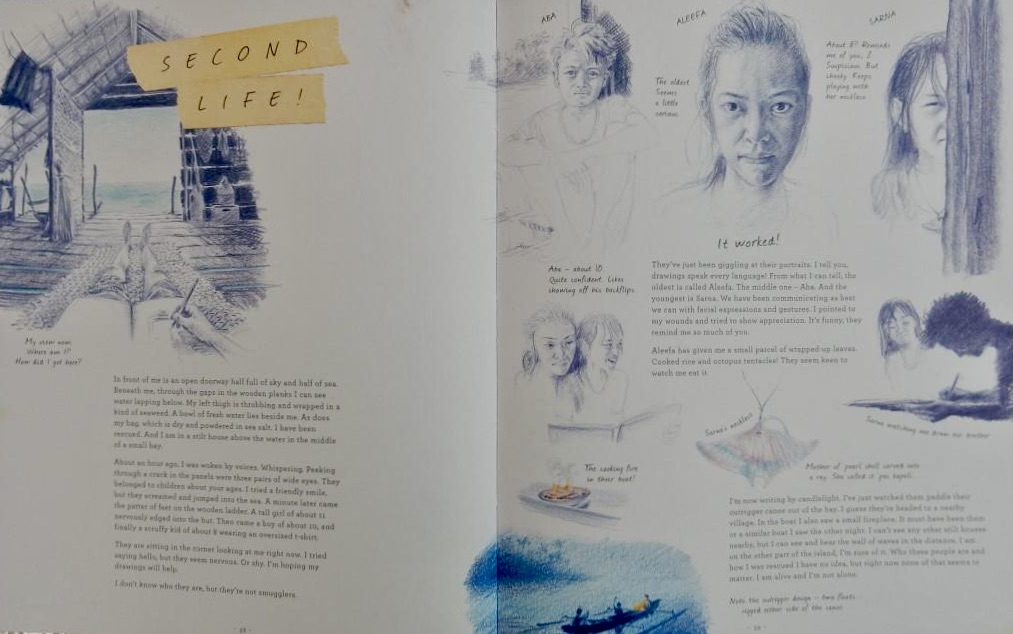
Big Bad Wolf Investigates Fairy Tales

Behind every fairy tale is a ‘what if ?‘. Behind all scientific discoveries also lies a ‘what if ?’. Bring the two together as author Catherine Cawthorne does here and the result is a really fun debunking of six of the most popular fairy tales by none other that the lupine villain of several of them.

First to come under his scrutiny is The Three Little Pigs and here, as with the others, he presents the story first and then on the next spread, proceeds to ask some somewhat crazy science questions. All this is illustrated in hilarious cartoon strip style by Sara Ogilvie. Readers learn that in fact, let alone not having hair on their chin chin chins, pigs don’t even have chins; it’s only we humans that actually have chins. As for a wolf huffing and puffing to blow down a house, even one made of straw: no chance there on account of having the wrong kind of lips. A whale would certainly do way better but then what would one of those be doing on land in the first place? Should little humans wish to test their own huffing and puffing, there’s a suggestion using a paper straw and a Malteser.

What about a gingerbread house: have you ever pondered upon what would happen to a gingerbread house in the rain? Probably not but courtesy of our scientifically minded wolf, you can try the gingerbread collapsibility test and find out.

As for that cunning pea test in The Princess and the Pea, the Queen devises to determine who is a real princess – it’s totally nonsensical: nobody could feel a single pea through all those mattresses. All you need to confirm this is a small Lego head (or a dried pea), all the pairs of pants you can find (don’t raid the dirty washing basket though) and a wooden chair. What fun – a Princess Bottom Pants Sensitivity Test.

Brilliantly quirky is the way Catherine and Sara have created this STEAM book that children will absolutely delight in. There are hours of investigative fun as well as hilarious retellings energetically illustrated by Sara.. Some of my family members tried out the huffing and puffing test and had great fun but came nowhere near the world record mentioned in the text.

Small Steps, Big Change

Containing fourteen suggestions, this book talks children through the United Nations Sustainable Development Goals in a straightforward manner. These everyday goals are presented in an upbeat style by iconic emoji-like heroes and are the kind of things even young children can do to make a difference to our world such as switching to meat free veggie meals, reducing the amount of plastic (think of all those rubbishy plastic toys that are attached to comics as come-ons to make little ones spend their pocket money on them), remembering to turn off taps and collecting rain to water the garden.

Each one is illustrated by James Jones whose scenes are alluring and playful.

Bursting with great ideas, a copy of this needs to be in every primary classroom and adults could do well to read it too. It’s all too easy for busy people to forget some of the simplest things – turning out lights, unplugging mobiles when charged – that can contribute to making better tomorrows for everybody.

Super Swifts / Night Flight

Astonishingly, swifts (champions of the bird world) are able to fly faster and higher than any other birds; even more astonishing is that they might stay airborne for as much as four years, flying up to seventy miles per hour.

Author, Justin Anderson begins this swift story in central Africa’s Congo region in early April and tells of the journey undertaken by one female in particular who with a group, flies from their place of overwintering, towards Europe and their destination in the UK.
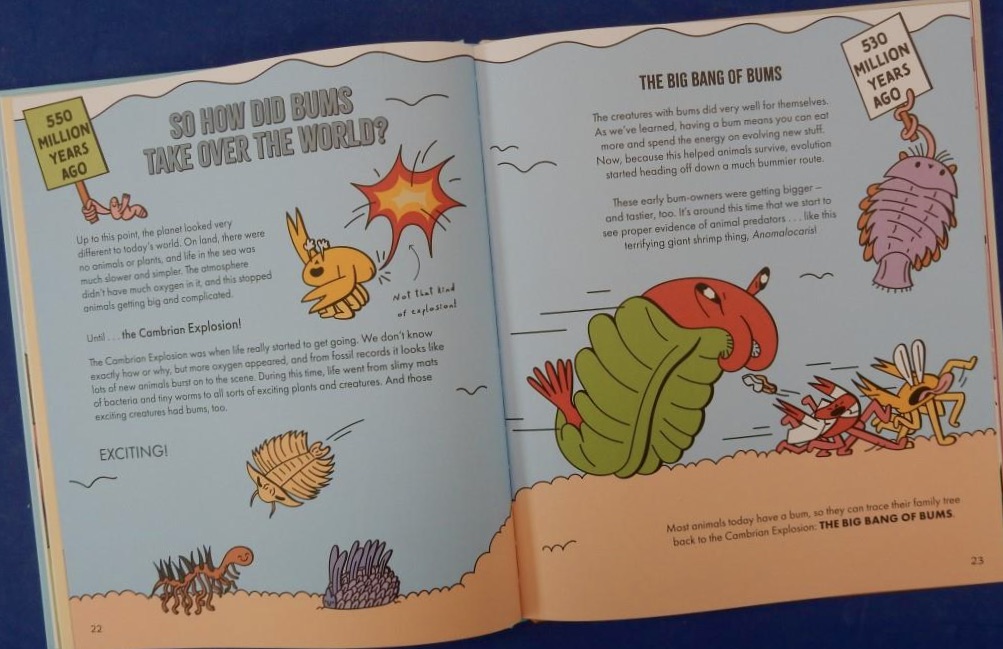
A month long journey that takes them over the world’s largest desert, across vast oceans, through thunderstorms to the place where our female will look for her mate, a bird she’s not seen for a whole year.

Clover Robin’s mixed media close ups of the pair show them making a nest in which the female lays three eggs each of which hatches into a hungry chick.

I love the author’s description of the pair sticking ‘their nest together with their spit, which sets hard like superglue.’ Come July, it’s time for the mother to make her return journey to Africa; she and the other super swifts will once more take to the skies.

On each spread, there’s a main narrative, alongside which is further information printed in smaller type. An inset box gives fascinating details of swift lice that nestle in young birds’ feathers and breed when the swifts nest again. A final author’s note contains information about some of the swift species and gives ways in which readers can help prevent swifts nesting in the UK from dying prematurely.
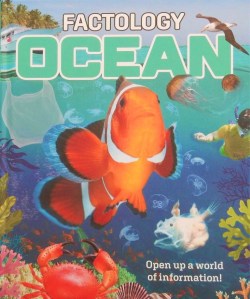
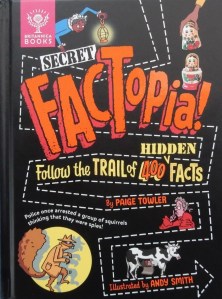
I’m looking forward to hearing their screeching cries as they fly over our house this summer.

Also on the subject of birds is a book wherein fact and fiction come together.