Little Bad Wolf

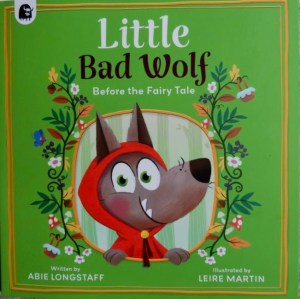
This is not so much a fractured fairytale more a fairytale prequel.
We first meet the wolf – Baby Wolf – as a cute looking creature but with the habit of gobbling up anything that makes him cross. This distresses his mother and also on his first day at school, the teacher and fellow pupils. Needless to say Wolfie does not get the Star Pupil badge at the end of the week.
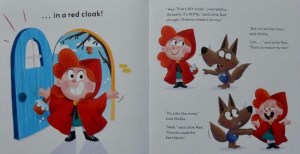
The following week though, our lupine resolves not to eat anything annoying, the result being he’s Star Pupil that Friday. His Dad is especially proud and makes Wolfie a swishy red cloak onto which is stitched a golden heart. Almost immediately Wolfie gets blueberry jam on the cloak’s hem.

One lunchtime the cloak disappears and who should arrive the next day but Little Red; guess what she was wearing. Wolfie is certain the garment is his but Little Red comes up with reasons why it’s hers

and this makes him want to revert to his old ways, but the teacher grabs him just in time. Little Red is absent the day after: she’s moved to Australia, so the teacher tells Wolfie who thinks he’ll never regain his cloak.

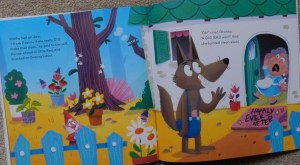
Years pass, Wolfie grows big and and stops (more or less) consuming annoying things. Then who should appear in the woods but a considerably larger Little Red, still wearing the cloak. “Everyone calls me Little Red Riding Hood now, because of my famous cloak,” she announces, going on to tell Wolfie that she’s off to visit Granny. Now, thinks Wolfie, this is my opportunity to find out if Granny really did made the cloak so he dashes off beating Red to Granny’s abode

and stows her safely away. Rather than spoil this hilarious story, that’s where I’ll leave things.

This is a great read aloud: when I shared it with a five year old relation, her ten year old brother stopped what he was doing to listen in, transfixed by the story even though he couldn’t see Leire Martin’s dramatic portrayals of the action with their fun details.

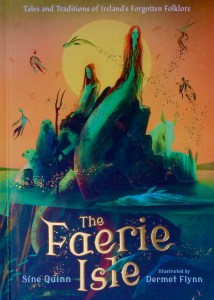
The Faerie Isle: Tales and Traditions of Ireland’s Forgotten Folklore

In this collection of Irish folklore you will meet all manner of faerie beings each of which has an introductory fact page that precedes the story. For example Giant tells of.their enormous height, awesome strength and fights, mentioning such as Fionn mac Cumhaill and the tale Stomping Ground relates how two cow eating giants, seen by a boy and his grandmother, fall asleep in a field. In the next field the grandmother keeps her beehives and she engineers that her bees should attack the giants, sting them so badly that they never go anywhere near her place again.

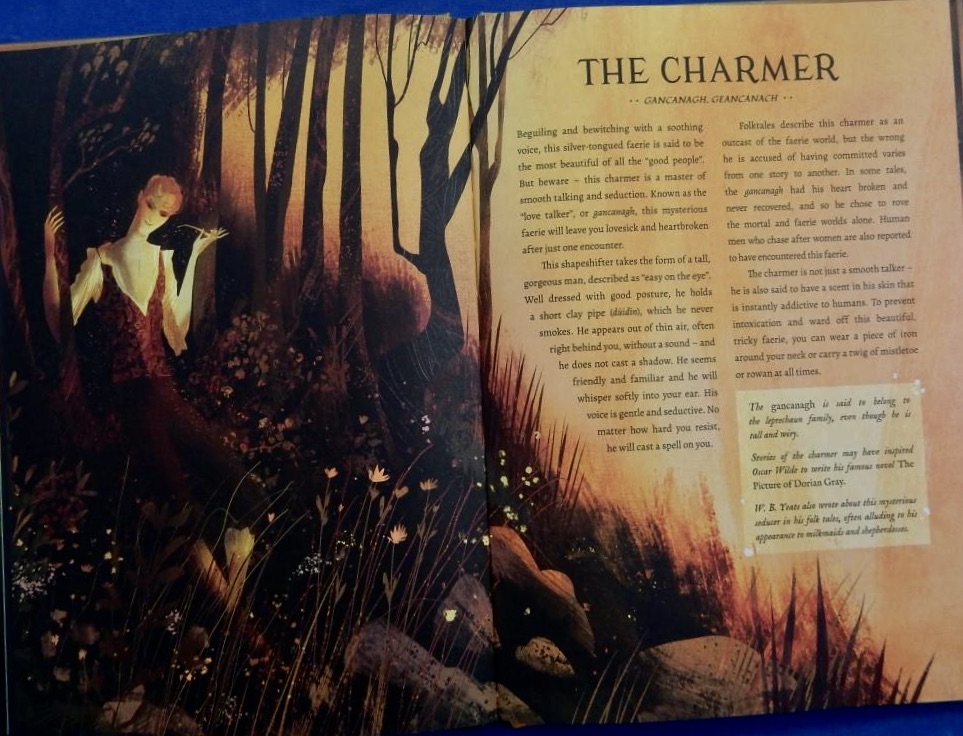
Then there are the shapeshifters of which there is an abundance in Irish folklore called piseoaitthe (charm setters) . One I found particularly fascinating is The Charmer, a silver-tongued faerie said to be the most beautiful of all the ‘good people’.

Also known as the ‘love-talker’ this mystifying faerie with his seductive voice, (supposedly a member of the leprechaun family), is able to leave a person trapped by unrequited love as was red haired Nora in the story that follows. One evening we read, she encounters a mysterious handsome stranger who charms her completely only to vanish almost immediately leaving the girl devastated to the extent that, so the story goes, she still walks the road whereon she met him, searching for her faerie lover.

Selkies, mermaids, a banshee and sheeries also wait to enrapture readers between the pages of this Faerie Isle. Anyone with an interest in folklore, especially those with some Irish blood running through their veins will be fascinated and enchanted by Sine Quinn’s text that has been richly illustrated by Dermot Flynn whose portrayals of the faerie folk range from utterly spine-chilling to alluring.

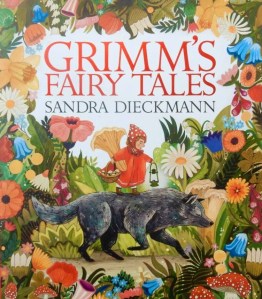
Grimm’s Fairy Tales

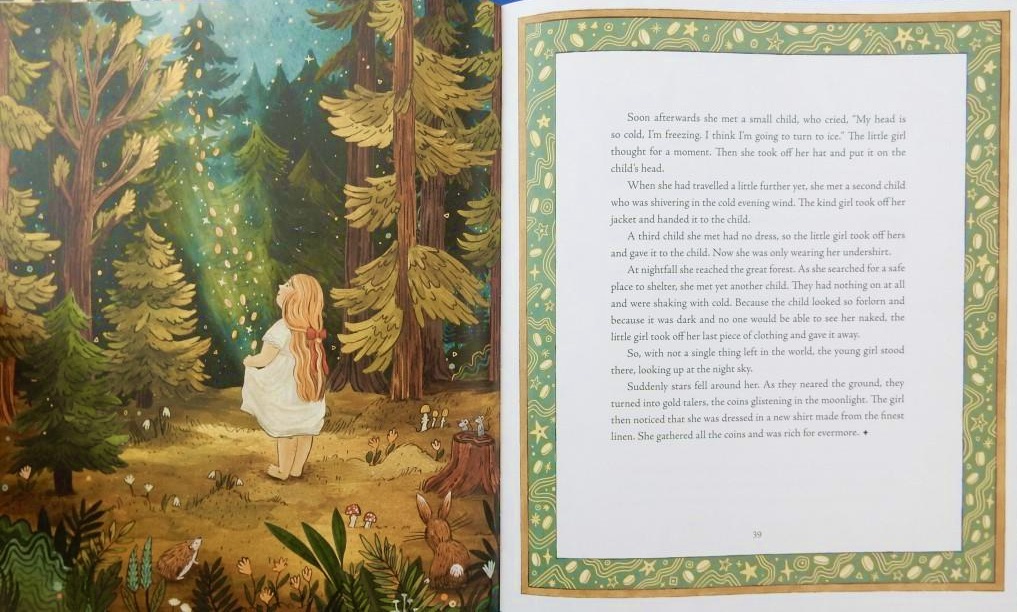
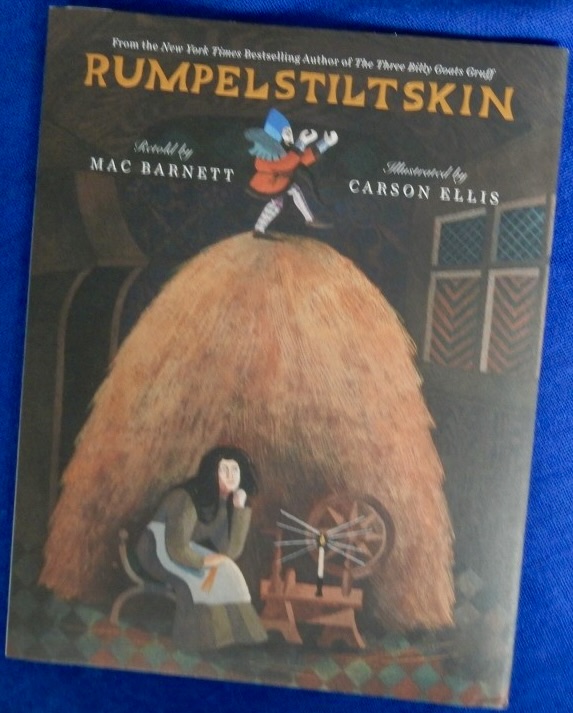
Inspired by her childhood in Germany, Sandra Dieckmann presents twenty of Grimm’s fairytales. most of which are well known, such as Sleeping Beauty, Rumpelstiltskin, Hansel and Gretel and Cinderella, others less so. The latter includes Jorinda and Joringel – about two lovers and a wicked sorceress, and one new to me, The Star Talers wherein a little orphan girl wanders the forest with just the clothes on her body and a piece of bread in her pocket. One day the lonely child meets a poor old beggar man asking for something to eat. She gives him the whole piece and then on coming upon a little girl who declares that she’s freezing, gives the little girl her hat. The third child she meets has no dress and the little girl gives hers to child three leaving herself clad in just an undershirt. Come nightfall, alone in the forest the kind girl stands staring up at the sky

and suddenly something magical happens: she’s clad in a new shirt of the finest linen and has sufficient gold coins to make her rich for life.

Strikingly illustrated throughout with a mix of presentations from a double spread devoted to a single picture of Sleeping Beauty to beautiful borders, with its subtle feminist twist, this is a wonderful book to buy, to treasure and to give.

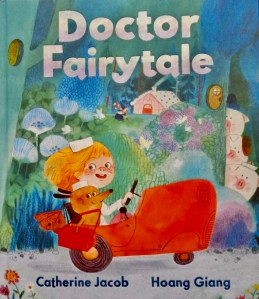
Doctor Fairytale

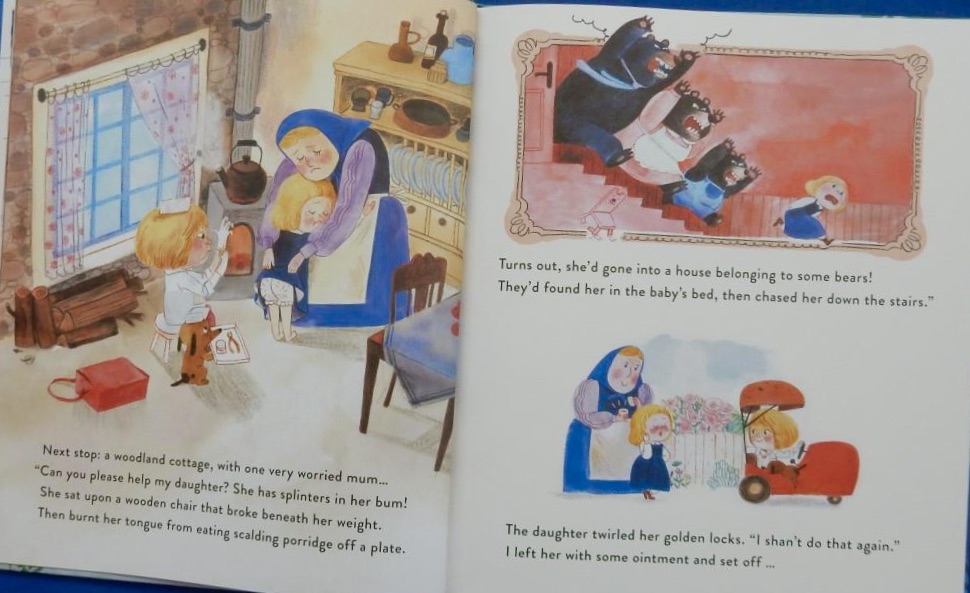
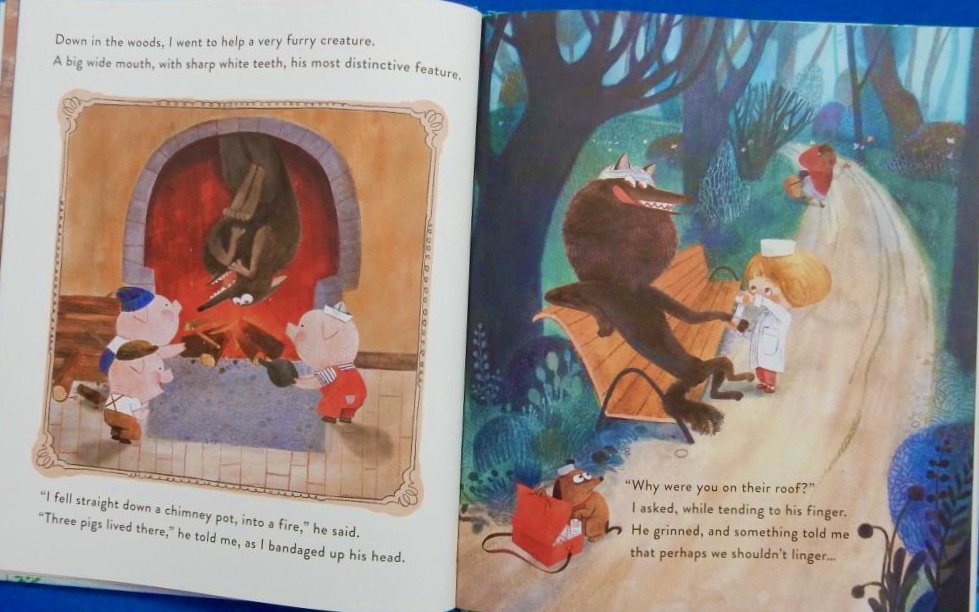
This is a rhyming spin on favourite traditional tales wherein a young girl physician and her assistant spend a rainy day administering to popular fairytale characters. The first is Cinderella – poor thing, her feet are covered in large blisters and her toes red and raw; Goldilocks’ bum is full of splinters after breaking a wooden chair and her tongue scalded from porridge she consumed hastily.

The big bad wolf has some very nasty burns having tumbled down the three pigs’ chimney into a fire;

Snow White falls into a deep sleep after biting into a rosy apple but during the doctor’s visit it’s not the patient but the doctor who ends up feeling poorly.

After a hectic day the little physician gets caught in a heavy downpour and reaches home soaking wet and feeling really ill herself. She retires to bed and as she rests she gets a big surprise: all the patients who received her care during the day have come to pay her a visit, something she well deserves after giving each of them her kind consideration and tender care.

I love the playful treatment of the fairytales and the way Catherine Jacob cleverly adjusts some of their endings, something children will delight in I’m sure. Hoang Giang’s warm, slightly quirky illustrations range between double page layouts to vignettes and youngsters will enjoy all the playful details and spotting the additional fairy tale characters not mentioned in the text. A gem of a book to share with those who are already savvy with the original stories.

Big Bad Wolf Investigates Fairy Tales

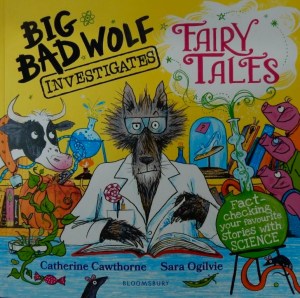
Behind every fairy tale is a ‘what if ?‘. Behind all scientific discoveries also lies a ‘what if ?’. Bring the two together as author Catherine Cawthorne does here and the result is a really fun debunking of six of the most popular fairy tales by none other that the lupine villain of several of them.

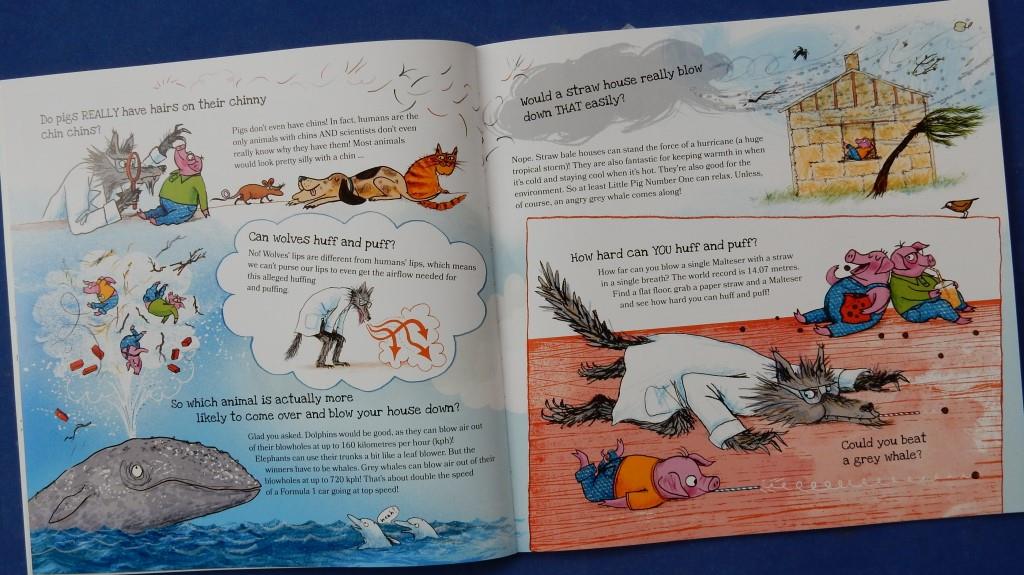
First to come under his scrutiny is The Three Little Pigs and here, as with the others, he presents the story first and then on the next spread, proceeds to ask some somewhat crazy science questions. All this is illustrated in hilarious cartoon strip style by Sara Ogilvie. Readers learn that in fact, let alone not having hair on their chin chin chins, pigs don’t even have chins; it’s only we humans that actually have chins. As for a wolf huffing and puffing to blow down a house, even one made of straw: no chance there on account of having the wrong kind of lips. A whale would certainly do way better but then what would one of those be doing on land in the first place? Should little humans wish to test their own huffing and puffing, there’s a suggestion using a paper straw and a Malteser.

What about a gingerbread house: have you ever pondered upon what would happen to a gingerbread house in the rain? Probably not but courtesy of our scientifically minded wolf, you can try the gingerbread collapsibility test and find out.

As for that cunning pea test in The Princess and the Pea, the Queen devises to determine who is a real princess – it’s totally nonsensical: nobody could feel a single pea through all those mattresses. All you need to confirm this is a small Lego head (or a dried pea), all the pairs of pants you can find (don’t raid the dirty washing basket though) and a wooden chair. What fun – a Princess Bottom Pants Sensitivity Test.

Brilliantly quirky is the way Catherine and Sara have created this STEAM book that children will absolutely delight in. There are hours of investigative fun as well as hilarious retellings energetically illustrated by Sara.. Some of my family members tried out the huffing and puffing test and had great fun but came nowhere near the world record mentioned in the text.

The Magic Callaloo

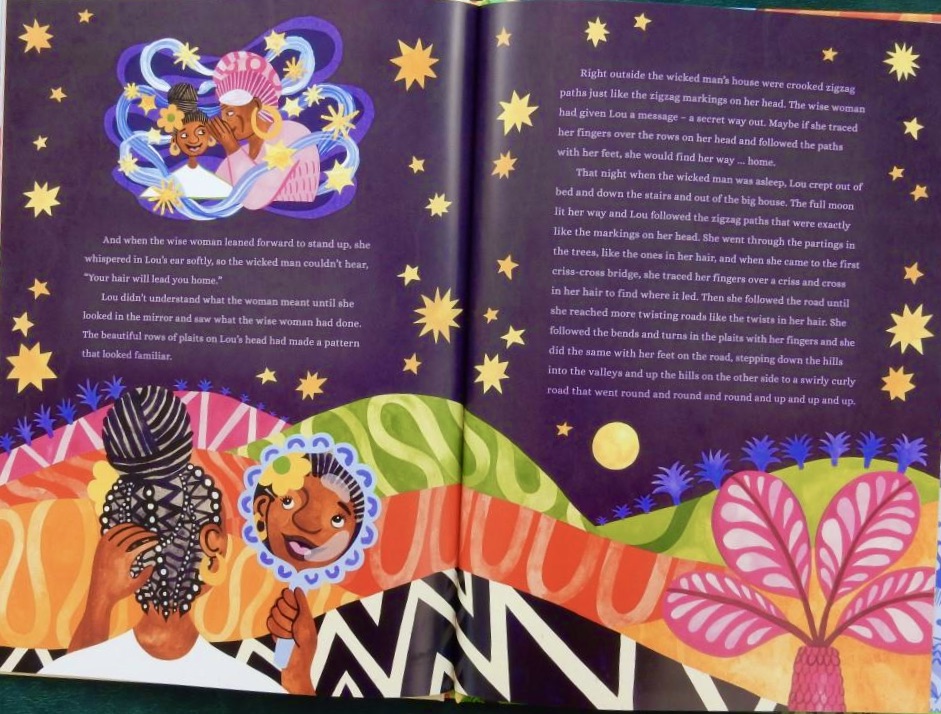
Inspired by stories of enslaved Africans who made patterns in their cornrowed hair, using them as maps to help them escape to freedom, Trish Cooke’s neo-folktale has its origins in Rapunzel, made popular by the brothers Grimm

It begins in a small village, long ago and far off where there grows a magical callaloo plant that would grant the wish of any villager who ate one of its leaves. Thus all the villagers had everything they needed; but one of those living in the village was selfish and greedy. One night this greedy man creeps into he square, uproots the plant and makes a wish: to have the plant for himself. He then proceeds to eat more and more leaves, making wishes for more and more things until he had so much he could barely move. His laziness of course, has an adverse effect on the callaloo: it shrinks until just one leaf remains.

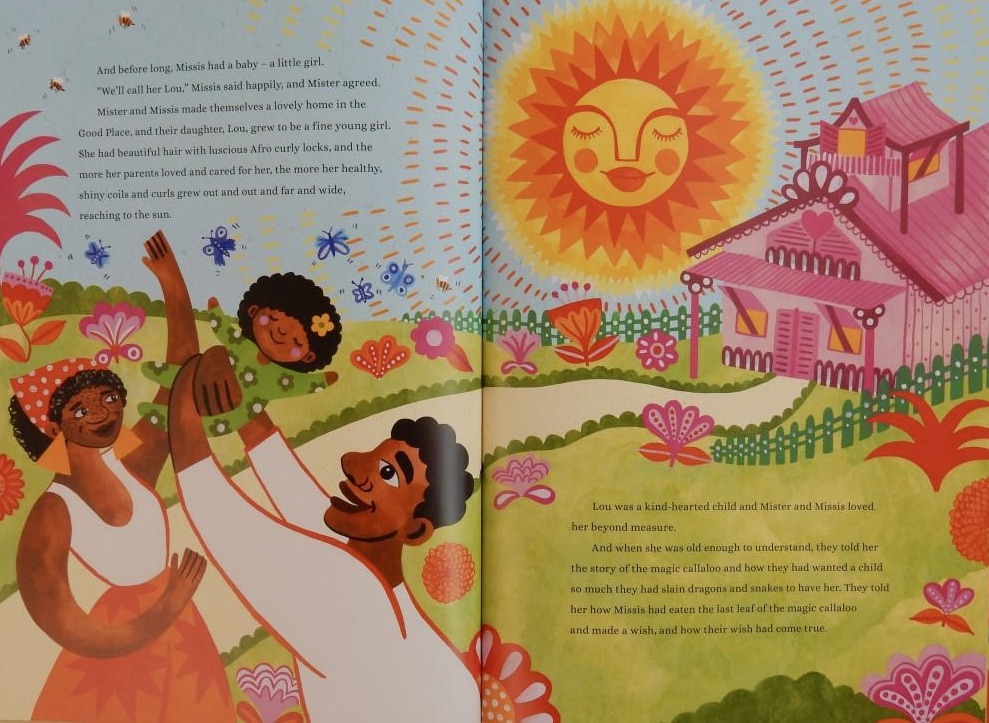
Back in the village, a couple hoping desperately for a child, are greatly distressed at the disappearance of the plant as their hope was that it could provide them with their dearest wish. Then one evening a wise woman tells them where the last leaf is and with renewed hope they begin to search, eventually locating the plant. The Missis eats the final leaf and both she and Mister wish for a child. Before long, to their joy, a baby is born and they call her Lou.

The girl grows into a kind, beautiful curly-haired girl and her parents tell her the story of the magic leaf. Lou makes up a magic callaloo song but her singing bothers her father in case someone overhears its words. Sure enough, the plant thief happens to pass through: he hears her song and snatches her away to his home where he keeps her prisoner, making her do all his work.

Both Lou and her parents grow ever more miserable, missing each other all the time, till years later who should come along again but the wise woman. Lou tells her of the cause of her sadness and the woman formulates a clever plan using the girl’s tresses which she twists into plaited patterns, quietly telling Lou, “Your hair will lead you home.”

However something else also returns with her.

With themes of longing, captivity and escape, Trish Cooke’s wonderfully woven tale is impressively embroidered with Sophie Bass’s art, which includes a wealth of flora and fauna in kaleidoscopic colours making every turn of the page a visual feast. This longish story will enchant readers across a wide age range.

The Shade Tree / Rapunzel

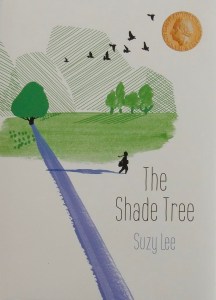
This is a re-telling of an old Korean folk tale wherein we see how a young traveller tricks a rich but heartless man into selling him the shade from the tree that grows on the latter’s land. The rich man considers he’s made some very easy cash but hasn’t considered the effects of the lengthening shadow of his house as the day progresses.Whatever the shade touches is thus owned by the traveller, and he can share it with whomever he wishes. Furthermore when the shade covers the rich man’s house, the traveller can enter that house, which he does,

eventually causing the wealthy one to move out. Once the house is vacant the traveller settles down and enjoys life as the new resident.

Much of the power of this thought-provoking telling lies in its simplicity, simple too is Suzy Lee’s art; it’s almost abstract in style and uses a limited colour palette to effect. With its dramatic gatefold, this is altogether an unusual book that feels at once both old-fashioned and contemporary. It would probably appeal most to older readers especially those with an interest in folk stories.

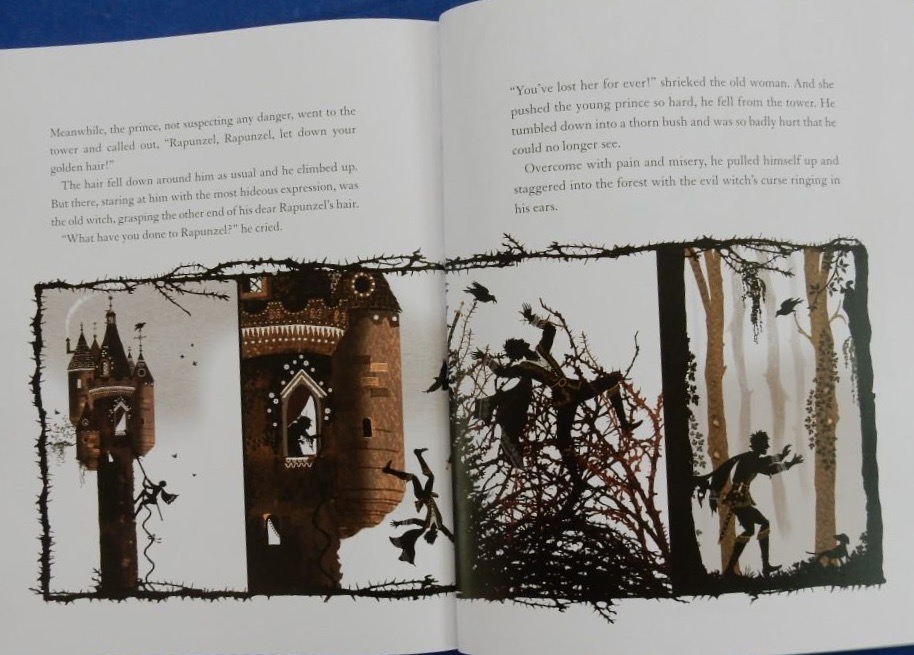
Sarah Gibb has taken the original classic fairytale and turned it into a visual feast.with a mix of gorgeous silhouettes and delicate, detailed colour illustrations, without losing any of the essential elements of the plot in her simplified telling. We still have the drama: the witch discovering the young husband helping himself to the salad leaves from her garden to cure his ailing wife and his promising to give her the baby when born in return. And romance: the baby Rapunzel becoming a beautiful girl incarcerated in a tower, who is visited by a prince and the two eventually marrying.

Rapunzel’s tower is illustrated in true fairytale style, with turrets and weathervanes, vines and roses
and the contrasting silhouette style prince staggering through the forest having been seriously hurt as a result of his fall from the tower.

Recently reissued with a new cover, I suggest that if you are looking for a highly pictorial version of the fairytale, look no further than Sarah Gibb’s offering.

Cinder & Ella / The Selfish Giant

Cinder & Ella
Barbara Slade and Lucia Soto
Owlet Press

Kind, clever and beautiful, Cinder lives a life of drudgery with her mean stepmother and idle stepbrothers. Nothing she does seems to please them, but what pleases Cinder herself is dreaming, not of a handsome prince, but a gorgeous, long-haired girl with blue eyes, who happens to be a princess.

Princess Ella too has dreams but as yet she can’t quite imagine what they might lead to. What she does know though, is the reason why her royal parents are hosting a ball to honour her eighteenth birthday. It’s a celebration to which everyone in the land is invited and one that thrills Cinder’s stepmother, who imagines either of her son’s as the perfect partner for the princess. In their separate abodes both Cinder and Ella are distraught.

Come the night of the ball. Cinder is left with countless chores to do while her stepmother and stepbrothers go off in their carriage. As she sits thinking of all those desirous of winning the heart of Ella, she hears a deep whisper, “Make a wish,” coming from Midnight, her horse. Surprised, she does so and magic happens. Her old ragged clothes become a fine outfit and a pumpkin becomes a gold carriage, pulled of course, by Midnight. On arrival he gives the twelve o’clock warning about the magic expiring and off goes Cinder into the palace ballroom.

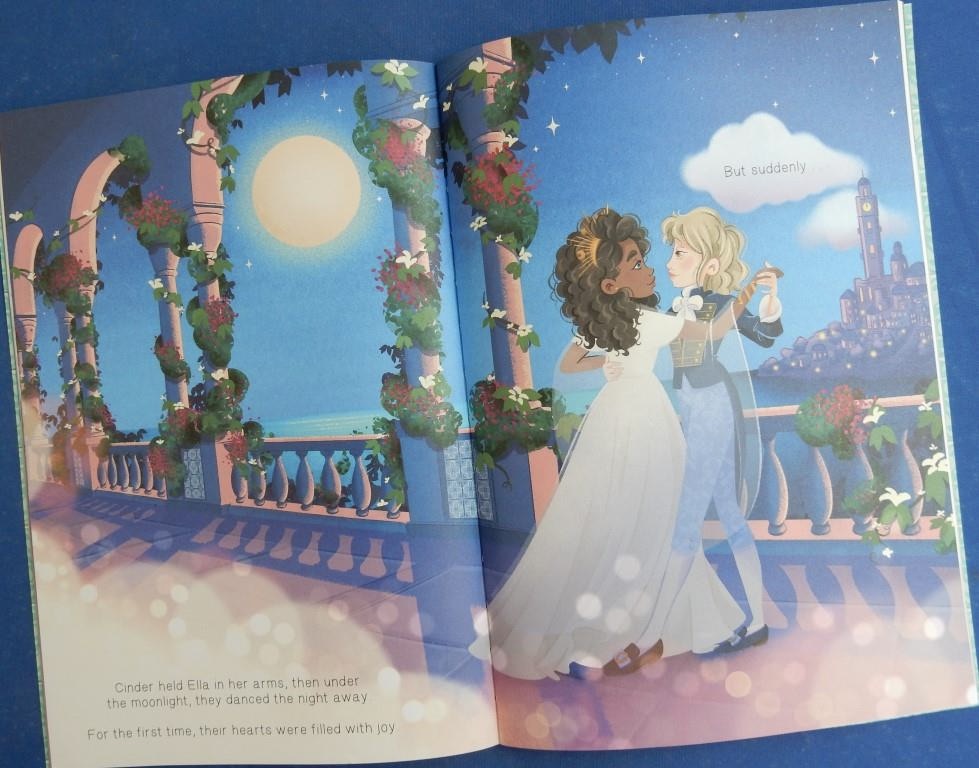
So enraptured with one another, are they that Princess Ella and Cinder dance the night away 

until that fateful midnight chiming begins and off dashes Cinder. Can the two overcome the odds and get their happy ever after? Let’s say that in this instance, thanks to hope, a special horse

and determination, love’s power prevails.

Just right for celebrating Pride Month, this is an enchanting reworking of a favourite fairy tale.

The Selfish Giant
Oscar Wilde, illustrated by Rita Voutila
Allen And Unwin

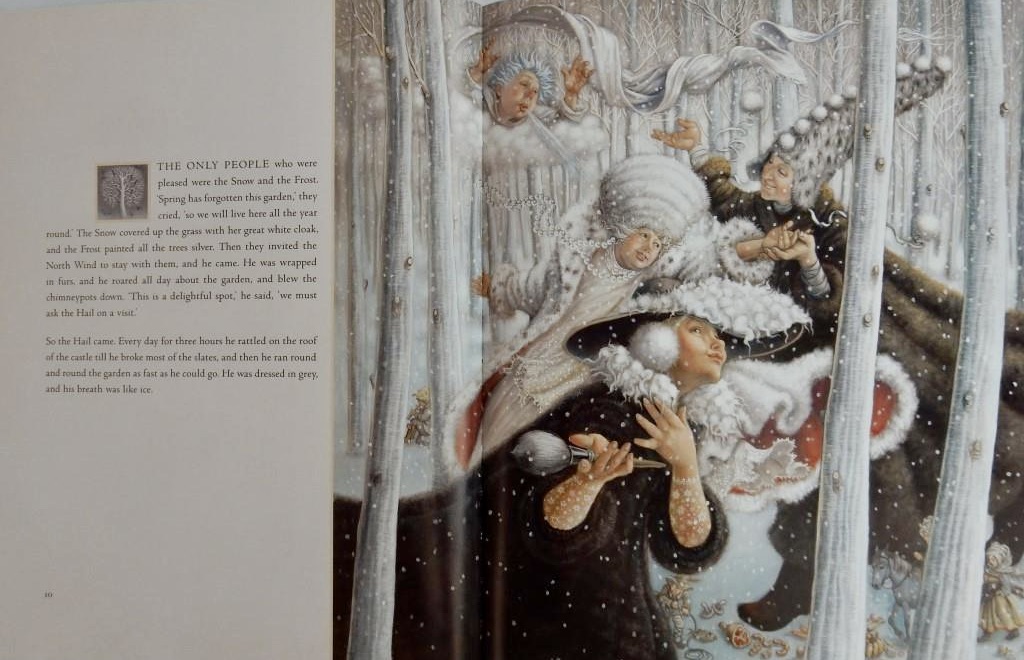
Richly coloured, finely detailed oil paintings grace every spread of this classic Oscar Wilde story of the self centred giant who returns from a seven year absence spent staying with his Cornish ogre friend to discover children playing in his garden. Children he immediately bans by erecting a high wall and putting up a ‘trespassers will be prosecuted’ sign. The only visitors that enjoy the garden for a whole year are the winter elements, Snow, Frost, the North Wind and Hail; 

the children are forced to play outside in the road.

As many adult readers will already be aware though, those children eventually creep back in, the giant sees the error of his ways and even helps a small boy trying to climb a tree. The remainder of the tale, which takes place over years, is told in the text of the book.

With lots of Christian symbolism for those who want to look for it, the story is a powerful lesson in selfishness and its consequences; Rita Voutila’s Northern Renaissance style art has a power of its own.