The Clean-Up Monster / My Dinosaur Shoes

These two board books feature happenings in the daily lives of neurodivergent siblings Roscoe and his elder sister, Ivy.

In the first, when their mother tells the children that it’s time to tidy up the job seems an overwhelming muddle of dough and toys. If only the ‘clean-up monster’ would come to their aid. Roscoe begins in completely the wrong way, getting more out, so he moves on to the dough but Ivy doesn’t like his way of tidying with container lids not matching the dough colours. The containers for the various toys all have visual signs indicating what goes where thus easing the process and then Mama appears in playful mood with the vacuum cleaner aka the clean-up monster.

In My Dinosaur Shoes, Roscoe is out-growing his soft, comfortable puppy shoes, his sister certainly thinks so. However Roscoe maintains that they’re not much too small and he definitely doesn’t need new ones. Ivy shows him some dinosaur shoes in a larger size, as well as pictures of other possible options. Roscoe ponders on them all but decides that he wants none of them. Ivy places the dinosaur shoes where her brother can see them every day and become accustomed to so doing.

Then one day his puppy shoes no longer feel comfy and soft. It’s time to try the dinosaur ones and hurrah1 they are absolutely perfect. Of course, he’s become used to seeing them so they no longer seem new.

The author, who is neurodivergent, explains on the back covers of both books that she developed her own strategies to use with her young neurodivergent children when the usual ones failed to work for them. These are illustrated in the simple stories for which Danamarie Hosler (also neurodivergent) shows Eleni’s strategies in action. Any parent/caregiver could benefit from adding these ideas to those they use already and little children will enjoy the simple stories.

One Cherry, One Cheetah

Originally published as a smallish hardback, it’s great to see this available in board book format.

A dozen exquisite watercolour and gold leaf paintings, all except one of wild animals, are to be found in this super-stylish counting book. To start with there is just one cherry – it’s almost begging to be eaten immediately. Turn the page and there are two regal dogs face to face . and ‘two balls, one big, one small.’ Then follow three bears, three bowls, three silver spoons.’ The next spread gets one wondering: why ‘Four fine foxes, sharing strawberries’ but they have only three strawberries.

Next come five elephants, elegant for sure, walking nose to tail but one of the them is sans elegant Indian style regalia. why one wonders. The six cheetahs are clearly having fun playing pat-a-cake, each pair with tails entwined. The seven pandas – giant ones – have ‘pretty painted parasols,’ five of them: two are sharing and another has a fan. (Love the alliteration in that sentence.)

Eight clever otters, two sporting sunhats, juggle with small stones
The nine white mice, so we are told, are ‘happy as can be’ though I have to say that to me at least two look rather downcast as they partake of the tea served with a ladle from a large pot into tiny china teacups..
Then, we have the one cheetah again, only now it has ten cherries. What do you think it will do with those? The final spread reveals all, or rather, a cheetah, thoroughly sated, one imagines, beside a row of …

Make sure to peruse the endpapers, they too are lovely: the front depicts ornately decorated numerals plus the cheetah and a cherry; the final one is a chart of numbers 1 to 10 but there’s no cheetah in sight. Maybe it’s exhausted from orchestrating the numbers at the front.

Every illustration offers both a wealth of aesthetic possibilities and opportunities for speculative and extended talk with a young child.

Play and Learn with Board Books

This is a sturdily designed, wordless book with a cover that acts as a container for the free-standing pages that fold in and out accordion style and it’s intended to be used with a baby lying on its front.
There’s a mirror, followed by illustrations, mainly black and white with splashes of colour that show a wide variety of items such as geometric shapes, faces and animals. Little ones can develop their fine motor skills by tracing trails, as well as developing their language, especially if an older person is using the images as starting points for talk.

This is the fourth story in the interactive Busy Chores for Little Paws series.
Lion’s neighbour, Bear, is coming to pay him a visit so Lion decides some tidying up is required. There are art materials scattered on the rug that need to go back on the shelf, crockery in the sink waiting to be washed up and put away, a dirty worktop to wipe and floors in need of a run over with the vacuum cleaner. Lion, with the assistance of little humans who use the slippers, flaps and wheel, get the work done just before there comes a knock on the door. Hurrah! Lion can welcome his friend to a spotless home.
Ideal for developing fine motor skills and beginning sound/symbol awareness by joining in the splish splash … chink … spray… whoosh and knock! knock! sounds.
There’s more interactive fun in:

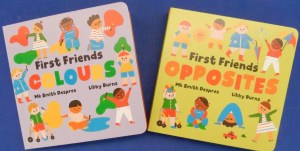
First Friends: Colours, First Friends: Opposites / Don’t Ever Mess with a Monkey

Colours begins with the nursery children and their teachers heading outside to play. The instruction is, ‘Look high, look low. / Look all around!// So many colours/ to be found.’ There are black ants marching across the sand, pink worms wiggling on two children’s hands, a red slide, a blue swing and a purple bar to swing along, as well as a wonderfully messy opportunity to use mud and leaves to create mudpie faces. Meanwhile at the water tray a floating and sinking activity has yellow, orange and white objects to test. Then just before snack time everybody blows bubbles with rainbow colours. The final spread encourages interactive learning with a ‘can you find’ showing all the coloured items featured throughout the book.
In Opposites, we join the children preparing for a rest time with some winding down movements that involve stretching high and low, then yawning, mouths open and sleepy eyes closed. When everyone wakes up, some are smiling, others frowning as they stack the mats up and take down the toys.
During the remainder of the session the narrative builds in other opposites – empty/full, small/big, behind/ in front and the final spread asks listeners to act out eight pairs of opposites.
Both books have bright, inclusive illustrations that show a diverse cast of characters.

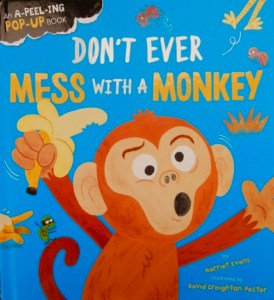
The latest in the Don’t Ever pop-up series features five wild animals that live in the savannah region. Readers/listeners are warned against riding a zebra, boxing with hyenas, question the decision of rhino, rob an ostrich or give a monkey food that isn’t to its taste. For sure, the results will be far from pleasant for anyone who ignores the warning on each spread.
Harriet’s rhyming text accompanies David Creighton-Pester’s dramatic scenes, each of which includes one or more bit part players that young children will enjoy spotting

Board Book Trio

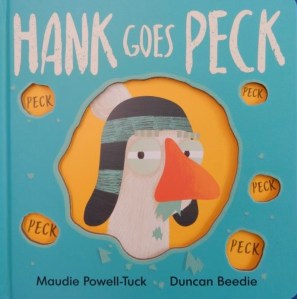
If you’ve read anything about Hank, then you’ll already know that he likes to make trouble for others. Now he’s not honking but pecking and at the request of a small rodent, little humans are immediately involved in the story by keeping an eye – preferably both – on what he gets up to on the farm. Oh dear! The first thing he does is to stick his beak into the trampoline on which the chicks are bouncing. What a pesky creature. As you might expect though he just cannot keep that beak to himself: next he sticks it right into the limo holding a trio of pigs. Surely that’s enough sticking his beak where it’s not wanted so he’ll leave the old sheep in peace to get on with her knitting. Oh NO! spoke too soon, but Mouse has said he must take time out and consider the error of his ways. Apparently temptation gets the better of him however as he struts past the bull without heeding Mouse’s warning. Has he learned his lesson at long last? I wonder …

Hank’s preposterous behaviour is wryly depicted by Duncan Beedie and Maudie Powell-Tuck’s text offers plenty of opportunities for sound making and action from young listeners who will enjoy emulating Hank’s pecking and the sounds made by the animals he upsets.

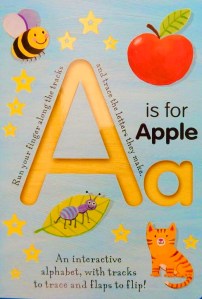
With flaps to lift and tracks to finger trace, this alphabet book clearly illustrated will immediately get little learners involved. They can trace the capital letters with the help of the arrows and then lift the flap on each page and discover something else starting with the same letter, this time written with a lower case starting letter. Better still, children can try to guess what is hidden before opening the flaps. Simple, playful interactive learning and on the back cover are some hints for parents/carers.

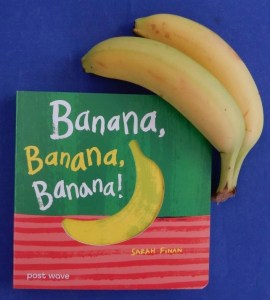
This is the second in a series of board books encouraging healthy eating from new publisher Post Wave.
Sturdily built to stand up to numerous readings, it’s told through a simple, jaunty rhyme and bold, bright illustrations with a clever die-cut on each double spread. The small children we meet in the book love to eat bananas in various situations and forms including as a smoothie slurped through a straw, sliced up for breakfast or lunch, to fill a hungry tum during a car journey or as a pre-bedtime snack. It’s good to see that even such young children know that the skin from a banana needs to be disposed of properly – in the bin, not tossed aside onto the pavement as a potential slip-hazard.

We Love Veggies! / I Really Really Need A Wee

These are two recent board books from Little Tiger: thanks to the publishers for sending them for review.

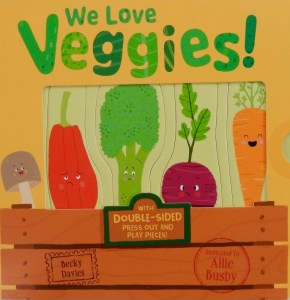
This is in the same style as We Love Fruit and again gives young children permission to play with food, albeit of the card variety. Having set free the double-sided veggie characters from the sliding tray inside the front cover of the book, child participants need to follow the clues given on each page and then select the appropriate cardboard piece. Can they work out which vegetable grows underground and is liked as food by rabbits? Or can they decide what vegetable is mostly made of water, has a purple, glossy skin and pale flesh?

A fun interactive guessing game with gently humorous illustrations by Ailie Busby and text by Becky Davies. Once you’ve shared the book a few times with toddlers it’s a good idea to introduce them to the real vegetables and to talk about how important it is to include ‘yummy’ veggies in a healthy diet.

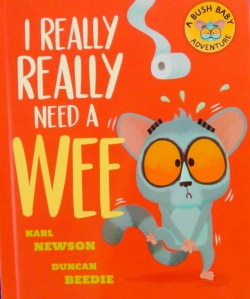
From the body language and facial expression of the bush baby on the cover of this one, you know you’re in for a tricky time, one that will surely be familiar to adults who have been out with little ones
Here, the creature narrator’s attempts to distract himself make things worse and his efforts to find a place to relieve himself are disastrous. Eventually however, the object of bushbaby’s intense desire is in sight but almost inevitably, there’s an extremely long queue. When finally the little room is at last vacant, ‘woohoo!’ what a huge relief . But very soon after … you’ve guessed it …

Little humans will find this wee-ally funny. They’ll delight in Karl’s rhyming telling and Duncan’s side-splitting scenes; together they’re almost enough to make them wet themselves.

Won’t Go! / Not Tired!

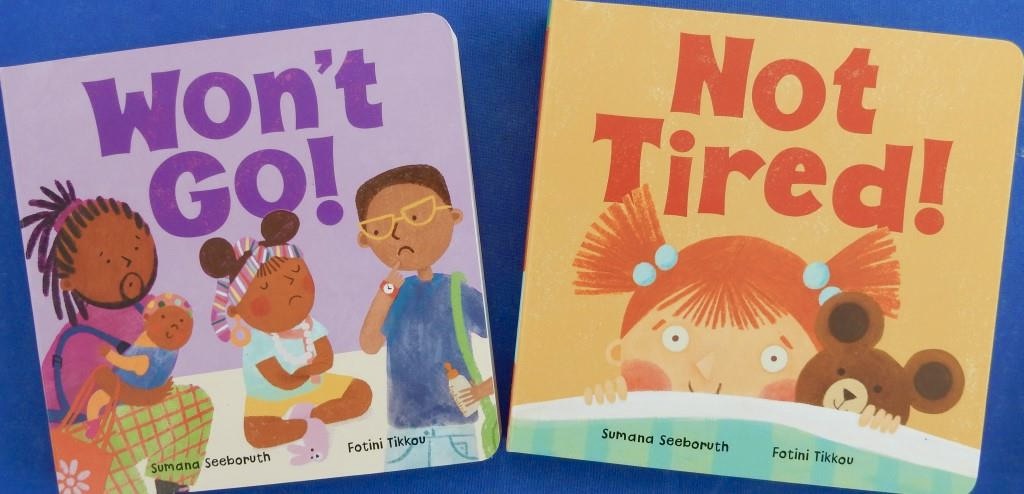
Both books are part of the publisher’s Feelings & Firsts series and with their bright expressive illustrations and simple words told from the featured child’s perspective, are worth having if you have a very young child.

Won’t Go! shows a small girl busy playing at home and protesting about being told she must stop and go elsewhere. Eventually though, after some playfulness on the part of one of her dads, it’s off to the ballet class. There however, all the other pupils are wearing blue, but fortunately the teacher has a pink dress and shoes in a similar hue to those of the little protagonist. This makes all the difference both during the lesson and afterwards when her dads arrive to collect her with the baby.

Not Tired! presents another situation that the majority of parents/carers will be familiar with. A small child wants to continue playing and certainly isn’t ready for bed. There follow a plea for another book, another snuggle and some shenanigans over a missing teddy bear until at last the little one has tired herself out and is ready for that goodnight kiss before falling fast asleep. In this book the mother is differently abled but this is shown rather than spoken of in the text.

Toddler Treats To Share

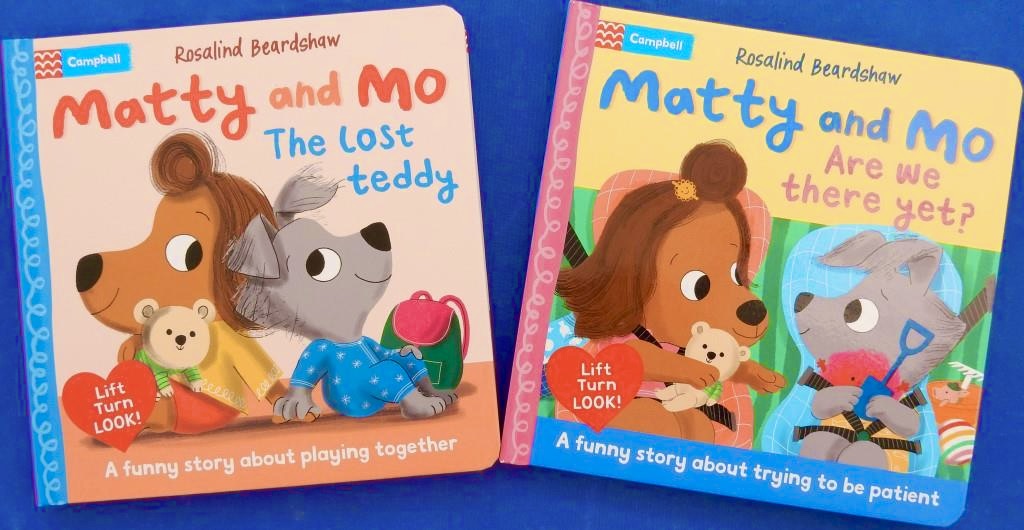
When you’re little there are SO many life lessons to be learned. So it is with the pups in this new series.
Matty and Mo are sibling puppies, Matty being the elder of the two. We meet them on a rainy day playing inside picnics together.. Matty notices that Ted is missing and Mo, of course wants to help find him. They search in the likely places – the bed, a cupboard and in their liege toy pile but there’s no sign of Ted. This upsets Matty and Mo attempts to cheer him up and suddenly Matty notices something sticking out of Mo’s ‘new useful bag’. What could it be? Mo, so it appears can sometimes be a little silly
In the second book Matty and Mo are off to the beach in the car with Mum. It’s quite a distance so patience is needed. In her excitement Matty gobbles all her snacks in one go and then inevitably, one of the pups needs a wee. It’s Mo. (Matty went before they set off.) Inevitably too, boredom sets in and Matty gets busy with her sticker book … Mum must have a lot of patience as she drives and at last the beach is in sight, but the puppies can’t see it until they wake up.
Trying to be patient has tired them out – only for a short time though.
Little humans will have a giggle at the puppies as they earn to deal with what to them are challenging experiences. They will also enjoy using the moving parts – flaps, a wheel and the final fold-out heart in both books that were inspired by real-life family experiences..

Wee Gallery are a husband and wife team who create books to help babies and very young children develop through visual learning.
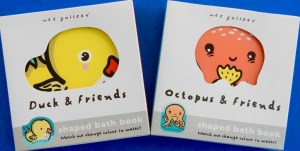
Both of these take the shape of the titular character and little ones will love joining in as both Duck and Octopus look for their friends in these splash splash bath books wherein each black and white creature magically comes to life in full colour when wet. Duck will meet the likes of frog, dragonfly and swan whereas Octopus’s friends include a large fish, jellyfish and a crab..
Splishy, sploshy, squishy, squashy tactile bath time fun for tinies.

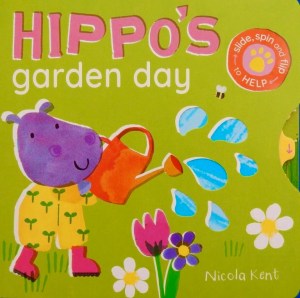
Lion and Hippo have very different gardens. Lion’s is neat and nothing looks out of place. In contrast Hippo’s is overgrown. I assume it’s not been left to grow wild deliberately. Hippo decides he needs to do some serious work on his grade. Having collected tools from his shed he sets about mowing, trimming, watering and in due season, harvesting fruit to share with his friend, Lion.
With some onomatopoeic language for small children to join in with as Hippo works, flaps to explore, a slider and wheels integral to the bold bright illustrations, this is a fun introduction to a task some adults thoroughly enjoy, some do under sufferance and others – those in favour of rewilding – don’t do at all. Toddlers however, will love the opportunity to assist Hippo in his work.

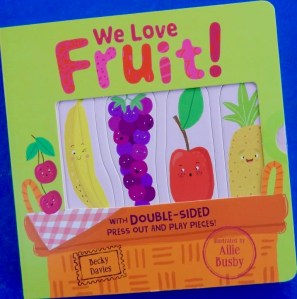
Minibeasts / What Can You See? In the Garden / We Love Fruit!

There are all new board books from Little Tiger – thanks to the publishers for sending them for review.

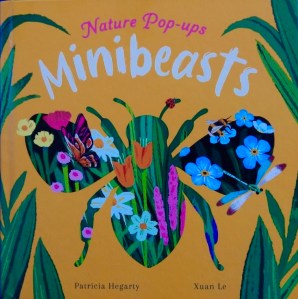
The first of a nature new series where the featured creatures almost leap out from among the plants growing in the flowerbeds. First comes a bumblebee that is busily collecting pollen from a composite flower; then there’s a ladybird that opens up its scarlet wing cases as though to take flight. Next not just one but – well maybe your little one can try counting them – the beautiful butterflies that, wings spread wide, take to the skies and flutter on the breeze. Meanwhile much closer to the ground, a shiny shelled snail climbs slowly, steadily amongst the grasses and ferns while, down by the pond darting among the lily pads, transparent wings shimmering is a dragonfly and finally, peeking from the foliage of blooming wisteria is a chirping grasshopper; but if you look very closely, there’s also one unnamed minibeast making its way along the branch.

Little ones will love watching all these small creatures as they peruse Xuan Le’s vibrant settings for Yoojin Kim’s cleverly engineered scenes.

More minibeasts appear in

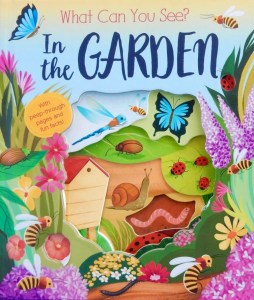
At Rosamund Lloyd’s suggestion, young children take a walk in the garden and discover minibeasts in flight, follow a butterfly through its various stages of metamorphosis, watch honey bees at work, see camouflage and other ways minibeasts keep themselves save from predators. If you take time to forage in the plant litter there are woodlice, millipedes and snails to discover whilst beneath the ground earthworms burrow and ants create colonies. Little humans will delight in such facts as “some millipedes eat their own poo’ and that unlike themselves who have a backbone, insects have a skeleton on the outside called an exoskeleton .
The cutaway pages are cleverly positioned to allow readers to peep through and see what awaits.

Spring is here so share the book and then see what awaits outside your front door.

Don’t play with your tasty food. This is frequently said to little ones by parents or carers but now this book gives toddlers permission to do just that. Indeed they will love pulling out the double-sided fruit characters from the sliding tray inside the front cover and meeting the eight different fruity personalities. From these, little humans must follow the clues given on each page and choose the matching cardboard piece. Can they discover which fruit grows in bunches and when dried is called a raisin or which one might take as long as three years to grow?

A clever interactive guessing game, playfully illustrated by Ailie Busby with words by Becky Davies that offers opportunities for adult sharers of the book to talk about the importance of fruit in a healthy diet. I suspect several helpings will be desired by toddlers.

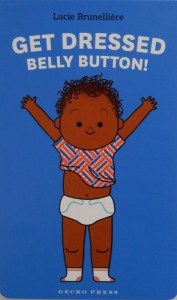
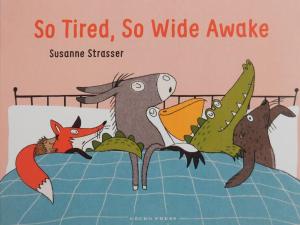
Get Dressed Belly Button! / So Tired, So Wide Awake!

Both these board books are from Gecko Press: thanks to the publisher for sending review copies.

It’s a chilly day so the toddler must be suitably dressed before heading outside into the cold. Tinies will enjoy watching as the adorable infant is clad in ‘two soft socks’, a ‘toasty t-shirt’ and a pair of jeans; but there’s a belly button still visible. What else will be needed before we’re ready to sally forth? Squeaky sneakers, a cosy warm coat, two woolly mittens, a bobble hat and a scarf and a special kiss. Hurrah! Off you go, little one.
An external narrator, presumably the parent or carer, does the talking in this cleverly designed, vertical flip-flap board book

A small bedroom drama unfolds as Hedgehog, Fox, Donkey, Pelican and Crocodile lie fast asleep in bed; but not so Seal. He apparently needs to visit the bathroom so up and out of bed he wriggles. Then in turn, his previously snoozing pals leave the bed and troop to the bathroom: Crocodile has forgotten to brush her teeth, Pelican needs a drink of water,

Donkey has itchy ears and so on, until only a scared Hedgehog remains. Up she scrambles and off she tip, tip tips to find the other animals. Where have they all gone? Somewhere where they can each receive a goodnight kiss before falling fast asleep. Unsurprisingly though, the kiss giver is still wide awake, squashed beneath the heap of slumberers.

Suddenly, a voice calls out, “What a stink! Who did that?” Thereupon, the animals rapidly return from whence they came and crash out in their own bed at last.

Little humans will enjoy watching the build up of tension before it’s revealed where the animals are all going, and delight in the whiffy solution that has them hastily retreating to their own bed. Fun to share with tinies especially as a pre-bedtime read.

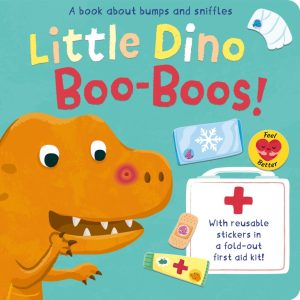
Early Years Bookshelf: Little Dino Boo-Boos! / Bear

The little dinosaurs are a very lively lot and inevitably accidents happen: Triceratops gets a graze, Spinosaurus gets a soaking, followed by a cold, Velociraptor take tumble and bumps his paw and so on, so it’s important to know what to do when one gets hurt or doesn’t feel too good.

Through this delightful interactive board book, with its first aid kit containing a set of reusable stickers in the form of a fold-out inside the back cover, very young children can begin to learn about first aid and care in a playful way. On a first reading you may just want to point out each item and name it, but this is a book you can share over and over so your little one can learn more about each item as appropriate in addition to enjoying Jannie Ho’s humorous scenes.

A story about learning to share – maybe.
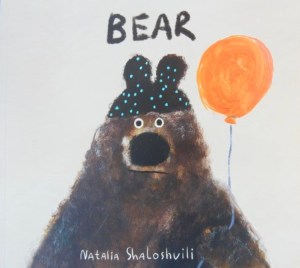
Bear is very happy with his ursine life: he loves his cookie, his book and his balloon; and he loves to sit by himself on his bench. As he sits comfortably contemplating, up comes Fox wanting to sit beside him on the bench. Wolf too wants something belonging to Bear – a delicious cookie; Rabbit wants a look at his book and Elephant asks for the balloon. Bear’s problem is that he doesn’t know how to say no to their requests

and consequently ends up with nothing. Now our ursine friend isn’t happy, he’s very, very unhappy as he sits thinking. Some while later along comes Duck with a cookie. Now we know Bear loves cookies so he requests a bite of Duck’s. I wonder how Duck will respond.

It’s important to know when to say no to others and this seemingly simple story with its wonderfully expressive, smudgy illustrations created with watercolour crayons and acrylic paints offers a good starting point for discussion with little humans.

My First 1 2 3 / Upside Down Opposites / Love

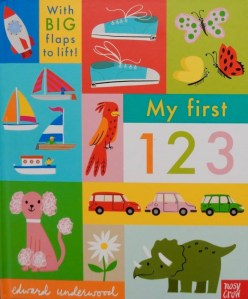
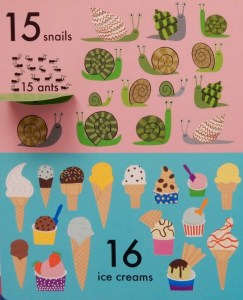
This is a new addition to the excellent My First series illustrated by Edward Underwood. With flaps to lift – one per page – toddlers will engage in the basic counting element and enjoy guessing what is hiding under each flap, quickly working out that the number of hidden items each time is the same as the visible item depicted and clearly labelled.. For instance beneath one of the 3 flowers, are 3 bees, and beneath one of the 18 birds are 18 worms.

A thoroughly engaging way of developing basic numeracy skills – number recognition and one to one correspondence.

The large format of this sturdy book make it ideal for sharing with a toddler and in addition to the mathematical aspects, there’s a wealth of potential for language development. Each of the images depicted on every single one of the coloured background panels is richly patterned and also provides talking/ storying opportunities aplenty.
Definitely one to add to family bookshelves and preschool collections.

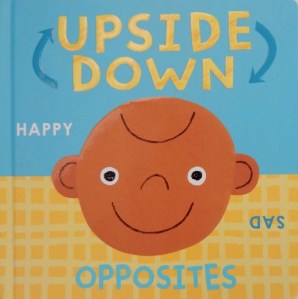
This is a rhyming and visual demonstration of eight pairs of opposites for an adult and young child to share. Each spread uses a different object – a bird in flight, a hand-held ball, a face, a snail, a drinking glass, a squirrel, a hand and a dolphin. The adult reads the sentence on the first verso, the book is then rotated and with the change of perspective, its opposite is seen on the recto and its respective sentence is then read.
Its clever construction means that the book can be read from either end.

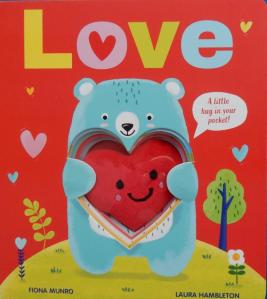
Herein we meet a group of ursine characters and their animal friends as one little bear finds out how the love of family members endures, even when they are separated by long distances and you cannot see your loved ones. Should you feel tired, angry or sad you can take hold of the heart in the centre of the die-cut and cuddle it close to you: that should help you feel that love flowing right to you.
A reassuring narrative by Fiona Munro and sweet, but not sickly illustrations by Laura Hambleton, remind us all, especially small children, that love is inside us and all around.

The Found Things / Guess How Much I Love You: I See Me

These are two Walker Books titles for very young children: thanks to the publishers for sending them for review.

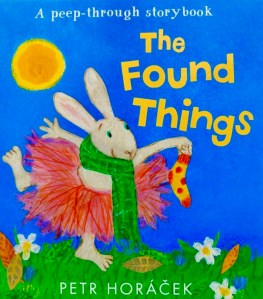
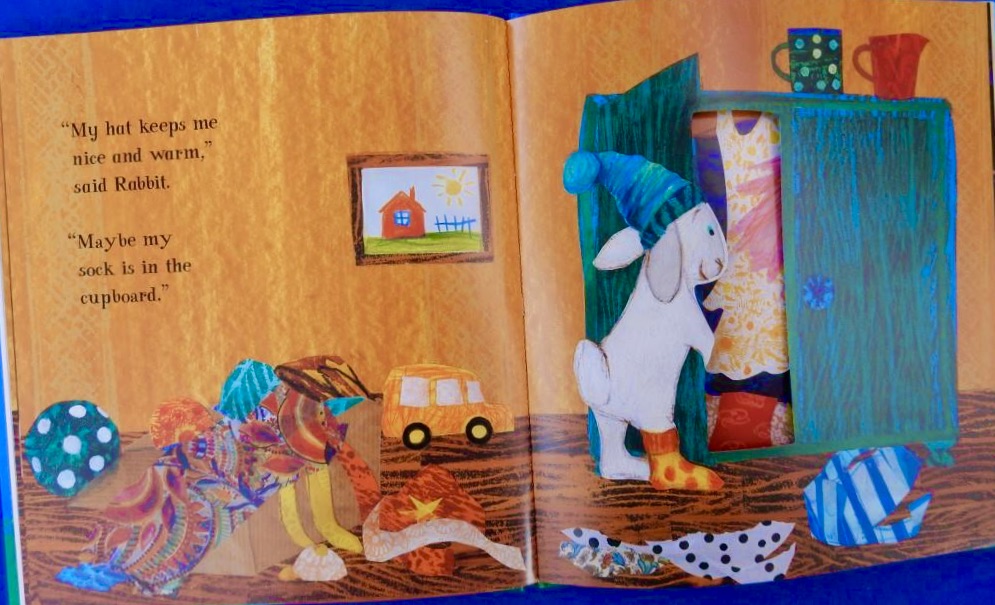
One morning Rabbit wakes to find the sun shining brightly and decides to go for a walk. First though she needs to dress, but one of her socks is missing. The hunt all over her abode for its whereabouts sees Rabbit discovering various other items of clothing, each of which she dons,

but of the missing sock there is no sign. Rabbit decides she’ll sally forth without it, albeit looking somewhat strange. So strange in fact that when she encounters Squirrel and Mouse, they mistake her for a monster. However the two have a special surprise for their lapine friend. What could it be?

Young children will love Petr’s vibrant, mixed media illustrations with their cutaway parts and enjoy participating in the sock search. Adult sharers especially will endorse Rabbit’s parting joyful comment on the final spread. The book also offers a simple, interactive fun text for children just gaining confidence to try reading it themselves, once an adult has shared it with them.

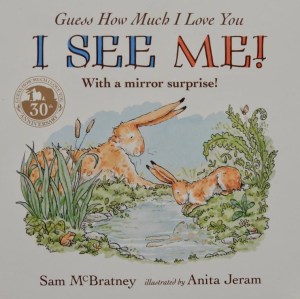
It’s a lovely spring day and Little Nutbrown Hare and Big Nutbrown Hare are out together enjoying themselves. As they explore they play a game of I-spy. Between them they spot a butterfly, a baby bird in a nest and a tadpole wriggling around in the pond. While they gaze into the water Big Nutbrown Hare asks, “What else can you see in the pond?” I wonder what Little Nutbrown Hare’s response is? (The cover is a giveaway!)

A sweet story featuring team McBratney and Jeram’s two wonderful characters that celebrate their thirtieth anniversary appearance in Guess How Much I Love You, this year. (The Nutbrown Hares have also appeared in a couple of animated TV series of the same name.) Many of the adults who share this board book delight with their little ones will likely remember meeting the characters in the now classic original tale.

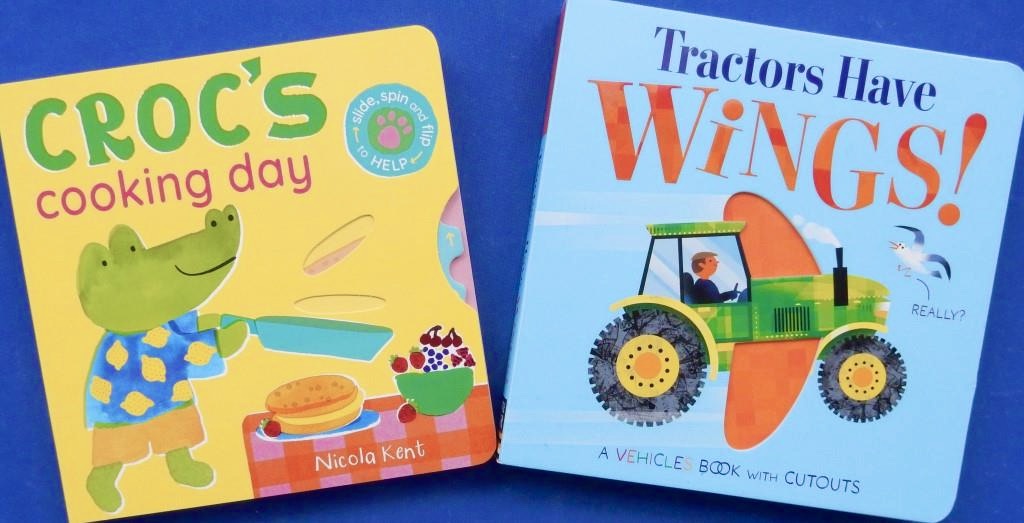
Croc’s Cooking Day / Tractors Have Wings!

These are both titles from Little Tiger – thank you to the publishers for sending them for review.

This is the second in the Busy Chores for Little Paws series.
When Croc hears his pal Hippo’s tummy rumbling, he decides to make some pancakes, with some assistance from young humans that is. Once Croc has taken the equipment and ingredients needed from the cupboard and measured out the amounts required, by pulling the strategically placed tab, said assistants can pour and sprinkle flour and splash milk into a mixing bowl,

manipulate the hand mixer and once the batter is fully mixed ready to cook, try their hand at tossing the pancakes.
Croc certainly looks pleased as he approaches Hippo. The pachyderm clearly enjoyed the repast judging by the rate at which he consumes his share. Let’s hope he doesn’t end up with tummy ache!
Interactive fun and lots of opportunities for little humans to develop their fine motor skills as they use the sliders, flaps and wheel.

Eleven modes of transport in all appear in this board book, some of which are deliberately introduced with a false statement such as ‘Did you know that tractors have wings?’ and ‘ And trains run on water’ which are clearly intended to provoke correction from a savvy young listener. However, when wheels appear on the scene, things get a little tricky. Sure, lorries, unlike unicycles and bicycles must have more than one or two wheels but though the two dimensional illustration of a lorry shows the vehicle with six wheels captioned with the statement ‘And lorries have at least six wheels?!’ True enough but it would need double that number if it were not to fall over on its side. Some youngsters will likely realise this; but beneath the same lorry depicted on the spread headed ‘Thank goodness you’re here to help’ are the words ‘Lorries have six wheels.’ Is this an illustrative faux pas or a deliberate ploy to instil a questioning disposition rather than believing everything that appears in print? I wonder …

First Friends: Numbers / First Friends: Shapes

The setting for both these board books is a nursery or pre-school where we join a group of young children.
Numbers takes the little ones through their time there from fond farewells from parents/carers right up to collection time by the same adult. In so doing the children share their play activities both indoors and out, eat lunch together, visit the loo and then rest on their mats, play again and bid each other and the teachers, goodbye before once again embracing a waiting parent/carer. The rhyming text and inclusive illustrations introduce the numbers 1 to 10 as we go through the day and there’s an interactive element in that the final ‘Can you find?’ will send little ones back searching for and counting the labelled items depicted.

Similarly presented is Shapes. Herein we join the same children as they, and those sharing the book find various 2D shapes – circles, rectangles, squares (actually cubes though they are are all shown face on), diamonds, moons and hearts, triangles. These are used to make winged insects, a rainbow arc, then ovals and stars as they play with soft toys. Come time to clear up, everyone joins in before gathering together for a circle time.
Finally there’s a spread depicting the ten shapes encountered introduced with a ‘How many can you find … ?’challenge. I wonder how many youngsters will include in their shapes counting the squares, circles on clothes and eyes etc. depicted in the bright scenes.

A fun way to reinforce basic maths alongside the all important play experiences.

Animal Encounters

These three board books from Graffeg: thanks to the publisher for sending them for review.

‘One fox called Fletcher’ and his friends are clearly enjoying themselves as we see two grey seals swimming in the sea … four friendly frogs hopping in the pond …five busy squirrels scampering after sunbeams and so on taking us through to ten twinkling stars shining in the sky. Charming, richly coloured illustrations showing the actions referred to in each single sentence, above which is a large numeral. I particularly like the author’s use of alliterative phrases in many of these.
A delight from start to finish.

In his garden home, Albert the tortoise – the one and only – has lots of friends too. Little ones will enjoy counting their way through to ten as they meet ‘two butterflies with their colourful wings’, three birds about to fly off, four flowerpots that are homes for woodlice, seven snails with shiny shells … and when all are assembled, there are ten friends enjoying some fun. The number word begins each descriptive sentence and the respective numeral is printed large on the opposite side of the double spread. A fun, gently educative way for small children to be introduced to a popular reptilian character.

In a snow-covered garden stands a tree. Attached to the tree is a swing; not far away is a bird table and between the two is an upturned red wheelbarrow. As yet there are no footprints in the snow but the text suggests that by walking their fingers from the tree to the bird table, a small child can create some. This action is watched from behind the tree by a little rabbit who is keen to join the fun of making a snowman. Following a sequence of instructions, Rabbit and child participant build a large snowman which Rabbit then gives a hat and scarf. A mouth and eyes are added but something is missing. What does Rabbit have behind her back … How will this brief interactive story finish: with a tasty lunch for Rabbit or a nose for the snowman?
This collaboration between sisters, author Jemma and illustrator Tiphanie offers seasonal fun for sharing with very young children on wintry days.

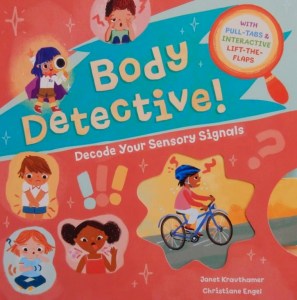
Body Detective!

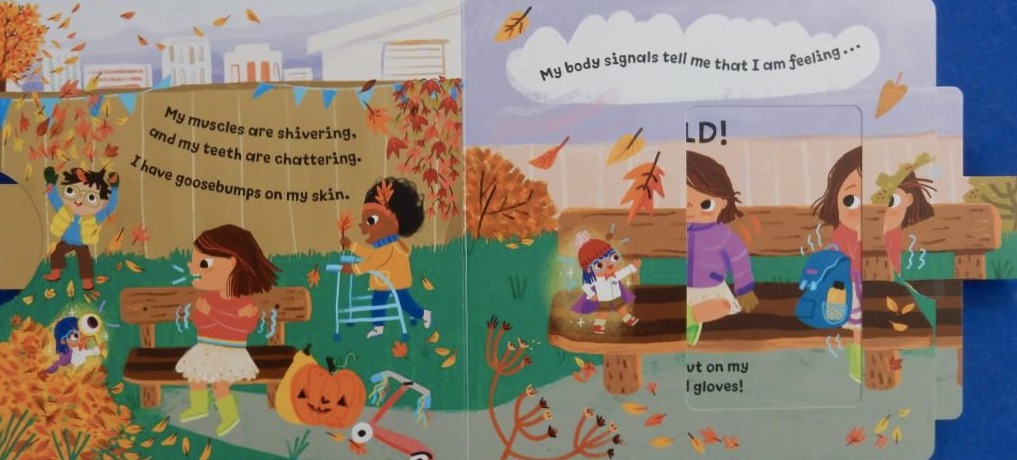
Written by an occupational therapist, this board book presents interoception to very young children. It’s important for little ones to be able to know and name what they are feeling: to that end author Janet Krauthamer and illustrator Christiane Engel use clear explanations, bright illustrations with flaps to lift, tabs to pull and mindful actions.

A playful, interactive, fun learning exploration of the human body’s signals: little ones will enjoy being body detectives and learning by means of descriptive language that for example, a dry, sticky mouth and lips are signals from the body that the person is thirsty and need to drink water. Chattering teeth and goosebumps on the skin are body signals indicating a person is feeling cold.

The last two spreads provide more information about interoception, and relevant body parts and describing words including discombobulated – now there’s a great word for tinies to use.

Use at home and in an early years setting for promoting health and well-being.

For Baby’s Bookshelf

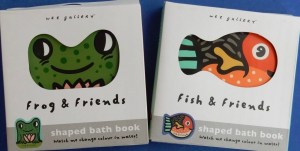
These bath books cleverly change colour when wet.
The first introduces a little green frog on the lookout for friends to leap with: there’s a dragonfly, a duck and an otter each of which will come to life on the squishy tactile pages as an adult speaks the dozen words of the text, possibly then adding some croaky sounds.
The second is a fishy shaped sub-marine offering wherein the titular fish and friends starfish, turtle, whale and seahorse assume their colour when immersed by tiny human hands.
Both books offer splishy, splashy tactile fun learning for the very youngest humans at bath time: peekaboo with a difference.

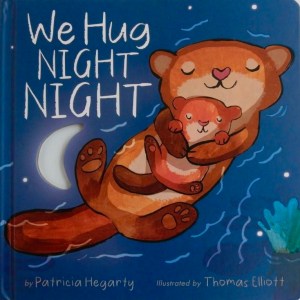
A loving father gently prepares a little child for sleep and in so doing, introduces listeners to parent and infant creatures – bears, possums, otters, cats, giraffes and birds all safe in their respective abodes also snuggling up in readiness for slumbering. Patricia Hegarty’s soothing rhyming words and Thomas Elliot’s endearing illustrations combine to lull little ones as an adult turns the cutaway pages of this goodnight charmer that is likely to become a bedtime favourite.

There’s parental love aplenty too in

Fun with Pip and Posy & Bizzy Bear

These are all recently published Nosy Crow board books: thank you to the publisher for sending them for review.

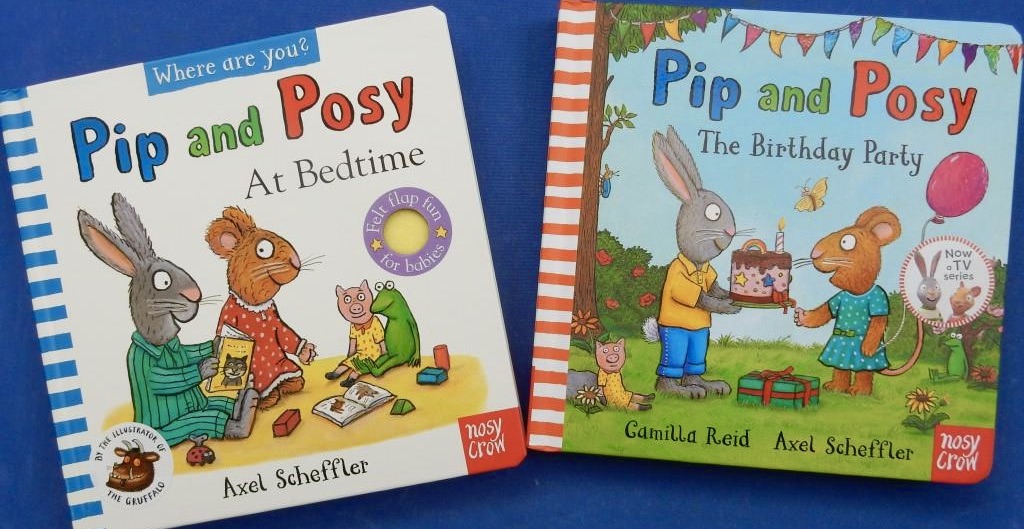
The first book is part of the Where are you ? series and we join Pip and Posy playing a pre-bedtime game of hide-and-seek. Pip hides and Posy seeks but can she discover her friend’s hiding place? Yes, with the help of toddlers who will love looking behind the felt flap on each spread. They will also enjoy frog’s antics as the hunt progresses.
In the second story it’s Posy’s birthday and Pip has come to celebrate with her bringing a present. They have fun playing with Posy’s new toy bus and enjoy lots of party games – musical statues, keepy up balloons, hide-and-seek and pinning the tail on the dinosaur. After all the games the friends sit down for a birthday tea and Pip then goes to fetch a special surprise for Posy but as he approaches the table, he trips on the new toy bus and both he and the cake go flying. Oh goodness me! Posy looks a sorry sight with cake all over her head. After a quick clear up, Pip saves the day with the suggestion of making some new cakes. Yummy cakes for everyone out in the garden.
Both books are just perfect for the very youngest children.

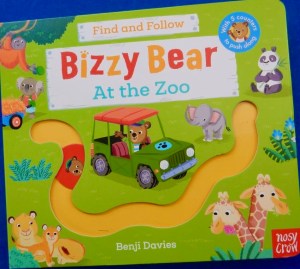
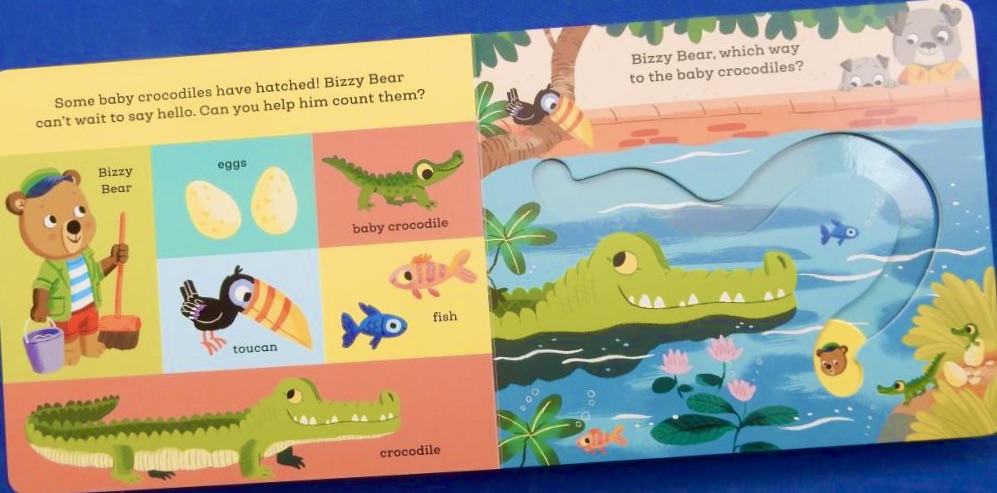
In this Find and Follow book, Bizzy Bear pays a visit to the zoo. He arrives at breakfast time to feed the animals but needs some assistance to find his way around. First it’s the elephants’ turn for some of that yummy fruit from his cart but Bizzy Bear is in need of some help to find his way to the hungry pachyderms so toddlers can guide him and in so doing practise their fine motor skills. Then comes the turn of the crocodiles including the newly hatched babies

– more help needed by Bizzy, not only to find the baby crocodiles but also the penguins. He drives his off-road jeep to get to those and meets lots of other animals on the way; and then it’s time to go home. First though he needs to say goodbye to the pandas – toddler help required again.
In addition to the moving disc, on each double spread the verso shows small, brightly coloured, named items that little ones can enjoy searching for in the larger scene on the recto. They will enjoy too, joining in with the repeat sentence, ‘Bizzy Bear, which way to the __ ? ‘ on each double spread. With Benji Davies’ alluring scenes, there’s lots of fun learning between the covers of this one.

A bear, a bee, and a honey tree / Dinosaurs: A Pop-Up Book

The book begins with the three natural objects named in the title each shown in an illustration of their own. The bee – a busy one of the honey obsessed kind – then flies out from the tree to visit a flower. The bear – a hungry one – sallies forth intent on obtaining some honey from that tree. On the bee’s return we see two busy creatures in the tree looking far from happy. The drama escalates as the honey hunting ursine faces a swarm of ‘fuzzy buzzing bees’, then cascades down to the ground coming to land in a weedy patch above which one angry bee searches and the bear hides before both the million buzzing bees, still busy, return to their tree and a very disgruntled, exceedingly hungry bear returns to it’s cave.

With its cleverly constructed text using minimal words by Daniel Bernstrom and dramatic story telling scenes by Brandon James Scott, this playful board book will entertain both little humans and grown-up sharers.

There are five double spreads allocated to dinosaurs in this large format novelty board book, each one introduced by popular illustrator, Ingela Arrhenius. First we meet the Long Necks, all nine featured are herbivores, each with a long tail, very long neck and small head.
Next come the Spiky Dinos – ten in all, and every one had bony plates along its back and spikes on its tail. (A Sauropelta (new to me) had spikes all over its body however.) Lifting the flap beside the Kentrosaurus (also new to me) is a sentence about its brain – despite the creature’s huge size, its brain was only the size of a walnut.
The third spread has nine dinos, all with bird-like beaks. Most also sported frills on their necks and some had horns. The least frilly of the Frilly Heads, Psittacosaurus got its name on account of having a parrot-like beak: Psittacosaurus means ‘parrot lizard’.

Fourth come the Feathered Friends, dinosaurs that walked on two legs and were often feathered and winged. The smallest known dinosaur is featured here: it’s the Microraptor.
The final spread features dinosaurs Fast and Fierce and includes Tyrannosaurus Rex, Spinosaurus and Allosaurus. Some of these beasties moved extremely fast, others had sharp claws and teeth with which they would attack and consume their prey.
Most small children are dinosaur mad so this book with its flaps, central pop-ups and brief factual snippets will be a winner for Ingela.

Interact With Board Books

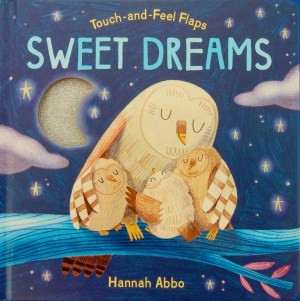
Very young children are invited to join mother owl as she hunts for food, soaring across the starlit sky one night. She flies over tall grass that shelters a mother rabbit and her little ones, passes a log pausing briefly to peep at Fox and its cub, discovers a mother mouse and her babies snuggled together under some leaves and finally flies back to the tree where she tucks her three waiting owlets safely beneath her wing.
With its alluring die-cut cover, five differently textured, touchy feely flaps to explore, a gentle rhyming text and scenes of the natural world at night from various viewpoints by Hanna Abbo this is a lovely board book to share with the youngest humans at bedtime especially.

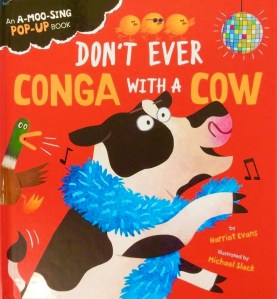
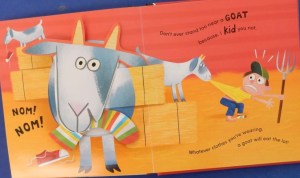
This is an addition to team Evans and Slack’s Don’t Ever series, this one being set down on the farm. Young children are warned against disturbing a slumbering rooster; tricking a woolly sheep, wrongly blaming a large pig for the mucky deposits it hasn’t left; getting your rear end too close to a hungry goat

and finally never ever attempt the titular conga with a cow; it’s sure to move to a different tune.
Farm animal silliness with creatures that are guaranteed to make little ones giggle and relish joining in with the RING! RINGs, YEE-HAWS, OINKs and NOM NOMs as you turn the pages making each animal in turn move. Cause alarm and you’re in for a shock.

Cows Are Pink! / How It Works: Fire Engine

These are both Little Tiger board books: thanks to the publishers for sending them for review.

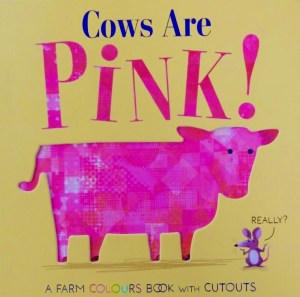
Down on the farm, the animals have all got their colours muddled up. Small children will enjoy predicting what is behind each cut out section before the page is turned to reveal in turn which animal is pink, yellow and red. What about cats though? They’re a bit more problematic and they certainly aren’t green, one of the colours visible through a cat diecut. So what is orange, black and green?
The final spread shows eight different farm animals and each is appropriately coloured, to the satisfaction no doubt of the little mouse character.
With bright, textured illustrations by Gareth Lucas this is a playful book for the very youngest.

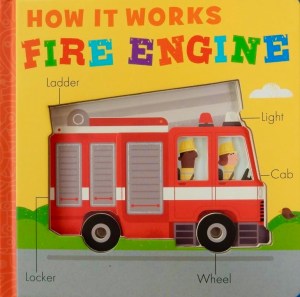
Curious learners, especially those with an interest in vehicles will enjoy this addition to the How It Works series. Nee-naw! Nee-naw! goes this emergency vehicle but first come explanations for little ones about where fire engines are kept; what firefighters do at the fire station when not out on call,, as well as what their uniform comprises. When the crew receives an alarm call it’s a case of off as fast as they can go, sirens and flashing lights warning other vehicles to give way as they approach.
Once the scene is reached it’s masks on and out with the hoses.Sometimes though fire engine crews have to perform acts of rescue for such things as cats stranded high in trees, or they might pay a visit to a nursery or primary school to teach the children the importance of fire safety. Perhaps some of them will be so enthused they go on to join the fire service themselves.

With cutaways, ‘did you know?’ questions, labels and a simple narrative there’s plenty to engage small children.

Tiny Bear Can, Too! / Where Do You Sleep?

Here’s a case of ‘anything you can do’ as an adorable baby bear copies the actions of a series of animals, for instance ‘If the frog jumps … Tiny Bear jumps too1’ This ursine character is certainly energetic for it also seeks to emulate cat’s stretch, snake’s wriggle and five other actions in turn.
Tiny humans will certainly enjoy demonstrating their own rolling, standing on one leg, flipping over kicking their feet up and hugging a loved grown-up. Equally they will delight in lifting the flaps – two per spread – as an adult reads aloud the simple repetitive text.

I envisage this interactive little board book being read to destruction.

Each of the featured young animals has a different place to sleep that suits them (eight if you count the owl in the hollow of the tree on the cover illustration revealed by pulling the tab.)
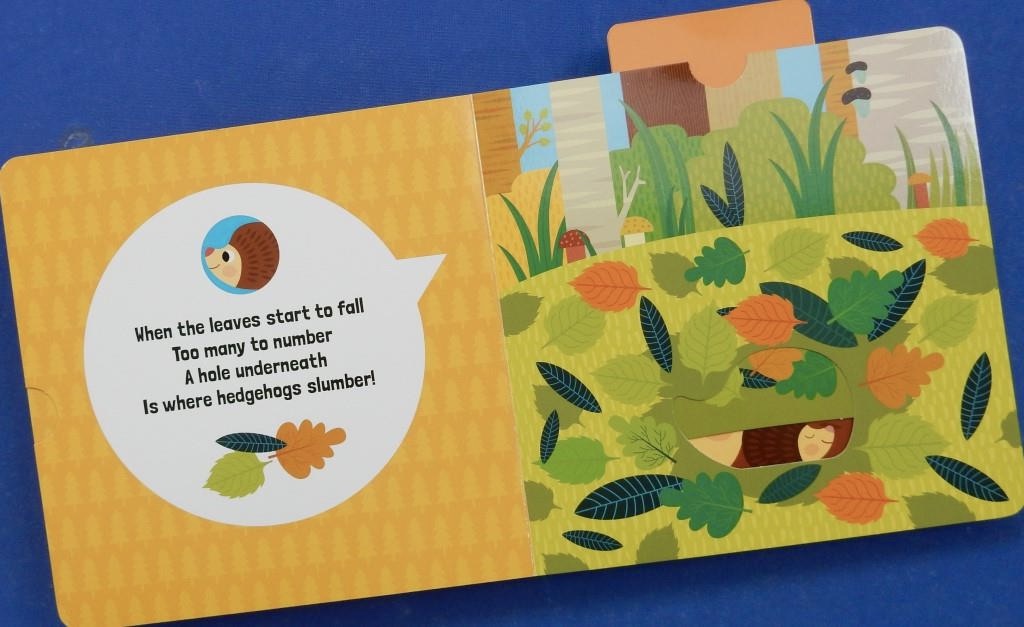
Small children will also discover a baby fox beneath the roots of a tree, a kitten in a basket beside the couch, a hedgehog with adult under a pile of fallen leaves, a bat dangling in a cave, a fledgling snuggled in a cosy nest, a husky in a den beneath the snow and a squirrel in a tree trunk hole. The final spread addresses the little listener who, as expected will fall fast asleep in a cot.

Each of the tabs stands out from the full page scene as the artist has used a colour that contrasts with the background and to keep the toddler’s interest, it’s not located in the same place on every spread.
Interactive fun that can also help little ones develop their fine motor skills.
Agnese Baruzzi’s text, four lines per animal, is written in rhyme that won’t cause the adult reader to cringe when they read it aloud and she also makes effective use of texture throughout.

Bear’s Wash Day / Hide and Seek with the Baby Animals

These board books are Little Tiger Books – thanks to the publisher for sending them for review

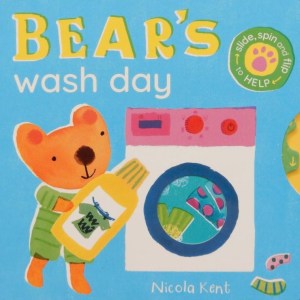
As a result of Bear and Croc’s smoothie making, Bear’s clothes are covered in spatters of juice so the two decide to do some washing. They collect all the dirty clothes, load up the washing machine, add the washing liquid and press the on button. Round and round go the clothes and once the machine has done its cycle, it’s tine to go out into the garden and hang everything on the line to dry in the sun. As soon as Bear’s dungarees are ready to wear once more, he puts them back on and the friends finally drink their smoothies.
With a spinner and flaps to help develop their fine motor skills, little ones can enjoy this simple domestic episode and have fun making the various sounds that accompany the action.

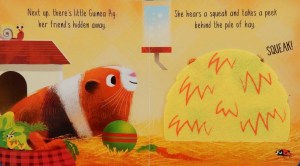
A game of hide and seek offers an opportunity to meet the baby animals that are playing the game on the five spreads herein. Each one has a different shaped felt flap behind which lurks a noisy little creature. Toddlers can join in the play and try to guess the baby animal that went WOOF!, the chirping bird in the birdcage, the squeaker behind the heap of hay,

and meet the bubble blower that’s giving his location away before finally meeting the winner of the game.
Touchy feely fun with dayglo bright scenes by Gareth Lucas in which various minibeasts appear on every spread, adding to the playful experience.
How It Works: Shark / Don’t Ever Laugh at a Ladybird

These are two new novelty board books from Little Tiger: thanks to the publisher for sending them for review.

Cleverly designed with strategically placed peep through parts of every page, this serves well as an introduction to sharks for preschoolers. They will be fascinated to learn that these powerful predators have super-strong tails that enable them to swim faster than a motorboat can move. They may well be surprised to hear that sharks were around before dinosaurs existed. I’m sure humans young and not so young are pleased not to have 300 teeth to clean, the number some sharks possess and having learned that, in contrast to humans, sharks very seldom sleep, young children might try that as an excuse not to go to bed at the proper time.
Playful, fun learning in bite-sized portions, with clearly labelled body parts and “Did you know? interjections from a deep-sea diving mouse that swims up on every spread.

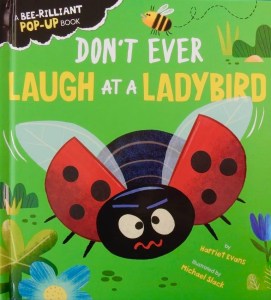
You will probably decide to heed the titular warning of the furious faced ladybird, as well as the rhyming ones concerning the other four irate minibeast kinds that fly, spin forth, leap or slither from the pop-ups on Michael Slack’s wacky brightly coloured spreads. If not, you might easily end up in a honey covered mess after baking with a bee, dizzy from trying to out dance a disco crazy spider, lose your voice while endeavouring to emulate a ribbiting frog, or smothered in slime should you hug a shell-loving snail.
Minibeast madness to read aloud with the very young

Words, Words and More Words

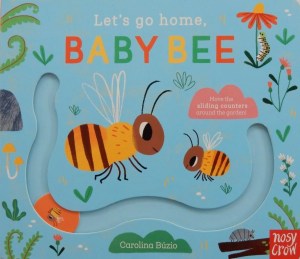
Baby Bee has to get safely to the hive and needs the help of little humans to do so. The same is true of some other baby minibeasts: baby ladybird wants help getting to a home log,; baby snail resides in a flower pot; and baby worm also needs guidance back home. There are plenty of things relating to the natural world to spot on each journey and each can only be completed with the help of a small human hand to guide the moving disc that depicts the named baby. Interactive fun that gives little children a sense of autonomy as well as delight at the brightly coloured spreads, each of which has the route on the recto and small, labelled images on the verso.

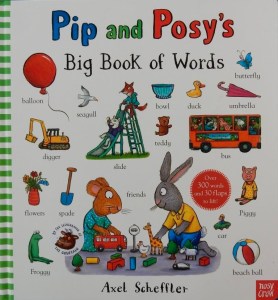
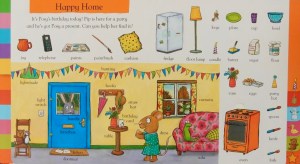
Little ones can learn and read more than three hundred words with friends Pip and Posy in this large format book. Its ten spreads have different themes each with flaps to lift and a multitude of labelled images both in and surrounding the scenes, the first being Garden Games. Here we see Pip busy planting seeds and Posy ready to entertain visitors by playing some musical instruments.
Next comes At the Shops where we find customer Posy, clutching a coin to buy a new toy. Sunny Seaside is the third destination and the two friends are enjoying a beach visit. Back at Posy’s Happy Home, Pip arrives bringing her a birthday present.

Christmas, Snow, Bubbles, Night Night follow and the final spread Learn with Pip and Posy presents colours, seasons, numbers (to 10)basic 2D shapes, and four examples of opposites.
Offering lots of potential for discussion, as well as vocabulary building and honing their visual skills, there’s a wealth of toddler learning possibilities between the sturdy covers of this book.

Also helping to enhance young children’s vocabulary are recent titles in a popular series:

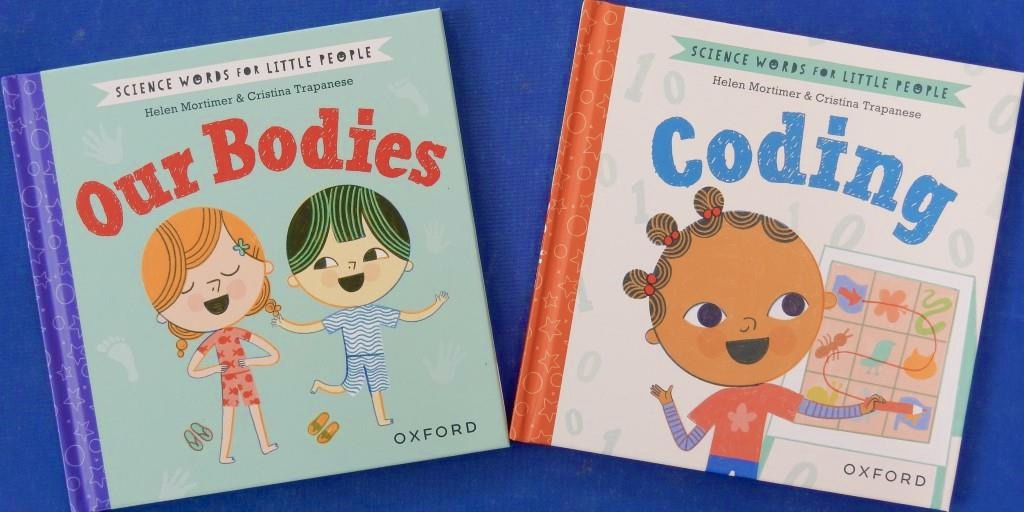
In Our Bodies children can take the plunge and have a day at the swimming pool where they can learn a wealth of body-related words from the brain to bones and senses to growing.
Coding presents basic language such as commands, sequencing, chain reaction and inputs and outputs. Both books feature a diverse cast of child characters, are engaging both visually and verbally and are worth adding to home shelves or collections in early years settings.

Guess Who’s Getting Dressed & Guess Who’s Going to Sleep / Lenny in the Garden

Hugely engaging, and tremendous fun are these two interactive lift-the-flap board books written in rhyme by Smriti Halls and zestily illustrated by Marta Altés.
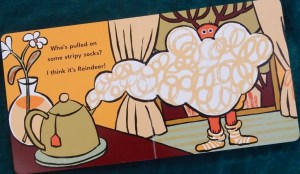
On the first four spreads in Guess Who’s Getting Dressed little humans are invited to respond to a question and given a possible answer (not the right one). Parts of an animal are visible from behind the flap on each recto, sporting the article of clothing the question mentions. For instance the suggestion is that Reindeer is wearing some stripy socks: not so, but the rhyme offers a clue …

The final spread presents the entire animal cast and a ‘Who else?’ to guess.
Guess Who’s Going to Sleep follows the same pattern but with a different animal cast and a slumber time theme.
Playful delight both.

Not a board book but also for the very young:

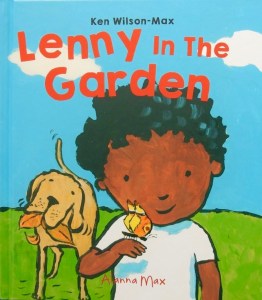
Lenny, his mum and Wilbur their dog are in the garden. On the lookout for new things, Lenny starts exploring, while mum gets busy digging. Before long Lenny draws attention to some ants walking in a line, so he says. Higher up a spider spins its web, round and round. Then as Lenny enjoys the tactile pleasures of toe wiggling in the grass, Wilbur makes friends with a wiggly worm that’s just popped up from underground. Mum finishes digging and begins watering, offering to water Lenny too but he’s too engaged with the nose tickling butterfly, the caterpillar and the dotty, spotty ladybird on a leaf.

Next he follows a snail slithering along leaving a trail behind; a grasshopper leaps hither and thither and Lenny attempts to emulate its bouncing until finally digging and watering done, mum calls to Lenny; he comes and the two sing a finger song ‘Tommy Thumb’ together before going indoors for lunch.

A simple, thoroughly captivating delight that is just right to share with the very youngest children. One hopes that having heard this story with its brightly coloured illustrations, listeners will become as observant as young Lenny in their own gardens or nearby outdoor spaces.

Number Garden / Noisy Construction / All the Things a River Can Be

These are all new Little Tiger interactive board books: thank you to the publishers for sending them for review.

A group of animal friends are shown around the number garden by Marigold the tortoise. With a fold-out to explore on every spread, small children will enjoy accompanying them and in so doing they can practise their counting skills to ten and respond to the other questions too.
First stop is the orchard, followed in turn by a hot-house and a rockery, then it’s off to the pond, a vegetable patch and the tour finishes in the meadow with a picnic.
Vibrant art work with just the right amount of detail for the very young (including minibeasts to spot), together with the interactive nature of the words make for a fun book to share with tinies. There’s a final spread whereon Marigold gives some extra facts about the six locations visited.

A rather unlikely subject for a board book but when shared with young children, this one, with its moving pieces and flaps, will likely lead to lots of learning.
In its half dozen spreads little ones can find out what makes a river special. People sometimes think of a river as a road, an inland waterway whereon they can travel in various kinds of boat. It also provides a watery habitat for lots of animals including many kinds of birds, fish, mammals and amphibians as well as plants, some aquatic, others that grow along the river banks. Some humans too make their home on rivers, choosing to live in houseboats. On its journey from source to mouth a river moves at different speeds, sometimes a slow trickle, at other times fast flowing and fierce. People who explore river beds can find all manner of interesting things such as coins, jewels and possibly even ancient remains.
The final spread brings together many of the activities people might do on a river visit, things that give them pleasure including boating, swimming and watching wildlife.

Maisy Loves Bees / Maisy Loves Trees

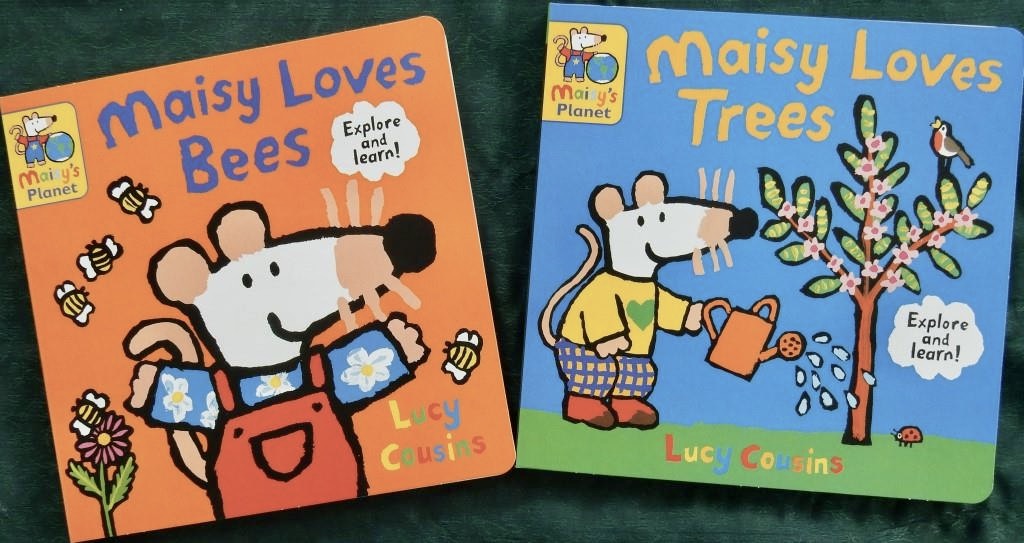
Young children’s favourite rodent Maisy Mouse has turned green – not literally of course: rather, she’s become a champion of helping to protect our precious planet.
In these Maisy’s Planet interactive board books, little humans are invited to join Maisy as she finds out about two of the most important organisms of the natural world. Maisy Loves Bees begins in her garden where she learns the basic characteristics of those stripy little insects and discovers why bees are so vital, what they need, what’s their role in nature. She also visits a beehive, finds a honey bees’ nest and finally invites her friends to join her in the garden where they all watch the bees busy at work.

In Maisy Loves Trees, she finds out what a tree is, how it grows, investigates different varieties of leaves, learns about seasonal changes through the year, discovers that not all kinds of trees undergo these changes and visits the park with Cyril the squirrel and Tallulah the chick to see examples of trees from all over the world.

With bold, bright illustrations, a final fold-out scene and simple explanatory texts, these are just right for encouraging tinies to become lovers of nature. Share and then go and do some investigating outdoors.

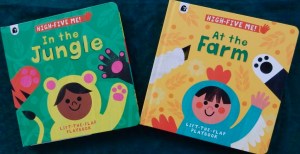
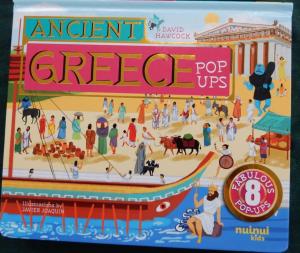
High-Five Me! In the Jungle / High-Five Me! At the Farm / Ancient Greece Pop Ups

These are the first two in a new board books series. Each has five double spreads, a simple, bouncy rhyming narrative written by Jess Hitchman and a sequence of vibrant, uncluttered scenes by Carole Aufranc.
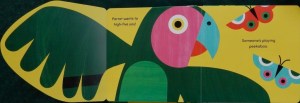
In In the Jungle little ones will meet Tiger, Chimpanzee, Parrot

and Sloth, each one peeping from a large flap waiting to be high-fived by a young child and the final one has a mirror hidden beneath its flap. This will encourage little humans to high-five themselves.
Equally playful, At the Farm, Horse, Cow, Sheepdog, and Sheep await a little human’s high-five and sometimes introduces the sound the animal makes.
These are just right for the very youngest children; they will love the playful nature of the books and I suspect, want to share them with an adult (or older sibling) over and over again.

For much older children is:

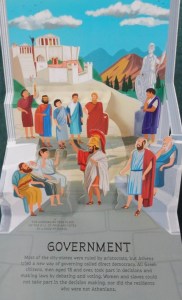
Ancient Greece often forms part of the upper KS2 history curriculum for it gives children an opportunity to gain some understanding of the culture of an ancient civilisation and how this has influenced the way life is lived today. In Ancient Greece for instance, only Athenian men aged 18 and over were able to make laws by debating and voting; neither women nor slaves could participate in decision making in the direct democracy practised in Athens.

Elements of Greek mythology are also taught to 10/11 year olds and this too is the subject of two of the dramatic pop-up spreads in the book. Included as well are brief facts relating to Athens (circa 500 BCE), trade, war and heroes. With its diorama style art by Javier Joaquin, primary teachers may like to include this in their resources to whet the appetites of learners.

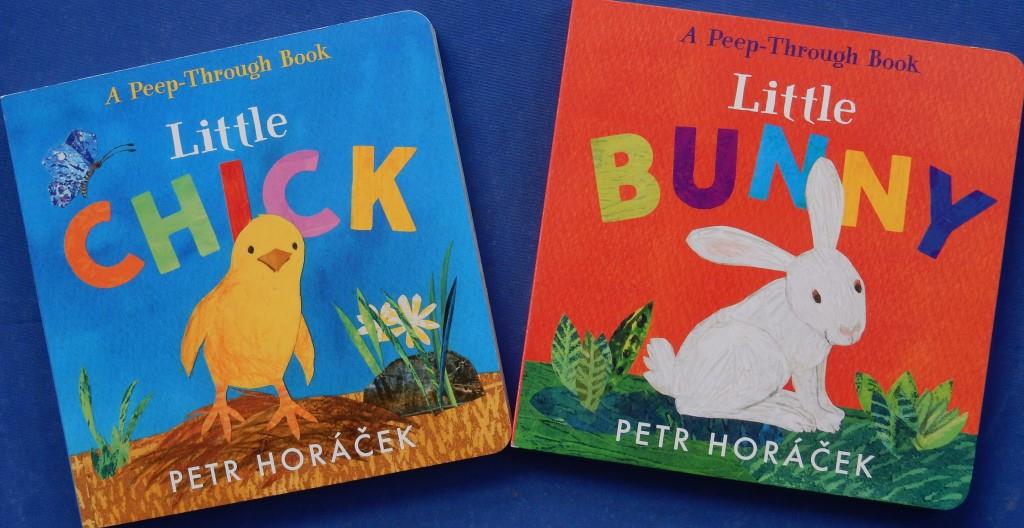
Little Chick / Little Bunny / One Little Tadpole

Vibrant artwork with cutaway pages and cleverly placed die-cuts, together with simple question and answer texts, will captivate little humans as they follow the titular animals through their simple stories.
The setting for Little Chick is the farm where she encounters in turn, a pig, a smily cat, a large cow and a tiny mouse, before suddenly emerging onto unfamiliar ground where a friendly horse assists the feathered infant in finding its mother, a mother that is also looking for her little one.


Little Bunny’s adventure takes place in the woods. There are lots of birds to spot as well as a friendly brown bear, but in the bushes lurks a red fox that scares the little leporine. Happily though a kindly owl leads the way to the safety of Mummy rabbit’s outstretched paws.

With his trademark glowing colours, Petr Horáček’s interactive ‘peep-through’ books will be enjoyed by adult sharers and the very youngest listeners. No child is too young for books such as these.

For an older audience is

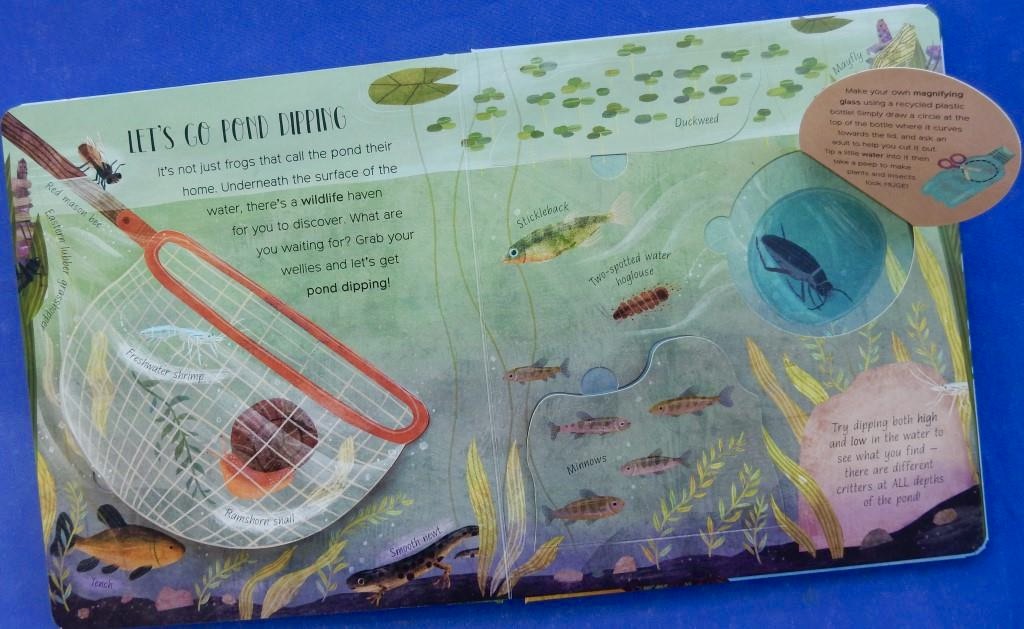
With more than thirty flaps there is plenty of exploring to be done between the covers of this large board book. Besides the life cycle of the frog there is information about the birds, insects, fish, mammals and the flora likely to be encountered in or around a pond. However, not all the creatures – for instance the two frog species illustrated on ‘The Circle of Life’ spread’ – are ones that UK readers would come across. Nonetheless this is a book that encourages children to use all their senses when exploring in the real world and to this end includes a spread on pond dipping.

It’s also good to see, on the final spread, the suggestion that readers create a miniature pond of their own as a way of helping nature to thrive.

Some of the illustrations give only an impression of the animal rather than an accurate means of identification so, having sparked a child’s interest, one would need to refer to a field guide rather than rely on this book’s visuals.

Can I Sit in the Middle? / Can You Catch the Bunny?

This image has an empty alt attribute; its file name is dscn9949-3.jpg

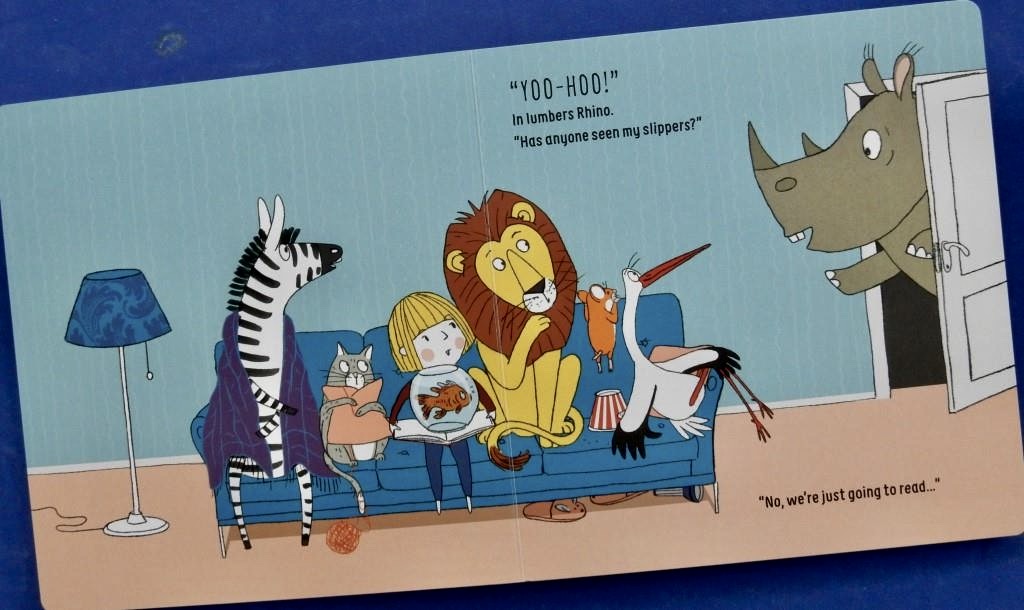
A child sits on the sofa to read with Hamster. The enthusiastic creature alerts the other animals – zebra, cat and lion – to join them. Just before the story starts Stork arrives, but then Cat decides to try and take possession of the cushion and Hamster gets up, fetches Fish and hurrah! Let the story begin. Or maybe not: some rearrangement of listeners is demanded and then the patient story reader can share the book. Oh! I spoke too soon for Rhino has mislaid a pair of slippers.

This image has an empty alt attribute; its file name is dscn9950-3.jpg

The large pachyderm upends the sofa to retrieve said slippers and OOPS! They all tumble into a heap. Does that mean no story? Happily thanks to a deft rearrangement of furniture and something else that Cat had found under the sofa, a perfect book sharing situation is created and finally, whoopee! it’s story time at long last.


As this drama unfolds small children will enjoy watching the chain of events, delighting in the details in the gently humorous illustrations and wondering who next is coming through that door to be part of the audience on the sofa.

This image has an empty alt attribute; its file name is dscn0001-1.jpg

Addressing the target audience of very young children directly, the author asks that they assist little Bunny in finding his way first through the vegetable patch and then out into the forest and from there around the garden and the orchard until finally he reaches the safety of the burrow wherein the rest of his family are waiting. With a wealth of treasures collected on his adventure, little Bunny is more than ready to share his spoils with his fellow rabbits.


Little humans will certainly hone their fine motor skills as they use a finger to touch and trace the trail on each spread as well as develop their powers of observation when with the help of an adult sharer, they look at the details – vegetables, other small creatures, fungi, flowers, mammals, and lots more besides, in each of Linda Tordoff’s scenes.

I Love You More / Love is in the Little Things / I Turtley Love You

Parental love and the wonders and beauty of the natural world come together one bedtime when Rae’s Mum attempts to tell her daughter just how much she loves her. Clare’s lyrical text in combination with team Howdeshell, the illustrators, convey the heartfelt message effectively, showing that such love is unconditional and life long.

Herein we encounter among other creatures, waddling penguins and snoozy seal pups atop the ice, gliding eagles, desert dwelling camels and lizards, various marine creatures ,

majestic big cats and pandas as well as celestial bodies – ‘sparkly planets shining brightly in the night’ and more. As the two finish counting the stars in the sky, Rae realises the enormity of her Mum’s love, .
a love that even then Mum feels she’s not expressed sufficiently strongly- and we see the two snuggled lovingly together.

The mixed media illustrations of the animals in their home environs suggest that the way is left open for Rae to change as she too explores beyond her immediate home and surroundings.

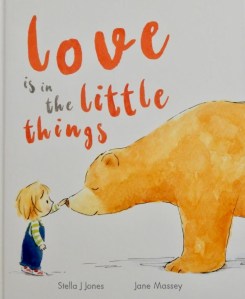
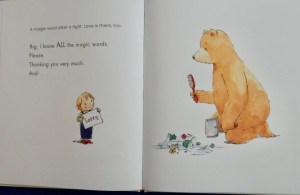
Small – a human child and Big – a large bear love one another very much, but how do they show that love? Stella Jones’s first person text and Jane Massey’s heart-warming watercolour illustrations show that essentially as Big says, ‘ love is made from the little things’ – every day things such as holding hands, making and taking tea together, a goodnight kiss, hugs, saying sorry,

extending a helping paw or hand. As Little realises as they look skywards, “Love is made of ALL the little things. Just like the trillions of tiny twinkly stars make the forever of the deep blue sky.’
Gentle, reassuring, and sometimes exciting like those ‘tingletastic, tummy jumbling, giant-enormous glorious fireworks and starbursts.’

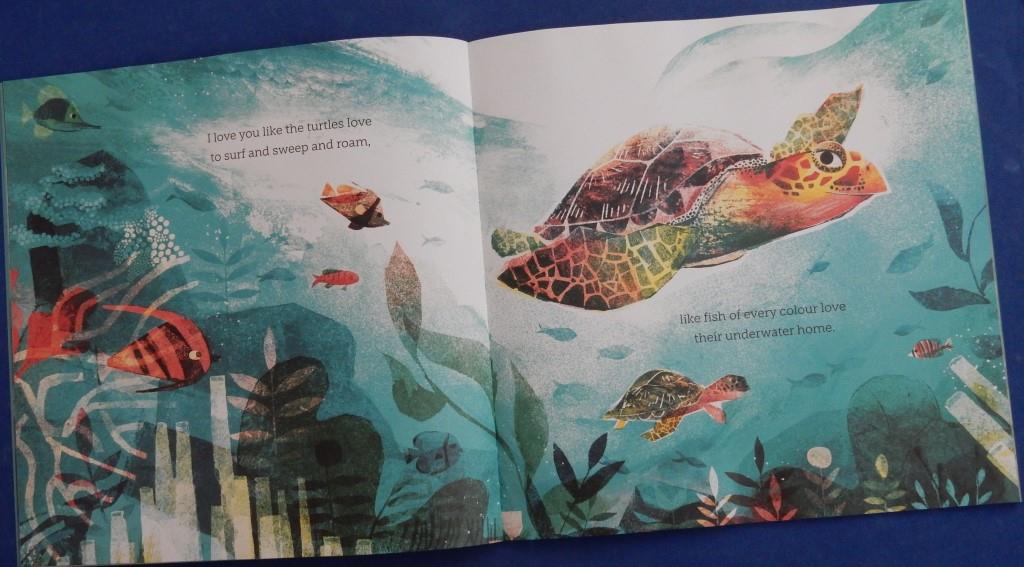
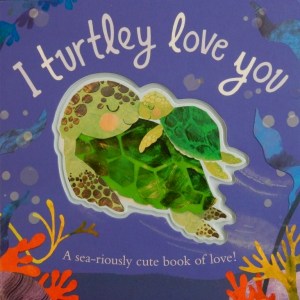
This board book takes readers beneath the ocean waves where, through Harriet’s gentle rhymes and Bryony’s engaging illustrations they will encounter several ocean creatures and their little ones. There are turtles, seahorses, clownfish, jellyfish and more either playing or snuggled up together. The emphasis on each spread is the love the adult gives to the little one.
With cut-outs and stand-outs on each spread, little humans will enjoy the tactile opportunities offered by interesting watery, collage style visuals. Some adults might find the words slightly too sugary.

Board Books Treats

This image has an empty alt attribute; its file name is dscn9866-1.jpg

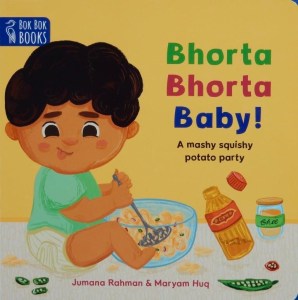
Jumana Rahman’s sweet , or rather savoury, debut board book introduces little ones to a favourite Bengali dish.
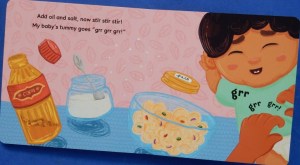
A baby sits in a high chair watching an adult dropping chopped potato into a cooking pot on the stove – the first task when making the dish. This is followed by the chop chop chopping of chillies which induces a coughing fit in the child. Next onions are sliced and dropped into a frying pan; this brings tears to the baby’s eyes. Turn the page and the infant’s hands are mashing and squishing in a mixing bowl; then in go oil and salt

This image has an empty alt attribute; its file name is dscn9867-1.jpg

as the little one’s tummy rumbles in anticipation. A taste soon comes as the adult whom we never fully see, pops a small piece into the little one’s mouth. Even teddy gets a taste of the treat. Yum, yum aloo bhorta is delicious.


With fun sounds to copy and Maryam Huq’s illustrations that include some details of Bangladeshi culture – books, a stool, poster on the wall, label on the oil bottle – this is a book to share at homes and in nurseries. To complete the experience, why not try making aloo bhorta with little ones.

This image has an empty alt attribute; its file name is dscn9751-1.jpg


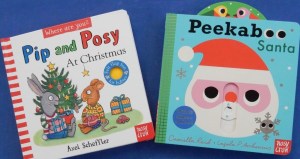
Pals Posy and Pip are enjoying a game of hide and seek in the snow and it’s Pip’s turn to hide. Has he hidden himself behind a tree, a hill, the house, a fence perhaps? No, Posy will need to go back indoors to find the whereabouts of his best friend.


Little humans will love lifting the felt flaps to help Posy in her search: I suggest they snuggle up with an adult before they start. That will ensure they’re not too shivery to enjoy the fun details in Axel Scheffler’s snowy scenes.

Peekaboo Santa is essentially a rhyming game with a Christmassy theme and sliders for little fingers to manipulate. So doing will reveal in turn, a pair of birds, a star atop a Christmas tree, an elf, Santa on a sleigh, a candle flame, a playful mouse, a surprise present, children anticipating Santa’s coming and finally, a mirror. With its bright colour palette and festive images , this is just right for the very youngest.

This image has an empty alt attribute; its file name is dscn9783-1.jpg

Little ones will encounter, not just the little dinosaur responsible (with their help) for the stomping, roaring and other sounds in this book, but a number of other prehistoric creatures too. There’s Triceratops, Diplodocus, Stegosaurus, Ankylosaurus and Tyrannosaurus to name just some, as well as a tiny hatchling hiding in plain sight on every spread, waiting for keen-eyed little humans to find it.


A fun book for sharing and as an adult or older sibling reads, said little humans following the story will love pressing the main protagonist’s squishy buttons and in so doing, will be developing their own fine motor skills and powers of observation.

Butterfly Skies / Fletcher and the Seasons

Readers can enjoy creating their own 3D butterflies – twenty in all – using the thick cardboard press-outs at the front of this book, which is published in collaboration with the National Trust.
The second section contains beautifully illustrated spreads of in turn, the Orange-tip, the Camberwell Beauty, the Clouded Yellow, the Comma with those wonderful patterns on the upper surface of its wings,. Then come the Swallowtail, the Peacock with its startling eyed wings, the Chalkhill Blue, (one of my favourite butterflies)

the Purple Emperor, the Pearl-bordered Fritillary and the Green Hairstreak. All these are European species, some being rarer than others, the Green Hairstreak, the UK’s only green butterfly, for instance.
The caterpillars of each species are also included in Kate Reid’s illustrations, as well as the flora – often the food plant – on which they are frequently found.

My only slight criticism of the art is the use of ‘googly eyes’ for the butterflies and caterpillars.
Give this to a child and you may well spark a life long interest in butterflies.

As little fox Fletcher journeys through the four seasons accompanied by his friends, he enjoys what each one has to offer and what makes it different from the other seasons. Spring brings woods with blossom on the trees; summer is warm and a great opportunity to play in the sun; autumn is the time when the leaves come fluttering down from the trees and winter often brings snow and ‘cosy lights aglow’.

With Tiphanie Beeke’s softly glowing illustrations evoking each different time of year and featuring the characters from the Fletcher picture books, and a brief accompanying text, this board book offers a good opportunity to introduce them to younger children, as well as to talk about what they enjoy about each season.

Don’t Take a T-Rex Out For Tea / My Big Playbook / Polly Put the Kettle On

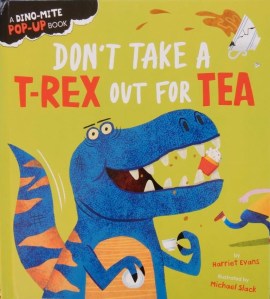
The five dinosaurs lurking between the covers of this large format board book practically leap off the pages as you turn them. In turn young children will delightedly encounter a stegosaurus – a decidedly bad sport that can’t bear to lose, a pterodactyl, not a creature to challenge for a race, then comes a diplodocus, an unsuitable dino. to try to hide in your bedroom on account of its colossal size, a triceratops that will put paid to any musical activities you might engage in, and finally be warned: T-Rex is always on the lookout for a tasty treat, so don’t even contemplate inviting one out for tea.
A rhyming text accompanies the prehistoric pop-outs depicted in Michael Stack’s splendidly silly scenes.

A large format board book, with a die-cut and felt flap to explore on every page. There’s a double spread devoted to numbers 1-5, with other pages of things that go, things you would see outside, shapes, weather-related words. things to find at home, colours, animal sounds and finally, bedtime, which includes a surprise hidden mirror.
Ingela P Arrhenius’ bright, enticing illustrations show either separate items each set against its own coloured background, or a whole scene.
Interactive fun learning for the very youngest to enjoy at home or in a nursery setting.

The local cafe is the setting for this version of a favourite nursery rhyme, its customers being a variety of anthropomorphic animals and Polly is a panda. Once the tea has been duly served, it’s down to pooch, Sukey to remove it from the stove. Off go all the tea drinkers and cake consumers waved on their way by Polly.
One of the ‘Sing along with me!’ series that has a sliding mechanism to add to the enjoyment on every spread and a QR code on the back cover to scan, which enables you to listen to the song. With ever fewer young children starting nursery knowing any nursery rhymes, this is a good place to start.

Albert and his Friends / Spooky Little Halloween / That’s How Much I Love You

Albert the Tortoise has already established himself as a popular character among children from around three and their adult sharers. Now he wants to introduce himself and his minibeast friends to the very youngest children. In this little book, with its simple text and close-up images, they will meet in turn, Butterfly with its gorgeous wings, then a pair of woodlice, wiggly worm pops its head up through the soil, Buzzy Bee alights on a flower just in time to say hello, Snail slithers up with its shiny shell, Ladybird gives a wave with one of its front legs, Spider proudly shows a newly spun web 

and the ants demonstrate their teamwork. On the final spread, Albert’s multitude of friends return the compliment, telling the tortoise what a good friend he is to all of them.
Just right for the under threes.

Not really very spooky as the eight characters that almost leap from the pages of this vibrant ‘Finger Wiggle’ book are all smiling in a friendly manner. First comes a little witch riding her broom, arms outstretched; she’s followed by a little wolf singing to the moon, a spider wiggling its eight hairy feet, a little ghost, a rotund pumpkin, an upside down bat, a black cat and finally a little monster proudly showing his first tooth – albeit a very sharp one. On each spread that introduces Nick Sharratt’s endearing characters, Sally Symes’ simple rhyming text provides a ‘wiggle wiggle’ and a fun, sometimes onomatopoeic phrase to join in with.

One cannot help but bring to mind Sam McBratney’s Guess How Much I Love You when reading this first person rhyming tale wherein an adult racoon tells its cub just how much it is loved. The rhyme reads well aloud presenting in turn pairings such as a sock and a shoe, the sun and the moon, a bowl and a spoon; but it’s Tiphanie Beeke’s richly hued illustrations painted on textured paper showing the two racoons that steal the show, especially the final one wherein paw in paw, adult and cub walk in a woodland setting at sundown.
A gentle bedtime wind-down book to share with toddlers.

One Little Leaf / All the Things a Tree Can Be / The Odd One Out

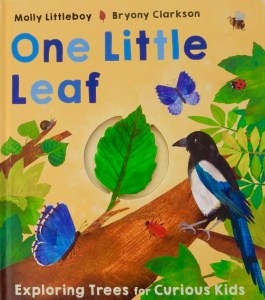
Trees are my favourite thing in nature and I think it’s never too early to introduce young children to their delights. This chunky, large format board book does just that, starting with a spread showing fifteen named leaves from different trees.Four are depicted on flaps, which when lifted reveal a brief paragraph of information about the respective trees on which they grow

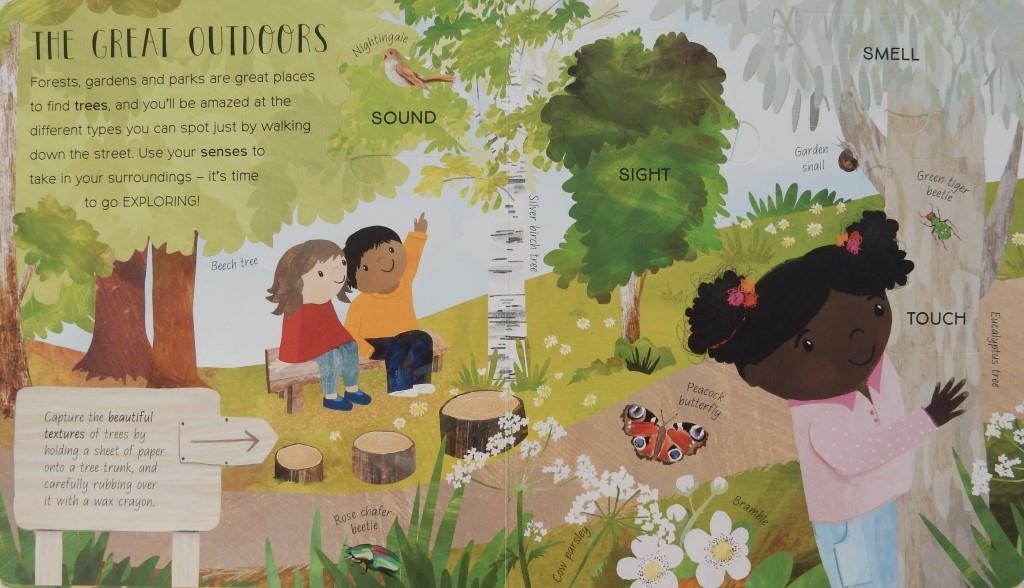
Other spreads are devoted to in turn, sensory exploration of the surroundings, 

the growth of a tree, the tree as habitat for other wildlife, some of the uses of tree parts, seasonal changes of a tree and finally, on ‘Happily Ever After’ readers are encouraged to plant a new tree and to explore the themes included further.

A chatty, engaging narrative runs through the whole book, comprising on each page an introductory paragraph and a suggestion encouraging children to become actively involved with the natural world.
With clear, naturalistic illustrations this is a good starting point on things arboreal, to share with children in their early years.

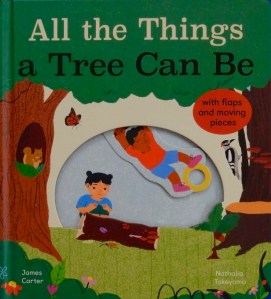
Presenting the wonderful things about trees is difficult in just six double spreads, but author James Carter includes the essentials in this little book. I love the description on the opening page, ‘Trees are ground-hugging / sky-nudging wonders!’ Indeed they are ,be they of the deciduous or evergreen kind, both of which are depicted in Nathalia Takeyama’s first illustration that also includes some woodland birds and animals, and humans.
Deciduous trees change with the seasons and this is the theme of the next spread, which has two flaps for little hands to lift and reveal simple sentences and a different visual.
The third spread takes us to visit a tropical rainforest, rich in both flora and fauna.

‘They are like nature’s tallest hotels!’ so we read on the spread depicting some of the animals that make their homes in trees, some of which benefit the trees in return. Continuing this idea, the final pages present some ways trees are vital to all manner of Earth’s life forms in that they provide food, shelter, warmth, wood, shade and most importantly, they clean the air that we all breathe.
With its integral moving parts, this is a simple introduction to a vast subject for adults and little ones to share.

This book offers a great opportunity for young children to develop their observation skills as they peruse the pages of this ‘spotting book’. The first fourteen spreads present all kinds of interesting animals, a different kind on each, including camels, bats, seals, tortoises, ostriches, pandas, monkeys, rhinos, flamingos, fish, lemurs, penguins and butterflies. In addition a pair of rhyming verses invite the reader to spot the difference on each spread, for example among the camel train, one of their number has a single hump, whereas all the others have two. Another spread asks, ‘Who gets the first fish? Can you spot the winner?’ and depicts a pod of hungry seals, ‘calling out for their dinner’, one of which depicted in the print-like pattern already has a fish in its mouth. 

Some of the puzzles are much harder to spot than others; this reviewer found herself going cross-eyed trying to find the cross-eyed lemur looking at its own nose. Young children will certainly be challenged and entertained by most of the spreads.

On the final spread, a new animal is hidden among the melee comprising several representatives from each of the previous spreads.

Peekaboo Car / My First ABC

Both books are Nosy Crow publications – thanks to the publisher for sending them for review

Even before opening this, toddlers will likely be captivated by the opportunity to manipulate the car’s headlights on the cover illustration. Going through the book presents them with an oilcan, a drill, a line of cars, a lorry, traffic signs, a petrol pump and other items that can also perform surprise actions when the sliders are used. Then on the final spread , there’s a mirror waiting to be revealed for a ‘Peekaboo … you!’
Offering lots of occasions to develop their fine manipulative skills, little ones meet vehicles, passengers, tools and drivers in this fun game of peekaboo presented through Camilla Reid’s simple rhyming text and Ingela P Arrhenius’s bright, patterned illustrations.

This is the latest of the excellent large format 100 First Words series. There are two letters on every one of the thick card pages, on which are various size boxes within each of which is an appealing image and a single word label in a clear, unadorned font. Toddlers will delight in engaging in a ‘point and name’ game with an adult or older child and in so doing will likely learn some new words, as well as seeing familiar ones in print.

Equally, they will enjoy guessing and then looking to see what’s hidden beneath the flaps on every spread – another feature that both publisher and illustrator know appeals strongly to very young children. In this book the hidden object begins with the same letter as that depicted on the flap.

Hours of fun learning potential in this well-designed, attractively illustrated book.

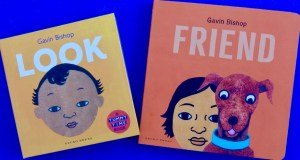
Lionel is just like Dad / Look / Friend

These are recent Gecko Press publications – thanks to the publisher for sending them for review.

This celebrates the relationship between a father and small child, lion style.

Little Lionel closely watches his father’s every move, copying his actions carefully.
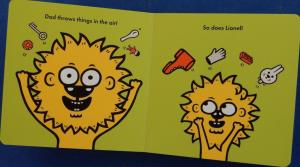
When Dad combs his hair. so too does Lionel, Dad taps his teeth, Lionel does the same, Dad scratches an itch, ditto Lionel, Dad sings a song very loud, Lionel reciprocates. Then after a brief break, Dad throws things into the air, Lionel does likewise; 

however something that Lionel throws falls on Dad’s head. with a THUNK! causing the parent to cry out in alarm, as does Lionel. Now Dad is not so impressed with his little one’s copying behaviour and they turn away from one another. After a think on Dad’s part and on Lionel’s the two go and hide themselves. Not for long though for all ends happily with forgiveness from Dad and hugs all round.

Charming, reassuring and a fun portrayal of a parent’s unconditional love. Ville’s seemingly simple illustrations show so clearly the emotional changes of both characters.

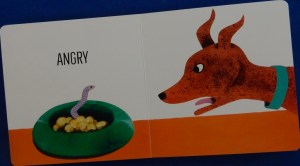
Essentially Look , a wordless concertina fold out, opens one way to reveal a sequence of ten faces, nine human and one a dog. Opened the other way, you find a series of seemingly random objects likely to be familiar to an infant – a bird, a bunch of keys, a doll, a ball, a pair of spectacles, a toy bear, a snail, a ship, a dog, a rabbit and a truck – each one simply depicted centre stage in bold bright colours.
Unfolding to almost 2 metres this simple ‘tummy time’ book is sturdily built to withstand the frequent use it might well get.

Friend features a child narrator – the owner of a dog – who clearly loves the animal , calling her ‘My best friend’ on the final spread. Words are kept to a minimum with four being the most on a spread, and several have just a single descriptive word: happy, angry, rowdy, sad, shy, each of which is mirrored in an expressive picture of the pooch.
Little ones will enjoy the sequence relating what unfolds when the dog discovers an unwanted visitor in her food bowl, 

expresses how she feels about it by howling at an adult, receives a ticking off from the girl causing the creature to tuck herself under the table for a while.

An opportunity for small humans to learn new vocabulary as they follow the action and interactions. showing that real friends don’t always need to say much; their expressions speak volumes.

Don’t Mix Up My Farm / What’s Scarier than a Spider? / I’m Not Scared, You Are!

These are three brand new board books from Little Tiger – thanks to the publisher for sending them for review.

Don’t Mix Up My Farm
Rosamund Lloyd and Spencer Wilson

Five farm animals – a sheep, a donkey, a cockerel, a pig and a duck offer tactile fun in this matching game of a book. Little ones will enjoy creating strange-looking creatures by mismatching one of their features using the wheel. Although none of the creatures will be impressed to be given wrong horn, beak, tail or comb, so they should make sure they also match each with the small pictures on the back cover; otherwise a lot of braying, bleating, crowing, grunting and quacking might break out down on the farm.

What’s Scarier than a Spider?
Amelia Best and Becky Davies

The scorpion, wasp, cockroach, mosquito, and spider more than meet their match in this altogether different peekaboo game. The aforementioned creatures are anticipating in turn, dinner, a fight, a tasty treat, being the boss

and upsetting something or someone. However as the fly on each spread delights in announcing, each one has an unexpected confrontation of the alarming kind.
There’s some delicious alliteration – ‘massive mantis’ and ‘biting beetle’ for little ones to try getting their tongues around, along with the delightfully shocking creepy crawly surprises revealed by lifting the flaps, especially the final extra large one to revel in. Amelia Best has portrayed some terrifying minibeasts in her arresting illustrations.

I’m Not Scared, You Are!
Patricia Hegarty and Thomas Elliott

With a plethora of scary sounds waiting to spook your little ones at the press of a button, we join two child characters on a foray out into the night. Their journey takes them deep into a forest wherein bats and owls are ready to alarm with their flaps and yowls. They board a passing ghost train that drops them off outside a cottage wherein a witch is busy stirring something that’s bubbling in her enormous cauldron. Hearts thumping, on they go over the bridge, under which lurk not one but three growling, grunting trolls, as they head towards a huge haunted house. Inside they are met by rattling skeletal sounds, followed by clangs and clanks sending them hurtling towards the door once more. After a frantic dash our adventurers arrive back home safely and of course, they confirm “No, we’re not afraid!’ But are they? …
Patricia Hegarty’s rhyming text reads aloud really well offering lots of opportunities for action as well as noise making and Elliott’s scenes are jocular rather than of the shivers-down-the-spine- sending scary.

What Can You See? At the Zoo / Word Museum / Where’s Mr Train?

What Can You See? At the Zoo
Katie Ware and Maria Pereira
Little Tiger

Maria Pereira’s cutaway scenes of a zoo park present an absolute wealth of animals, large and small. Reptiles and insects share the first spread, along with several frogs. Turn over to see lots of brightly coloured birds and a pair of slumbering owls; then it’s off to a more arid part of the park where meerkats await. On the last three spreads there are tigers and monkeys; a watery area with penguins, seals and sharks and finally, hippos keeping cool, rhinos, elephants, zebras and giraffes – two of each creature as well as a couple of wading water birds.
At each location there’s a ‘can you spot … ?’ question and some snippets of information. Plenty to engage little human visitors to this particular zoo.

Word Museum
Sophie Ledesma and Isabel Otter
Little Tiger

Along with Oriel ostrich and her students, little human learners can explore the word museum in this interactive book that introduces them to learning topics – museums and words. The tour starts in the ancient pottery arcade, proceeds to the animal gallery and thence, the furniture hall, after which it’s time for a quick snack break at the rooftop cafe. Next comes an exploration of gadget corridor with lots of different devices on view and the tour concludes outside in the fashion courtyard.
Sophie Ledesma’s lively, patterned illustrations and Isabel Otter’s engaging text will set young children on the road to becoming culture vultures as they explore the exhibits, peek through die-cuts, lift the gatefold on each spread and answer the questions posed, while learning lots of new words along the way. Fun learning, quality board book style that’s just right to share with toddlers

Where’s Mr Train?
Ingela P Arrhenius
Nosy Crow

The latest in this felt-flap hide-and-seek series introduces toddlers to four different means of travelling: a tram, a ferry boat, a bus and a train. Each except the completely hidden bus has a small part slightly visible before the flap is opened and the final spread shows all four in their entirety and there’s a mirror behind the flap.
With simple bright illustrations and a simple question and answer text, this is ideal for the very youngest children.

Friends, Shapes and Scares Board Book Style

These are recent board books from Little Tiger – thanks to the publisher for sending them for review

Let’s Make Friends
Leah Osakwe and Becky Paige

This is a simple exploration and celebration of friends and friendship for the very young. The author uses similes to liken friends to a wide variety of things – a yummy breakfast to give you a good start to the day; a bouncy trampoline that’s ‘there for you through all your ups and downs’, a soft snuggly blanket that wraps you in warmth and love, a guide on an adventure helping you follow your dreams. On gloomy days, just like the calming glow of lamplight, they bring brightness and cheer; they’ll always make space for you. Friends help you blossom into whoever you are meant to be, just like a garden where flowers bloom and so much more. I love the concluding spread that likens friends to sets of unmatched socks.
This is one to share and talk about with nursery friends.

Nibbles Shapes
Emma Yarlett

Nibbles the book-eating monster is so ravenous he’s started sinking his teeth into shapes. He gobbles circles, chomps at squares, takes small bites from a star then moves on to attacking triangles, diamonds, rectangles, even arrows. He’s saved his favourite till last; it’s a large pink heart ‘for me and you’ so it’s said, but before we can catch him to say thank you he’s made a hasty exit right through the back cover of this, now very holey, little book. Small humans will enjoy following the shape devourer through the pages.

What’s Scarier than a Shark?
Amelia Best

Not for the faint hearted is this sequence of mock scary marine creature confrontations. First to go on the attack is crab but not for long for a biting beastie more often found in fresh waters is on the look out for something to gobble.. Next is a killer whale but according to our shrimp narrator, that too has made, not a catch but a mistake. What about the swordfish – predatory it might be, but has it met its match with that enormous octopus? Angler fish look terrifying but what is lurking nearby? Something with a tail that is more than a tad terrifying though the angler doesn’t yet know that. Finally along comes a shark intent on devouring our narrator but there’s a surprise in store and it’s lurking behind a double flap.
Peek-a-boo with a difference assuredly; little ones will enjoy the fun of discovering what is revealed when they lift the flap on each of Amelia Best’s brightly coloured spreads..

Pip and Posy In the Garden / Pip and Posy At the Seaside

Pip and Posy In the Garden
Pip and Posy At the Seaside

Axel Scheffler
Nosy Crow

Best friends Pip (rabbit) and Posy (mouse) takes turns to play hide-and-seek. In the Garden has Pip doing the hiding and Posy searching in various places, first the shed, then up the tree, behind the space hopper and in the vegetable patch. None of these are her friend’s hiding place, although a variety of smaller creatures are revealed when he brightly coloured flaps are opened. But who does that pair of ears poking up above the top of the bush belong to?

On and around the beach provide possible places for Posy to hide herself At the Seaside. Maybe she went behind the lighthouse. No! Perhaps under the umbrella – err sorry, mind the pincers though Pip. Nor is Posy making a purchase at the ice-cream shop. Could that ice-cream Pip is enjoying help him discover her whereabouts and you never know she might have been joined by another of their pals.

The simple repeat pattern text, Axel Scheffler’s delightfully detailed pictures of the friends at play and the hidden surprise endings work perfectly with little humans who will enjoy participating in the fun of the two searches.

Playing and Learning with Board Books

Little Bear Where Are You?
Little Dog Where Are You?

Ekaterina Trukhan
Nosy Crow

It’s true to say that babies enjoy playing with mirrors and this new Where Are You? series has a mirror on every spread.
Taking inspiration from the hugely popular Family Finger rhyme, Little Bear introduces in turn little frog, little deer, little rabbit and little bear by means of a text with a repeat pattern: ‘Little —— , / Little —— , / where are you? // On the opposite page, comes the reply, ‘Here I am! Here I am! / Where are you?’ When the animal’s face is flipped down we see the words, “There you are!’, and a mirror is revealed for little humans to see their faces.
The final spread shows all four animals and beneath the fold, the titular character addresses the baby whose face is reflected in the mirror.
The large card flaps are easy to manipulate and sufficiently sturdy to stand up to the frequent use the books are likely to have.
Using the same structure, in Little Dog, illustrator Ekaterina Trukhan portrays first little hamster, followed by little bird, little cat and lastly, little dog (sporting a bobble hat).

Peekaboo Lion
Camilla Reid and Ingela P Arrhenius
Nosy Crow

This latest in the novelty series with sliders and a final mirror, features wild animals, although they look deceptively friendly in Ingela’s vibrant, patterned illustrations. The playful rhyming text comprises two words per page and introduces animals large and small; and there are opportunities to meet both adult animals and their young on some spreads.
A fun way to develop tinies’ language and manipulative skills together with a surprise finale.

Don’t Mix Up My Puppy
Rosamund Lloyd and Spencer Wilson
Little Tiger

Little humans will enjoy getting their paws on this mix-and-match doggie delight, with its five different puppies depicted, one per spread, in Spencer Wilson’s bold illustrations.

First we meet a Dalmatian with a spotty, dotty tail, then a velvety tailed dachshund, next comes a sly terrier whose tail is fancy and flowy; the white poodle’s tail matches his cute, curly self and finally there’s an Irish setter with a fluffy, furry tail.

Toddlers can have fun turning the wheel, finding each pup’s tail and feeling the respective tactile rear end appendages. Just right for developing hand-eye coordination too.

All Change! / Colour Gallery

Here are two new board books from Little Tiger – thanks to the publisher for sending them for review.

All Change!
Harriet Evans and Linda Tordoff

Transformations in the natural world is the theme of this board book with its clever, enticing cover picture.
By means of the flaps integral to each of Linda Tordoff’s illustrations, we see changes brought about by the seasons, through life-cycles of insects and frogs, the weather, danger, the lunar cycle, the need to catch food, for safety and more. Executed in soft, soothing colours, each scene is pleasing to the eye and the simple text offers a starting point for discussion with very young children.

Colour Gallery
Sophie Ledesma and Isabel Otter

Ready and waiting to take the animal visitors, and readers, on a learning tour around the art gallery is Gigi the giraffe. First stop is the Red Mosaic Hall, followed by the Blue Portrait Gallery, the Green Sculpture Park and the Yellow Landscape Room. This art establishment certainly makes effective use of all its space for there’s a corridor devoted to still life paintings

and the cafe displays abstract art on its walls.
As well as reinforcing the concept of colour in an unusual manner, Isabel Otter’s interactive text, the book’s design with its shaped pages and gatefolds and Sophie Ledesma’s bright illustrations (with a tiny mouse lurking on every spread), provide a fun introduction to the world of art for the very youngest children.

Let’s Go Home, Baby Tiger / Eggs! / Pip and Posy: Favourite Things

Three new board books all published by Nosy Crow: thanks to the publishers for sending them for review

Let’s Go Home, Baby Tiger
Carolina Búzio

By means of the sliding discs on each recto, little humans can help the baby animals featured in this chunky book to find their way home. First comes baby tiger, followed in turn by baby parrot, baby elephant and finally, baby crocodile, each of which responds to the respective adult animal’s ‘Let’s go home baby …’

The moving discs and tracks will help to develop hand-eye coordination as young children endeavour to keep the baby animals upright and not make them dizzy by revolving the discs. There are several items to look for on each journey and the verso pages show what they are.

Lots of of fun learning here.

Eggs!
Katie Dale and Jenny Lovlie

A counting book with an egg theme that invites young children to guess what’s inside the eggs shown on each spread. What could be in the one egg about to crack open in the desert?
The nest beside the river contains two eggs: what is soon to crawl out of each? The jungle nest holds three eggs, each with a baby animal waiting to emerge, but what? Four eggs are ready to crack in the nest beneath the ocean: the babies within have lots of legs. I wonder what they could be … The farmyard nest holds five white eggs, just starting to crack and five fluffy birds are ready to hop right out.
A ‘guess what’ game and counting practice presented through Katie Dale’s rhyming text and Jennie Lovlie’s detailed scenes of the nesting locations of the five featured creatures. With a new life theme it’s just right for Easter and beyond.

Pip and Posy: Favourite Things

Inspired by illustrator Axel Scheffler’s original series and based on the TV show for preschool children, this tabbed board book introduces the best pals Pip (a rabbit) and Posy (a mouse) and their other friends, showing how they love playing together dressing up and having adventures. The friends in turn introduce their favourite toys: Froggy is Posy’s favourite and Piggy is Pip’s.
We also meet Jamila the squirrel, Zac the terrier pup who loves to zoom around on his bike, and level-headed Frankie the cat. All very different but with one thing in common: they love playing together.

I suspect adults and toddlers will enjoy reading this together.

Kind Crocodile / Who’s Hiding? On The Farm

Kind Crocodile
Leo Timmers
Gecko Press

Little does Crocodile know when he decides to leave his watery abode and go for a stroll that he’ll end up as an animal rescue service. First comes a mouse fleeing from a scary snake, closely followed by a warthog hotly pursued by a hyena; next is an impala chased by a cheetah and then a rhinoceros with a lion in pursuit. Crocodile sees off the chasers with some strategic and menacing GRRRRs and offers a safe haven to what becomes, with the addition of the heaviest animal, a surprised heap comprising rhino, impala, warthog and mouse each precariously balanced in a tower upon the kind croc’s back. This makes him let’s say, somewhat flattened, physically at least, as well as voiceless.
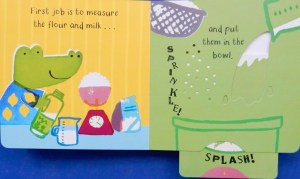
How will they see off that hungry lion now?

Happily teamwork comes to their rescue; but the last word (make that almost the last) is definitely that of Crocodile, which creates a moment of suspense before his final utterance. Then off they all go, the animal tower somewhat differently arranged.

With Timmers’ humorously expressive mixed media illustrations, simple patterned text and that fun plot twist, this a funny large-format board book to share with little ones.

Who’s Hiding? On The Farm
Pintachan
Little Tiger

When a little chick loses his mummy, he asks Pig to help him find her but they can’t do so without little readers’ assistance. Following Pig’s instructions, they can explore what’s hidden behind the flap on each spread. They will also discover several other little chicks that have tucked themselves away cheeping, and once located those too can help in the search.
With bright jolly art by Pintachan and cutaway pages of farm scenes with minibeasts too, a simple text that includes animal speech bubbles to join in with and a happy ending, there’s plenty to entertain little humans in this fun board book.

Hop, Hop! / One Little Egg

Both these titles are from Little Tiger: thanks to the publisher for sending them for review

Hop, Hop!
Isabel Otter and Sophie Ledesma

In this interactive ‘slide and seek’ board book little humans can follow Little Bunny through an entire day from sunrise to bedtime. In so doing they will meet Bunny’s forest friends, those that live in and on the river and goodness me, behind a large rock, not completely hidden so youngsters can guess what’s there, is something growly, furry and hungry.

After all that hopping and scurrying, Little Bunny needs to sleep, zzzz.

With sliders to move up and down, or in and out, flaps to open and a wheel to turn, young children will be developing their fine motor skills, enjoying a simple story and feeling involved in Bunny’s day. Then with a final spread that asks, ‘What did you spot on the way?’ showing ten labelled items, they can also develop their observation skills.

For older children, also with a nature theme, and lots of interactive elements is

One Little Egg
Becky Davies and Charlotte Pepper

This sturdy book is part of a non-fiction series that encourages children to use all their senses to actively engage with and explore in detail, the natural world.

Starting with eggs, Charlotte Pepper presents brightly-coloured spreads of birds’ nests, birdsong, feathers and birds in flight. There’s a spread devoted to bird spotting – you can do this without binoculars no matter where you are –

the food chain and urges youngsters to become involved in helping birds (and indirectly all wildlife), survive and thrive. The text presents a wealth of facts, some of which are hidden beneath flaps adding further reader involvement, and there are questions and activity suggestion boards that will stimulate discussion with young children.

A lively, engaging introduction to the wonders of the world of birds.

Not Just Another 123 / Not Just Another abc

Not Just Another 123
Not Just Another abc

illustrated by Jack Viant
Noodle Juice

All kinds of crazy shenanigans occur between the covers of these concept books; their creators clearly had both adult and child audiences in mind when they dreamed them up. Whether or not young children will understand the clever combinations of visual and verbal humour, I have yet to decide. However I certainly had a good laugh at for example, in 123 the chicken and egg conundrum, the flexible flamingos working on their yoga asanas

and the sheep endeavouring to emulate them and the not so elegant octopuses getting their tentacles in a twist as they do a repeat performance of the hokey cokey. After a tongue twister involving toucans, a representative of each animal group turns up on the final spread – a number line – to encourage little humans to count from one to ten.

The abc book uses three letters per spread (except for the y and z page), and the chosen words on each verso combined with the illustration on the recto, present a mini story as well as perhaps, a starting point for a longer tale co-created by adult and child. Facing the words ‘alligator before crocodile’ are two scaly creatures standing outside a door above which is the sign ‘Dr Smiles Dentist’ and via speech bubbles they discuss who should go in first. The possibilities are many here, but my favourite is this …

I suspect the dragon’s thought bubble will go way over the heads of young children though they can have great fun generating ideas as to what might happen next. The fairy is clutching a wand so maybe she can find a way to save herself …

Different parts of speech – adjective, verb, noun, preposition – comprise the word combinations used adding the possibility of an extra grammar lesson for older readers.

As the characters’ speech bubbles on the covers assert ‘Boredom-free guaranteed!’