BLITZ One Family’s War

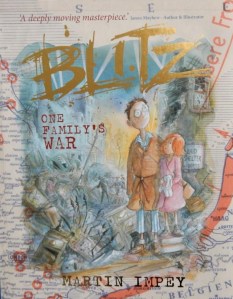
“Wow! Someone has taken a great deal of trouble over this,” commented our postman as he handed me a parcel containing this superb book. He was referring to the illustrated wrapping paper but it most definitely applies to the entire book too.

With consummate artistry, inspired by his childhood stories, Martin Impey has created a sequence of watercolour illustrations, which together with the storytelling presented from the perspective of a brother and sister, take readers through what happens to the family living at number 2 Dane Place, Bow.

We’re really given a sense of how the lives of the East End family change from before war broke out through to when two of the children were evacuated to somewhere safer; the feeling is one of instant and direct involvement with their fears, sadness

and their hopes as they carry on their daily existence in the midst of the chaos and unpredictability of the Blitz.

In addition to the family’s history there is a double spread about the impact of the Blitz on London and the rest of the country as well as extracts from letters and contemporary documents and radio broadcasts announcing the outbreak and the call for volunteers for the Dunkirk evacuation by the ‘little ships’.

With its evocative, engrossing storytelling both verbal and visual, this is a treasure of a book for individual readers, for family sharing and with my teacher’s hat on, an absolute must have for classroom exploration. It’s rich in opportunities of all kinds as I have no doubt will be the continuation of the story, Evacuees, which I eagerly await.

Little People, Big Dreams: Rafa Nadal / Little People, Big Dreams: Usain Bolt

These sporting heroes are great additions to the series of mini biographies. Both are legends who have gone beyond their sporting successes and helped other people,.providing great role models for younger readers.

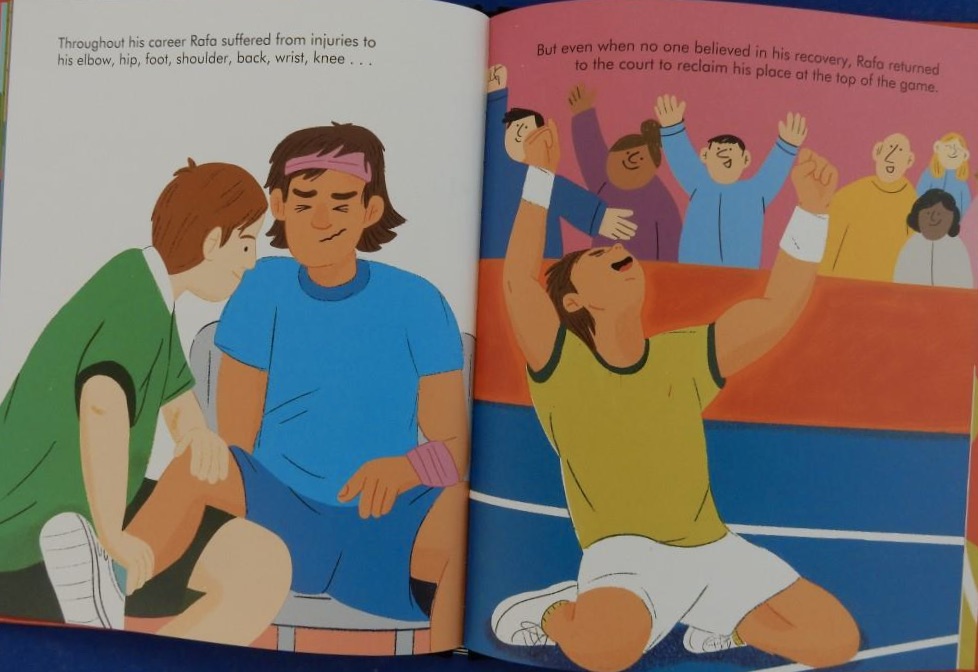
Rafa Nadal was born into a sporting family: one of his uncles passed on to the boy his love of football; another uncle gave him his first tennis lesson when the lad was just four years old. When he started winning tennis tournaments it wan’t only his innate ability but also his humility and determination to do well that made him such an outstanding player. How many others I wonder would turn up early to train and stay after everyone else to sweep the court and collect all the tennis balls. And how many others could continue playing with a very painful broken finger and win a tournament? That was just one of the many injuries Rafa sustained during his career and he never let them hold him back,

rather he increased his efforts determinedly wherever, whenever he played. His resolve also came to the fore again when Mallorca, his home, suffered devastating floods; Rafa was among the first people to help with the clean-up. Moreover through his charitable work he used sport and education to help future generations.
The book’s final timeline focuses on key highlights of his life and has further details of his story.

Usain Bolt’s first sporting interest was cricket; indeed it was his cricket coach who convinced the boy to join the track team and before long, having won a silver medal was offered the opportunity to move to Kingston and practice alongside other promising young athletes. At only fifteen, despite suffering pre-race nerves, he become the youngest ever World Junior champion. He learned an important lesson about dedication and discipline a few years later though: preferring to hang out with his friends rather than focus on running technique, he suffered an injury during the Athens Olympics and was eliminated. However a new coach made all the difference to what happened thereafter. Despite his scoliosis, his height and determination, Usain won two gold medals at the 2008 Beijing Olympics (one with a shoelace undone)

and earned the name ‘Lightning Bolt’. He went on to be the only sprinter to win Olympic 100 m and 200 m titles at three consecutive Olympics (2008, 2012, and 2016). In so doing he found himself a place in the heart of every Jamaican. Even more so by starting a foundation to help other children follow their dreams.
Both books deserve a place in primary school collections.

Uprising

Set in Poland during World War 2, this book is based on the real life story of Lidia Durr – a girl whose life changed irrevocably when the Nazis invaded Poland. Lidia, a talented pianist, is just twelve in September 1939. She and her family went into hiding in their basement when the Nazis began bombing Warsaw as part of their house was smashed by bombs. When the German takeover was complete, Lidia and her family went back to living upstairs but then were forced out as the Germans took the house for themselves. Papa meanwhile has donned his uniform from WWI and gone to fight for Poland.

The Durr family – Lidia, her mother and brother, Ryszard, together with a Jewish woman their former maid, Doda, and Doda’s mother relocate to a tiny apartment adjacent to Warsaw’s Jewish quarter from where, at the mercy of their occupiers, Lidia helplessly watches family, friends, and countless strangers suffer terrible cruelty, starvation and injustice.

With life becoming ever more difficult, Lidia, desperate to fight back, seeks opportunities to play her part. She sneaks food into the ghetto and enrols in an underground school but as she gets older, with Ryszard having joined the resistance, she finds this isn’t enough. Always hoping for liberation, she begins to fear that the world has forgotten Warsaw.

Frustratingly, her brother doesn’t talk about his resistance work so Lidia finds her own ways to increase her participation. She begins by running messages for the resistance but soon becomes a crucial element taking on ever more dangerous assignments. Admitted into the circle of people planning Operation Tempest, Lidia (code name Cello) rapidly rises up the ranks.

This is a powerful story with Polish people who are not Jewish as its main characters that demonstrates just how very dangerous it was to speak out of turn, let alone be a pro-active member of the resistance movement. Lidia survived and was eventually reunited with her mother in Chicago, dying in 2011: her father and brother perished during the war.

Child readers and adults cannot fail to feel in awe of what she and others like her contributed to her country. (Some black and white photographs of Lidia and her family follow the main narrative.)

Signs of Survival: A Memoir of the Holocaust

This is a true story of two sisters, Renee (age ten) and Herta (age eight). It’s based on video testimonies of the Jewish siblings born and living in Bratislava, the capital of what was then Czechoslovakia, during World War II. Both the girls’ parents and Herta are deaf, so they all communicate by means of sign language with Renee acting as the family’s ears. The book opens in 1943 with Renee’s voice and then alternates between hers and Herta’s.

By then, so adept has Renee become at recognising the sound of soldiers’ boots beneath the windows of their apartment that she’s able to warn other family members of danger, ie Nazi soldiers rounding up fellow Jews in the town.

Having been sent to a farm for safekeeping by their parents, the sisters eventually find themselves the last Jews in Bratislava and they give themselves up to the Slovak police. The police put the girls on a train bound for Bergen-Belsen, to join their parents so they were told. However what the girls didn’t know was that their parents had been sent to Auschwitz.

We read vivid accounts of the horrors the siblings witnessed, but what stands out is the power of the relationship between the sisters and Renee’s protectiveness that sustained them through horrendous ordeals.

When the war ends, the sisters are sent to Sweden where they learn their parents are dead; there they spend three years. The final part tells of the girls’ post war lives in the USA, where with the help of the Red Cross, they arrived to live with American relatives residing in New York in 1948.

Then follows a poem written by Renee, an epilogue written by Joshua M.Greene giving historical background relating to the Holocaust, and some photographs.

Simply told, this compelling, enormously moving story will linger with you long after you close the book.
It’s a must read for primary children especially those learning about World War Two in their history lessons.

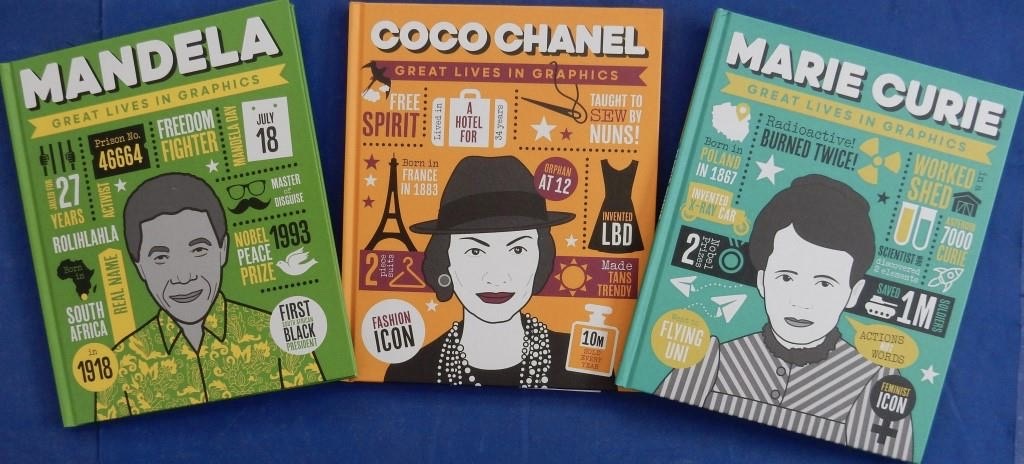
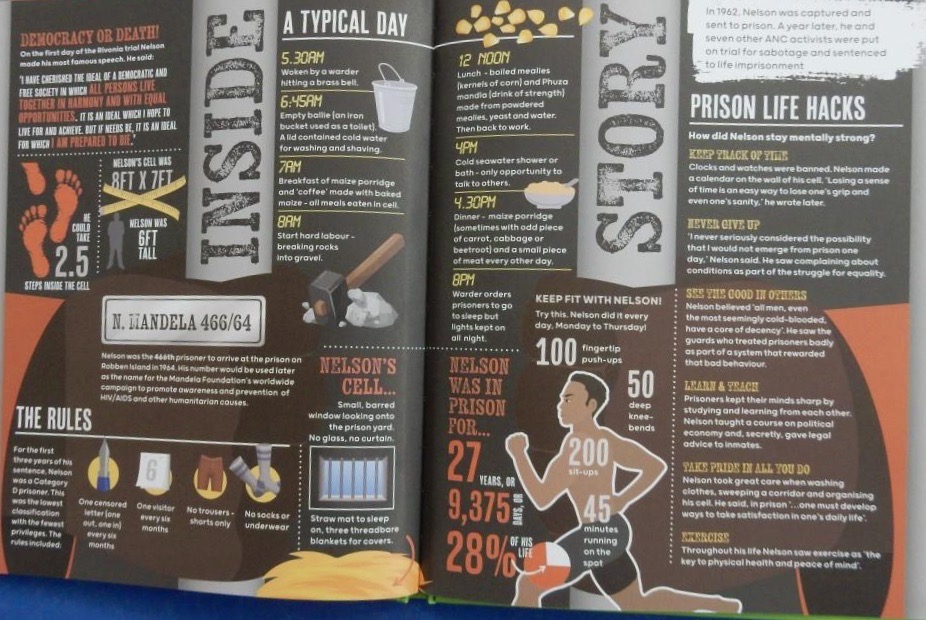
Great Lives in Graphics:Mandela / Great Lives in Graphics: Coco Chanel / Great Lives in Graphics: Marie Curie

When in my early years of teaching, I passed on the news to my KS2 class that Nelson Mandela had finally been freed from prison, we all climbed up on the tables and cheered. (You’d never get away with that now but Mandela was then and has remained, my all time hero.) So of course, I was immediately interested to see the first of these titles being added to this very useful series. Readers will discover how Nelson’s life as the son of an African chief resulted, through his education, in his becoming an activist who protested against the apartheid system imposed by the white minority in South Africa in 1948; how his activism eventually led, when he was leader of the military wing of the ANC, to his arrest in 1962. He was sentenced to life imprisonment in 1964.

Fortunately though, he was released age 71, in 1990, a year before apartheid was abolished. After his release, Nelson was awarded the Nobel Peace Prize (1993) and the following year became South Africa’s first democratically elected president. he spent his last years in his home village.
An awesome man indeed.

If vou have an interest in fashion, then try a companion volume about Coco Chanel who overcame poverty as a child to become one of Paris’s key artistic talents. However, during WW2 it was rumoured that Coco acted as a Nazi spy. She made a comeback in fashion, in 1954, aged over seventy when she transcended ageism with her designs.

We all owe a great deal to Marie Curie, subject of the third book, the only woman to have been awarded two Nobel prizes, the first for physics, the second eight years later in 1911, for chemistry. Justifiably being dubbed a scientific genius, Marie faced prejudice and sickness, dying suddenly in 1934 from a bone marrow disease resulting from the effects of radiation.

All three, highly visual biographies, each of which has a final glossary, are definitely worth adding to KS2 libraries.

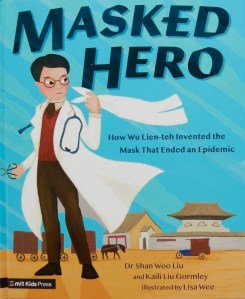
Masked Hero

This image has an empty alt attribute; its file name is dscn0042-1.jpg


The co-authors of this book – a mother and daughter – both descendants of their subject, tell the story of Wu Lien-teh. Born in 1879, he grew up in what was then Malaya in a happy home with his parents and ten siblings. Wanting to become a doctor, the boy studied hard both at home and school, eventually winning a scholarship to the University of Cambridge where he studied medicine.


Following medical training, came post graduate research in Great Britain and other European countries. On returning to his homeland he had trouble finding an official post due to racial discrimination, however he was undeterred, studied further in Kuala Lumpur, married and opened a medical practice. He then moved to China to lead a new medical college. However in 1910, an awful disease struck Northeast China, killing large numbers of people. Lien-teh agreed to leave his family and travel north to the city of Harbin, near the Russian border, on a rescue mission.


His observations led him to realise that the deadly disease was being spread by a bacterial germ, transmitted when people coughed.
He needed to do something urgently, so, drawing on his creativity and ingenuity, Lien-teh fashioned a new sort of multi-layered mask.

This image has an empty alt attribute; its file name is dscn0043-1.jpg

This met with resistance from racist fellow doctors but within months the epidemic was under control.
Lien-teh continued his work, setting up hospitals and medical colleges all over China and in 1935 he became the first person of Chinese descent to be nominated for a Nobel Prize. His innovations were even crucial in the fight against COVID-19 when masks became part of the lives of us all.
‘When we wear a mask to stop a disease, we are all heroes – just like Wu Lien-teh!’ conclude the authors.


Neatly describing the medical and racist issues Lien-teh faced, as well as drawing parallels between the past and recent times, these authors pay tribute to an amazing person who still hasn’t really received all the credit he deserves. Stylised illustrations by Lisa Wee help bring him to life on the page and the back matter includes some black and white photos.


An inspiring pictorial STEM biography to add to classroom collections.


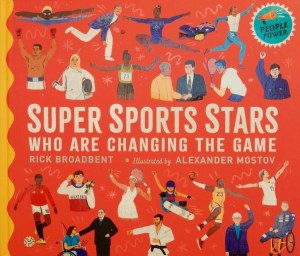
Super Sports Stars Who Are Changing the Game

I couldn’t help but feel rather insignificant when reading about the twenty sporting legends featured in this book. Each one is allocated a double spread, characteristics of which are a brief resumé recounting how the star got to be where they are, a ‘Fair Play’ paragraph, a ‘super sport power’ and an activity for the reader.

All these superstar legends have one thing in common: they’ve all had to overcome obstacles to be where they are at the top of their game, but in addition have spoken out about a cause they passionately believe in and in so doing, have changed not only their sport, but also the world, for the better.

Most of the names are familiar to me – Tom Daley, Marcus Rashford and Ellen MacArthur for instance, but several are new. One such – I’m well aware of his achievements, but not his name – is Ludwig Guttmann a German doctor. Because he was Jewish and therefore in great danger, he left Germany eventually coming to live in England. He set up Stoke Mandeville’s National Spinal Injuries Centre for wounded soldiers. A firm believer that sport was important in their treatment, he organised the first Stoke Mandeville Games and eventually in 1960, those games were staged alongside the Olympics in Rome. This first Paralympics featured 400 athletes from 23 countries and since then, they too take place every four years. 

Also new to me is Tesla Loroupe who grew up in Kenya, looked after cattle in the fields and ran ten miles to school every day. Her talent was spotted and in 1994 she became the first female African athlete to win the New York City Marathon. Wanting to give something back to her community, Tegla set up the Peace Marathon, a race that encouraged members of warring tribes to run together. She also works with refugees offering training to athletes in refugee camps, helping youngsters to continue their education. She is the founder of the Tesla Loropue Peace Foundation that aims to promote peace through sport and to highlight the suffering of refugees. Another of her achievements is the Olympic refugee team, which is the result of her petitioning the Olympic committee.

These are just two of the amazing men and women you’ll find in this inspiring book, the final spread of which issues a challenge to readers: identify something you would like to change and set about so doing: everyone has the power to make a difference is the vital message.

Little People, Big Dreams: Vanessa Nakate / The Flying Man

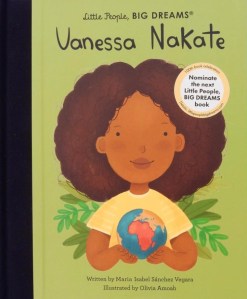
Little People, Big Dreams: Vanessa Nakate
Maria Isabel Sánchez Vegara, illustrated by Olivia Amos
Frances Lincoln Children’s Books

In this addition to the excellent series we meet a young and outstanding activist. As a child growing up, Vanessa lived with her parents in Uganda’s capital city, Kampala. Her parents always encouraged her to speak out for what she thought was right, but in the countryside where she attended school, climate change seemed a world away.

At university however she began noticing how, despite being the least responsible, Africans were suffering most by climate change. Thus she became an activist and persuaded her friends and relations to do likewise. She spoke out against the destruction of the Congolian rainforests and its consequences and one day she, one of few from the African continent, was invited to join other young climate activists in New York where they hoped to make world leaders take action against global warming.

When she returned home Vanessa continued her fight and after a setback at a protest in Switzerland, her work has been recognised
and now she is an inspiration to fellow young Africans and indeed the entire world. A vital topic and with its focus on Africa, this is an excellent book to inspire KS1 readers to use their own voices and indeed actions, to support the on-going fight to save the planet.

The Flying Man
Mike Downs and David Hohn
Astra Young Readers

In this picture book biography Mike Downs pays tribute to a relatively unknown German aviator, Otto Lilienthal, whose pioneering spirit led him to create the first flying machine.

Perseverance was key as despite considerable skepticism from others around, he and his younger brother, Gustav worked away observing, experimenting, testing and improving their designs until in 1891 Otto was successful in making a hang glider that travelled through the air . Eventually in 1896 in a more sophisticated (albeit still flimsy) glider he soared above admiring crowds with, so the illustrator shows, a euphoric expression on his face.

Following this a photograph dubbed him ‘The Flying Man’ but sadly a week later, Otto died from injuries that were the result of a crash. (This information the author places in an afterword) Nonetheless his work inspired many other fliers, including the Wright brothers who cited Otto as their greatest inspiration.

It’s evident from his writing that author of this book Mike Downs, found Otto Lithenthal inspirational too.

Little People, Big Dreams: Marcus Rashford / Little People, Big Dreams: Laverne Cox

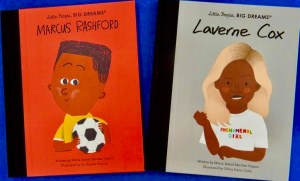
Little People, Big Dreams: Marcus Rashford
illustrated by Guilherme Karsten
Little People, Big Dreams: Laverne Cox
illustrated by Olivia Daisy Coles
both written by Maria Isabel Sánchez Vegara
Frances Lincoln Children’s Books

World famous soccer player and campaigner against child poverty, Marcus Rashford is a truly inspiring person. Coming from a loving family in Manchester he spent much of his childhood practising with his football. His mother did everything within her power to ensure her children had enough to eat, though the family still had to rely on free school meals supplemented by food charities. Supported by his mother he followed his soccer dreams, was scouted and joined the academy at Manchester United where he worked hard to become a great forward, eventually becoming at just eighteen years old, the youngest player to score for his country in his debut match.

However, every single time he played he believed he was doing it not just for himself but for everyone who had shared his dream; and he never forgot where he came from. During the 2020 school closures on account of the Coronavirus pandemic children no longer had free school meals and Marcus’s social conscience led him to start a nationwide campaign so that no child would go hungry.

With powerful illustrations a timeline and additional information, this is an inspiring addition to the series.

One of twins, Laverne Cox experienced considerable bullying as she came to terms with her gender identity. She received no support from her mother, turning to dance to find some joy in her life.
Eventually she gained a scholarship to Alabama Academy of Fine Arts where youngsters were encouraged to be true to themselves. At last Laverne was able to express herself as she was and to make real friends. While studying ballet in New York she was offered a role in a play, discovered a love for acting, went into film and supported by friends who had already made the journey, developed sufficient confidence to start her gender transition.

A very useful book for younger primary age children to learn about the importance of acceptance and respect for others as well as being true to oneself.

Darwin & Hooker

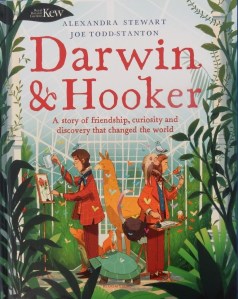
Darwin & Hooker
Alexandra Stewart, illustrated by Joe Todd-Stanton
Bloomsbury Children’s Books

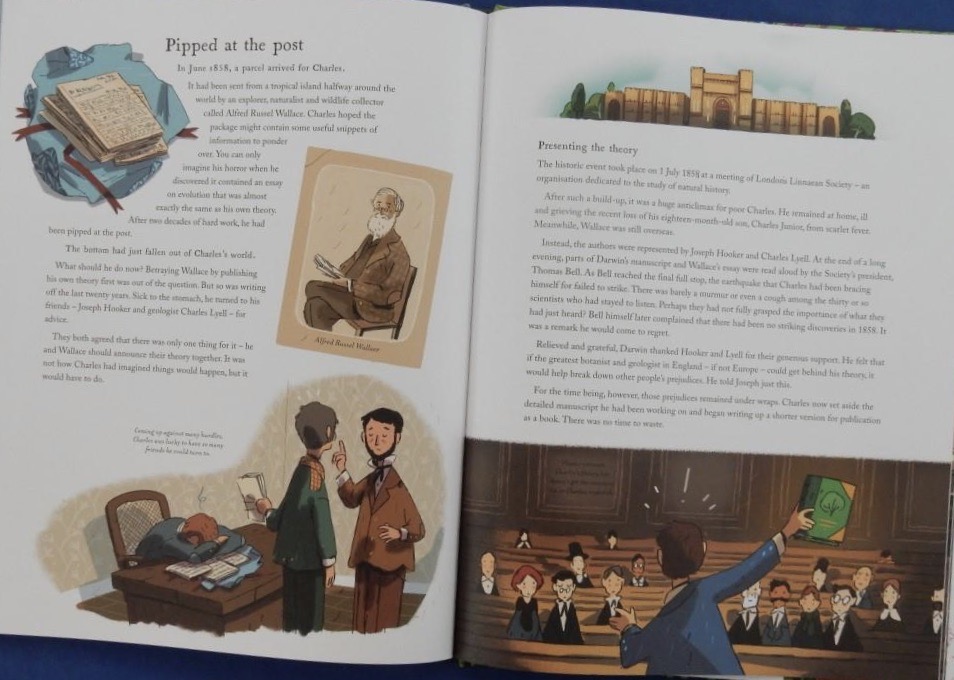
This biography of two friends who became two of the most eminent naturalists of the 19th century is a fascinating exploration of their discoveries and of the birth of science as we know it.
Most people know something about Charles Darwin, his theory of evolution and his seminal work On the Origin of Species but I suspect far fewer know more than the name Joseph Hooker. This book published jointly with the Royal Botanic Gardens, Kew, tells the story of Charles and Joseph (who was once Kew’s Director), linking Darwin with Kew.

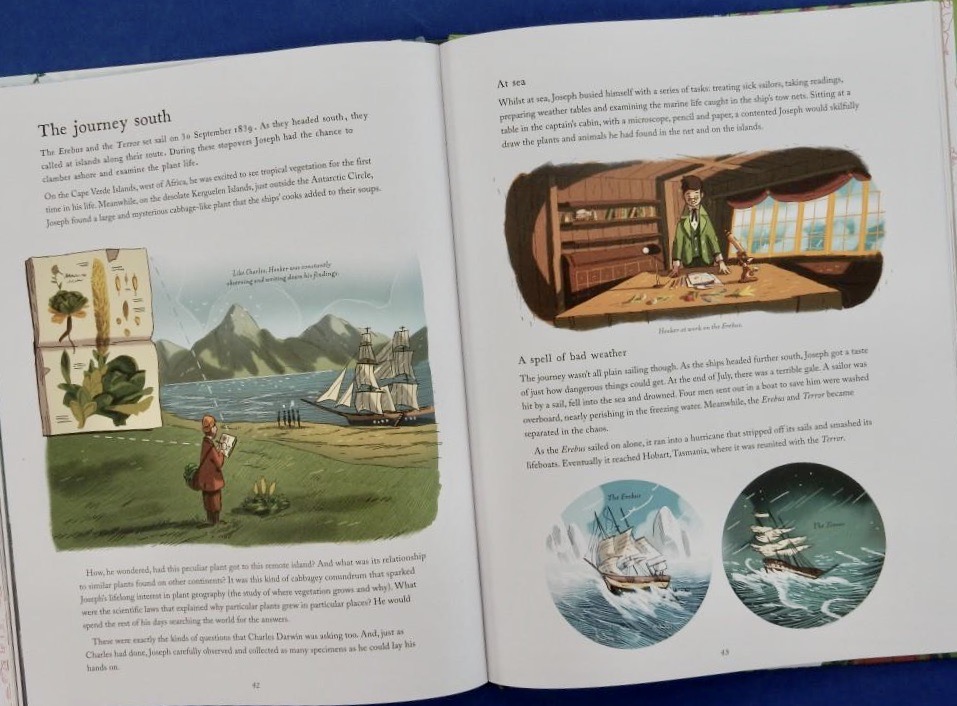
Divided into four parts, the book takes us on a journey through the early lives of Charles and Joseph, their adventures on their respective voyages, the start and progression of their close friendship, and the amazing legacies they left behind. Little did either of them know that when an erstwhile shipmate of Charles introduced him to his companion in London one day as the latter was preparing to depart for Antarctica, this meeting would gradually evolve into one of the most important ever friendships for science.

It’s incredible to read that very soon after Joseph’s return from his voyage of what turned out to be four years, he received his first letter from Charles – a congratulatory one but in it he also asked the botanist to examine his Galapagos plants and over the next forty years 1,400 letters went backwards and forwards between the two.

A fascinating, compelling read that shows young readers the importance of curiosity, determination and teamwork in scientific endeavour. Joe Todd-Stanton’s enticing illustrations break up and illuminate the text, helping to make it accessible to older primary school readers.

Amazing Activists Who are Changing Our World

Amazing Activists Who are Changing Our World
Rebecca Schiller and Sophie Beer
Walker Books

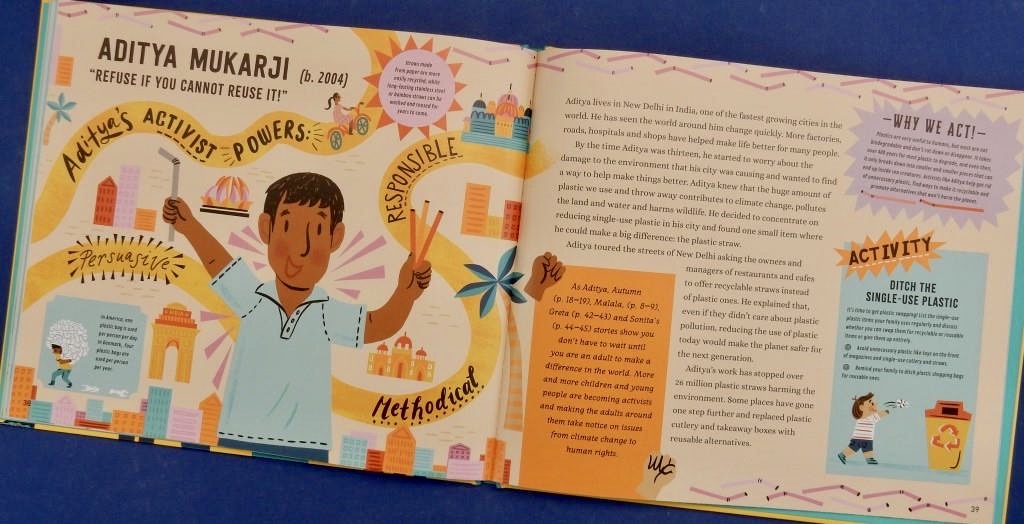
Having explained on the opening pages what activism is essentially about and the wide-ranging causes people devote themselves to, author Rebecca Schiller has selected twenty awesome activists, some familiar some less well-known, to present to younger readers. She chooses widely going back as far as the 18th century – William Wilberforce, and including several contemporary figures from various parts of the world, allocating a double spread to each one. Thereon is essential biographical information along with some words about their beliefs, the reasons they acted as they did and why each one remains important today. Included for each activist is a quote that acts as a subtitle to the spread and an activity for readers and a specially nice touch is three words describing the person’s activist powers; for Emmanuel Ofosu Yeboah, a cyclist with a disability these are ‘optimistic, tough, active. 

For environmentalist, Aditya Mukarji, whose focus is reducing plastic pollution and who has prevented more than 26 million plastic straws being added to environmental waste, the words are ‘persuasive, responsible, methodical’ 

and attributed to biologist Wangari Maathai, creator (along with a team of helpers) of a tree planting project, The Green Belt Movement are ‘expert, hopeful, organiser’.

Visually alluring and with Sophie Beer’s striking illustrations, children will meet individuals who opposed racism, slavery, stood up for human rights, women’s rights, female empowerment, disability rights, LGBT+ rights, environmental causes, wildlife and freedom of speech. Offering a wealth of possible starting points for discussion as well as the ideas themselves, the book ends by asking its audience to think about the things they feel strongly about and to identify their own powers.

Women Who Led The Way

Women Who Led The Way
Mick Manning and Brita Granström
Otter-Barry Books

Herein, team Mike and Brita celebrate 21 inspiring women adventurers and explorers from all over the world, going back as far as the 9th century. Speaking for themselves, these women are exemplars of the huge amount of courage, determination and sheer power their achievements demonstrate against the odds: boundary breakers all for sure.

A new name to me, the first to tell her story is Aud (the deep-minded), daughter of a Viking ruler of the Hebrides, who, after her warrior son was killed in battle, secretly had a ship built and then together with a loyal crew of twenty warriors, captained a voyage of escape and discovery, eventually starting a Christian settlement on an Icelandic hillside.

French woman Jeanne Baret, disguised herself as her beloved husband’s manservant in order to accompany him on a voyage that eventually took them around the world, exploring and collecting specimens of plants, shells and stones for study, retiring to her native France ten years later, after the death of her husband.

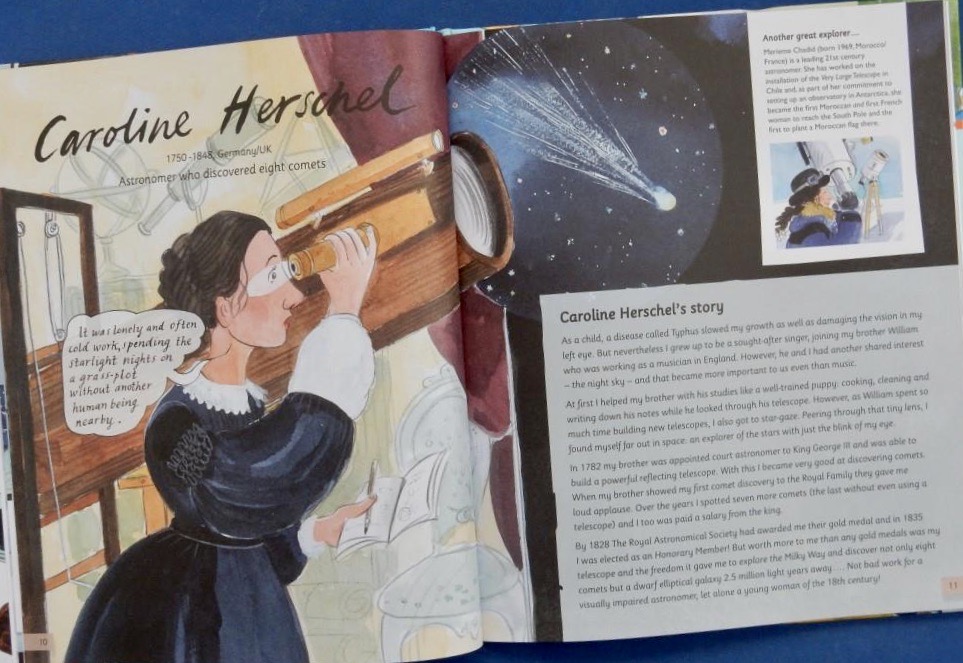
Not all the women travelled so far from home though: In the 18th-19th century Caroline Herschel whose vision was damaged by childhood Typhus, became an astronomer who not only discovered eight comets, but was awarded a gold medal by the Royal Astronomical Society, even being elected an Honorary Member.

Some of the others featured will likely be familiar names to readers – adult ones at least. There’s Mary Anning, Harriet Tubman who escaped slavery to become an army scout and political freedom activist, undercover journalist Nellie Bly, Bessie Coleman the first African-American and Native American female to hold a pilot’s licence, Amelia Earhart (first woman pilot to fly the Atlantic), archaeologist Mary Leakey and nature conservationist Jane Goodall.
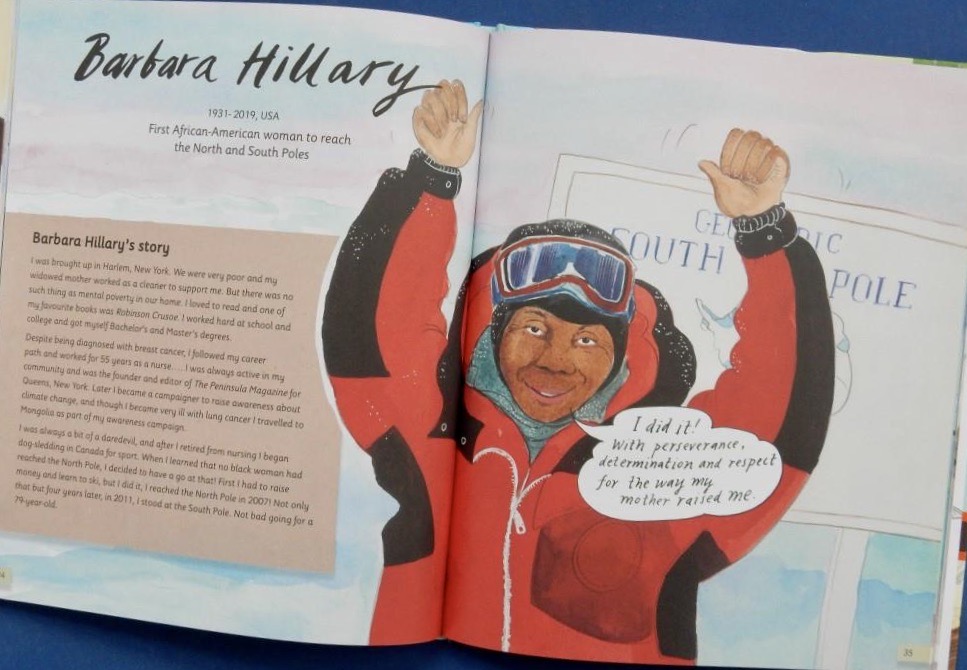
It’s impossible in a short review to name all those included herein but we meet Barbara Hillary polar explorer;

the first woman to climb to the top of Everest, and the first female amputee to climb both Everest and Mt. Vinson. Wow! “Set your goals high in life and don’t stop until you reach there.” are words spoken by this inspirational mountaineer on the final spread.

Set into many of Brita’s arresting scenes along with the main narrative, are small illustrated fact boxes, some giving dramatic moments in the life of the featured woman, others providing brief details of another one or two who followed in her footsteps.

One can’t help but feel awed by the achievements of every single one of those exceptional women. Adults who want to inspire children, either in school or at home, to reach high and never stop believing in themselves, should make sure they read this book.

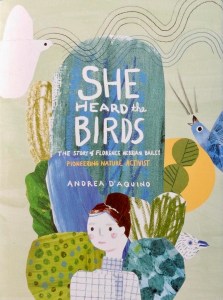
She Heard the Birds

She Heard the Birds: the story of Florence Merriam Bailey
Andrea D’Aquino
Princeton Architectural Press

In this inspiring picture book biography author/illustrator Andrea D’Aquino shines a light on key moments in the life of the pioneering American ornithologist and nature activist Florence Merriam Bailey who was born in 1863.

Daughter of a camping enthusiast father and astronomer mother, Florence grew up surrounded by nature in which she developed an early interest, especially when it came to birds. These she found the most fascinating and she spent time learning as much as she could about these feathered creatures.

As a young woman, while visiting the city, Florence was appalled by the sight of people – dedicated followers of fashion – wearing hats decorated with feathers and the bodies of birds. She was even more disgusted by the sounds of the gunshots in the woods of those ornithologists who thought it acceptable to shoot birds in order to study them.

Determined to make a difference, Florence, armed only with her tools for observing birds – knew she must answer the calls for help of the birds and to do so she must dream big.

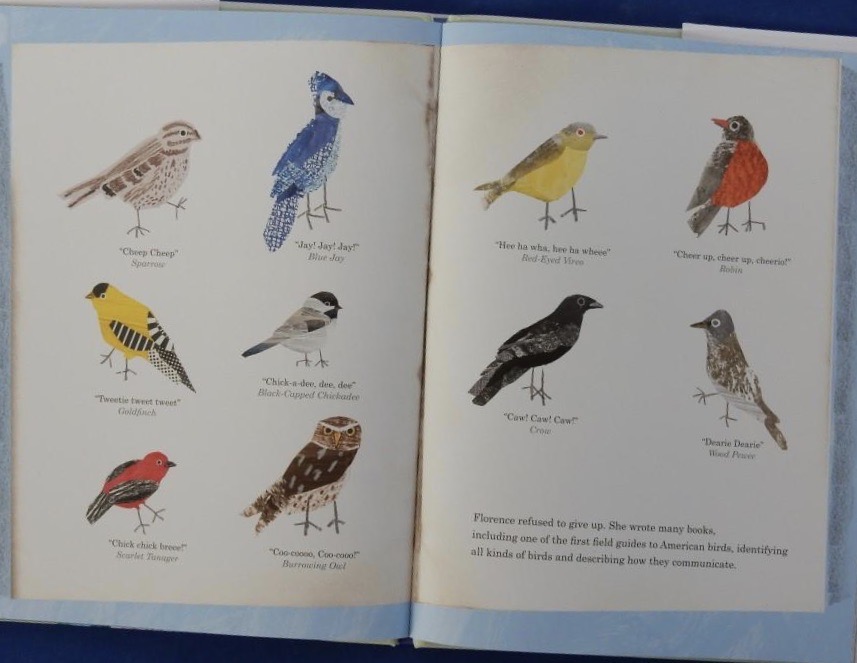
She put the information she’d collected into print, writing field guides, and other bird books some giving suggestions about how readers too could learn about these precious creatures becoming peaceful observers of birds in nature too.

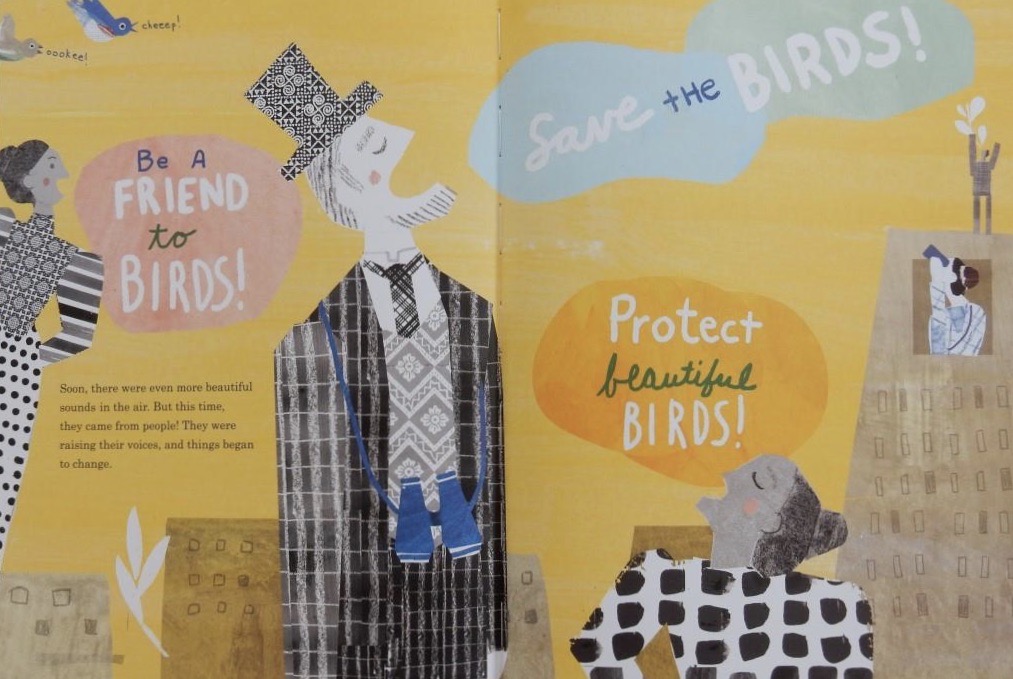
Thus guns could be replaced by binoculars and listeners to their songs taking heed of her ‘Shhhhhhh! Listen. What are they saying?’would be filled with delight and share her determination to push forward crucial changes.

Thus it was that one person’s mission gradually became that of many;

the end result being that ‘The world became safer for the birds, and more beautiful for us all.’ How this was actually achieved we aren’t told but it’s evident that the millinery trade and others got the message that began with a single woman nature lover.

In her hand-painted collage, oil pastel, and pencil illustrations, Andrea D’Aquino focuses the reader’s attention on her subject’s personal mission while using rich colours to emphasise the overwhelming importance of nature and its beauty, and giving the birds centre stage.

In addition to giving more detail about Bailey’s life, the final spread contains a reminder that the struggle to protect birds continues and there are some recommendations for readers who want to help.

Great Britons

Great Britons
Imogen Russell Williams, illustrated by Sara Mulvanny
Nosy Crow

Who could fail to be moved by the stories of the fifty people featured in this selection of biographies of key figures who have made Great Britain their home, have made great contributions to society and had a significant impact upon the ways we live, think and feel in today’s world, of which Great Britain is but a small part.

Coming from many different walks of life and eras as far back as Boudicca, the warrior queen of early Britain who led the revolt against the Romans, to contemporary authors Malorie Blackman,

and Lemn Sissay, and Malala Yousafzai, who continually fights for every girl’s right to an education, each of the men and women has added to the rich diversity and talent that is Britain. Every person is allocated a bordered double spread wherein author Imogen Russell Williams highlights the key events of his/her life and their achievements, and is thoughtfully illustrated by Sara Mulvanny.

Herein readers can meet inspiring contributors to medicine, science, engineering, sport, the arts, activism, and the environment including Edith Cavell and Elsie Inglis, Alexander Fleming and Tim Berners-Lee,

Isambard Kingdom Brunel, Mo Farah and Tanni Grey-Thompson, Shirley Bassey and Freddy Mercury, Paul Stephenson and David Attenborough. One name is new to me so I must mention Olaudah Equiano once a slave, who as a writer and abolitionist made an enormous difference to the fight against slavery.

A book to add to primary school libraries and family collections.

I Saw a Beautiful Woodpecker

I Saw a Beautiful Woodpecker
Michal Skibiński, illustrated by Ala Bankroft
Prestel

This moving, hauntingly beautiful book, set in and close to Warsaw, tells the story of the author around the outbreak of WW2.

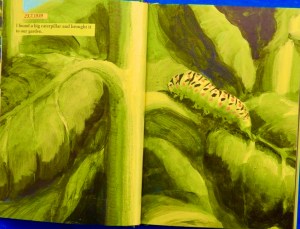
Assigned a summer project by his schoolteacher, unaware that war is soon to come, eight year old Michal Skibiński writes a single sentence in his notebook every day. ’15.7.1939 I walked to the brook with my brother and our nanny. ‘ ’27.7.1939 I found a big caterpillar and brought it to our garden.’

Each sentence is given its own double spread with a painting – a natural landscape and unpeopled scenery – by Ala Bankroft. Readers truly feel they’re seeing things as Michael saw them: a church window behind a shadowed stone wall; a verdant woodland – green hues prevail in what is at first, an idyllic time.

After sequences of several spreads of Ala Bankroft’s awesome paintings, the pages of Michal’s notebook written in Polish are photographically reproduced, with translations below.

Little by little though, the boy’s observations start to include images of a war slowly approaching. Then comes a stark ‘The war began’ on 1st September followed five days later by, ‘They dropped a bomb near us.’

Adult readers know that awful things are coming, as Michal still somewhat innocently says on 14th September, ‘Warsaw is defending itself bravely.’ the wooded illustration for this now having an orange sky.

Throughout, the boy’s single line entries intensify the impact of the colours used in the paintings.
Indeed it’s only by reading the notes at the end of the book that we know that his 29.8.1939 ’Daddy came to visit me.’ was to be the last time Michal saw his father. He was a pilot and leader of a Polish bomber squadron, and lost his life in a plane crash on 9th September. This powerful resonant revelation brought a lump to my throat when I read it. Here we also learn that today, Michal Skibiński lives in a retirement home for priests and a photo on the book’s back inside cover underscores just how real this story is.

Yes a thing of beauty in its own right, but this unusual, splendidly designed book would also make a good starting point for a class theme on World War 2.

Science and Me

Science and Me
Ali Winter and Mickaël El Fathi
Lantana Publishing

Following their Creators of Peace, author Ali Winter and illustrator Mickaël El Fathi present profiles of thirteen more Nobel Prize winners, this time for their work in medicine, physics and chemistry.

Coming from all over the world and starting with Marie Curie (1903) and concluding with Donna Strickland (2018 winner for laser technology), each of the laureates is given just one double spread so there’s only space for a brief biography that focuses as much on the dedication and challenges overcome as the individual’s discoveries / achievements and the social impacts thereof. For example, it took decades for the discovery of Subrahmanyan Chandrasekhar relating to ‘black holes’ to be recognised.

Michaël El Fathi takes a key moment or element from each featured life as the basis for each collage illustration: for Youyou Tu it was the ancient book mentioning ‘Qinghao’, the Chinese name for herbs in the Artemisia family. From these could be extracted Artemesinin, the drug that has subsequently prevented over two hundred million people worldwide dying from malaria.

I particularly like the way in which the author involves readers in considering what science contributes to making the world a better place for us all; she does so both through the title lead in to each of the scientists as well as through the summation on the final spread, the last line of which asks “What does science mean to you?

Beatrix and her Bunnies

Beatrix and her Bunnies
Rebecca Colby and Caroline Bonne-Müller
Nosy Crow

For many adults, myself included, Beatrix Potter’s animal stories and nursery rhyme books were part and parcel of childhood. Indeed I had the entire set. How many though, are aware that Benjamin Bunny and Peter Rabbit were real live creatures that the author befriended as she was growing up. That’s getting rather ahead though, for this pictorial biography of Beatrix starts with her childhood when she lived a rather lonely existence in a large London house. Even then she was an animal lover and had lots of small creatures as pets, but nonetheless she longed for a ‘special friend’ with whom she could play.

Rebecca Colby writes of how on family visits to the countryside, Beatrix would search for wild rabbits to play with but none would stay. None that is until Benjamin. A friend at last and one that would allow his carer make lots of sketches of him, honing her drawing skills in so doing. Inevitably though, Benjamin eventually dies and once more, Beatrix feels lonely. She uses drawing and painting to lift her spirits but, it’s only when she visits the countryside that Beatrix’s drawing really flourishes.

Some time later, another rabbit enters her life, it’s Peter, a truly playful and engaging creature, much loved by visiting children.

This gives Beatrix an idea. Perhaps she can write and illustrate a story about her much-loved bunnies so that children everywhere could read about them, and so she does.

Getting Peter’s adventures published is challenging but eventually she succeeds and the book becomes a huge success, allowing her to move to the countryside where she creates lots more stories.

A lovely book for young enthusiasts of her books and of the environment about which Beatrix cared so much. The elements of Beatrix’s life are beautifully interwoven by the author, who also provides an additional final note explaining Beatrix’s connection with the National Trust (who are collaborators in its publishing) – and equally beautifully illustrated by Caroline Bonne-Miller.

The Stuff between the Stars / Get Up, Elizabeth!

The Stuff Between the Stars
Sandra Nickel and Aimée Sicuro
Abrams Books for Young Readers

This is an inspiring picture book biography of brilliant astrophysicist Vera Rubin, from the time when she was a star-gazing eleven year old who, despite opposition and ridicule

and being ignored during much of her lifetime, became, thanks to her dedication and an opportunity at the Carnegie Institution, a recognised and leading light in the field of astronomy. For it was while working at one of the Institution’s observatories that Rubin made her seminal discovery that “dark matter” explains the phenomenon that stars on the edges of the galaxy move as quickly as those at the centre—and that this dark matter makes up 80 per cent of the matter in the universe.

I love the Rubin quote at the end of the story,: ‘Each one of you can change the world, / for you are made of star stuff, / and you are connected to the universe.’

If the main body of this hugely engaging book hasn’t inspired youngsters, those words surely will. So too will Aimée Sicuro’s gorgeous watercolour, ink and charcoal illustrations that cleverly reflect Rubin’s spiralling ideas in this well researched, enormously engaging account.

An author’s note on Vera, a timeline of her life and a select bibliography conclude the book. It’s one I’d strongly recommend for primary age readers.

Get Up, Elizabeth!
Shirin Yim Bridges and Alea Marley
Cameron Books

The Elizabeth of this rhyming narrative is in fact, the child who later became Queen Elizabeth 1 of England.
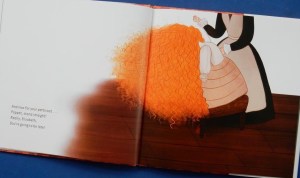
It’s her morning routine we share as we hear her being roused from her slumbers. She’s then ordered by the rather impatient-sounding lady-in-waiting to submit to donning her smock, having her stockings laced, her face scrubbed and her teeth rubbed (with soot no less!). All this she tolerates with a degree of meekness but then having been laced into a petticoat,

and acquiesced to sleeve pinning, the young miss attempts to assert herself by stashing a mouse in her skirt. It’s no go though; and with her ruff duly stitched in place, there’s still that mop of unruly hair to be tackled.
Finally, she’s set to go and we watch as she stands, still seemingly meekly, before a throng of waiting subjects.

Shirin Yim Bridges’ rhyming narrative falters slightly on occasion during this chivvying regime and in this small slice of history, it’s Alea Marley’s visuals of the shock-headed miss with her radiant tresses that are the real show stoppers.

There’s a final page giving some extra details on Elizabethan fashion and routine ablutions, as well as a cheeky message from that mouse asking ‘Did you find me on all the pages?’ which adds a search-and-find element to the book. It certainly takes a bit of finding on one or two spreads.

Rashford Rules / Van Dijk Rules / Be Your Own Football Hero: Ronaldo

Rashford Rules
Van Dijk Rules

Simon Mugford and Dan Green
Welbeck Publishing

These two highly illustrated biographies are the first in a series of Football Superstarsand both author Simon and illustrator Dan are soccer fans themselves, supporting Ipswich Town.

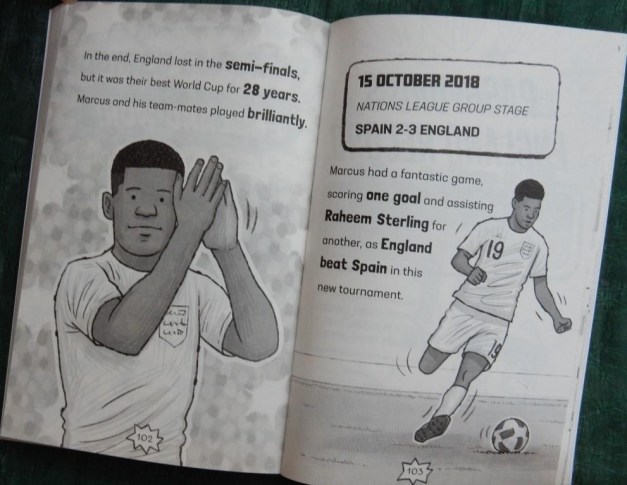
Marcus Rashford has recently hit the headlines again with his superb campaigning for free school meals over the half-term holidays which received tremendous community support and certainly put the government to shame. The opening pages of the book acknowledge his national hero status both as an awesome goal scorer and as a charity campaigner. Readers are then told what makes him the brilliant player that he is, and can also discover some statistical information.
Divided into short chapters, there’s information on his Manchester childhood, early achievements, his debuts including a comment by Rashford’s hero Ronaldo. Then come his path to national England player 

and the final chapter focuses on his activist charity work during the Coronavirus lockdown. All this and he’s still only in his early 20s.
The book ends with a quiz and some key soccer words as does the companion book Van Dijk Rules

This follows a similar pattern, giving facts about achievements, his early life in the city of Breda in the Netherlands as a child who always had a football at his feet, and how he progressed from over-grown, sometimes troubled teenager with a part-time job washing dishes in a local restaurant, through his successes with Celtic 

and Liverpool, and as captain of the Dutch team. Both this and the previous title are enormously engaging for young soccer enthusiasts especially. Dan Green’s black and white illustrations capture the essence of the individuals and add additional detail and humour to Simon Mugford’s accessible writing.

Be Your Own Football Hero: Ronaldo
Matt and Tom Oldfield
Studio Press

The Oldfield brothers invite youngsters to don football boots and participate in a decision-making activity as they select one or other of the options presented at intervals throughout the book. There are many choices to be made in the world of a soccer professional such as Cristiano Ronaldo, some of which take the reader along the path taken by the real Ronaldo, others are would-be alternative realities – what might have beens.
Readers are taken back to Ronaldo’s childhood when as son of encouraging, soccer-enthusiast, hard-up parents. the football mad boy has his chance to go and play with his cousin at a Andorinha training session. It turns out to be something of a disappointment so what is your response when your dad asks if you enjoyed it? Time for that first decision …
And so it continues.

I’m not a football fan, but to readers from around six or seven, I can perfectly understand the allure of these books, written by the authors of the Ultimate Football Heroes biography series.