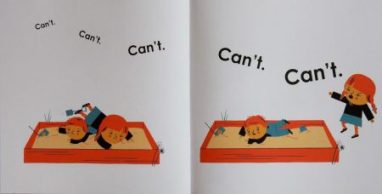
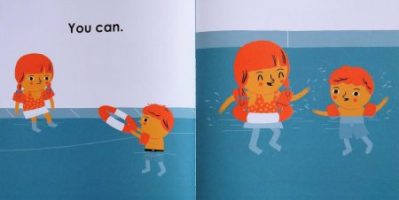
Big Bob, Little Bob / Mine Mine Mine Said The Porcupine

dscn9219

Big Bob, Little Bob
James Howe and Laura Ellen Andersen
Walker Books
The possibility of friendship seems unlikely when Big Bob moves in next door to Little Bob: the boys are just so different and it’s not just their relative size; their interests are totally different too. Little Bob likes quiet activities such as block building and playing with dolls; Big Bob’s play is altogether more boisterous. “Boys do not play with dolls,” he asserts. Despite this Big Bob does make efforts to involve his neighbour in his play …

dscn9220

but nothing can bring the two round to the same way of thinking or doing.

dscn9221

However when a girl moves into their neighbourhood, the first person to jump to Little Bob’s defence when she questions his choice of play activities is none other than Big Bob. “Hey! You stop picking on my friend!” he tells her. “Boys can do whatever they want!” Gender stereotyping is seemingly not so fine now.
But then it turns out that Blossom prefers trucks to dolls: can the three find a way to accommodate everyone’s choices …
Any story that challenges gender stereotyping is worth a look in my book. This one is delivered with a gentle humour that is accentuated by Andersen’s comical scenes of the children at play. Definitely a book to share with those around the same age as the characters herein; it will give them plenty to think about and discuss.
Also looking at building friendship is:

dscn9216

Mine Mine Mine! Said the Porcupine
Alex English and Emma Levey
Maverick Arts Publishing
Alfie returns and this time he has a porcupine as his visitor; a porcupine whose sharing skills leave a lot to be desired. Alfie does his best to engage the porcupine in some play, but everything he offers is immediately seized by his visitor. “Mine!” he claims at each attempt.

dscn9217

Eventually, Alfie decides enough is enough and leaving the possessive creature to his own devices, he goes to play on his own. Now the porcupine has what he wants – or has he? Can he perhaps find a situation where that word he loves so much, is appropriate?

dscn9218

A gentle lesson in sharing delivered in a rhythmic text easy enough to read so that those around Alfie’s age can try it for themselves. Emma Levey portrays the porcupine as hirsute making him appear cuddly rather than a prickly character and he certainly knows how to talk with his eyes.

Plants and Animals: Fact & Fiction

%0a

How Plants Work
Christiane Dorion and Beverley Young
Templar Publishing
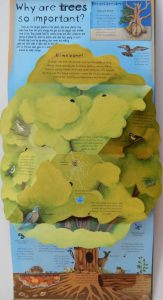
A sequence of questions is used to introduce nine topics relating to the world of plants in this book that’s jam-packed with information. Each question is explored in a stylishly illustrated double spread, the first being ‘Why do plants have flowers?’ However an even more fundamental consideration: What is a plant?’ is discussed on the fold-out flap on the side of this spread.
This is followed by how plants grow from seeds, what plants feed on and how, defence, habitats and the importance of trees …

%0a

We’re then introduced to some of the ‘weirdest’ plants, the edible ones and the final spread focuses on some of the uses of plants including some ideas that have come from observation of particular plants such as that by Swiss engineer George de Mistral who got his idea for Velcro from the burrs that attached themselves to the fur of his dog.
There are lots of flaps and tabs to explore; and the superb paper-engineering from Andy Mansfield really brings the whole thing to life. (Some of the tabs are not very robust and may not stand up to the enthusiastic handling of classroom use so it may be better to give this to individual readers.)

dscn9340

Knowledge Encyclopedia ANIMAL!
written by John Woodward
Dorling Kindersley
This truly is a weighty, although not a heavyweight, tome. After the contents page, introductory ‘What is an Animal?’, discussions on ‘Evolution and Extinction‘ and a classification diagram, the book is divided into six sections: Invertebrates, Fish, Amphibians, Reptiles, Birds and finally, Mammals.

dscn9392

The first spread of each section explains the meaning of the class as well as providing some general information.
I learned a fair bit (even with zoology as part of first degree studies) from this fascinating book including meeting some new animals such as the Sugar Glider and the Blue-Tongued Skink (note the helpful thumbnail picture, beside a human hand to give an indication of real size).

%0a

The 3D photographic illustrations are very impressive and many of the animals appear to be leaping right out of the pages, and the textual information has been authenticated by the Smithsonian Institution for accuracy.
A book for the family, for animal lovers young and not so young, and a worthwhile addition to the primary or secondary school library.
For those who prefer animals in stories take a look at:

%0a

Greatest Animal Stories
chosen by Michael Morpurgo
Oxford University Press
Author, former Children’s Laureate and co-founder of the children’s charity Farms for City Children, Michael Morpurgo has selected seventeen of his favourite animals tales from various parts of the world for this anthology.
These traditional tales are retold by ten different authors and illustrated by a dozen different artists.
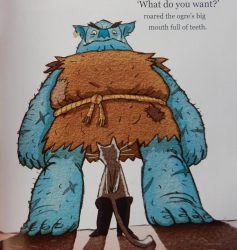
Some of the stories can be read in a few minutes, others such as Pippa Goodheart’s lively telling of Puss in Boots

%0a

Puss in Boots is confronted by the ogre – a   Thomas Radcliffe illustration

and Morpurgo’s compelling rendering of Peter and the Wolf take a fair bit longer. No matter which story you choose to share at any particular time, make sure you allow time to explore the illustrations – every story has superb illustrations at every turn of the page.
All manner of animals from tricksters such as Anansi the Spider, Brer Rabbit, and Baboon to talking cows and cats are featured and Morpurgo provides a brief introduction to each of the tales outlining its origin, underlying message and something to ponder upon.
One for the family bookshelf or classroom library, or to give as a present perhaps.

The Snowflake Mistake / The Bot that Scott Built

%0a

The Snowflake Mistake
Lou Treleaven and Maddie Frost
Maverick Arts Publishing
The latest scientific research shows that what we’re told as children – that every snowflake is different – isn’t altogether true, although there are a great many structural variations. Now here’s a modern pourquoi tale explaining the popular idea that every one is different.
Princess Ellie lives with her mum, the Snow Queen, in a floating ice palace high above the clouds. In that palace is an amazing machine that collects clouds, squishing, crunching and stamping them to make into identical snowflakes.

dscn9243

But when Ellie’s mum has some business to attend to elsewhere, the young miss, (who would much prefer to be out playing) is left in charge of the machine. She decides to speed up the snow production …

%0a

and that’s when things, or rather the machine goes terribly wrong, and with a BOING! BANG! POP! it grinds to a halt.
With the only alternative being no snow for the children to enjoy, Ellie knows she must find another way of making snowflakes. Out comes her scissors and with the help of the birds, she makes snowflakes of all shapes and sizes, not perfect exactly, but every one beautiful, every one different. Hooray!
Full of wintry delight this rhyming story is another invention from the creator of the Oojamaflip – another quirky machine. Maddie Frost’s digitally rendered collage-style illustrations, especially those of the snowflake machine, are great fun and the final page provides information on how to make a snowflake.

dscn9187

The Bot That Scott Built
Kim Norman and Agnese Baruzzi
Sterling
It’s Science Day for Scott and his classmates and it’s Scott’s turn to demonstrate his robot. Things don’t go quite to plan though and that moment of glory rapidly descends into chaos as angry ants rampage, freaky frogs frolic and feast on flies, there’s a big-bellied boa on the loose and a whole lot more besides.

dscn9188

The cumulative rhyme dashes along at a frenetic havoc-making pace; and with lashings of alliteration and illustrations packed with hilarious details as the whole session turns from calm to mayhem, young listeners have plenty to enjoy as the catastrophes cascade into being until finally, a sense of order is restored. PHEW! Now who could have pressed that button in the first place, one wonders.

Are You Sure, Mother Bear / Goodnight World

dscn9229

Are You Sure, Mother Bear?
Amy Hest and Lauren Tobia,
Walker Books
It’s the very first night of winter; snow has fallen all around and it’s time for Little Miss bear and her mother to start their long winter sleep. The young bear however, is not ready for sleep just yet; she’d far rather watch the snowflakes falling. The two snuggle up together, munch on toast and stare through the window and gaze at the snowy world beyond.

%0a

Little Miss begins thinking of everything she’ll miss once she succumbs to sleep: the stars, the moon and the hills just right for rolling down. They’ll all be right there come spring, Mother Bear reassures her little one; but then she gives in. Out the two go for one last moonlit roll …

%0a

before finally, no matter what, it’s time for bed and sleep at last because that’s what bears do in winter, seemingly even semi-domesticated ones.

%0a

Full of feel-good warmth and reassurance, this is a lovely book to share with sleepy littles, who will enjoy both the snuggly indoor scenes and the beautiful outside woody, snowy landscapes.

%0a

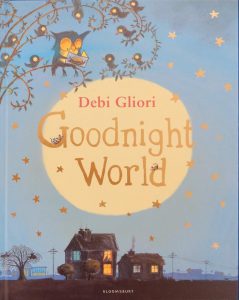
Goodnight World
Debi Gliori
Bloomsbury Children’s Books
With a gentle, lilting narrative and soft, soothing scenes of a world already to slip into sleep, this is a beautiful just-before-bed story for young children. As we bid ‘Goodnight’ to sun, moon and stars, ships upon oceans, rockets, cars and planes, the birds, bees and fishes,

%0a

the flowers and grasses, the animals in the zoo and in the park – pretty much everything in fact, a little child curls into a parent’s arms and shares a favourite book before finally falling fast asleep.

%0a

Gorgeous, dream-like images drift gently across every spread providing plenty of visual delight before gently lulling the listener to the land of slumbers too. Equally though, it’s great for joining in so I’d suggest a second reading and a third to allow for that, maybe on consecutive nights.

dscn9251

The Listzs

dscn9262

The Liszts
Kyo Maclear and Júlia Sardà
Andersen Press
Are you a list maker? There’s something satisfying about lists, especially lists of things to do, and in particular, the crossing off part. That was the part my favourite literary list-maker, Toad in Arnold Lobel’s Frog and Toad Together liked most too. In fact he couldn’t function properly without his ‘list of things to do today’.
A whole family of list makers populates this wryly whimsical book and they’re called, unsurprisingly, the Listzs. There’s Mum and Dad who make lists all year round, Sundays excluded; on such days they’re um, listless. Youngest child Frederick is a ‘list of fun things to do’ maker whereas big sister Winifred’s lists feature top tens and middle child Edward is a nocturnal list maker. Not wishing to be left out, Grandpa too makes lists – ‘his greatest admirers and most fearsome enemies’; even the cat’s a list maker.
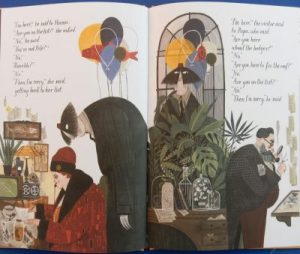
Then one day a visitor arrives; nobody wants to engage with him – he’s not on their lists –

dscn9259

until he comes upon Edward. He has a list of questions and what’s more, he’s the one who’d left the door open and is ready to admit it too. “The door was open,” says the visitor. “I know. I left it open. …” comes the reply. “For me?” – that’s the visitor. Edward thinks so. The two exchange questions, which leads to more exciting outcomes …

dscn9261

Hurray for spontaneity and the possibility of something unexpected turning up.
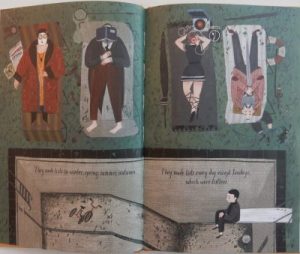
With a quirky gothic feel to it, this near nonsensical tale is likely to appeal to adults as much as children. Visual humour abounds in the suitably dreary-hued illustrations: look at this scene with the family spending a restful Sunday.

dscn9258

This is illustrator Júlia Saradà’s debut picture book: her illustrations herein reminded me very much of the work of Edward Gorey’s witty style. I look forward with interest to seeing what comes next.

Boo!

%0a

Boo!
Ben Newman
Flying Eye Books
No one is as brave as me and nothing scares me … you’ll see!” That’s the claim of the tiny stick-wielding character on the first spread of Ben Newman’s latest offering. (If you’re familiar with the awesome Professor Astro Cat books you’ll recognise him as their illustrator.)

%0a

Turn the page and you’ll immediately see this is far from true …

%0a

and then it’s a case of a series of claims to be the wearer of the ‘bravest’ mantle as an owl, a mischievous monkey, a toothsome, jaw -snapping croc, a leaping tiger …

%0a

and finally, a stampeding elephant all BOO! the previous pretender clean off the page.
Abolutely no one is as brave as me and nothing scares me!” asserts the latter super-confidently. Make no mistake about it; he does NOT have the final word …
Such a satisfying circularity herein and part of the fun is in the anticipation of the next BOO and the hooting, giggling, growling, snorting opportunities presented as each animal introduces itself. Oh, and that ‘nothing scares me … you’ll see!’ is repeated by each claimant, making it ideal for beginning readers to join in with on subsequent sharings of which, I foresee, there will be many.
Stylish and oodles of fun!

Penguin Problems

dscn9210

Penguin Problems
Jory John and Lane Smith
Walker Books
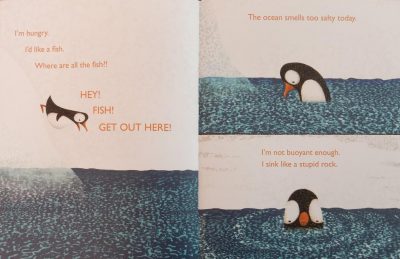
Being a penguin isn’t a barrel of laughs as we quickly discover in the first Jory John/Lane Smith collaboration, certainly it isn’t for the penguin narrator of this book anyway; we learn that right away when he’s woken from his slumbers by squawking from his fellow penguins. Nothing it seems is to this little fellow’s liking: he hates snow, the sun’s too bright and he’s extremely hungry. If the land’s not to his liking, the ocean’s even worse – too salty, distinctly lacking in fish, dark and decidedly chilly.

dscn9211

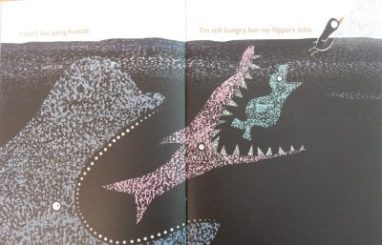
Oh great. An orca. Oh great. A leopard seal. Oh great. A shark. What is it with this place?” he mutters as he becomes hunted rather than hunter …

dscn9212

This fellow also has body issues; his buoyancy is faulty, his flippers tire too fast, his waddle is more of a wibble …

dscn9213

and of course, he can’t fly. Then there’s the issue of look alikes …

%0a

Enter stage right a walrus. His words of wisdom should go some way to changing Penguin’s attitude to ‘half full’ at the very least – some of the time anyway …

dscn9215

This book exudes humour both verbal and visual but put together the result is sheer gigglesome comedic delight at every turn of the page. Actually, make that before you start turning the pages; the perversity of the cover and penguin’s litany of negativity on the front inside flap, set the scene for what’s to come.

The Wish Tree

%0a

The Wish Tree
Kyo Maclear and Chris Turnham
Chronicle Books
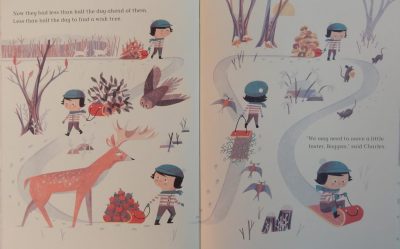
When I taught reception age children we’d sometimes have a wish tree as part of the classroom environment, perhaps for the International Day of Peace or as part of an RE theme. Of course it wasn’t a whole tree, just a branch that had broken off and been collected for the occasion. Now here’s a storybook character wanting to find a wish tree in the great outdoors. His brother and sister dismiss the idea but with his trusty ‘Boggan’ for company, Charles sets out into the snowy world on his quest to find one.

dscn9184

Up hill and down they search, venturing into the woods where they stop to help various animals and make some new friends;

dscn9185

but try as they might, they cannot find a wish tree. Evening is nigh and the searchers are weary; they can go no further. But then something truly wonderful and magical happens as Charles and Boggan’s kindnesses are rewarded.

%0a

His newfound friends help him on his way and when he wakes up, he sees before him a snow-laden pine tree. Charles writes a wish, ties it to the tree and then he, Boggan and the animals partake of a seasonal feast together.

%0a

As the moon glows in a star-filled sky, Charles and Boggan finally make their way home to bed and perhaps to dream.
The snowy scenes have a subtle pinkish glow that radiates the wonderful warmth of the story despite the chilly outdoor setting. Openheartedness and friendship win through in this subtle tale of determination and tenacity.
With its in-built repetition that offers listeners opportunities to join in with those ‘La-di-da-di-da-daaaa’s of Charles and Boggan’s ‘Whishhhhh’ songs, this is a lovely book to share as temperatures drop and the nights draw in. I love the magical elements and the way gaps are left for readers and listeners to fill for themselves.

Charles Darwin’s Around the World Adventure

%0a

Charles Darwin’s Around the World Adventure
Jennifer Thermes
Abrams
In this introduction to the work of Charles Darwin, the author focuses on his five-year long voyage aboard HMS Beagle, the ship on which he served as naturalist. Before that though we’re given brief details of his earlier life leading up to his departure on the ship whose mission was making maps of South America.
The young man was absolutely fascinated by the sights and sounds around. He kept a journal, writing in it detailed daily observations of what he saw and heard –‘big observations about the tiniest of creatures’ we’re told.

%0a

So delighted by the wild life was he that Charles would often choose to remain on land while the Beagle sailed up and down the coast. This delight is portrayed in Thermes’ detailed watercolour portraits of the young man at work, work that set his imagination on fire and would later contribute to his ideas and writings on evolution. Her narrative fills in other details, particularly that of Darwin’s observations on individual creatures: ‘He saw a rare bird called a rhea that used its wings to steer as it ran, but could not fly’, and later in Tierra de Fuego, on the interconnectedness of all wild-life, indeed all of nature itself.

%0a

The stop on the volcanic Galápagos Islands particularly amazed Charles with its 200 pound tortoises big enough to ride on, but most notably the different kinds of finches he came across.

dscn9287

In addition to a detailed cross-section of the departing Beagle, there are large, colourful maps charting the exciting voyage for readers to enjoy …

%0a

Further information is given about Darwin’s life and work, and other related facts in the two final spreads.
All in all this does a very good job of capturing the excitement not only of the voyage, but of the wonders of nature as a whole. Definitely one for the primary school bookshelves and for individuals interested in wildlife in general.

Pinball Science & The Pen

%0a

Pinball Science
Illustrated by Owen Davey
Templar Publishing
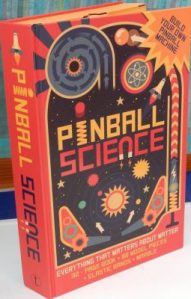
The teacher part of me has always advocated putting scientific learning into a meaningful context: now here is an exciting project incorporating a whole lot of scientific principles that’s a tremendous learning opportunity. All you need to do is open up the box and follow the step-by-step instructions for assembling an 88 piece model complete with levers, plungers and flippers – awesome! In practice, I think it may prove a little more tricky.
Before plunging in though I suggest reading the pages describing the science behind the whole pinball wonder.

image1

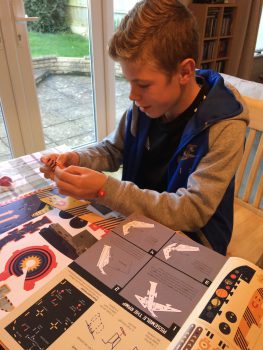
Here’s Jack working on the model

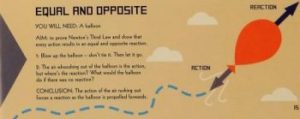
It’s fascinating stuff: I learned it in deadly boring, text book only O-level physics with nay a practical in sight, but only understood what some of it really means, for instance Newton’s third law of motion ‘Every action results in an equal and opposite reaction’ when messing around with toy cars while teaching infants many years later. Now, it’s explained along with a simple investigation with a balloon.

%0a

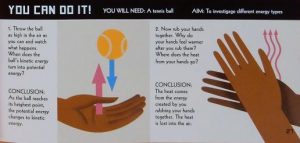
And the difference between kinetic and potential energy? I remember learning that off by heart with little understanding but here, it’s neatly explained through an investigation with a tennis ball.

%0a

These practical activities and many others, all relevant to the enterprise about to be undertaken, provided by authors of the project, Nick Arnold (of Horrible Histories fame) and Ian Graham, are all stylishly illustrated by the wonderful Owen Davey.

dscn8435

The Pen
Raphaël Fejtö
Firefly Books
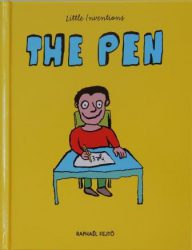
This near pocket-sized book is one of a series called Little Inventions. It’s a fascinating and delightfully quirky look at the history and development of a writing implement from the beginnings of writing when sharp reeds were used to engrave on soft clay tablets. It takes us up right through to the advent of Biros and then, the disposable BIC pens we’re so familiar with. In Japan, brushes were used for writing and these led to the invention of felt-tip pens so popular today for writing and colouring.
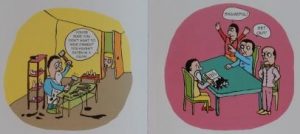
That’s it briefly; and the final page is a memory quiz. With amusing illustrations on every page,

%0a

this is just the kind of book to fascinate those youngsters less keen to embark on fictional stories: a whole lot of information, delivered narrative style, is packed into just 32 pages. Having read this one, I suspect children will want to seek out the other titles in the series: The Fork, French Fries, Glasses, Pizza and The Toilet (I bet that one proves popular!).
Just right for a school topic box, home library – anywhere there are readers (and writers) actually.

Pandora

%0a

Pandora
Victoria Turnbull
Frances Lincoln Children’s Books
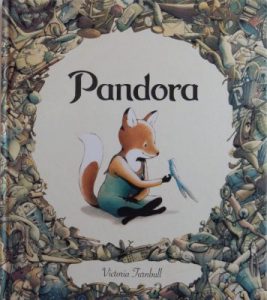
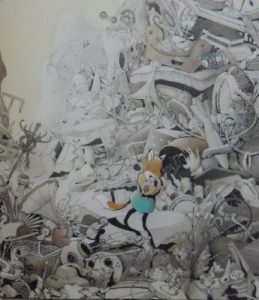
I have to admit to doing a little dance when I saw this. I’ve loved all Victoria Turnbull’s books so far, but this one, with its tactile, satin, gold-sheened cover, is sublime. It takes picture book perfection to another level as it draws readers into Pandora’s lone world of broken things …

%0a

where she spends her time collecting, mending and recycling whatever she can.
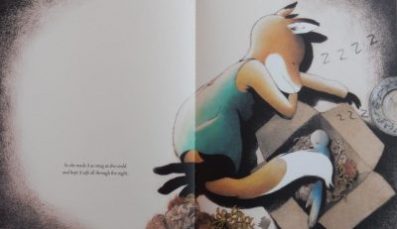
Into that world one day crashes a small creature. That too needs fixing, but Pandora’s mending skills are, she feels, inadequate. Clearly not her caring though, for she nurses it with tenderness …

%0a

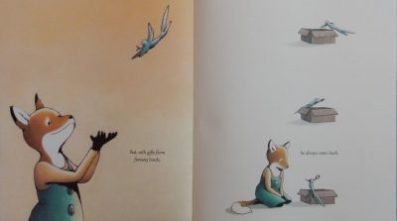
as it gradually gains strength and is able to fly once more. Pandora’s kindness is rewarded with small treasures …

%0a

But then one day she is faced with an empty box.
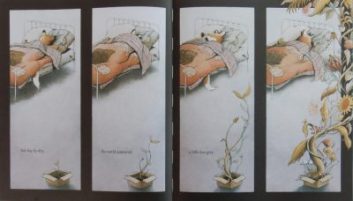
The emotional turmoil this creates is as devastatingly heart-wrenching for the reader as for Pandora. Alone once more she nurses her broken heart and, as it slowly grows back together,

%0a

other things start to grow in that box until one morning, the sun shines into her room drawing her outdoors to the best of all possible surprises …


%0a

The spare text means that every turn of the page is part of an exquisite contemplative experience that has you in its thrall throughout Pandora’s highs and lows, as you linger to explore every delicate detail of this ultimately, uplifting, fable of transformation; for as Alexander Pope said, ‘Hope springs eternal …’

The Darkest Dark / Ludwig the Space Dog

%0a

The Darkest Dark
Chris Hadfield and The Fan Brothers
Macmillan Children’s Books
The dark is for dreams – and morning is for making them come true.’ So says Chris Hadfield, retired Canadian astronaut on whose childhood this book is based. Herein we meet him as a boy, a boy who dreams of becoming an astronaut, flying to the moon or Mars.
Chris however, was afraid of the dark. For him the darkness that filled his bedroom when the lights were turned out was a darkness filled with aliens, very scary aliens.

%0a

One particular night, he has to overcome his fears and sleep in his own bed or miss the opportunity to visit a neighbour’s house the following evening to view the Apollo 11 lunar landing. So on the night of July 20th 1969, as he watches the TV (the only one on their island home) and sees the events unfolding, he realises just how dark space is – ‘the darkest dark ever’.
This is a turning point for the would-be astronaut. Chris has lost his fear and for the very first time he appreciates ‘the power and mystery and velvety black beauty of the dark.’ And in that dark your dreams await, dreams that can become your life, not tomorrow morning but some time …
The illustrators of this story really bring out both the mystery of darkness and the depth of young Chris’s nyctophobia when everything around him takes on a brooding, sinister appearance …

%0a

Certainly this is an inspiring story to share with youngsters who fear the dark, as well as those with an interest in space, whether or not they aspire to become astronauts: one never knows. Stories can generate dreams and you’ve read what Chris Hadfield has to say about those …
There’s more for space lovers in

%0a

Ludwig the Space Dog
Henning Löhlein
Templar Publishing
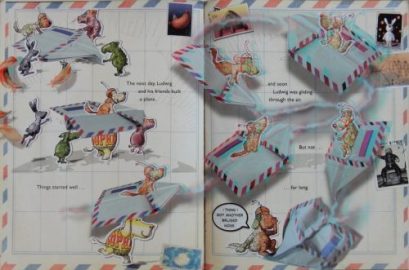
I guess if I had to choose an alternative world in which to live, I’d be pretty happy with the one wherein Ludwig and his five friends reside. It’s a world of books no less and unsurprisingly Ludwig loves to read, especially books about space. These books – as books generally do – generate dreams and ideas; and for Ludwig those ideas are about space and flying.
Try as he might though, Ludwig just cannot stay in the air for more than a very short time;

%0a

but then something unexpected crash lands right before his eyes. From that something steps its pilot – a space explorer who is in urgent need of assistance. And that is the starting point for a whole new life for Ludwig. Having fixed the rocket’s engine, he accepts the explorer’s invitation and finally takes flight on an amazing exploration of space.
Children can enjoy entering the bookish world of Ludwig and his friends, and joining the dog on his space adventure through the 3D glasses provided in the pocket inside the book’s front cover.
I love those quirky collage style illustrations of Henning Löhlein, which, even without the glasses, have in places, a three-dimensional look.

Line, Colour, Shape and Contrasts: Some Explorations

dscn9121

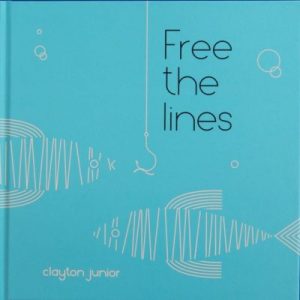
Free the Lines
Clayton Junior
Words & Pictures
It’s amazing how much you can say in a picture book without a single word of text. Clayton Junior does it all with lines – straight lines, curvy lines, thick lines and thin lines, lines close together and lines far apart; white lines and black lines. Using all these and the occasional bit of blocking, he tells a story of a small cat in a small boat sailing out into a large ocean to catch fish.
%0a

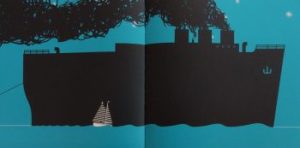
Into that same water comes a huge, smoke-belching trawler,

%0a

a trawler that casts an enormous net, an enormous net that scoops up everything in its path.

%0a

Fortunately- for the trapped, though not the trawler’s crew – an outstretched paw with a large pair of scissors puts paid to the marine life devastation and cat sails serenely into port over an ocean once more teeming with life.
This thought-provoking tale poses questions about the ethics of fishing and the fishing industry, as well as offering lessons in visual literacy and opportunities to explore and experiment Clayton Junior’s minimalist techniques of creating shape and form. It has something to offer all ages from around four to adult.
From the same artist is

%0a

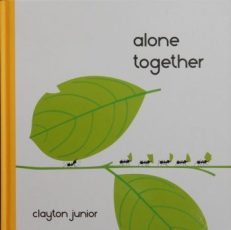
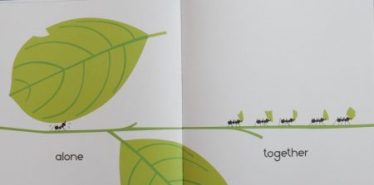
Alone Together
Herein all manner of animals are shown as a means of exploring a wide range of opposites and contrasts. Each one of the stylish spreads could well be a storying starting point in addition to demonstrating the concepts chosen. This one really made me smile:

%0a

Also worth adding to your early years collection are:

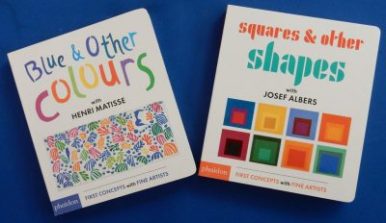
dscn9118

Blue and Other Colours with Henri Matisse
Squares and Other Shapes with Josef Albers

Phaidon
These are two of the ‘First Concepts with Fine Artists’ series, beautifully produced board books that use the work of famous artists to introduce very young children to everyday concepts.
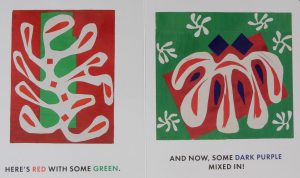
In the first, coloured cutouts from Matisse’s collages are the basis for teaching not only about colour, but also about shape and form, and how various colours can work when juxtaposed. Although blue crops up on most spreads, here’s one where it doesn’t …

%0a

Both inside covers are used to provide information: at the back is a brief introduction to the artist and some of his works, in particular the cutouts; and at the front, in tiny print, is a key to the works featured with their dates.
An unusual way to introduce colours and the notion of ‘painting with scissors’ and more important, especially if like me, you believe most children do not actually learn colours from books but from life experience, a springboard to creativity.
Equally fascinating and also essentially about colour juxtaposition and perception too, but this time introducing basic 2D shapes is an introduction to the 20th century artist Josef Albers’ work, in particular, Homage to the Square.

Home in the Rain & Home and Dry

%0a

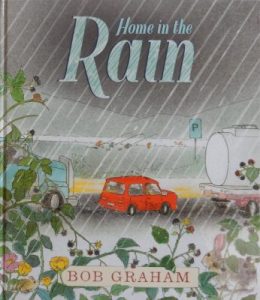
Home in the Rain
Bob Graham
Walker Books
How does pouring rain make you feel? I must admit it doesn’t fill me with feelings of joy, far from it, but when I read John Updike’s quote below the dedication in this wonderfully warm story, I felt I was being chided somewhat. Here it is and it’s key to the story I feel: ‘Rain is grace; rain is the sky condescending to the earth; without rain, there would be no life.
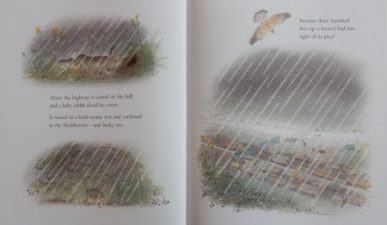
A drive home from Grandma’s in pouring rain is the backdrop for Bob Graham’s warm-hearted story. In the little red car are Francie, her mum, and ‘her baby sister’ making her presence very much felt in Mum’s tum. The drive is long and the rain ceaseless; the car makes its way in the stream of traffic and as it does so we see the minutiae of life unfolding around: the baby rabbit diving for cover, the tiny mouse narrowly escaping becoming a kestrel’s next meal …

dscn9144

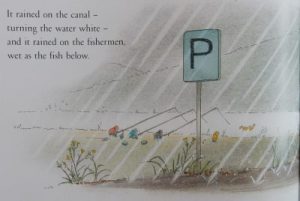
the fishermen hunched in a line

dscn9147

and the duck family just being, we even see a tiny snail and down below two men out of their cars arguing over a shunt.
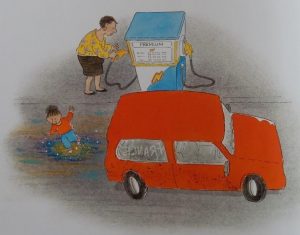
The little car pulls off the road: Francie writes on the misted windows to help pass the time; she writes family names and then pauses; her little sister is yet to be named. They eat their picnic lunch and Francie snuggles. On they go and stop again to fill up with petrol: small events unfold: Francie sploshes in rainbow puddles,

%0a

an old man feeds his dog, a small girl loses her sweets and suddenly Francie’s Mum has a name for the new sister. The journey continues, the world moves on; the sun appears.
Bob Graham provides plenty to pore over and to discuss in his tender depictions of everyday life. It’s a lovely book to share, especially in those families where a new baby is imminent.
Also with a rainy backdrop is:

dscn9150

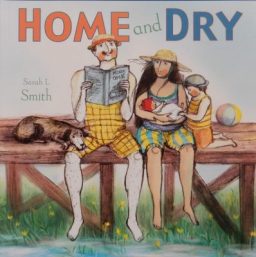
Home and Dry
Sarah L.Smith
Child’s Play
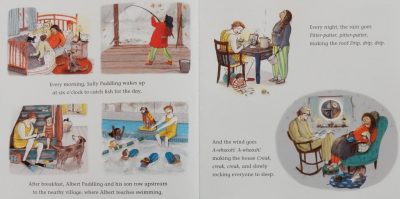
I certainly wouldn’t relish the prospect of living where the Paddling family does – on a small island underneath a large black cloud. A large black cloud from which for much of the year, heavy rain falls. This lifestyle seems to suit the Paddlings – Dad, Albert, a swimming teacher, Mum, Sally, who spends her time fishing, and their young son.

dscn9151

Come summer though, the rain ceases, the water dries up and the family home is now atop a hill. Life changes for the Paddlings who no longer receive their regular ferry delivery of food and mail. Off in search of a place to picnic, they’re unaware that another Paddling – Mr B. Paddling has set out to visit his nephew.
Uncle B. as he’s known, duly arrives to find an empty house so he decides to go back to the station. Down comes the rain, up comes the water …
It takes a rescue to bring Mr Paddling A. and Mr Paddling B. together at last and a celebratory fish supper is served by Albert.
There are echoes of both Sarah Garland and Mairi Hedderwick in Sarah L.Smith’s illustrations in this unusual family story. Much is shown in the watery paintings that isn’t told: most notably that the Paddling family grows from three to four during the story, and that’s before Uncle B. arrives on the scene.

Creature Close Up

%0a

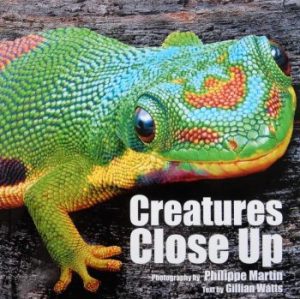
Creatures Close Up
Philippe Martin and Gillian Watts
Firefly Books
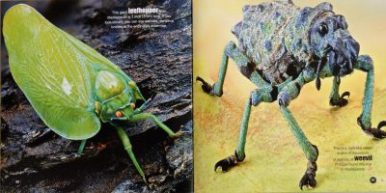
If you’re at all interested in natural history, or know children who are, then take a look at the stunning photographic images in this book. Philippe Martin, captures his subjects in pin sharp focus by taking multiple close-up shots which are slightly different and combining them into a single image using computer software. The results are truly amazing. Most of the creatures were photographed in the Madagascan rainforest and some in the south of France where Martin lives. You can see every minute detail of the insects,

dscn9166

amphibians, reptiles, spiders, crustacea and mammals he has chosen as his subjects.
Every page evokes a sense of awe at the wonders of nature and nature as designer.

%0a

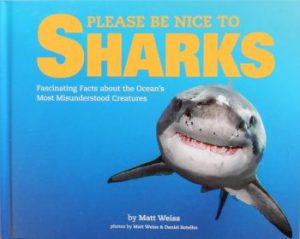
Please Be Nice To Sharks
Matt Weiss and Daniel Botelho
Sterling
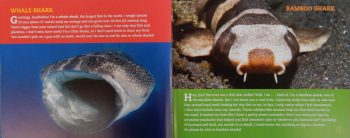
Over a dozen sharks introduce themselves in this photographic parade of one of the world’s threatened species; threatened partly because of their popularity as the chief ingredient of shark’s fin soup, a Chinese delicacy but they’re also hunted for sport. Their loss as a species would be disastrous for the food chain as a whole as they play a vital role in keeping the animal populations of the oceans in balance. From the largest Whale Shark to the Bamboo Shark, one of the smallest …

dscn9181

each variety represented concludes its personal resume with the urgent plea: Please be nice to … sharks” and the final spread offers further information about what this means for we humans. One for the primary school topic box I suggest.

dscn9172

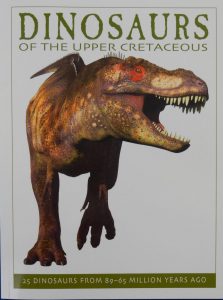
Dinosaurs of the Upper Cretaceous
David West
Firefly Books
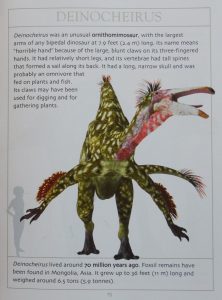
If you’re a child fascinated by dinosaurs – and that’s an awful lot of children – you probably can’t have too many books on the subject. This particular one is part of a series of six each of which covers a specific period, that together make up the Mesozoic Age. The twenty five dinosaurs included herein are from 89 to 65 million years back – the period known as the Upper Cretaceous and, after an introduction to the period, are arranged in alphabetical order. Among them are some of the most well known such as Tyrannosaurus and Triceratops but many of those featured are less familiar, certainly to me. I’d not heard, for instance, of the Deinocheirus whose name means ‘horrible hand’ and whose fossil remains have been discovered in Mongolia.

%0a

Helpfully there is a shadow image of either a human (child or adult) or a cat alongside each of the computer-generated dinosaur images to gauge their relative sizes.
Interesting facts such as what each one ate, the meaning of its name, a description of specific features and where fossil remains have been found are provided. Addicts in the 6-11 age group will probably want to collect the whole set.

Yoga for You

dscn9175

Yoga for You
Rebecca Rissman
QED Publishing
Over the last decade children have become more and more pressurised with constant testing and increased curriculum demands in school, shorter breaks, hours of homework and more. It’s no surprise that many of them feel stressed, exhausted and completely unable to relax.
In my experience one of the very best ways to alleviate anxiety and stress is through yoga and happily, some schools are beginning to take this on board and offer yoga and, or, meditation as part of the curriculum. Not enough though; but here is a handy little book for children from around nine or ten, which can serve as an introduction to the practice.
In a straightforward manner, its author, herself a yoga teacher, explains all the basics that a beginner needs to know. There are sections outlining what yoga is and how it can benefit those who practise it as well as how to choose a class – this summarises some of the many different types of yoga.
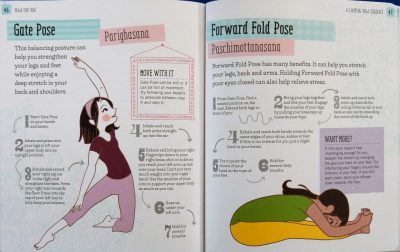
There are two sequences: the first is a more active, energising one comprising 17 asanas; here are two of them …

dscn9177

the second is a calming sequence of 18 asanas or poses – two are shown below …

dscn9176

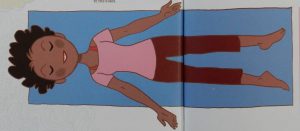
although as the author points out, the final savasana (or corpse pose) is used to end any yoga session and I would certainly endorse this.

%0a

Savasana

Every pose is illustrated, but it’s important to remember what the author says indeed what any yoga teacher should tell you, ‘Never do a pose that causes you pain.’ It’s also wise to remember that a beginner trying a pose will not necessarily look just like that in the illustration right away: flexibility takes time to develop. The Sanskrit names are given for each one of the poses and there are also brief sections on breath control or pranayama as well as mindfulness and meditation. The final pages comprise a list of useful links and a glossary.
Written in an extremely user-friendly manner, this is an excellent starting point for youngsters contemplating taking up yoga.

Motor Miles

dscn9201

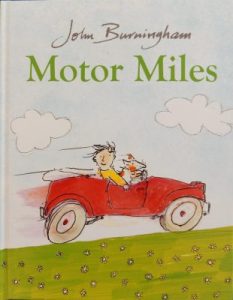
Motor Miles
John Burningham
Jonathan Cape
A new Burningham book is always a cause for celebration.
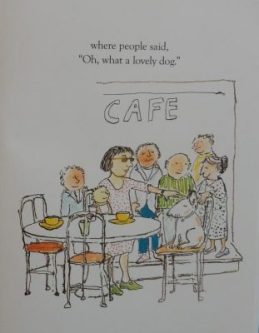
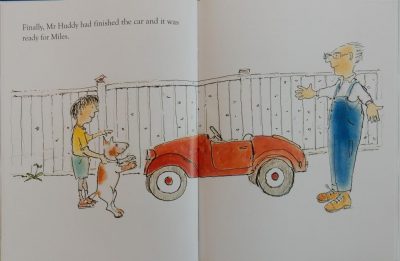
Meet Miles, a rather difficult dog. He refuses to come when called, doesn’t like walks, turns his nose up at the food he’s offered and barks way too much. Despite all this he’s managed to win the hearts of his owners, Norman, and Alice Trudge who takes him for car rides, most notably up the hill to a café where he becomes a petted pooch.

%0a

This however, becomes something of a chore for Alice Trudge. Thank goodness then for neighbour Mr Huddy, who builds Miles a car of his very own.

dscn9198

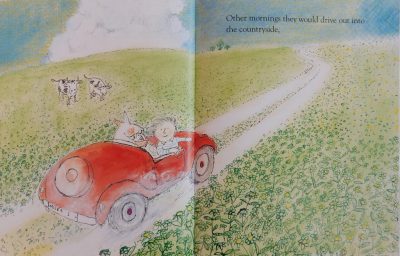
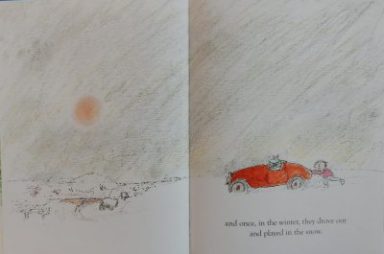
Miles learns to drive – love that sequence – takes to the road and starts taking young Norman on secret excursions. Some glorious Mr Gumpylike scenes show the two enjoying seasonal jaunts through fields …

%0a

woods and valleys,

dscn9200

all of which have a positive effect on Miles, who gradually becomes a reformed character. Inevitably however, Norman outgrows the car and Miles stops driving. Perhaps Mr Huddy has another surprise up his sleeve though …
John Burningham’s down-to-earth telling leaves his masterful illustrations of Miles discovering the joys of freedom, and those lyrical landscapes, to do the talking. For me, Burningham still wields a very special magic.

Maverick Junior Fiction

Maverick is already well established itself as a picture book publisher; now they make their first foray into junior fiction with a trio of exciting titles:

dscn8899

Grandma Bendy and the Great Snake Escape
Izy Penguin
Rickety Rocket
Alice Hemming and Emma Randall
Letter to Pluto
Lou Treleaven
Maverick Arts Publishing
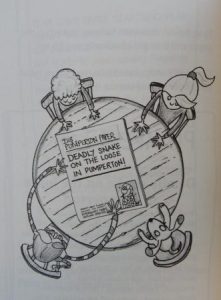
Grandma Bendy boasts an interesting cast of characters including Grandma’s grandchildren Max and Lucy, Mike Grimace – he’s the school bully, Lady Lavender, Sergeant Nevil Rodent and Mr Brain Freeze, all residents of Pumperton (twinned with Bottumburper and Le Pongue) where the story unfolds. Already you’ll be guessing that this is a funny book and one likely to grab the interest of newly confident readers. The story starts on the first day of term with 4B embarking on a session of ‘Show and Tell’. Mike Grimace has brought his pet snake to school and he has a wicked grin on his face as he transfers it from his school bag to Lucy’s as she’s about to open the session and talk about her Gran.
Before long there’s a snake on the loose, the school is empty and the entire town of Pumperton is beside itself with ‘snakeitis’.

%0aThen it’s down to Lucy, brother Max and the indomitable Grandma Bendy to apprehend the snake and put things right.
Funky illustrations by the author adorn every page and add to the fun of the whole crazy experience.
Rickety Rocket contains three short stories starring adventure-loving Spacey Stacey, her friends Timble the robot, twins Zip and Zap and creative Moondoodle. Then there are their rivals, Astro Pete, Jack Boom and Jill Zoom. The first story tells what happens when they all take part in The Great Space Chase. Who will be first across the finish line: Spacey in her Rickety Rocket or Astro Pete in his shiny shuttle? It’s going to be a close thing for sure.
In the second adventure Stacey is overwhelmed with orders for her special jellies and resorts to using a jet-pack to speed deliveries up a bit. Things don’t quite go to plan of course but her aeronautics are certainly a crowd-pleaser.

%0a

Picnic Planet sees the friends heading off for a day out but there are warnings not to feed the space bunnies scattered around. Then when food begins to vanish, those innocent-looking creatures are under suspicion: they couldn’t be the thieves surely …
Letter to Pluto revolves around an interplanetary penpal programme initiated by Jon’s teacher, Mrs Hall. Jon happens to be paired with a Straxi and he’s not happy about it: firstly she’s a girl and secondly she lives on Pluto, which is the smallest and the most boring planet in the entire universe; and it’s smelly! Almost the whole book takes the form of illustrated letters between Jon and Straxi …

dscn8902

and through their correspondence we learn how the two eventually become firm friends and manage to save Planet Pluto from ecological catastrophe. Great fun!
All three are ideal for that taking off stage of reading but would also work well as read alouds for KS1 classes.

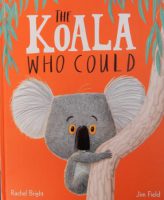
The Koala Who Could

The Koala Who Could
Rachel Bright and Jim Field
Orchard Books
Some of us find it harder than others to step outside their comfort zone; one such is koala, Kevin. This enchanting, cuddlesome creature is totally change averse and has three things – relaxing in the sun, clinging on and napping, and munching on a leaf-bun down to a fine art. Technically I suppose that’s four but for the sake of the story let’s not quibble. Our Kev. is ‘King of the Staying-Still Kings’. Put another way, he just stays put high up in his tree.
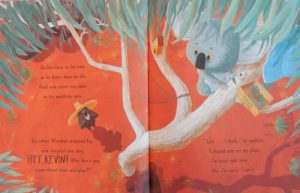
Down below the other animals race about enjoying themselves and making a lot of noise – it all seems far too large and strange for him, and despite invitations from the likes of Wombat,

and encouragements from the dingoes and kangaroos, nothing can shift cling-on Kevin. Occasionally he might have ideas about joining in but it never happens; his life just stays the same day in, day out.
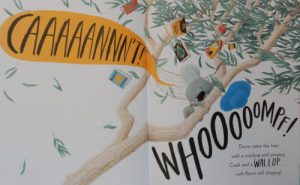
Then one day something happens that undermines his whole raison d’être. Can Kevin finally let go of his safe, or now decidedly unsafe, existence?

The answer lies in just two little words.
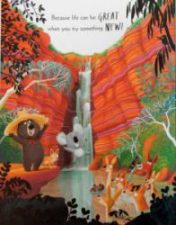
I loved Bright and Field’s previous offering The Lion Inside with its African landscapes. Now we have a tale set in Australia, land of the eucalyptus trees that Kevin is so firmly attached to. What delectable scenes Jim Field has created to accompany Rachel Bright’s catchy, fun to read aloud, rhyming narrative. Kevin is a real heart-stealer; he might do nothing much, but his changing expressions as captured by Field, are a whole comedy in themselves. There’s so much more to delight though –the animated antics of the other animals, and the delight on the faces of one and all on the final page – that pretty much sums up the whole thing …

What are you waiting for? Join the new Kevin and give it a go.

Canine Capers

dscn9113

Fred
Mick and Chloë Inkpen
Hodder Children’s Books
Hooray! More from Fred.. I fell in love with this mischievous puggish pup in I Will Love You Anyway and now here he is, bouncing right back to delight us once again with his prankish behaviour. In fact now it seems he can tick off a whole lot of ‘can do’ items from the list of accomplishments one might expect of a little dog. He can fetch a stick, come when called, sit and stay. There’s one word though that still eludes the little chap; he doesn’t understand the meaning of Fred – a word often on the lips of his young owner. And something else puzzles him too: another dog upstairs that looks just like him –mmm!

%0a

Could he perhaps know what this strange ‘Fred’ word is all about? Strangely enough he seems to be popping up in other places too, places like the park and he has his paws on a certain ball belonging to our narrator …
After a very wet awakening, followed by a scream, a dash, and a jump, another face appears, a face that whispers a certain word over and over and then – light bulb moment …

%0a

Adorable!

Another canine has recently won a place in my affections; he’s the Boston terrier that stars in:

%0a

Harold’s Hungry Eyes
Kevin Waldron
Phaidon
Harold is a real foodie; he spends almost all his time either eating or day dreaming about his next meal. His dreaming is done lying in one position or another on his favourite chair – a chair he loves almost as much as he loves food. One day though, this super comfy chair is no longer where it should be when he goes to eat breakfast. A devastated Harold sees it being loaded onto the rubbish cart.

%0a

Without another thought for his meal, he takes off in hot pursuit and is soon lost and even worse, his tummy is starting to rumble. His food obsession kicks in and Harold begins seeing things of the edible kind wherever he looks …

%0a

Happily though, his wits and those hungry eyes of his finally lead him back home where he finds a satisfying breakfast and a delicious surprise … a new place whereon to relax.
With smatterings of edible humour, this stylish book is a wonderful visual feast that’s more than likely to have young audiences chuckling and perhaps, drooling.

Samson the Mighty Flea

%0a

Samson the Mighty Flea
Angela McAllister and Nathan Reed
Andersen Press
Samson the Mighty Flea is top of the bill at Fleabag’s Circus, which is no surprise: he can lift a match, a pea and, the lovely Amelie – all at once. Despite this, he’s not satisfied; Samson longs for the big time so he bids farewell to fellow Fleabag performers and off he goes determined to be “the biggest star in the world“.

%0a

But the world is a very big place and he’s such a small flea: “Go back where you belong,” a bug tells him. There’s no going back for Samson though, not until he’s performed before a huge audience. That does eventually happen …

%0a

but so does something else: Samson realises that however much he’d longed for fame, it’s worth nothing without his old friends and one in particular.
Meanwhile back at Fleabag’s that particular friend is about to give the performance of her life too …

%0a

Thought provoking and funny, this circus romp moves in and out of rhyme and so requires careful perusal by an adult reader aloud before public performance. I loved the offbeat nature of the whole thing: its unlikely characters are portrayed with finesse by Nathan Reed, who provides visual delight at every turn of the page.

Snail Mail

Snail Mail
Sharon King-Chai
Hodder Children’s Books
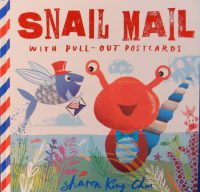
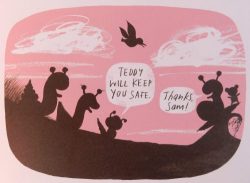
The majority of us receive much of our communication by text, e-mail and social media nowadays; letters are mainly junk with the occasional thing to delight – a letter from abroad, an exciting piece of publishers’ information, and of course all those wonderful books to review; I only ever receive picture postcards from one person. As a young classroom teacher in the 80s and 90s, before social media, one of my most favourite books to share was Janet and Allan Ahlberg’s The Jolly Postman and there have been other books with letters and cards thereafter. These can be a great stimulus for children’s own writing and now, there’s one more. Herein we meet 4 year old Seashell Snail, Sam, our narrator who has a large group of adventure-loving family and friends. Take big brother Tiger; it’s he who generates the snail mail, which gives the book its title. Tiger sets out on a world trip promising to write to Sam every day.

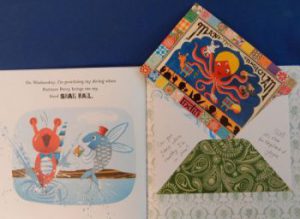
Good as he word, Tiger sends Sam a picture postcard from every place he stops at -. Brazil on Monday, the USA on Tuesday, India on Wednesday, Japan on Thursday, France on Friday. Goodness he does get around and those communications surely do keep Postman Perry busy, not to mention sparking off exciting activities for the seashore residents. Each card is delivered in a beautifully designed envelope appropriate to its place of origin; here’s the one from India.

The final communication contains something very special – a birthday treat for Sam; and it’s one that will undoubtedly inspire its recipient to start making some international travel plans too.
A super-silly story with appropriately crazy illustrations to delight – lots of fun to share and perhaps, a classroom stimulus to some imaginative written correspondences.

The Building Boy / Here Comes Mr Postman

%0a

The Building Boy
Ross Montgomery and David Lichfield
Faber Children’s Books
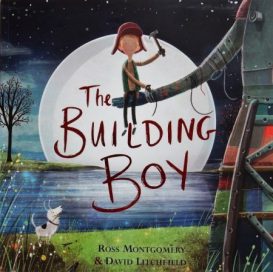
This is a powerfully moving story at the heart of which lies the relationship between a boy and his Grandma who had once been an award-winning architect. Before bedtime in the house they shared, the two would snuggle together and Grandma would show her grandson photographs of buildings she’d designed.

dscn8844

That was all in the past but now, she had plans for a wonderful new house she’d build with his help – a home the two would share.
Grandma, all the while is growing ever more frail and one day when he returns home, the boy finds she has died. The lad is overcome with grief.
Such is his love for his gran however, the boy is driven to carry on building. He works on a huge robotic-looking structure somewhat akin to The Iron Woman,

%0a

a seeming reincarnation of his Gran; and she has plans … plans for an amazing journey the two will undertake together …

dscn8847

Where that journey ultimately leads is to a deeply affecting finale – a place wherein the spirit of his beloved Grandma will forever reside …

%0a

David Lichfield, who demonstrated his artistic brilliance in The Bear and the Piano imbues this enigmatic tale of love, loss and finding your calling with a sense of awe and wonder. His use of dark and light transports readers to that dreamlike place where anything is possible and the unbelievable becomes believable …

%0a

What an inspired partnering of author/artist this was and the result is a book that will linger long in the mind.

%0a

Here Comes the Postman
Marianne Dubuc
Book Island
It’s Monday morning and with cart loaded, Mr Postmouse sets off on his rounds. We join him as he delivers letters and parcels to all manner of unlikely animal recipients. The story itself is a straightforward description of the various stopping places but the illustrations are absolutely crammed with quirky details as we look into each home visited. It’s no easy round for Mr P has to scale heights …

%0a

and dive deep …

dscn8734

to complete his round and every stop provides readers an opportunity to peep inside the huge variety of residences and see for instance Dad Rabbit busy preparing a meal, a Crocodile languishing in the bath and another enjoying a book (and a nibble),and some bats – errr – dangling.
After all the hard work, there’s one package left in Mr Postmouse’s cart and it’s a very special delivery he has to make – to his small son, Pipsqueak whose birthday it is.
This is definitely a book to share and to pore over: I can see a fair bit of time being spent over each and every location Mr P delivers to. Terrific fun.

WNDB_Buttonlocalbookshops_NameImage-2


This Book is Out of Control / Happy Hooves Yuk!

These two picture books welcome back some old friends:

%0a

This Book is Out of Control
Richard Byrne
Oxford University Press
The perils of the remote control are explored in this third comic romp starring Ben and Bella, not forgetting Bella’s dog of course. It all starts when Ben turns up clutching his new favourite toy – a remote controlled fire engine. Eager to show off his control skills he begins by demonstrating the UP button but a press yields no response or rather the ladder stays fixed: Bella’s dog doesn’t as we readers can see. Ben and Bella however are oblivious to the action taking place inside the house behind the door, which nestles in the gutter of the book and Bella has firmly closed.
With their eyes fixed firmly on the ladder Ben tries another button, which results in this …

dscn8887

I’ll leave you to imagine the results of pressing the siren button. Ben tries VOICE, which yields an utterance from the dog who opens the door revealing his predicament to the children. Things go from bad to worse despite Ben’s frantic button pushing and it’s then a case of over to you “Dear reader” especially as the expert remote controller has started to turn a delicate shade of green. Things are getting pretty desperate up top when readers are addressed once again …

%0a

Does this work, you might be wondering – it certainly appears that one of the characters is in control …

%0a

but we’re still left with one button none of them has tried …
With some rather crazy interactive opportunities, this is somewhat more sophisticated than the previous stories in the series. For me, the dog is undoubtedly the star of the show here.

dscn8997

Happy Hooves Yuk!
A.Bogie and Rebecca Elliott
Fat Fox
The third Happy Hooves story sees Pig deciding to treat his pals to a culinary feast. But even after his careful preparations things don’t go quite as he’s planned. Cow turns her nose up at the first dish; Foal frowns at the second;

%0a

Donkey is decidedly disturbed at the third and Sheep shudders at the thought of what she’s offered. Poor Pig: it seems none of his favourite dishes tempt his friends. He has one final course though: could this be the one? It certainly looks pretty scrumptious … let the party begin!

%0a

I envisage a whole lot of ‘eughs’ and ‘yucks’ when you share this engaging rhyming tale; and as a veggie, I found myself in total sympathy with Pig’s friends about his offerings – definitely disgusting! Let’s celebrate friendship and chocolate cake instead. Let’s also celebrate Rebecca Elliott’s patterned scenes: I love the retro style and the occasional bordered spreads.

%0a

Focus on those frogs …

Wonderful Wildlife

dscn9092

It Starts With a Seed
Laura Knowles and Jennie Webber
Words & Pictures
Sometimes I open a parcel and just know I’m going to love a book before I’ve even got inside the cover. Such a one is this and as the title says It Starts With a Seed – a sycamore seed.
In this gorgeous book Laura Knowles’ rhyming narrative takes us on a journey – a journey through days, weeks, months, seasons and years as we follow the growth of that seed from the time it falls to earth right through until it’s a mature tree – fully formed with its own ecosystem. Jenny Webber’s delicate, detailed illustrations show every stage of the tree’s development from seedling …

dscn9095

to sapling to the ‘leaf-laden, bark-bound arboreal home’ to the plethora of insects, birds and mammals that live therein.

%0a

What I love so much about this book though is the sense of awe and wonder it’s likely to engender in those who read or listen to its lyrical words and pore over its painterly portrayals of the natural world. Such a superb way to embody a fair amount of information and the whole narrative is presented again on the front of a gatefold finale that opens to show seasonal changes to the leaf and flower and provide additional information such as ‘A sycamore’s small flowers grown in clusters known as racemes’ and ‘A sycamore can grow 35 metres tall’ – wow! And all from one tiny seed.
A book to buy and to keep, a book to share and a book to give: it’s perfect for autumnal reading but equally, it’s one to be returned to often, at home or in the classroom.
Laura Knowles has also has co-written

%0a

British Wildlife
Matthew Morgan & Laura Knowles
QED
Essentially this is a visual introduction to some of the riches of the natural world to be found in the British Isles from frogs to fruits …

%0a

and fishes to fungi.

%0a

Illuminature
Rachel Williams and Carnovsky
Wide Eyed Editions
This is an awesome look at over 180 animals and the plethora of plants that inhabit ten of the world’s very different environments from the Congo Rainforest to Loch Lomond and from the Californian Redwood Forest to the Ganges River Basin.

%0a

Awesome because, thanks to the three-coloured lens (included in a pocket at the front of the book) readers are able to get three different views. Look through the red lens and you see the diurnal animals, the blue lens will show nocturnal and crepuscular creatures and the green lens reveals each habitat’s plant life.
Each habitat is allocated six pages – two ‘viewing’ spreads, one giving key facts about the place and a textless “observation deck’ …

dscn9090

followed by a black and white one –

dscn9091

a ‘species guide’ that provides more detailed information on the particular animals featured in the coloured scenes. I foresee squabbles arising over this one.

Potion Commotion

%0a

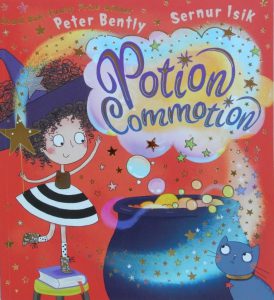
Potion Commotion
Peter Bently and Sernir Isik
Scholastic Children’s Books
There are echoes of The Sorcerer’s Apprentice and The Magic Porridge Pot in this rhyming tale of magic and mayhem. With warnings of a dragon in the vicinity, Mum pops out shopping leaving young Betty alone in the house. A risky thing to do, you’re probably already thinking; all the more so when Betty decides to mix up a culinary treat for when Mum comes home. Into the pot goes pretty much everything the young miss can lay her hands on …

%0a

then she utters Mum’s cooking spell, stands back and waits.

dscn9279

Before long the cauldron is bubbling and spilling all over the floor and out the cottage door but there’s no way Betty can halt its progress– she’s forgotten the words of the stopping spell her mum uses. Goo foams, froths and flows onto the road and through the whole town. Luckily Mum arrives in the nick of time. She halts the gloop in its tracks but then what should also fly along but the dragon and it’s ready for a human feast.

dscn9280

Can anything be done to avert disaster?
Lively cartoon style illustrations and Bently’s fast-flowing narrative together create a recipe for a diverting read aloud for Hallowe’en or any time of the year.

Four Silly Skeletons / Boo! Haiku

%0a

Four Silly Skeletons
Mark Sperring and Sue Hendra
Bloomsbury Children’s Books
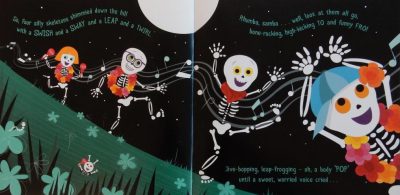
Meet the silly skeleton quartet: there’s Fred, Sid, Belle an Bill, residents of a hill-top house, while down below at the foot of the same hill lives their sweet-natured Auntie June with Skellybones, her cat. The four young’uns get up to all manner of shenanigans and it’s down to their aunt to set their wrongs to right.
One dark night when the sky is full of stars and the young skellies full of energy, off they shimmy down the hill,

%0a

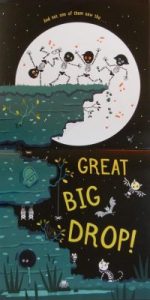
only to be halted in their tracks by Auntie June clutching a large bag full of lamps and other lights and warning of the darkness on the hill. But do those four sillies pay heed to her concerns? Oh dearie me, no: what’s the need for extra light when the moon’s big and bright, they say. But that’s before they come upon this …

dscn9239

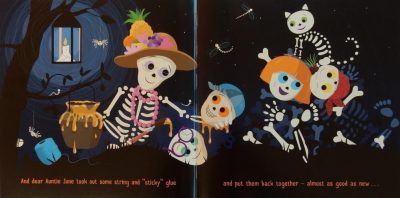
which results in a hurtling, spinning, screaming drop that ends in bone-scattering disaster. So it’s just as well that Auntie June has heard their wails and come to their aid, and just happens to have a large pot of sticky stuff with her; sticky stuff that is just the thing for some hasty repairs.

%0a

Now let that be a lesson to those full-moon frolickers.
Told in rowdy, bone rattling rhyme and illuminated by Sue Hendra’s super skeleton scenes of mischief and mayhem, this is just the thing for a Hallowe’en romp.

%0a

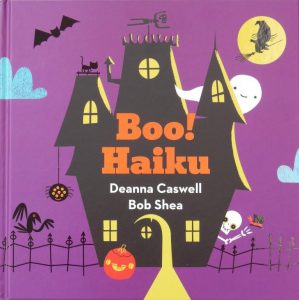
Boo! Haiku
Deanna Caswell and Bob Shea
Abrams Appleseed
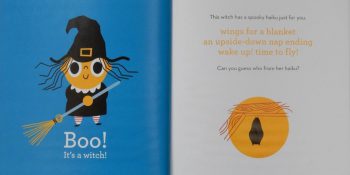
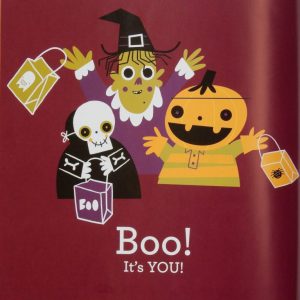
In this follow up to the Guess Who, Haiku are a host of mock-scary frights to delight! Starting with ‘broom across the moon/ pointed hat at the window/ hair-raising cackle’ children are asked to guess who. There’s a small visual clue below the text in addition to the haiku and the answer is revealed when the page is turned.

%0a

The subject then presents another haiku to listeners and so on through traditional Hallowe’en-associated items – a bat, a skeleton, a pumpkin (jack-o’lantern), a ghost and so on and finally –

%0a

The last page provides information about the haiku form and syllabification; and I particularly like the reference to ‘an element of play’.
This cries out for audience participation and is great to share with preschool children who will be honing their listening skills while having fun.

Duck Gets A Job

dscn9072

Duck Gets a Job
Sonny Ross
Templar Publishing
How many people end up doing jobs in city offices, jobs that perhaps pay well but are not fulfilling and certainly not the kind of thing they’d dreamed of? I suspect an awful lot, but they haven’t the courage to do anything about it and may even claim to love what they’re doing. Perhaps that’s also the case with some of Duck’s friends …

%0a

in this droll, super stylish debut picture book from Sonny Ross. First let’s meet job seeker, Duck as he peruses the situations vacant columns in search of a job, a job like his pals.

%0a

In spite of not sounding totally his thing, Duck applies for one and succeeds in getting himself an interview. Now more decisions have to be made – appropriate gear and mode of travel. Both prove somewhat problematic …

%0a

but eventually Duck arrives at the office where he lands himself a job.
Pretty soon however, he realises facts and figures are never going to float his boat; a city job is not the life for him so he walks out and decides to follow his heart and dreams.

%0a

Using an uber cool colour palette that is perfect for the job, Sonny Ross puts a brand new spin on joining or rather, not joining the rat race: and he ought to know – there’s an element of autobiography herein.

A Bottle of Happiness

%0a

A Bottle of Happiness
Pippa Goodheart and Ehsan Abdollahi
Tiny Owl
A Bottle of Happiness – now that’s something we could all do with from time to time; but how could it be caught and then put into a bottle? Well the first part’s easy: we can infect people with our own happiness; but bottling it? That’s altogether different. It is however the challenge young Pim is faced with in this neo fable when, accompanied by Tiddle, his dog, he crosses the mountain.
Now Pim and his people lived on one side of this mountain: they worked hard and shared what they had – stories in particular. On the opposite side lived the rich people who were traders, intent on getting richer: they didn’t give, they sold things to one another at a big market. Pim decides to go over that mountain in search of a new story and it’s there in the market place he finds himself looking at a basket of mouth-watering fruits. The seller of same doesn’t give things away though and so Pim, a perceptive and thoughtful lad, agrees to bring him happiness, the one thing his own people have more of, in exchange for some of the fruit.

%0a

Back he goes and collects song, laughter, music and love from his fellow villagers. With all this safely stored in a bottle, back he goes; what comes out when he removes the stopper however, is total silence – but not for long …

%0a

Now how could that be, and how does Pim manage to bring about an amazing transformation in the relationship between the sellers and the givers? That would be telling; and I think I may already have. For the rest you’ll need to get hold of a copy of this book and savour the delights of Ehsan Abdollahi’s intriguing peasant style patchwork illustrations.
This is a book that demonstrates that rather than being just for the vey young, picture books really are for all ages.
I asked some children what they would put in a bottle of happiness. Here are some responses:
A trampoline, a diving board, my brother, my family’ James 8
‘My family, a smiley face, a tennis court, a football pitch’ Daniel 7
‘Smiles, hugs, music, books, tortoises, love, flowers, art’ Rosa 7
‘Friendship, love, snow, sweets, beaches, Easter, sunshine, mice’ Nina 10
‘Love and respect’ Dolci 5
‘Mummy and Daddy’ Elena 3
‘Swimming with friends on holiday’ Gracie 7
Food for thought …

Olive Owl & Parker Penguin / Hello Mr Moon

%0a

Olive Owl
Barry Tranter and Emma Tranter
Nosy Crow
There’s something about owls in stories that endears them to very young children: most notably the classic, Owl Babies, and now here is an information picture book likely to win those far from cute creatures more friends.
Based on the Rounds apps this is one of a new series for the very young. Having read on the publisher’s press release that Olive’s creators are ‘firm believers in education through play’ it sounded as though they’re kindred spirits. There’s certainly an element of playfulness about this book. Emma and Barry Tranter’s design backgrounds are also reflected in this charming book: the owl characters and some other objects– in keeping with the Rounds series title – are made up of circles or parts of same.
Olive is a barn owl and through a mix of a narrative running across the top of the page, and factual snippets printed within circles scattered throughout each spread, readers and listeners can find out about her life cycle …

%0a

diet, shape and size as well as her mating habits and other characteristics. Young children will be interested particularly to learn that a barn owl’s wing span is wider that a 5 year old’s armspan.

%0a

There are also occasional speech bubbles that help make Olive something of a character.

%0a

All in all, a thoroughly enjoyable way to introduce an important aspect of the natural world to very young children; one to add to the early years’ book collection I’d say.
In the same series and also worth having is:
Parker Penguin
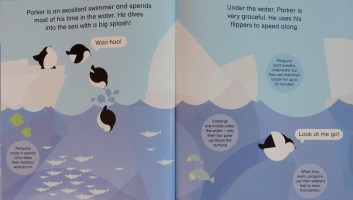
Hailing from the Antarctica, Parker is a rotund young penguin, but although he’s a bird, he cannot fly and still won’t be able to by the time he reaches adulthood after three years, which happens towards the end of the book. Instead he moves by sliding, waddling, swimming –

%0a

and ‘marching’. Marching is what he does, along with lots of other penguins, to the breeding ground and it’s there he finds a mate and after around seventy days out hatches a new chick, a male, Percy and …

dscn9030

the cycle begins again.
A different kind of cycle is explained in: 

%0a

Hello, Mr Moon
Lorna Gutierrez and Laura Watkins
QED
The moon is the unlikely narrator of this rhyming story that takes the form of a response to a child’s observation, “Hello, Mr Moon … You’re up. You’re down. / Why so skinny/ and then so round?” Mr Moon then goes on to explain and is joined by a host of (mainly) nocturnal animals – a bat, a fox,

%0a

a badger, a fish an owl and a cat, each of which interjects an observation or a question for him, until the whole lunar cycle from new moon to full moon has been described and shown in Laura Watkins’ powerfully atmospheric woodland scenes.

%0a

Young children will enjoy the narrative – verbal and visual , learn some basic astronomical facts and at the same time absorb terms such as ‘gibbous’ from the context.
The teacher part of me does not like didactic directions but I appreciate that many adults may well find the “Next Steps’ suggestions on the final page helpful.

Little Owl’s Egg

%0a

Little Owl’s Egg
Debi Gliori and Alison Brown
Bloomsbury Children’s Books
Baby Owl’s response to Mummy Owl’s announcement that the egg she’s just laid will become a new baby owl is anything but positive. “I’m your baby owl. You don’t need a new one,” he insists.
As they take a walk together wise Mummy Owl plays a ‘suppose that’ game with Little Owl, suggesting the egg might hatch into a worm,

%0a

a penguin, a crocodile even; or could it perhaps be made of chocolate.

%0a

Little Owl ponders all these possibilities rejecting each: he, although definitely not his  mother – is more in favour of a dragon egg.

%0a

In fact though, it seems he’s becoming rather fond of the egg; something special must be inside he decides, something like a baby “Princess Wormy Choco-Penguin Crocophant Dragowl.” – something that will need a very strange diet.
On the other hand it might after all be better, if what emerged from that egg of theirs should turn out to be a brand new Little Owl, because that would make the present one something even more special – a new Big Owl and that could never change, no matter what.
Tenderly told, this gently humorous story goes to the heart of what many young children fear when a new sibling is on the horizon: that their mother’s love will be transferred away from them to the new arrival. Mummy Owl and Little Owl as portrayed by Alison Brown are totally endearing characters and she captures the inherent humour of Debi Gliori’s narrative beautifully in every scene.
This is just the thing to have on hand when a new sibling is imminent but it’s too much fun to restrict just to such an occasion. I’d share it with a nursery group or class no matter what.

I Broke My Trunk / Let’s Go for a Drive

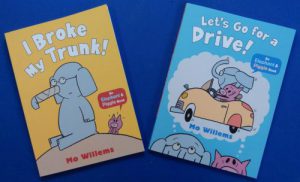
I Broke My Trunk!
Mo Willems
Walker Books
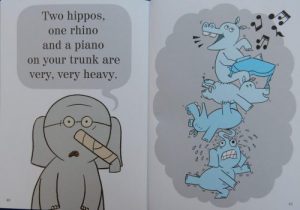
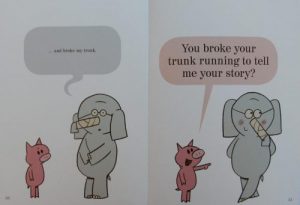
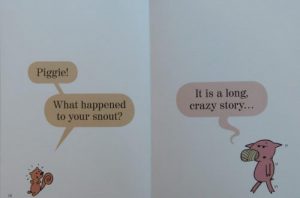
I love Mo Willems’ Elephant and Piggie stories; they’re ideal for beginning readers and totally crazy. In the first one poor Gerald has a damaged trunk and just when Piggie is wondering why his friend hasn’t put in an appearance, along comes Gerald looking just a tad sorry for himself. “What happened to your trunk?” asks Piggie and thus begins a protracted and rather convoluted tale of misadventure and madness. Imagine trying to balance a hippo on your trunk; that’s what Gerald did, and a rhino, followed by Hippo’s big sis who just happens to have a piano with her.


Well of course Gerald’s trunk would break under all that weight wouldn’t it? Actually no; there’s more to this bonkers story because Gerald’s trunk managed to stand up to all that mis-use; but then in classic Willems/ Gerald fashion comes the embarrassing part …

and a final whoops:

let’s leave Piggie to have the last word – or rather words.
Hilarious nonsense, but utterly irresistible and delivered all in dialogue and through Mo’s minimalist chucklesome pictures. Make sure you peruse the final endpapers – seemingly Piggie has found another old friend to share his tale with.
More delicious Gerald and Piggie nonsense in
Let’s Go For a Drive
Mo Willems
Walker Books
Let’s go for a drive!” suggests Gerald; “That sounds fun!” agrees Piggie. “Drive! Drive! Drivey-drive-drive!” they shout together gleefully. Gerald then announces the need for a map – he’s just a little bit of a fusspot (a pedant) and continues listing a whole lot more items crucial for the enterprise while poor Piggie dashes around collecting sunglasses, umbrellas, bags, …

We have so much to pack,” interjects Gerald; but that’s not all … “There will be a lot of driving on our drive,” he continues. Really? Haven’t they forgotten about one fundamental item for this drive.

What should they do now? Luckily for Gerald, PIggie has an answer and, a plan.
Another winner in this early reading series –young readers don’t need a plan either – all they need is right there in this satisfying little book.

Toto’s Apple

%0a

Toto’s Apple
Mathieu Lavoie
Phaidon
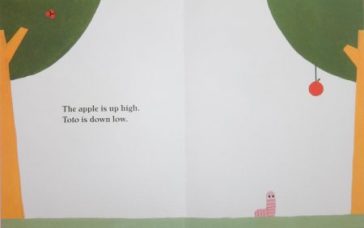
Toto is a little worm (you might at first glance mistake him for a sock) and he’s set his heart – and his eyes – on a rosy red apple. The trouble is Toto’s on the ground and the apple? Dangling tantalisingly way too high out of his reach. What’s he to do?

%0a

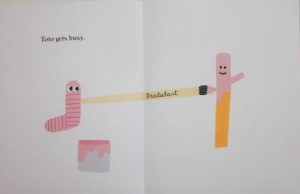
Along comes a bird and an idea too. Toto seizes a paintbrush – don’t ask me how or from where; it matters not. He gets to work …

%0a

and then waits. Bingo! His trick works and Toto hitches a ride but now look where he is …

%0a

Does he give up? Oh no he doesn’t. Out comes that paintbrush again and here we go once more, courtesy of a squirrel. Another miss and another dab of that brush and he’s ready for another try– wheee!

%0a

Oh no! He’s right back where he started. Game over? Definitely not – even when a little girl, Didi, has her teeth sunk into his prized apple – and Toto? Seems he’s still in with a chance …
A tasty ending? Sure!
Uber silly but totally brilliant is this super-satisfying Lavoie treat. Love, love, love Toto’s creativity and persistence. His tale is certain to become a much requested storytime favourite wherever it’s shared – home, early years setting or classroom.
And with its spare narrative, it is – yes all 64 pages of it – a cracking book for those in the early stages of reading to sink their teeth into. So much more satisfying than most of the rubbish fodder learner readers are fed; but you’ve got to consume it in a single sitting and THAT, takes time.

I Saw Anaconda

%0a
I Saw Anaconda
Jane Clarke and Emma Dodd
Nosy Crow
Most of us are familiar with the nursery favourite, ‘There was an old woman who swallowed a fly’. What Jane Clarke provides herein is a riotous reworking of the rhyme featuring a little boy – the narrator – and a gigantic, guzzling anaconda intent on devouring everything from the tiniest tick …

dscn8962

to an alligator.

img_1212

And even that’s not enough; she goes on to consume the boy – binoculars and all – too. Story over then? Not quite.
We all know the outcome of over indulgence and here it is …

dscn8964

Young children relish the build-up as they wait for Anaconda’s comeuppance and if my experience is anything to go by, will demand an immediate regurgitation of the whole yucky tale. The description on the cover pretty much sums up the snakey shenanigans herein: it’s great fun to share. Clever use of foldout pages,

%0a

multi-flaps …

%0a

and pop-ups give extra room for Emma Dodd’s deliciously gigglesome artistry, and to display the hapless victims within their devourer.

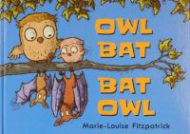
Owl Bat Bat Owl

Owl Bat Bat Owl
Marie Louise Fitzpatrick
Walker Books
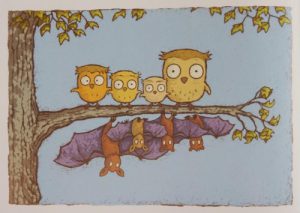
I’m a big fan of wordless picture books and this one is a cracker. It features two families one of owls, one of bats.
As the story opens, the owls are happily settled on their roomy branch enjoying some shut-eye when all of a sudden along comes a family of bats. They too decide to make their home on that self same branch so we then have …

Unsurprisingly the two families are circumspect: after all owls and bats don’t really make the best of friends.
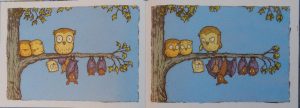
After a fair bit of positional adjustment, the families both prepare to sleep but baby animals, like humans are inquisitive and so you can probably guess what happens after this …

Now we know that human children are much more ready to accept newcomers than are most adults. The same is true of owls …

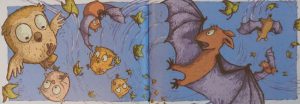
though mother owl soon has her youngest offspring back where she wants, beside her and all is peace and quiet. But when the chips are down and disaster strikes in the shape of a storm,

differences don’t seem to matter – co-operation is now the name of the game.
This book works on so many levels and is open to a multitude of interpretations. We often talk about the power of words: here, picture power rules.
What a wonderful demonstration that reading is about so much more than getting words off the page.

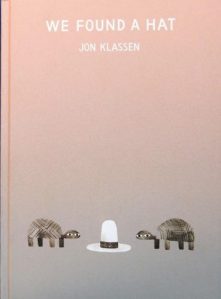
We Found A Hat

dscn8926

We Found a Hat
Jon Klassen
Walker Books
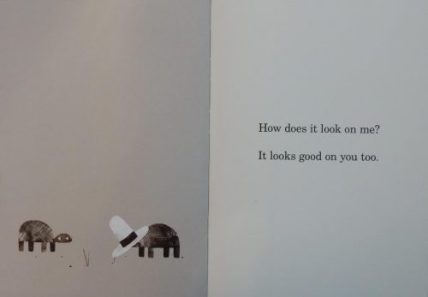
This, the concluding book in Klassen’s “Hat’ trilogy is delivered in the artist’s dead pan style. Longer than the previous two at 56 pages, and divided into three chapters, it features two turtles and just one hat – an exceedingly large one – for turtle heads, that is. Each in turn tries it on and reach one conclusion: It looks good on both of them.

%0a

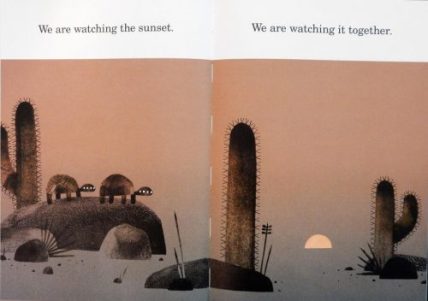
Rather than have a bust-up, the two walk away to watch the sunset from a nearby rock – together.

dscn8928

One starts thinking about the sunset – so we’re told; the other starts thinking about you know what …
Night falls and the two prepare to sleep. One turtle starts moving downwards in the direction of a certain article of headwear … The second dreams – of stars and identical hats, one for each of them. Hmm: now what?

%0a

Seemingly that’s for readers to decide as they relish the subtleties in this Klassen finale. With its spare text and slow-moving visual action – it’s entirely a case of showing, not telling here –
and they are turtles after all. What’s going on behind those eyes? That is the key.
Rendered in sombre hues with a gradual fading out of the soft orange as the sun finally sinks, this is desert dryness in more senses than one.

WNDB_Buttonlocalbookshops_NameImage-2

Secrets of the Sea


Secrets of the Sea
Eleanor Taylor and Kate Baker
Big Picture Press

It is in the oceans that all life on Earth began, yet they are one of the least explored and least understood places on the planet.’ So writes Kate Baker in her introduction to this stunningly beautiful book that takes us from ‘In the Shallows’, through the ‘Forests of the Sea’and the ‘Coral Gardens’, into ‘The Wide, Wide Blue’ and down ‘Into the Deep’.
Venture beneath the waves and there’s an amazing variety of plant and animal life from single celled organisms such as ‘Sea sparkle’ …

to the Giant pacific octopus an enormous cephalopod that resides in the depth of the ocean and has an armspan of up to 4 metres. Not all octopus species are deep sea dwellers though: Coconut octopus is to be found in the shallows of tropical waters. This amazing creature is able, we’re told, to hide itself not only by changing its colour, texture and form to blend in with its surroundings, but also it can pick up an empty coconut shell, crawl inside and hide. Unsurprisingly it is considered the ‘master-mind’ of invertebrates.
Dive down to the kelp forests and discover minute algae and other fascinating creatures like this Hooded nudibranch:

The coal reefs are home to almost 25% of marine life much of which is brightly coloured such as these Pygmy seahorses …

It’s in the open oceans where such as the Sea angel can be found. This graceful dancer is a predatory sea slug, another deadly hunter …

Dive deeper and at depths of about 2000 metres are thriving communities of squat lobsters, white crabs, mussels, snake-like fish, anemones and these giant tube worms …

This is a book that opens the eyes to the staggering beauty of marine life in all its forms. Every illustration is a celebration of the wonders of the oceans and focuses on the intricate shapes, structures, patterns and colours that are revealed when the marine flora and fauna are examined in extreme close-up. Kate Baker’s accompanying text provides a broader picture describing habits and habitat of each organism and some basic facts including Latin name, size and other fascinating snippets of information.

localbookshops_NameImage-2

Fun and Games / Migloo’s Weekend

dscn8754

Fun and Games
Alain Grée
Button Books
This is chock-full of playful activities –over 50 altogether – all devised and illustrated by artist Alain Grée. There is something that should appeal to a wide age range from around 3 up to 6 or 7. Each activity is given a single page printed only on one side and glued so that it can be removed for use. There’s a variety of matching games, find the odd one out, true or false games, calendar cubes, spot the differences pages …

dscn8756

and other games to develop visual perception as well as activities that entail cutting, folding and creating objects including a tiny puppet theatre

dscn8757

and a sentry box. You can even make a stand-up Santa chain.
All the pages are attractively presented and full of details that are the hallmark of Alain Grée’s illustrative style. It’s just perfect for indoor days and likely to keep a child or two engaged for hours at a time. An ideal diversion from endless screens too.

dscn8930

Migloo’s Weekend
William Bee
Walker Books
A day spent in the company of dog, Migloo and his Sunnytown friends is tiring: a whole weekend is totally exhausting, from an adult perspective as least. Youngsters tend to delight in rushing from one venue to another and there’s plenty of that herein. We join Migloo as he accepts a lift in Noah’s fish van and head for the market where Mrs Luigi has just opened a new café but it doesn’t look as though he’s going to be served any time soon judging by the queue, so off they dash to the farm instead. That too is very busy, but Farmer Tom has plenty on offer: Migloo’s spoilt for choice.

%0a

Appetite sated, the next stop is the museum, followed by the cinema to watch the latest movie, and guess what – that too is action packed. After all the fun, it’s bedtime for Migloo and all his pals. Phew!
Sunday is equally busy and Migloo manages to pack in a visit to the car races and a funfair extravaganza where he gets involved in an exciting rescue of a film star.
There are fold-out pages and things to spot aplenty; there’s even a spread called ‘Busy Page’, though I thought every page was pretty busy .
If you have or know children who like to be involved in a picture book that isn’t (despite what we’re told) a story, this could be just the thing. With plenty to explore and discuss, it’s likely to will keep youngsters amused for hours.

That’s NOT How You Do It!

%0a

That’s NOT How You Do It!
Ariane Hofmann-Maniyar
Child’s Play
Think how boring our lives would be if everyone did things in exactly the same way, but that appears to be how one of the characters in this charming story would like it to be. Meet Lucy; she’s an expert at pretty much everything from eating with a knife and spoon to gymnastics; she’s a pretty dab hand at painting and origami stars too.

%0a

In fact she seems to act as adviser on pretty much everything to all and sundry until, along comes Toshi. Now Toshi’s pretty confident in his eating and musical abilities; his moves are pretty cool too.

%0a

His art is awesome and it looks like he has a talent for paper folding. The only trouble is – for Lucy at least – his ways of doing are very different from hers; and THAT is what bothers her.

%0a

Eventually she can hold back no longer: “That’s NOT how you do it!” she yells at the newcomer as he completes this for her…

%0a

Now, it’s a case not of teaching but of learning where miss Lucy is concerned; she, it seems, has at last learned a vital lesson about understanding and celebrating difference. We all have so much to learn from one another.

%0a

That’s a lesson all children, and a good many adults too, need to take on board. It’s most definitely something teachers need to know as they start out, and to remember every time they present a new learning opportunity to a class or group. Such a hugely important message, so simply and charmingly delivered through the two delightful characters in this simple little story.

Handstand

dscn8968

Handstand
Lisa Stickley
Pavilion Books
If you’ve spent any time in a primary school during the summer term you’ll know that one of the crazes that unfailingly comes around every year is handstands. During playtimes, seemingly half a school population is endeavouring to perfect the art of handstanding. Now we have a storybook character doing just that; she’s the narrator of this quirky picture book and her name is Edith. It’s at home or in the park, not school where she’s honing her inversion skills though; watched – or more accurately, interrupted – by various creatures – a worm, a bee, a bird in flight, a spider …

dscn8966

none of which is happy about what she’s doing. Her “giant” hand was too close to the worm’s favourite ‘popping-up’ spot; her ear tricked the bee into thinking it was a flower; the bird, well he’s actually happier than the others as Edith provided useful ‘target practice’ for his flying poops. And the spider is shocked having ended up in her shorts when doing his ‘daily descent’.
Over the course of a week she goes from 1 second to 6 of ‘upsidedown-ness’ – the six being with a bit of support from Dad, who naturally has better things to do most of the time. By Sunday, Edith appears to have got this whole handstanding thing pretty much licked – in more ways than one …

%0a

I love the humour inherent in this tale of persistence and determination: Edith is a real cool cookie. I love too her various patterned outfits and the way, Lisa Stickley has incorporated pattern into other elements of her funky artwork; and there’s a bit of counting too. A debut picture book delivered with panache.

Time Now to Dream

%0a

Time Now to Dream
Timothy Knapman and Helen Oxenbury
Walker Books
Alice and younger brother Jack are playing ball when they hear what sounds to them like ‘Ocka by hay bees unna da reeees’. They stop playing and follow the sound into the nearby forest – Jack more than a little reluctantly for he’s worried it might be the Wicked Wolf. Hand in hand they go and soon hear another sound …

%0a

which troubles Jack all the more: he’s now thinking about the waiting claws of that Wicked Wolf. “Shhh, … Everything is going to be all right.” comes Alice’s assurance as on they go, creeping now. More sounds … Jack’s convinced they’re lost and is talking of ‘snap-trap jaws’, and his warm snuggly pyjamas.

dscn8948

The sound gets closer and now it’s Alice who’s frightened …

%0a

Jack however is rooted to the spot, transfixed by what he sees and hears: not a wicked wolf but a motherly one. To reveal what she’s doing would spoil the story but try saying slowly out loud those words that drew the children into the forest at the start.

%0a

Timothy Knapman controls the pace of his story with supreme skill; not a word is redundant in his narrative. Helen Oxenbury’s painterly watercolours of the forest capture the essence of its fairy tale spirit at once mysterious, misty, shadowy and sun-dappled …

%0a

and of the children, Jack and Alice, the timeless joys of childhood and the power of the imagination. This surely is bedtime picture book perfection.

WNDB_Buttonlocalbookshops_NameImage-2

Nothing Can Frighten a Bear

%0a

Nothing Can Frighten a Bear
Elizabeth Dale and Paula Metcalf
Nosy Crow
The title claim may hold true for most bears but Baby Bear in this rhyming tale is more than a little alarmed when he’s woken by an enormous roar. It’s a monster, he decides, and calls for help. His parents do their best to reassure him but Baby Bear insists on an exploratory search to rule out any possibilities. Off stride the family – Daddy, Mum and three cubs marching through the trees with Dad in the lead confidently stating, “there’s no monster there. And anyway, nothing can frighten a bear.

%0a

But as the journey continues and the group encounter various creatures – none of them monsters – the number in their party starts to diminish. First Mum gets tangled in a tree, then Ben falls in the stream,

dscn8971

young Grace is stuck in some oozy mud leaving just two – Daddy and Baby. Suddenly they realise they’re alone. Could the others have gone back home or has a monster got them?
Youngsters delight in being in the know while Dad and Baby panic, first at that possibility, and then at the sight of what is right there in the moonlight …

dscn8972

Dad’s not looking quite so fearless now … and it’s left to Baby Bear to do the reassuring. Then it’s a case of back to bed but is that the end of those noises in the night?
Elizabeth Dale’s narrative bounces along nicely and Paula Metcalf catches the humour and mock scariness so well in her nocturnal scenes of the alternately fearless and fearful bear family: it’s all in the eyes and the body language.

Time for a Poem

%0a
Jelly Boots Smelly Boots
Michael Rosen and David Tazzyman
Bloomsbury Children’s Books
I’m not sure who has more fun when it comes to Michael Rosen and poetry – the author or the children who read or listen to, his offerings. For this collection of over seventy rhymes, wordplays and musings including a sprinkling of ‘dustbin poems’ he has a new illustrator in the wonderful David Tazzyman; and as always it’s a cause for celebration. Rosen has the unfailing knack of drawing children in to his language meanderings and showing them what pleasures poetry has to offer. Try ‘Question Mark’ for starters …

%0a

or Mm? which begins thus: ‘Can you cancan on a can?/ Can you carwheel on a cart? / Will you whistle in the wind? ? Have you heard it in your heart?

%0a

I suspect this is going to be another of those collections where an adult chooses a poem, reads it to a class or group and is immediately asked for another and another and … Enough said! Try it and see.

%0a

Topsy Turvy Animals
Wes Magee and Tracey Tucker
QED
A plethora of animals pursuing unlikely pastimes are presented by poet Wes Magee in this crazy rhyming world where there are somersaulting tigers, stilt-walking meerkats, a cartwheeling moose and a pair of macaws that must be tired of life judging by where they’ve chosen to perform their ablutions …

dscn9036

And this poor cat is the unexpected recipient of a very large splat …

%0a

Tracey Tucker animates all this madness and more with riotous, appropriately garish scenes in a variety of settings – icy, sandy, rocky, mountainous, jungly and grassy.
The main messages children will pick up here are: that language is fun; and that if you give full rein to your imagination, anything can happen …

If like me, you believe that nursery rhymes should form the bedrock upon which a child can build a love of poetry, then this beautifully produced book may be of interest.

dscn9066

Classic Nursery Rhymes
illustrated by Dorothy M.Wheeler
Bloomsbury Children’s Books
Time was that the 29 rhymes contained herein were known by almost all young children starting school or a nursery class; sadly, that’s not so nowadays.
Children’s Laureate Chris Riddell has written the foreword for this centenary publication of rhymes with art work  by Dorothy M. Wheeler whose claims to fame include being the illustrator of some of Enid Blyton’s books such as The Magic Faraway Tree. Her highly detailed watercolour illustrations for this book evoke a bygone era …

%0a

when the rhymes were learned on a mother’s or grandmother’s knee and perhaps sung around a family piano. (The second part of the book contains music for each rhyme.)

Arthur and the Golden Rope

%0a

Arthur and the Golden Rope
Joe Todd-Stanton
Flying Eye Books
From the trailing golden rope on the cover of this beautifully produced book (it is Flying Eye after all) you know you’re in for a treat. From the enormous beast snarling at you even before you start reading, you know there’s going to be much to excite. It’s a wondrous tale of myth and magic – the first of a series so I understand.
We begin in the family vault of one Professor Brownstone, who is a kind of custodian cum storyteller and indeed it’s he who acts as the narrator of the very first tale in his treasured collection, that of Arthur “the unlikeliest of heroes.”

%0a

Arthur was an Icelandic boy independent, brave and always up for a challenge. Which is just as well, for having been accused of being a meddler and probably responsible for his town being terrorised by the monstrous black wolf Fenrir, the lad embarks on a dangerous quest to visit the hammer wielding Viking god Thor to enlist his help in saving the town from total freeze-up.
That’s only the beginning though. A deal is struck …

%0a

and Thor dispatches Arthur on a challenging mission to secure two vital ingredients needed in the creation of the Golden Rope of the title, an object necessary to overcome Fenrir and rekindle the town’s fire.
Sumptuously illustrated, rich in detail and a fusion of graphic novel, picture book and comic, this is a true celebration of the power of story, the oral tradition and in particular myth to grip the reader and hold them spellbound. It’s so cleverly executed in the way it moves from wordless comic strip …

%0a

to intricately detailed spread with Arthur teetering on ladders as he does his research, there’s even a spell emanating from an open book on the floor …

dscn8804

It’s a book for pausing and losing oneself in the detail of the visual images and then letting the direct telling move us forward to what comes next.
For those readers wanting something sophisticated without too much text Arthur’s tale is pure gold. For those who enjoy a great story, ditto. Let’s just say, Joe Todd-Stanton and Flying Eye (yet again!) have struck gold with this one.

WNDB_Buttonlocalbookshops_NameImage-2

Wings! / Bertie Wings It

DSCN8709

Wings
Paul Stewart and Jane Porter
Otter-Barry Books
Paul Stewart, co-creator of the wonderful Edge Chronicles series turns his hand to picture book writing and has teamed up with Jane Porter; the result is a picture book that celebrates friendship, determination and discovering your own talent.
It’s the Great Gathering of Birds and everyone is there having fun, until that is one of their number shouts, “Last one to the top of the tree’s a rotten egg!” With that the whole gathering takes to the air, all except Penguin. The poor fellow is left all alone and it’s not the first time. Time to teach himself to fly, thinks Penguin but try as he might his feet remain well and truly grounded, despite the help of some of his friends.

DSCN8710

Emu, Kiwi and Ostrich can’t see what all the fuss is about; they much prefer to walk but Penguin remains determined. Owl steps in and offers a spot of coaching but all penguin perfects is running, jumping and flapping. Seemingly nothing can get our penguin pal airborne – or can it? Wait a moment … what’s that string for?

DSCN8711

Oops. Is this the end of Penguin’s flight then?.

DSCN8712

Not quite: there IS one place where those wings of his can be put to good use …

DSCN8713

Jane Porter’s richly coloured mixed media collage pictures are full of humour and pathos: her love of birds shines through in every one.

%0A

Bertie Wings It!
Leslie Corin and Brendan Kearney
Sterling
Bertie knows it’s time to fly the nest. He’s all prepared and the sun is shining: “Today is the day that I fly!” he announces stepping, wings a-tingle, to the edge of his nest. That’s when things start to go wrong.

DSCN8705

Seemingly every other bird around has opinions as to how it should be done. Bertie listens attentively to their input and some time later, he’s ready for the off; he now looks like this …

DSCN8706

and there he goes … Uh-oh!

DSCN8707

That’s not quite the end though: Bertie picks himself up and suddenly he feels freer. Now he KNOWS for sure exactly what to do and this time, he’s going to stay true to himself and follow his own instincts.
A fun look at what happens when you stop trusting yourself and start listening to everyone else’s opinions instead; and a good starting point for discussion.

Animals, One Cheetah One Cherry & Flip Flap Pets

%0A

Animals
Ingela P Arrhenius
Walker Studio
This over-sized picture book by Swedish illustrator/designer Arrhenius is sure to have youngsters poring over its gigantic retro-style pages. It features thirty two animals large and small from grasshopper …

%0A

to gorilla, and hippo to frog …

%0A

Every one of the pages would make a lovely poster and it’s hard to choose a favourite animal: I love the muted, matt colours used and the careful placing of pattern; and the lettering fonts and colours seem to reflect the essence of each animal portrayed.

%0A

If you’re looking for something impressive to generate language in youngsters, try putting this book on the floor in your book area and see what happens.
It might also be put to good use in an art lesson for older children.

%0A

One Cheetah, One Cherry
Jackie Morris
Otter-Barry Books
Absolutely stunning paintings of wild animals grace the pages of this stylish, smallish counting book. We start with ‘One cherry, one cheetah’ showing a graceful beast with a luscious-looking cherry between its paws and continue, encountering two dogs, three bears, four foxes …

%0A

five elephants, six tigers, seven pandas, eight otters, nine mice, ten cherries – all carefully poised, thus :

DSCN8682

which takes us back (numberwise) to None. The cheetah has feasted on those ten delicious cherries and looks mighty pleased about it.
What a wonderful array of animals and activities. The language too is so carefully chosen: alliteration abounds as here: ’Four fine foxes/ sharing strawberries.’
or, try getting your tongue around this one: ‘Seven giant pandas, with pretty painted parasols.’

%0A

Such delicate patterning on those parasols and lantern. Indeed pattern is part and parcel of every painting, so too is gold-leaf; but that’s not all. The end papers are equally gorgeous, the front being a dance of numerals, orchestrated by the cheetah and the back shows the number symbols in order with animals/cherries alongside.

DSCN8591

Flip Flap Pets
Axel Scheffler
Nosy Crow
Axel Scheffler offers a multitude of opportunities to create quirky creatures in his latest Flip Flap rhyming extravaganza. Youngsters can turn the basic ten or so popular pets into a whole host of crazy combinations of feather, fur, scale, shell and more. What happens for instance when you cross a stick insect with a budgerigar? You get a STICKERIGAR of course …

DSCN8593

Try crossing a goldfish with a tortoise – that results in a GOLDFOISE:

%0A

and a snake crossed with a cat gives something pretty irresistible – a cake!
It’s possible to make – so that butterfly on the back cover of this bonkers book informs us – 121 combinations. What are you waiting for? If my experience of previous titles in this series is anything to go by, this new addition to the series is likely to inspire children to set about making their own flip flap books.

WNDB_Buttonlocalbookshops_NameImage-2

I Am a Very Clever Cat / Two Can

DSCN8750

I am a Very Clever Cat
Kasia Matyjaszek
Templar Publishing
With such an arresting cover, this book will be hard to resist. Its narrator, Stockon, is certainly not short on self-esteem: “I am a very clever cat,” he tells us by way of introduction and goes on to demonstrate some of his skills. His greatest claim to fame is his wizardry with a pair of knitting needles: here he is as he sets about creating the ‘fanciest scarf for the fanciest soirée.’

DSCN8751

Naturally being such a wiz with those needles though, Stockton has no need for a pattern: he just makes it up as he goes along. So super-confident is our wool worker that he is completely oblivious to what’s happening while he talks until …

DSCN8752

Seems his chances of strutting his stuff at that soirée have just taken a tumble.
How fortunate it is that all the while, his antics have been watched by a pair of mice; can they perhaps save the day?

DSCN8753

Stockton may have dropped a whole lot of stitches but he’s certainly picked up a couple of pals, very clever ones at that, in the course of his knitting capers.
I’m sure those capers will win him a whole lot more friends among young listeners (and adult cat lovers) who will delight in the interplay between words and pictures in Kasia Matyjaszek’s funny debut picture book.

%0A

Two Can
Smriti Prasadam-Halls and Ben Javens
Frances Lincoln Children’s Books
What a cracking little book! Using just 29 words, its creators explore a whole range of emotions. Small children at play in a park demonstrate playing solo, playing apart and playing together, occasionally falling out …

DSCN8759

sometimes co-operating, sometimes empowering …

DSCN8762

or encouraging and concluding (almost) …

%0A

SO simple, so clever and SO effective. Perfect to share with one, with two or with a few …
It’s equally perfect though, for beginning readers to try for themselves: what an ideal opportunity to say, “I can” therafter.

The Star Tree

%0A

The Star Tree
Catherine Hyde
Frances Lincoln Children’s Books
A tender lyrical story of a flame-haired girl, Mia who makes a Midsummer’s night moonlit wish.

%0A

It’s a wish that launches her on an amazing magical journey by air, sea and land, a journey made possible by a huge owl,

%0A

a Little Red Hare …

DSCN8768

(look at the toys on Mia’s window sill), Big White Bear and his air balloon and, Giant Stag. It’s he that takes her up to the top of the high hill upon which stands the Star Tree shimmering and sparkling in the night. From it Mia takes one small star …

%0A

and clutching it to herself, boards the waiting Great White Goose and flies homewards ‘along the river’s silver pathway. / Up and over the drowsy land, over the hills, / over the church with the blunted vane / that barely stirs in the still air.’ to her bedroom wherein something else truly magical awaits her …
Breath-takingly beautiful illustrations and equally magical words meld into a spellbinding reading experience. Every one of Catherine Hyde’s atmospheric paintings has a mesmeric quality, which transports readers – particularly this one – to those other worlds of the imagination where anything and everything is possible. On subsequent readings try letting that happen; focus on one scene, pause and release your mind for a while before continuing Mia’s journey with her.
A perfect bedtime share; but equally a story to read at anytime; and a wonderful demonstration of how visual and verbal artistry can work together as a truly harmonious whole.

WNDB_Buttonlocalbookshops_NameImage-2

The Road Home / Hocus Pocus, It’s Fall!

%0a

The Road Home
Katie Cotton and Sarah Jacoby
Frances Lincoln Children’s Books
What a beauty this is: Katie Cotton’s gentle cadences combine with picture book artist Sarah Jacoby’s atmospherically beautiful illustrations to create a memorable evocation of the approach of winter.
Fly with me to far away, / where sun still warms the ground. / For winter’s in the dying light/ and in that windswept sound.’ the mother bird says to her young one as they prepare to leave the safety of their nest and undertake a long, arduous flight together.

%0a

It’s a flight that will take them and readers on a meditative journey as a mouse builds a nest for her little one and rabbits flee from wolves hunting their prey.

dscn8728

Yes, nature is hard, brutal at times, and this is no cosy picture woven here from words and pictures; rather it’s a powerfully gripping contemplation of the contrasting harshness and stark beauty of life in the wild ‘This road is hard, this road is long.’ we’re told over and over, but at the same time it’s a reassuring one: ‘ … we are not alone. / For you are here, and I’m with you … / and so this road is home.
The impact of this book is slow-burning: it’s an impact that grows with each re-reading, with the words and landscapes lingering in the mind long after the covers have been closed.

dscn8391

Hocus Pocus, It’s Fall!
Anne Sibley O’Brien and Susan Gal
Abrams Appleseed
The same partnership that brought us the lovely Abracadabra It’s Spring! has moved the focus to the autumn, as it’s called in the UK. It’s the time when the long summer days are already getting shorter, the temperature starts to drop, the leaves are just beginning to get those tinges of orange and gold and school opens once more. Everywhere are signs of change: seed pods burst scattering an abundance of feathery ‘clouds’…

dscn8393

birds get ready to fly to warmer climes and the trees are glowing in a multitude of glorious colours.
In a short time, ‘Chilly gusts/ toss leaves around. / Shazam!‘ And a carpet of leaves covers the ground just waiting for children to frolic and kick them skywards. What joy!

%0a

This is the season for squirrels to start laying away food for their winter store, there’s an abundance of delicious fruit to be picked and cooked …

dscn8395

or hollowed and made into pumpkin faces. Some animals curl up in their burrows for a long sleep and we humans dig out our warmer clothes and delight in all the season brings…
All of this is celebrated in pictures verbal and visual. Eleven gate-folds open up to reveal Gal’s glorious extended scenes to delight the eye and complement O’Brien’s exciting rhyming text.

The New Libearian / Goldilocks and The Three Bears

DSCN8558

The New Libearian
Alison Donald and Alex Willmore
Maverick Arts Publishing
It’s storytime at the library; all the children are ready but somebody is missing: Miss Merryweather isn’t there. The children search – they follow the footprints or rather, the tracks …

DSCN8559

and come upon some rather unsettling clues that take them to …

DSCN8560

Several of the children are wary but when the new ursine librarian agrees to read them a story and a scary one at that, they are well and truly won over …
But then who should appear on the scene but Miss Merryweather herself and her story is an old favourite, Goldilocks and the Three Bears; the only trouble is there seems to be a character missing.
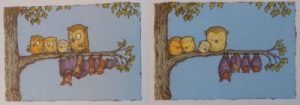
DSCN8562

Now where might Baby Bear have got to?
Well of course, we all know the answer to that one, but it’s not quite the end of the story … I won’t spoil that though. Get yourself a copy of this Three Bears-inspired tale of mischief and the magic of story sharing, that is also a celebration of our wonderful libraries and those who work therein.
Alex Willmore’s illustrations are enchanting and that growling, stomping, roaring bear is guaranteed to be a winner with both listeners and readers aloud alike.

On the subject of Goldilocks and the Three Bears it’s great to see Andersen Press have brought out a 40th anniversary celebratory edition of this wonderful rendition by master illustrator, Tony Ross:

%0A

Just look at his unforgettable portrayal of Goldilocks sampling porridge from ‘the largest bowl’ …

DSCN8577

If this super book isn’t in your collection, get it now.

WNDB_Buttonlocalbookshops_NameImage-2