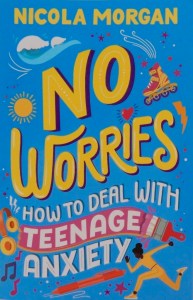
No Worries: How to deal with Teenage Anxiety

Expert on teenage well-being, Nicola Morgan has written a guide to help young people cope with anxiety, according to a survey, the most used word, so she discovered, used when talking about their health and well-being. Nicola’s advice is based upon the latest science and her formidable knowledge and understanding of what makes for a healthy and balanced teenager and she divides her latest book into three parts.

Part One is Anxiety and YOU, part two is called All About Anxiety and looks at what is happening in an anxious person’s body and brain, as well as the effects of anxiety. The third part offers Strategies and Solutions – obviously the most important section. Here you will find among other things, breathing strategies, mindfulness and meditation strategies and suggestions of practical ways to distract from worrying thoughts.

The book concludes with some anxiety experiences shared by people from their own lives and there’s a list of further resources.

Highly practical and written in a language that is both accessible and full of wisdom, this is a book I’d strongly recommend to all young people particularly if they are struggling with pressures and the resultant anxiety in their lives. Assuredly one to add to a teenager’s bookshelf; it’s packed with helpful information and advice.

Welcome to Wild Town

Welcome to Wild Town
AF Harrold and Dom Conlon, illustrated by Korky Paul
Otter-Barry Books

Have you ever wondered what it means to be truly wild? No? Then you really should pay a visit to Wild Town, for which Korky Paul has provided a map to peruse before arrival. Like the poems, the town is organised into several areas or sections and having, like Dom Condon, signed The Wild Agreement, readers are free to enter therein.

As a vegan, I’m happy to see that our first location is Herbivoreville. However after sampling several of the poems I’m not sure how relaxed I feel here, especially after reading Harold’s Wild Town Proverb #1: ‘A weed’s just a plant / growing in the wrong place. // Tell that to the fly-trap / latched onto / my face.

Playful, yes, as are The Rabbit’s Prayer and Dom’s Elephant Cleaner: ‘ The Elephants empty the bins in twos, / then wash he floors and clean the loos. / They wipe the tops with hairy mops – / one works hard whilst the other stops – / and yet the truth, I must confess, / is that they leave the house a mess.’

Moving on, the Fluttertown offers an opportunity to stay at Chrysalis Hotel, though after reading this in Harold’s description, “Squeeze in and relax // Relax so much you turn to mush – / become a soup filling the room.” I might just give it a miss and move on with some trepidation to the Carnivore Quarter, stopping only on account of Dom’s The Rule Breaker because I tend to be a rule breaker: here are a couple of the verses:’We crept outside when it was dark / We climbed the fences int he park / We did the things they said we couldn’t / We didn’t stop at things we shouldn’t . … We wouldn’t eat the food they grew / We wouldn’t learn the things they knew / We ran and played and sang out loud / We stood up tall and were not bowed’.

All manner of animals reside in this environment, significantly the lions and cheetahs – they feature in several poems; the ducks in Wolf Park are a pretty intolerant lot causing a to do on account of the streaker in Harald’s Going Green or A Worrying Sight in Wolf Park wherein you’ll meet a man who, so he says, has started photosynthesising. He’s so doing to save the planet.

Next stop is The Quiet Side of Town and there I loved He Lives on Slow Lane where in the final verse Dom says, “He’s the oldest of the wild ones / he’s the freest of the free / he’s the calmest in the forest / and he’s often called a tree.’ – a wonderful description of my favourite thing in the natural world, Wild Town or wherever.

It’s now time for Leaving Wild Town but first I certainly will do as Dom asks: ‘Let this landscape / draw itself upon your skin / marking the heart // with an X’. That shows just how much this reviewer has enjoyed a foray into such a special place where both the verbal and visual pictures leave an indelible memory. May the wild go with you too.

Shifty McGifty and Slippery Sam: Train Trouble

It’s almost impossible to believe that this is the tenth anniversary of the robbers turned bakers/cum mystery solvers, Shifty and Sam. Now the delightful dogs are off to bake on the deluxe train, The Pawrient Express, destination Venice for Carnival Night.

Little do the duo know but their old adversary, Kitty Claw, is also aboard the train ,masquerading as a porter. However just as the pooches have served supper – of their very highest quality of course –

out go the lights and there comes a cry, “I think we’ve been robbed!”. That’s when they realise the identity of the thief.

The chase is on; but manipulating a gondola through the carnival crowded canals is difficult as they pursue Kitty on water, and then on paws through the city square

and even through the air. But can the dogs retrieve the stolen gems and will they be able to apprehend the criminal?

Tracey’s rhyming text bounces along in the jaunty fashion one has come to expect of this smashing series and Steven’s illustrations are as delicious and zesty as ever, whether or not they include any actual confectionery items.

An action-packed read aloud that fans will relish, and if you’ve yet to savour their canine capers, you are sure to be wanting more.

Keisha Jones Takes On The World / Stink: Superhero Superfan

Having learned of her Great Aunt-Bee, a lawyer and activist, from her Grandpa Joe while he was hiding away to avoid the celebrations for his 70th birthday, Keisha decides that she too will become an activist, standing up for equal opportunities, striving to fight against injustice and making the world a better place; and she’ll do so in memory of her aunt.

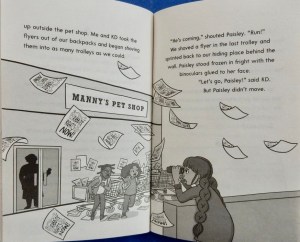
To help her in her endeavours, she shares her plan with her best friends Paisley and KD and together they form the Bee Squad in honour of Aunt Bee. She also asks the advice of her teacher who suggests she look for an issue of concern in the town and go from there.

Now being a spirited girl with a big heart, Keisha can’t wait to get started. So, after school when she accompanies her Dad to Manny’s pet shop and sees that the cost to buying a male rabbit is double that of a female, she realises that she has found the Bee Squad’s first cause. She dismisses the owner’s reason for this disparity and spends the next week working on a Rabbits’ Rights plan.

With a promise not to cause any more trouble in the pet shop, she enlists the help of her Aunt Marie who, not knowing what’s about to happen, takes her fellow activists and her younger brother back to Manny’s Pet Shop and carries out her rather outlandish stratagem.

A fair bit of mayhem ensues. But that’s not quite the end of this story, though I will add that our young hero’s indomitable spirit results in her declaring, “ justice for female rabbits was served.”

It’s great to have empowering characters like Natalie Denny’s Keisha in stories for young readers and with Chanté Timothy’s zesty illustrations to bring the world of Keisha to life, this is a book to encourage primary children to stand up for what they believe in.

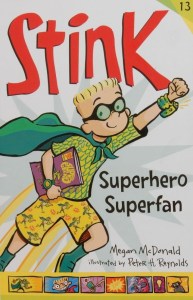
In this thirteenth story Stink is super-excited when he learns that the next topic for his Saturday Science Club is superhero science. Immediately he starts imagining himself in a cape with the titular words emblazoned across it.

Returning home full of enthusiasm, he finds his family sorting things to put in their yard sale and he adds some of his own items.

Next day at the sale, Stink discovers a box full of old comic books about Super Gecko, a superhero he’s never heard of: What could be more fantastic – GROOL in fact – than a part-man, part-lizard with superpowers? Moreover, said superhero has a sidekick, Gecko Girl.

Then Stink hears that there are real geckos in his vicinity and he and his pals decide to go and investigate the creatures that very evening. The hunt yields no geckos but they do find a note supposedly from Super Gecko – hmmm, mysterious.

Could it mean that Super Gecko is set to make a comeback? There is certainly a brand new Super Gecko comic book due to be published the very next Saturday. How will Stink manage his next Science Club meeting and getting to the bookstore to buy a copy before they run out, even if he can raise the money he needs for his purchase? Seemingly the boy faces much that will test his own deductive super powers; can he manage everything? Possibly, with the help of family and friends.

I love the gentle humour, the endearing characters and the mix of sleuthing and science; so too will young solo readers and listeners whether or not they have already met Stink et al.
April’s Garden

April’s Garden
Isla McGuckin and Catalina Echeverri
Graffeg

It is evident from the lack of bright colour in Catalina Echeverri’s first three spreads, that April is feeling downcast, living with her mum in a room in temporary accommodation. There is a garden – something Mum refers to as contributing to the ‘silver lining’ she keeps talking about, but it always seems to be raining, making her daughter feel even more confined.

When Mamma suggests drawing the garden of her dreams, April creates a colourful scene.
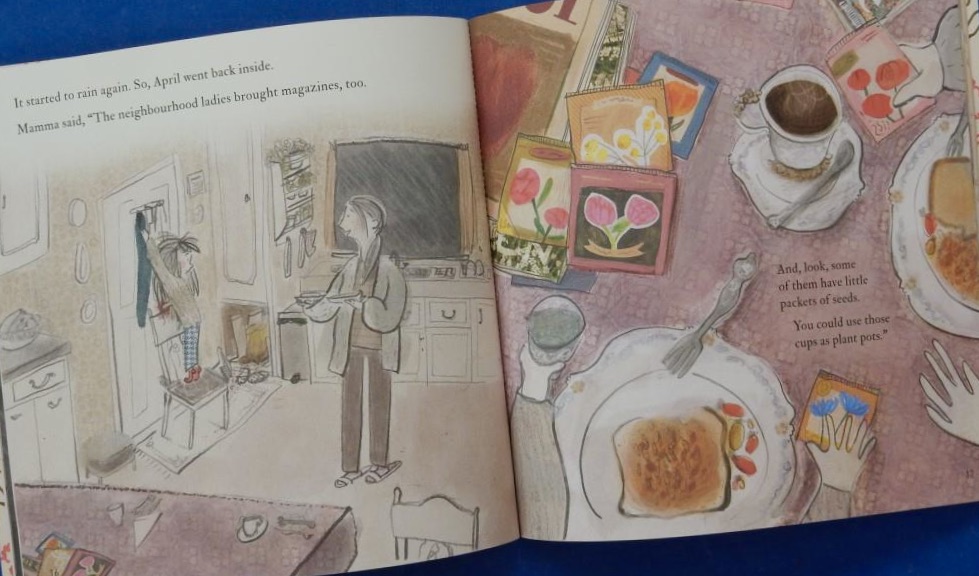
Eventually the rain stops and April heads outside for some fresh air, but it’s not long before down comes more rain so in she goes, to learn that attached to the magazines the neighbour ladies have given them. are some packets of seeds.

Despite the rain, April heads back outside with the seed packets and some cups. She plants the seeds and goes back inside. Then comes a long, long wait during which April, despite Mum’s words of wisdom – “Lovely things are just around the corner,” – feels more and more dejected. She rushes out into the garden to give vent to her emotions, after which she feels slightly less angry.

Some months later, it’s time for the two of them to move to their new home, With them they take all the cups with the seeds April had planted and joy of joys, she notices in them something is starting to sprout.

Finally, after several weeks, beautiful flowers are blooming in every cup: at last April is filled with happiness.

Hope is key in this moving, superbly and sensitively told and illustrated story of the healing power of nature, finding solace in the seeds and renewal.

Lionel is just like Dad / Look / Friend

These are recent Gecko Press publications – thanks to the publisher for sending them for review.

This celebrates the relationship between a father and small child, lion style.

Little Lionel closely watches his father’s every move, copying his actions carefully.
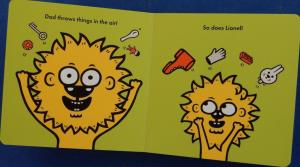
When Dad combs his hair. so too does Lionel, Dad taps his teeth, Lionel does the same, Dad scratches an itch, ditto Lionel, Dad sings a song very loud, Lionel reciprocates. Then after a brief break, Dad throws things into the air, Lionel does likewise; 

however something that Lionel throws falls on Dad’s head. with a THUNK! causing the parent to cry out in alarm, as does Lionel. Now Dad is not so impressed with his little one’s copying behaviour and they turn away from one another. After a think on Dad’s part and on Lionel’s the two go and hide themselves. Not for long though for all ends happily with forgiveness from Dad and hugs all round.

Charming, reassuring and a fun portrayal of a parent’s unconditional love. Ville’s seemingly simple illustrations show so clearly the emotional changes of both characters.

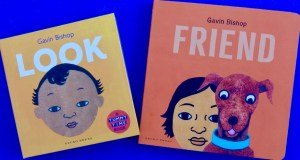
Essentially Look , a wordless concertina fold out, opens one way to reveal a sequence of ten faces, nine human and one a dog. Opened the other way, you find a series of seemingly random objects likely to be familiar to an infant – a bird, a bunch of keys, a doll, a ball, a pair of spectacles, a toy bear, a snail, a ship, a dog, a rabbit and a truck – each one simply depicted centre stage in bold bright colours.
Unfolding to almost 2 metres this simple ‘tummy time’ book is sturdily built to withstand the frequent use it might well get.

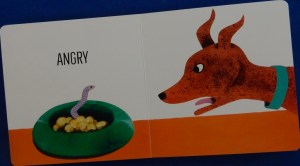
Friend features a child narrator – the owner of a dog – who clearly loves the animal , calling her ‘My best friend’ on the final spread. Words are kept to a minimum with four being the most on a spread, and several have just a single descriptive word: happy, angry, rowdy, sad, shy, each of which is mirrored in an expressive picture of the pooch.
Little ones will enjoy the sequence relating what unfolds when the dog discovers an unwanted visitor in her food bowl, 

expresses how she feels about it by howling at an adult, receives a ticking off from the girl causing the creature to tuck herself under the table for a while.

An opportunity for small humans to learn new vocabulary as they follow the action and interactions. showing that real friends don’t always need to say much; their expressions speak volumes.

Mason Mooney Supernatural Sleuth

Mason Mooney Supernatural Sleuth
Seaerra Miller
Flying Eye Books

This is the third and final story of the world’s greatest paranormal investigator, Mason Mooney.

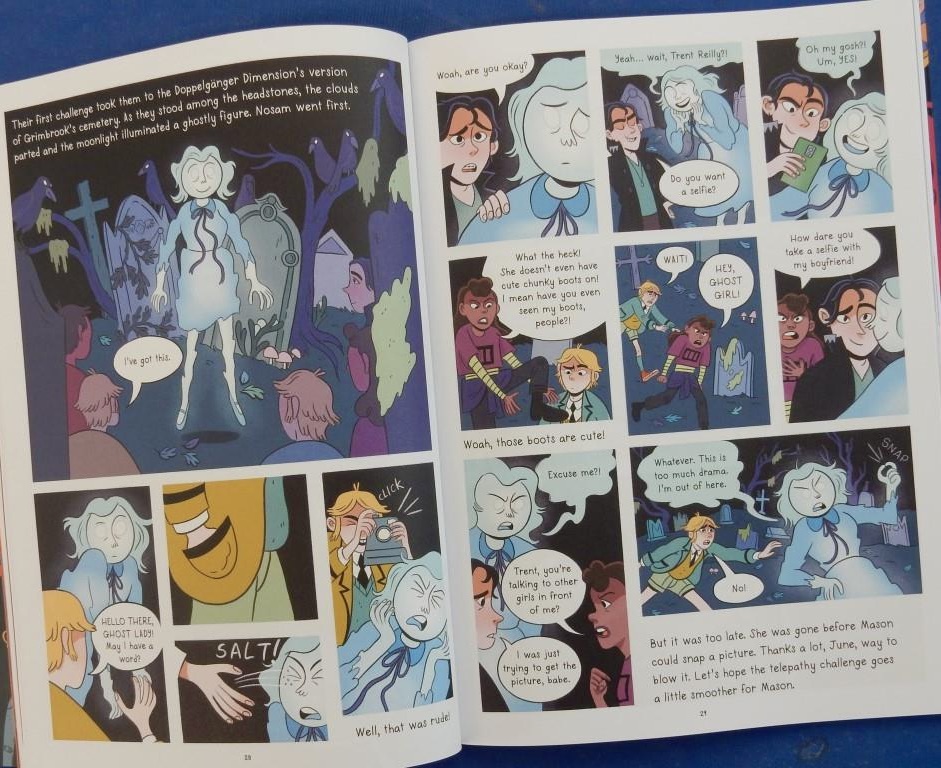
With his heart currently in another dimension thanks to Nosam, Mason’s evil Doppelgänger, Mason and his best friend, Iris, are bemused by the sudden appearance of pits around Grimbrook. Despite the foul stench, they realise they must follow the person who disappears through a manhole and enters a warren of underground passages.

Before you can say, ‘Emerald Palm’, the two friends are on a mission to get hold of the Hand of Glory before Talitha finds it and creates total havoc. However, Iris has just been handed a necklace – the only one available – welcoming her as a member of the Order of the Emerald Palm; this causes Mason to get a fit of jealousy, the two get separated and end up in different dimensions. Mason then faces a number of challenges against Nosam in order to obtain he thinks, the Hand of Glory.

However things go badly wrong for Mason. Then he meets Constance, chats and realises that only by overcoming his jealousy can he stand a chance of getting his heart back, finding Iris and saving Grimbrook. With nothing more to lose, your favourite investigator will give it his all.

Thoroughly engaging, fast-paced and presented with panache, this series finale will surely satisfy Mason’s followers.

Pick A Story: A Superhero + Mermaid + Dragon Adventure

Pick A Story: A Superhero + Mermaid + Dragon Adventure
Sarah Coyle and Adam Walker-Parker
Farshore

This is the third in the interactive picture book series that encourages children to read in a different way, inviting them to use their imagination and direct the route the story takes. Herein Sarah Coyle and Adam Walker-Parker have integrated a superhero, mermaids and dragons into a tale to recover an important drawing of a bicycle.

It begins as Davy is on his way to school proudly clutching his best ever picture for Show and Tell when suddenly the picture vanishes. Was the taker a superhero stuck for creative inspiration, a fiery dragon, marauding mermaids perhaps; and can any of these be of assistance in Davy’s search for the missing article?

Along with enjoying Sarah’s lively text with its word play aplenty and choosing the narrative direction, readers are invited to give thought to a number of questions that relate to the text and Adam Walker-Parker’s zany, eye-catching scenes: ‘What would you buy if you had five sea gems to spend?, ’What’s your super-cool handshake?’

and ‘What’s your favourite thing to do with a friend?’

Decision making is an important skill for children to learn and this story and the previous ones are a super way to foster this; with a diverse cast of characters, the book will appeal to a lot of readers. Add to family bookshelves and KS1 class collections – I wonder what might happen if two children read the book together?

Leif the Unlucky Viking: Saga of the Shooting Star

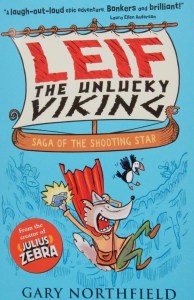
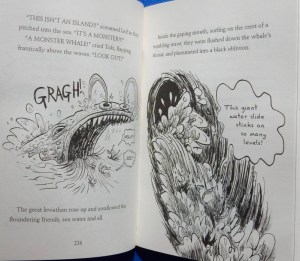
Leif is a little wolf pup of the Viking variety. Despite being small in stature, he has big dreams. he wants to be an explorer just like his dad, Eric the Red. However, it’s certainly not going to be plain sailing for there are certain things that might get in his way. First of all, he has a habit of tripping up, which means he splits his trousers on average once a week, and sometimes he even falls down holes. Far from an auspicious beginning for an aspiring explorer, albeit a determined one.

It’s his determination that leads him to attempt to unravel the riddles of a witch, find a rock shard fallen from a shooting star and then wield its magical powers. Now this journey won’t be smooth sailing but that’s not unusual for the best explorers; he will need to battle with snow and ice, enter polar bear country,

pit his wits against giants and trolls, as well as extricating the team from within an enormous whale-like creature with a top resembling an island,

not to mention sorting out his errant sister. All of which means he’ll need every morsel of luck he can get.
What he does have for company though, are Olaf the irritated duck, Toki, a foolish puffin and Flora the decidedly whiffy muskox Shame none of them is any good at map reading.

Prepare for one calamity after another as you laugh your way through this tempestuous tale, liberally illustrated with Gary Northfield’s comic book style drawings that serve to render his writing even more anarchic than ever. Utterly and absurdly brilliant.

Our Earth is a poem

Our Earth is a poem
Little Tiger

Another exciting collection of poetry in the publisher’s highly illustrated series, this time one that celebrates nature’s bounties through the work of twenty poets from different parts of the world, mini biographies of each being given at the end of the book, along with those of the four illustrators. Some of the work is familiar but it’s like encountering them anew, for each poem asks the reader to look at the familiar in a different way. Diana Hendry’s What Is the Pond Doing? (illustrated by Masha Manapov) particularly caught my attention having just returned from a walk that took me past a very large millpond surrounded by trees and vegetation. Here’s how her poem starts: ‘Wobbling like a jelly / Being a bucket for the rain / Sending flash-backs to the sun / Cheeking the sky . Giving the moon a bath , Letting swans, ducks and winter leaves ride on its back/ Licking the lollipop reeds’ …

Another poem – almost a prayer to nature – that I found particularly captivating today is Nature Nurtures by Jay Hulme. Here is the opening verse: Let me walk in forests, / and climb up all the trees; let me walk in fields, / and lean into the breeze.’ and the final one, “Let me make my promises / to stone and dirt and tree, / to give myself to all these things / that made humanity.’ Just beautiful. And what immersive and captivating colours Nabila Adani has used to illustrate this.

I have chosen to mention these two poems on this particular day but there isn’t a single poem that I wouldn’t gladly turn to and enjoy either for myself or share with a class of children; and each illustration too is deserving of close attention. With its kaleidoscope of colours used in the illustrations and verbal imagery that makes the reader ponder upon each subject, this is definitely an absolute must to add to home and class collections, to be visited and revisited.

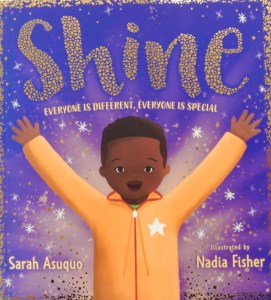
Shine

After the end of the summer holiday, Kai’s enthusiasm for returning to school and meeting his friends again, is quickly dampened on the very first day. The reason for this, he tells his mother, is because having participated in building a den, which he understood was for everyone, the other children told him he was too tall to fit inside. “I wish I wasn’t tall.” he says.
His mother responds, “Be proud my son, that you are tall; stand as high as you can be.” His height, she continues, enables him to see beyond what other children can. Yes, Kai is different in this respect but he should be true to himself, letting the special light that is within us all, shine through.

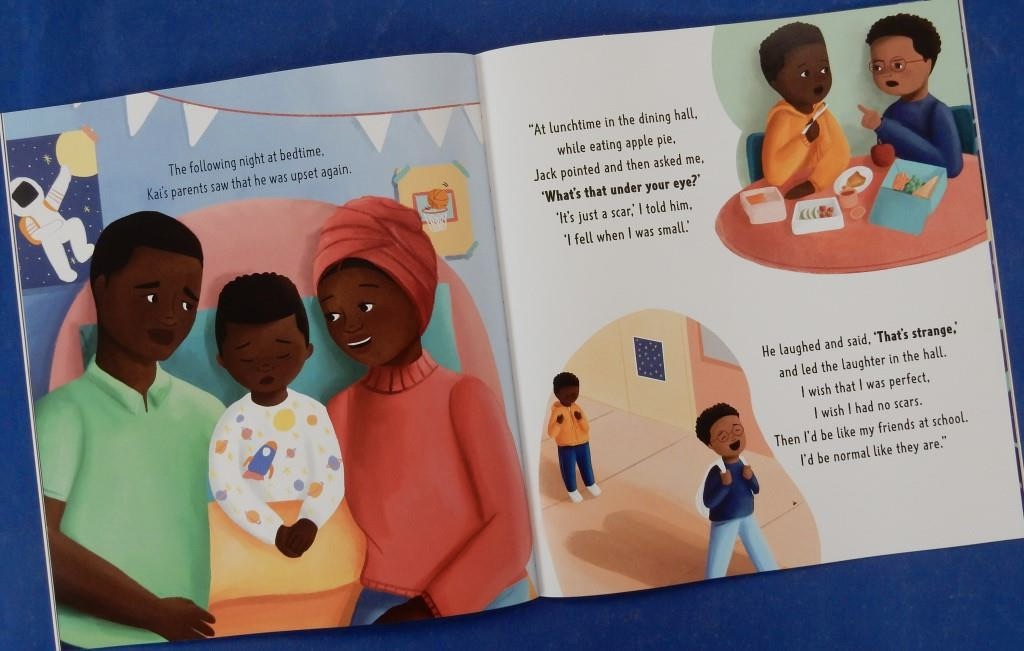
Next evening at bedtime, Kai is upset again, this time on account of being laughed at for the small scar beneath his eye. He feels this imperfection stops him from being normal.

Now dad speaks, gently telling his son to be proud of his scar for it adds to his shine. Then he opens the curtains and asks whether it’s possible to say that either the stars or the moon is best. ‘Everyone is different, son. You must be true to you. // Within us all is a special light. / Will you let yours shine through?” Kai nods in assent and then it’s time to say goodnight. The boy now realises that the very things that make him different also make him special.

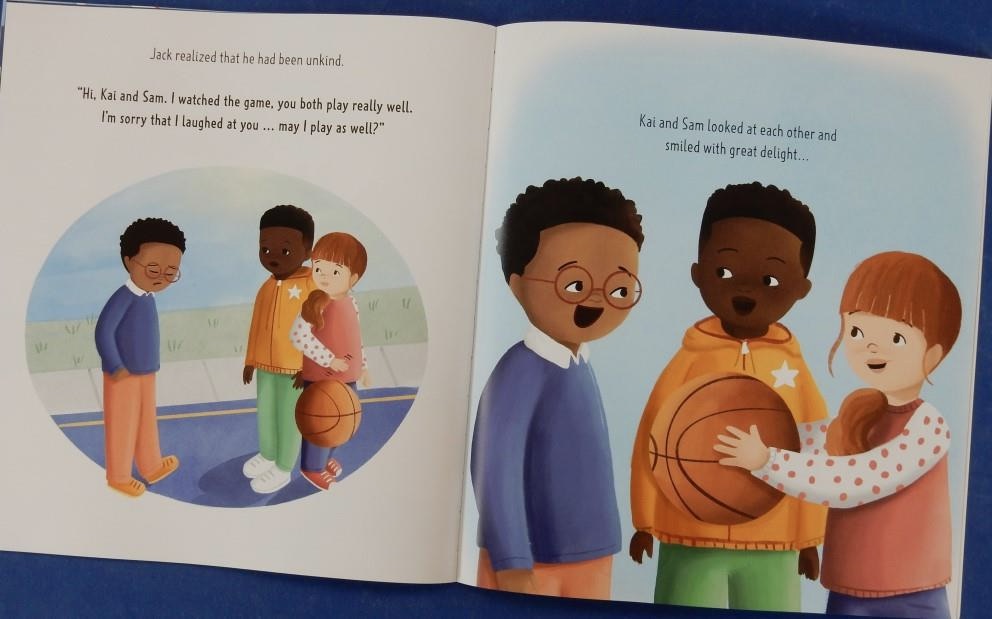
At school the following playtime, Kai’s friend, Sam, is upset: she had been told she was too small to join the game of basketball. Kai shares his parents’ wisdom , likening her speed when she plays to a shooting star. An ideal complement for his height – the perfect team. Moreover the two impress their classmates and the boy who had laughed at Kai’s scar realises that he needs to apologise for his unkindness.

Then when he asks to join their game, Kai’s affirmative response is “we all can shine if we just unite.”

Kai underwent a big change as, with his parents help, his low self-esteem was transformed into inner confidence, and an ability to understand the importance of both individuality and inclusivity.

Sarah Asuquo’s narrative is presented in prose and the text breaks into rhyme whenever a character speaks. Nadia Fisher’s mixed media, digitally worked illustrations shine a light on Kai’s feelings as he navigates the first week back at school and a steep learning journey.

Diary of an Accidental Witch: Stage Fright / Emerald and the Sea Sprites

Eleven year old Bea Black, resident of Little Spellshire returns for a fifth sharing of her journal.

Her Dad is now totally smitten with Taffy so home life is somewhat different.
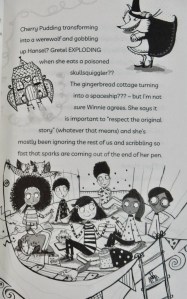
Excitement is high in Bea’s class at the School of Extraordinary Arts when Teacher Madam Binx, an ex actor – famous so she says – announces that the pupils are to put on a play and they have just a few weeks to prepare. The decision is that they’ll perform a very special version of Hansel and Gretel in front of the entire school, adapted and directed by Winnie.

After what seems like an age Winnie has finally finished writing the play and then come auditions for the various roles and every single member of Bea’s class wants to try out for a part. However acting is only one element of a performance; there is also the matter of a song and dance coordinator, stunt coordinator and assistant and a set designer. With all these tasks duly assigned and the cast chosen, it’s a case of work, work and more work. Some pupils will have to hone their ‘behaving like animals’ skills and Bea’s Dad is chuffed to be asked to make all the costumes.

How much spell making of the transformation kind is going to be involved in all of this? And with anywhere inside the school out of bounds following an unfortunate incident, whereabouts will this dramatic enterprise actually take place?

With Bea’s ever more endearingly earnest writing style and Katie Saunders’ even funnier illustrations, this is sheer delight from start to finish.

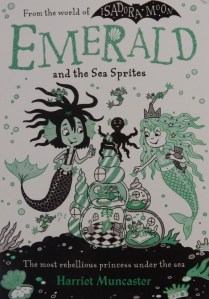
Emerald, a princess since her mum’s recent marriage to King Auster, is now spending half her time living in the palace and the other at her dad’s house on the other side of Scallop City. 

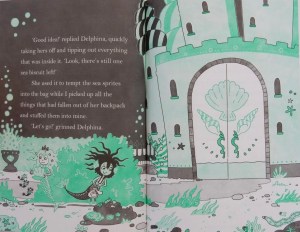
As this second story starts, she’s reading quietly when suddenly into the room bursts her stepsister, Delphina, wanting to play. It’s not long before Delphina has persuaded Emerald to go with her on an adventure to search for sea sprites, something that means sneaking out of the palace which is strictly against the rules. None the less, with backpack stuffed with the necessities for their mission, Emerald swims out of the palace, meets up with her stepsister and off they go into the deep open sea to a coral reef where they pause for a snack. It quickly becomes evident that sea sprites are just as fond of sea biscuits as the little mermaids.

After a playful encounter, Emerald realises it’s time to head back but the sea sprites start to follow them. 

Eventually, back in the palace, the little visitors settle into Emerald’s doll’s house where they spend the remainder of the evening all playing together. 

However, the following morning, the sea sprites look decidedly sickly and the little mermaids realise it was wrong to take them from their habitat. They must return them to the coral reef, but can they reach there in time to save the sprites? And if so, will they ever be able to see them again?

An enchanting story about letting creatures stay in their habitats, stepsisters bonding, and having the courage to do what’s right and kindness, that young solo readers, especially those who enjoy Harriet’s other series, will love plunging into. (I’d not read the Emerald and the Ocean Parade but it didn’t affect my enjoyment of this story.)

Doggy Dance Off

Doggy Dance Off
Steve Smallman and Robert Starling
Little Tiger

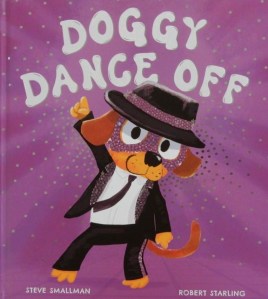
There’s plenty going on should you care to join the cool canines and pay a visit to the Doggy Dance Off. However, despite the flea-ridden Superstar DJ Patch who’ll immediately get you a’scratching, all disco dancers are having the time of their lives.

There’s golden retriever, Eva, the dance floor diva, Dynamite Doug, the body popping pug

and Duke Doggy Doo a punk rocker cockapoo bounding up and down kangaroo style. The newbie Lenny Labrador is so super-excited he leaves a puddle on the floor so beware should you feel like kicking your shoes off and joining the masked dancer that just can’t wait to perform the boogie woogie and several other show-stopping dances,

unaware of where she was putting her paws. However, despite her prowess, this masked marvel isn’t all she seems as a sudden slip sends her mask flying skywards, likewise her hat, and a splendid surprise awaits both readers and the movers and shakers at the Doggy Dance Off. Moreover should you subsequently pay this venue another visit, you’ll find it’s been renamed.

Steve’s rhyming text goes with a real swing when you read it aloud and coupled with Robert Starling’s funky disco dance scenes of the pooches strutting their stuff, you’re guaranteed a fun-packed time if you venture between the covers of this full-on canine caper.

One Little Word

This image has an empty alt attribute; its file name is dscn9676-3.jpg


Two friends are playing in the park when suddenly an unspecified incident happens between them. There’s face pulling, shouting and a monster appears – The Argument – that keeps on growing as the quarrel escalates and the two children separate. Still the beast grows involving all the other children and making the most of the situation to keep on getting bigger and bigger

This image has an empty alt attribute; its file name is dscn9677-3.jpg

until the two that triggered things stand face to face and the girl who is narrating gives the other one a nasty push, immediately resulting in her feeling ‘sad and angry, mixed-up and confused’. He retaliates with a push too and both children end up in floods of tears. Those tears prove cathartic and the two are able to exchange just one tiny but crucial word. The effect on The Argument is dramatic: it gradually shrinks

This image has an empty alt attribute; its file name is dscn9678-3.jpg

until it disappears completely and very soon the park is full of happy, laughing children once more.


This is absolutely brilliant, both verbally and visually. Allison Colpoy’s attention to detail is superb, capturing the changing expressions of the two protagonists and their concerned, supportive pals. Her colour palette is hugely effective in highlighting the emotional journey and accompanying physical changes of the engaging adversaries especially : what a superb complement for Joseph’s lyrical telling.

This terrific book needs to be in every primary classroom to be shared over and over, carefully considered and discussed. The potential of its impact is tremendous – like that of The Argument at its most monstrous.

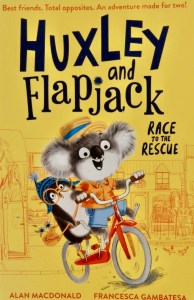
Huxley and Flapjack: Race to the Rescue

Koala bear, Huxley, who finds possibility in each new day, and his best friend, Flapjack, a penguin that worries rather a lot, share a tree house on the edge of the woods.

One morning a delivery from the postwoman includes notice of a new store opening in the town so they decide to go and pay a visit to this Jolly Goods establishment. It’s an enormous place and things are a tad confusing for the pals but Huxley quickly gets into his stride and enjoys trying out or trying on lots of the gear on sale. While the koala is deliberating what to spend his pocket money on, somebody on a skateboard whizzes past the pair.

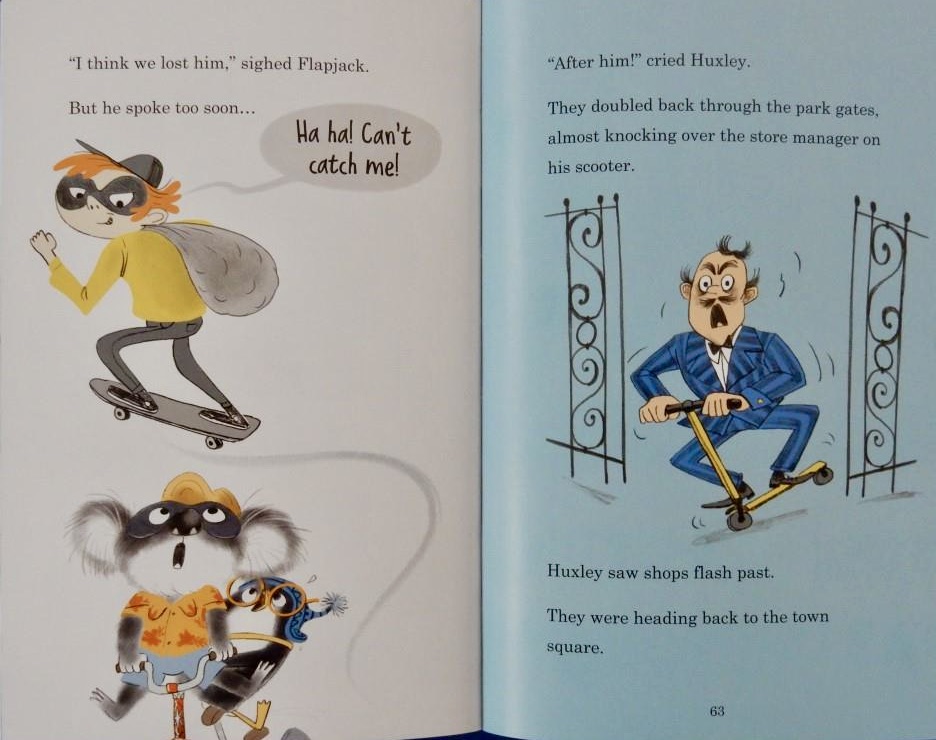
The bear eventually decides on an outfit that makes him look just like a superhero. Unfortunately though back comes the skateboarder wearing a mask just like the one Huxley has just bought, there’s a collision causing watches and jewellery to spill from his sack, and the skateboarder retrieves the goods, snatches away Huxley’s purchase and off he zooms.

There’s a case of mistaken identity by the store manager who thinks Huxley is a thief. Off pedal the two friends in pursuit of the person they’ve decided is the real thief, with the manager scooting behind.

A chase ensues through the town and eventually the pals are apprehended by the manger who takes them back to his office. Eventually a plan is devised to catch that actual skateboard thief but can Huxley and Flapjack outwit Fast Fingers Frankie and arrive home in time for tea?

A fast-moving fun story, ideal for new solo readers with zany, dynamic full colour illustrations by Francesca Gambatesa on every spread. I suspect this duo will gain lots of young followers who will eagerly anticipate their further adventures.

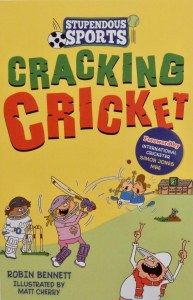
Cracking Cricket

Cracking Cricket
Robin Bennett, illustrated by Matt Cherry
Firefly Press

Written with humour and bursting with facts and advice on how to be an ace bowler, batter and fielder in any combination and much, much more.

The author begins with the history of the sport that includes some wacky theories about how it started, the favourite being that it was made up by bored shepherds some time between 1300 and 1600 – hmm! And like most of the chapters, this ends with a focus on a favourite player; there’s also one or more ‘cool quotes’ in each chapter. I particularly liked this from Stuart Broad, ‘people talk about cricket being an individual game, but I really don’t agree; everything is done in a partnership.’ and had to laugh at this said by Aussie, Greg Chappell, ‘ I can’t say I’m batting badly . I’m not batting long enough to be batting badly.’

We meet the members of a team – opening batters, the top, middle and lower orders, bowlers – fast and spin, the fielder (every team member must be one of those) and the wicket-keeper, and learn about the task of the nightwatchman (that name needs updating) and the joy of being an all-rounder.

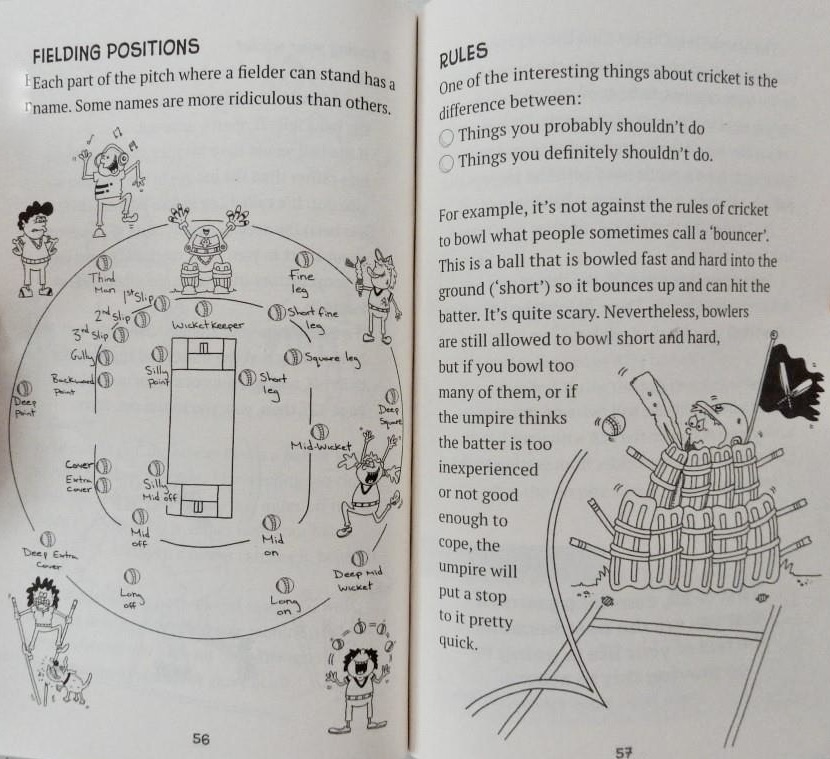
One thing I often get confused about is all the different fielding positions and illustrator Matt Cherry provides a helpful diagram of these, complete with several fielders.

There’s a chapter on skills and tactics, another on the future of the game that looks at diversity, masses of stats, plus explanations of key terms.

Wisden it isn’t, but it is a smashing little book (the 3rd in the Stupendous Sports series), for young readers be they players or not. I learned a lot despite being a keen follower of the game.

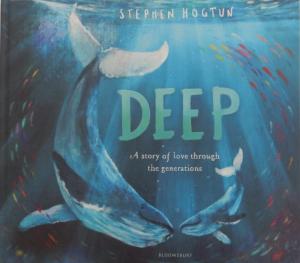
Deep

Deep
Stephen Hogtun
Bloomsbury Children’s Books

In this wonderful story we follow a mother whale and her little one from the time the infant takes his first breath. Guided by his mother, the calf learns to swim alongside her and is keen to travel without her, but first, mother and calf must take a long journey together. We accompany the pair as they head into the unknown on a swim that is sometimes stormy and challenging,

but with his mother close at hand to offer reassurance and protection, the calf learns to face his fears as well as see beauty in the peaceful nights they spend together.

Eventually of course, as it is for all mothers, she realises that it’s time for her offspring to set out and make his way alone in the world,

safe in the knowledge that should he need her, his mother is always waiting.

Wise, gentle, lyrical and exquisitely illustrated, this is a book that truly expresses the devotion and love of the mother whale and her young one. Capturing to perfection the beauty of the ocean world, it not only conveys the feelings of the two whale characters, but also the universal bond of a human mother and her infant – what greater gift than knowing you are loved?

An immersive tale to open up discussions about growing up and life’s journey; this is one to share at home or in a KS1 classroom.

Don’t Mix Up My Farm / What’s Scarier than a Spider? / I’m Not Scared, You Are!

These are three brand new board books from Little Tiger – thanks to the publisher for sending them for review.

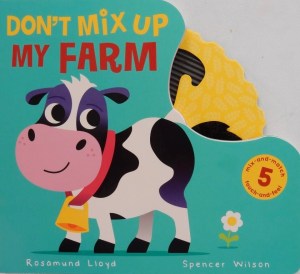
Don’t Mix Up My Farm
Rosamund Lloyd and Spencer Wilson

Five farm animals – a sheep, a donkey, a cockerel, a pig and a duck offer tactile fun in this matching game of a book. Little ones will enjoy creating strange-looking creatures by mismatching one of their features using the wheel. Although none of the creatures will be impressed to be given wrong horn, beak, tail or comb, so they should make sure they also match each with the small pictures on the back cover; otherwise a lot of braying, bleating, crowing, grunting and quacking might break out down on the farm.

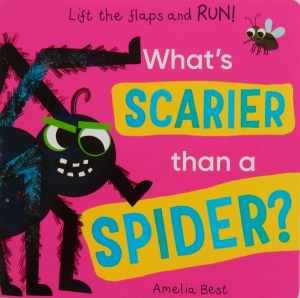
What’s Scarier than a Spider?
Amelia Best and Becky Davies

The scorpion, wasp, cockroach, mosquito, and spider more than meet their match in this altogether different peekaboo game. The aforementioned creatures are anticipating in turn, dinner, a fight, a tasty treat, being the boss

and upsetting something or someone. However as the fly on each spread delights in announcing, each one has an unexpected confrontation of the alarming kind.
There’s some delicious alliteration – ‘massive mantis’ and ‘biting beetle’ for little ones to try getting their tongues around, along with the delightfully shocking creepy crawly surprises revealed by lifting the flaps, especially the final extra large one to revel in. Amelia Best has portrayed some terrifying minibeasts in her arresting illustrations.

I’m Not Scared, You Are!
Patricia Hegarty and Thomas Elliott

With a plethora of scary sounds waiting to spook your little ones at the press of a button, we join two child characters on a foray out into the night. Their journey takes them deep into a forest wherein bats and owls are ready to alarm with their flaps and yowls. They board a passing ghost train that drops them off outside a cottage wherein a witch is busy stirring something that’s bubbling in her enormous cauldron. Hearts thumping, on they go over the bridge, under which lurk not one but three growling, grunting trolls, as they head towards a huge haunted house. Inside they are met by rattling skeletal sounds, followed by clangs and clanks sending them hurtling towards the door once more. After a frantic dash our adventurers arrive back home safely and of course, they confirm “No, we’re not afraid!’ But are they? …
Patricia Hegarty’s rhyming text reads aloud really well offering lots of opportunities for action as well as noise making and Elliott’s scenes are jocular rather than of the shivers-down-the-spine- sending scary.

Little Chimpanzee / Little Whale / Little Monkey / Tiny Tadpole

Little Chimpanzee
Anna Brett, illustrated by Rebeca Pintos
Little Whale
Anna Brett, illustrated by Carmen Saldaña
Words & Pictures

These are the latest additions to the Really Wild Families series of fun, informative interactive books for children and adults to share.
Having introduced itself, Little Chimpanzee invites readers to spend a day exploring its African rainforest home and meeting the sociable family community comprising father, mother, older brother, aunts, uncles and cousins. The creature narrator explains how chimpanzees care for and groom each other and talks about the social structures and relationships in the group , including how they communicate with one another.There’s a spread about chimp conservation and another about the vital work of Jane Goodall and the chimps in Gombe Stream National Park.
The narrative is followed by a quiz and a craft activity. A charming, effective way for young children to find out about our nearest relative, while gently reminding them of the importance of caring for creatures in the wild; vibrantly illustrated with gentle humour.

The Little Whale of the title introduces itself and the rest of its pod of humpback whales and readers join their annual journey from warm waters to search for the cold waters of the Antarctic Ocean where there’s plenty of food. On the way we learn about how the creatures move, their external features, breathing, breeding, diet and feeding,

possible predators and whale song.
Following the story are the usual factual spread, a look at conservation, a craft activity, a quiz and we meet Migaloo, a albino humpback that lives off the Queensland coast of Australia. Carmen Saldana’s underwater illustrations are beautiful and really add to the book’s appeal.

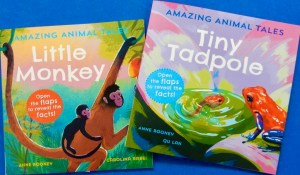
Narrative works really well as a means of transmitting information to young children and these are additions to the Amazing Animal Tales series that also successfully use this approach along with straightforward facts found beneath the flaps.

Little Monkey
illustrated by Caroline Rabei
Tiny Tadpole
illustrated by Qu Lan
both written by Anne Rooney
Oxford Children’s Books

Little Monkey is a spider monkey and we first encounter him high in the rainforest treetops clinging round his mother’s tummy as she moves from branch to branch. Lifting the full-page flap reveals two pages of information and a simple question to further engage listeners.
As the story continues there is information about feeding, what this entails.and how it changes as he becomes more independent, an independence that makes him want to go off exploring by himself.

Anne Rooney’s way of presenting the information is appealing and perfectly pitched for an Early Years audience, the special skill being the combination of the two styles, with Caroline Rabei’s delightful illustrations containing just the right amount of detail.

The Tiny Tadpole also lives in the rainforest but further south than the monkey family. Herein we follow the transformation from tadpoles hatching out of the protective jelly eggs and the growth and changes that ensue in their habits and in the care provided by the mother frog,

until the tiny black dot has become a froglet. This one is illustrated using a rich colour palette by Qu Lan and every picture is bursting with life.

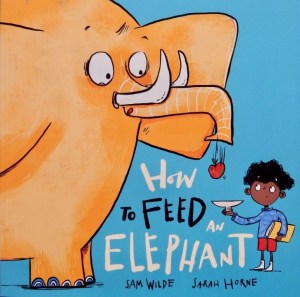
How To Feed An Elephant

How To Feed An Elephant
Sam Wilde and Sarah Horne
Oxford Children’s Books

In the unlikely event that an elephant should be able to read and thus, respond to a wanted poster in the same way as the one in this story did, then you will definitely need to be able to provide the creature with an appropriate diet and know how to take care of it too. With regard to food, both quality and quantity are important

and since elephants are thirsty creatures, you will need access to at least 200 litres of water daily and that doesn’t include that required for washing your pet unless it insists on having mud baths.

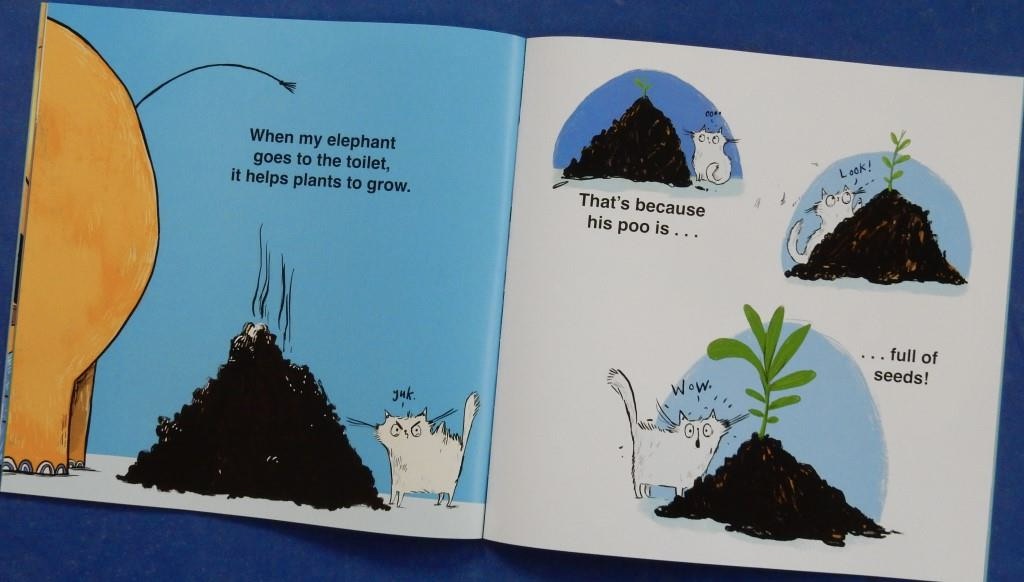
Poo, as you might expect, will be plentiful but it won’t go to waste as it helps to add vegetation to your garden.

Comfortable sleeping quarters are another important consideration, and despite elephants only sleeping for a couple of hours per night, you really don’t want your neighbours complaining about a lack of sleep on their part on account of its noise.

It’s more than likely however, that having given it a go, you and your family will decide that despite the affectionate bond you’ve formed with your colossal pet pachyderm, it would be better off living back home with its own family; and who knows, a more suitable pet could turn up at any time …

Totally silly but enormous fun, especially with that final farewell spread, Sam Wilde’s straightforward text and Sarah Horne’s hilarious illustrations, many of the latter including the silent bit part playing resident moggie, work really well together.

After the story is a ‘top elephant facts!’ spread. This might result in some children having even more fun envisaging a few of these facts using the characters from the story. Furthermore, did you know that elephants can be either right- or left-tusked, I certainly didn’t.

Curious Creatures Talking Together

It’s common knowledge that humans spend a considerable amount of time communicating with one another in various ways, mostly though not always using words, but less well known is that all manner of animals communicate wordlessly by means of movements, sounds and smells.

In this latest Curious Creatures book, Zoe Armstrong presents in her relatable style, some of the ways this happens in the animal kingdom. Many times I’ve stood in Bushy Park and watched what the two hikers in the highlands of Scotland are witnessing: two stags roaring, stamping and bellowing. This happens during the mating season when males compete for females and one wants to prove himself stronger. Having described their mode of communication, the author briefly compares their actions with ways we humans might sort out a disagreement. I especially like this feature, which is part of each section.

The next couple of spreads present examples of other creatures that communicate by means of visual signals, the peacock spider being one. I love the description of the male’s dance vibrations as ‘rumble rumps’ ‘crunch rolls’ and ‘grind-revs’. 

The book continues with spreads each focussing on in turn, sound signals, 

chemical ‘smelly’ signals, tactile or ‘touching messages’. There’s also a spread on ways some domesticated animals communicate with humans and finally comes a reminder that if we pay close attention to signals from animals, we can discover what they want, need and perhaps, feel, and thus develop empathy with them, which should emphasise the importance of protecting the world’s fauna and treating them with respect.

Anja Sušanj’s vibrant illustrations augment the text and will help to entice children into exploring the information. A worthwhile addition to primary class collections and libraries.

Nabil Steals a Penguin

Nabil Steals a Penguin
Nishani Reed and Junissa Bianda
Nosy Crow

On the last day of a holiday in France with his parents, Nabil is at the zoo watching the penguins when one of them addresses the boy introducing itself as Pierre. The penguin goes on to complain about his dull diet – fish, fish and more fish, saying he’d love to sample something more exciting. Obligingly, Nabil offers to share his lunch with Pierre and before you can say ‘spicy’ the penguin has scoffed the lot.

As the family are departing, Pierre bids farewell to his fellow penguins and dives into Nabil’s backpack and eventually, after a somewhat worrying journey for Nabil, the family plus penguin reach home. Very soon Nabil’s sister suspects something strange is going on: how on earth is the boy going to conceal his increasingly lively guest from his parents?

The answer is, he can’t. Into the bathroom comes Mum;

what will her reaction be? Young readers and listeners may well be surprised at what happens thereafter. I’m sure they’ll approve however.

Deliciously daft, this tasty offering is author Nishani Reed’s debut picture book. Junissa Bianda’s wonderfully expressive illustrations capture Nabil’s consternation at the antics of the lively stowaway and the delight of the entire family in the final few spreads.

Vegetable biryani anybody?

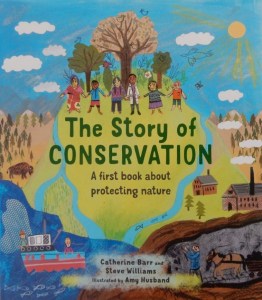
The Story of Conservation

The Story of Conservation
Catherine Barr and Steve Williams, illustrated by Amy Husband
Frances Lincoln Children’s Books

Catherine Barr and Steve Williams present an overview of the interaction of humans with planet earth. They take readers on a journey from prehistoric times to the present, highlighting the changes in people’s habits, the ways nature has been harmed, the natural resources used, and the ways people have worked to counter those changes to protect nature, citing Rachel Carson’s work as key when it came to the use of chemicals on crops in North America.

As well as highlighting the importance of changing global habits, the book also gives examples
of problems that different countries are facing – the consuming of ‘wild-caught’ meat in some parts of Africa being one, and the displacement of indigenous people.

Along with scientists’ attempts to stall the onslaught of global warming and pollution, the book discusses protests and attempts at conservation solutions.

Amy Husband’s gently humorous illustrations and the integral timeline show how human life has changed, and the way we use natural resources has evolved over time as practices like hunting and farming have altered the way we live. All of this should help children to develop their understanding of climate change globally and hopefully accept the authors’ final challenge to join in and make a difference.

A terrific introduction to the most pressing issue currently facing us all; this is a book to share and discuss in primary classrooms, and this, one hopes, will galvanise children into taking action.

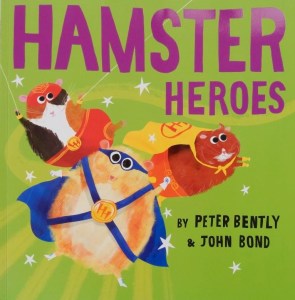
Hamster Heroes

Hamster Heroes
Peter Bently and John Bond
Harper Collins Children’s Books

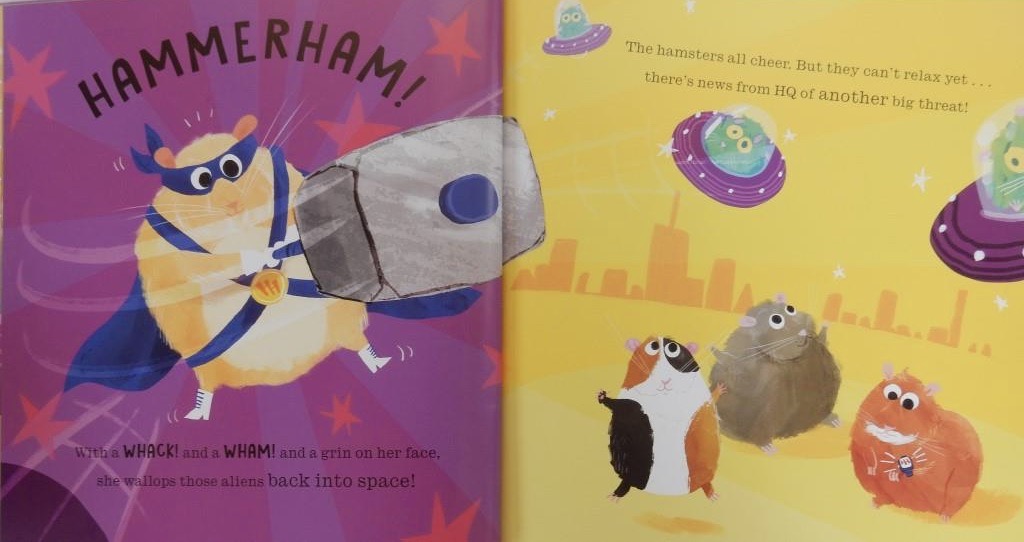
Following on from their terrific Dogs in Disguise and Cats in Chaos, team Bently and Bond present another pet-themed picture book. Here a team of courageous hamsters respond to calls from Hero HQ and proceed to take on alien gerbils invading from outer space. Those are immediately seen off by PomPom aka Hammerham and her trusty massive mallet.

But a second threat soon follows in the form of giant chinchilla, Chinzilla. This time Jiffy, transforms into Superham and sends the monster packing.

Snack time is underway when their broccoli feast is rudely interrupted by another call: their worst enemy Goldenpaw Guinea-Pig is on the screen with his dastardly weapon threatening to vamoosh with the entire world supply, right under the noses of the snackers.

However he’d reckoned without Pushkin morphing into The Bulk and along with the other super hamsters, giving chase. Hurrah for those hamster heroes and hurrah for pulling off an awesome rescue of this reviewer’s favourite vegetable – bonus accolades for that and have a good snooze, you super-pets.

Peter’s deliciously silly rhyming narrative combined with John’s wacky scenes of the super-hamsters in action, deliver what will surely become a story time favourite with young listeners at home, or in the classroom or nursery.

Hello Me!

Hello Me!
Dr Naira Wilson and Elisa Paganelli
Little Tiger

Positivity is key in this gentle book wherein the author, a child psychologist, presents a young boy narrator explaining and showing how he gradually learns self-care and self-acceptance.
He begins thus: ‘Sometimes I think my mind is like a house. Just like a house, I need to treat my mind with love and care.’

Like all of us, this child has flaws and makes mistakes, but just like us all too, he acknowledges those mistakes using them as a powerful learning tool.

When jealousy rears its head, our narrator accepts that nobody is perfect and everyone is different. The important thing is to be flexible in your attitude to routines, make the best of what you have and not to be afraid to ask for help when it’s needed. Friends and their love are key but so too is learning to love yourself for who and what you are.

The final spread breaks down the key points in the narrative, augmenting them with vignettes taken from Elisa Paganelli’s beautiful larger illustrations.

Accessible and easy for young children to relate to, this would be a good book to open up a classroom circle time discussion on looking after and loving oneself.

Yomi and the Fury of Ninki Nanka / Fairytale Ninjas: The Magic Crown 

This image has an empty alt attribute; its file name is dscn9658-4.jpg


Yomi (soon to go into her final year in primary school) and her brother Kayode, two years younger, are supposed to be on the trip of a lifetime visiting The Gambia with their Uncle Olu. But thus far their holiday has been boring, boring, boring, and involved something to do with their uncle’s research.

However after despairing there will be anything like an adventure, or the sight of any Nkara, Yomi’s sleep is disturbed by a terrible roaring and she witnesses Ninki Nanka, the Dragon King being kidnapped from the sky. From then on, things become a whole lot more exciting. Determined to rescue him, the siblings encounter magnificent beasts, unearth a number of secrets, meet a reckless boy hunter

This image has an empty alt attribute; its file name is dscn9659-4.jpg

and face dangers aplenty. Yomi and Kayode are highly motivated and resilient, but can they save Ninki Nanka?

Vividly told, by an author who clearly has a great depth of understanding for, and love of, African mythology, this fast-paced West African-inspired fantasy adventure is the first of a new series – The Nkara Chronicles – and with Adam Douglas-Bagley’s striking illustrations, deserves to be a winner with primary readers. I thoroughly enjoyed it.


This image has an empty alt attribute; its file name is dscn9649-2.jpg

This second story set in the kingdom of Waybeyond begins with Red wishing for another adventure with new magical creatures when suddenly a fireball drops from the sky and becomes a fiery little golden bird, followed not long after by a large ice dragon. Now there’s no need to go seeking adventures, instead one has found Red, Snow and Goldie (aka the Fairytale Ninjas). In fact pretty soon the entire town is full of frost fairies too.

With trouble afoot, it’s time for a visit to Redrock Canyon, dwelling place of sand dragons and firebirds declares Snow. Having, with the help of their gingerbread supplies, persuaded a unicorn to take them, they’re off at a gallop only stopping at the edge of a cliff beneath which goblins and rats are busy digging holes in the rock with saucepans and spoons. Why? They don’t stop long enough to find out though and instead continue to the icy mountains region, but now clad in their ninja suits to blend in.

This image has an empty alt attribute; its file name is dscn9645-3.jpg

This allows them to overhear a conversation about a wooden box hidden by an old king the contents of which will make their master the most powerful person in the entire kingdom. They must be working for Sir Scallion surely? But an untimely sneeze results in the three being discovered and they have to dash for their unicorn, stopping briefly to rescue a tiny ice dragon. Whither now? Goldie has an idea and they soon find themselves in a mysterious library. I’ll leave them there and merely say ‘Rumpelstiltskin’ and recommend you get a copy of the book and find out how the magical tale ends.

With its wealth of illustrations by Mónica de Rivas, emergent readers will devour this twisted fairytale, along with some gingerbread.

The Quickest Bedtime Story Ever!

The Quickest Bedtime Story Ever!
Louise Fitzgerald and Kate Hindley
Nosy Crow

Most young children will go to extreme lengths to delay getting into bed and this behaviour is what debut author, Louise Fitzgerald, plays on in her story.
According to our narrator, the story contains just ten words: well that’s as maybe, but there’s a whole rigmarole to go through beforehand. First, we – the listeners and the four little animal characters herein – need to promise to go to sleep at the end of the book. Then, in fairness, the grown-up reader aloud must promise to use their best reading voice and of course that will only be possible if said voice has done a whole-hearted warm-up. Comfort is crucial for all parties involved, so pillows must be plumped up,

a check kept so no pages are skipped (as if!). It’s vital too, for all the toys to be tucked in (they love a bedtime story and you can devise a way of doing this) – check they’re all present as the odd one could still be lurking unnoticed. Oops! almost neglected a bit of a razzmatazz,

but that over – hurrah! We can begin – we’re on the way … zzzzzzz.

This hugely funny take on the bedtime formalities will surely strike a chord with vast numbers of humans, young and adult but it’s difficult to know which category will like it more. I really, really, really wish I’d had this book yesterday when I was putting a very reluctant three year old relation to bed; a procrastinator of the first order, she could give Louise Fitzgerald more than a few additional ideas. I know young Faith and countless other preschoolers will love exploring the plethora of funny details in some of Kate Hindley’s spreads and joining in with the actions depicted on many others (more opportunities for delaying tactics).
I suspect sharing this story will become part of the bedtime routine in many a household.

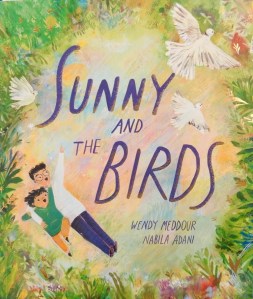
Sunny and the Birds

This image has an empty alt attribute; its file name is dscn9572-2.jpg


Sunny and his family have only recently moved to a new country. Almost inevitably there are things his dad misses. Every evening when they watch the birds through the window and Danny’s father asks him if he can name them, Dad’s response refers to similar ones “back home”. His son’s reply is “But this is our home!”

This image has an empty alt attribute; its file name is dscn9573-2.jpg

It’s evident that Dad doesn’t yet feel at home where he now is. In the middle of the night both Sunny and his Dad are wide awake and the boy acknowledges his father’s sad feelings.


This image has an empty alt attribute; its file name is dscn9574-2.jpg

After school the following day, Sunny’s Nanna meets him and the boy asks if they can go and buy Dad a present – a surprise. Can his bird-related plan help his father begin to feel at home in this new country?


As always Wendy Meddour’s story is written with great sensitivity. Presenting what for many immigrant families is a challenging time, she shows how with love, support, kindness and nature’s healing power, the process of adjustment to a different life can begin.


The richness and beauty of the natural world – real and remembered – is elegantly captured in Nabila Adani’s misty illustrations and you can read the changing emotions in her portrayal of the two main characters.


With more and more schools having immigrants as part of their community, this book would help children understand how newcomers might be feeling. Share at home, share in the classroom and invite listeners to participate in discussion, whatever the setting.

Dirty Bertie: Splash! / Dirty Bertie: Mighty Mishaps / The Trapped Puppy

These are additions to popular young fiction series – thanks to publishers Little Tiger for sending them for review.

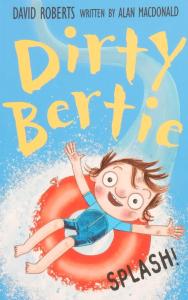
Dirty Bertie: Splash!
David Roberts, illustrated by Alan MacDonald

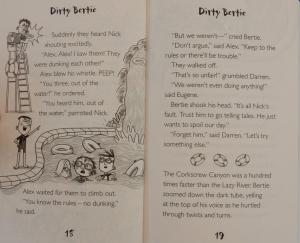
This is Bertie’s 35th set of escapades and some people will be surprised that he’s still as full of crazy ideas as ever. In the first Bertie and pals, Darren and Eugene are finally being treated by Bertie’s mum to a visit to Splash City, the new waterpark. However they hadn’t reckoned on arch enemy Know-All Nick also being there and worse still, Nick’s cousin, Alex is one of the lifeguards. Alex is quick to point out the set of rules that must be obeyed or serious consequences would result.

Can the three friends still have the fun time they’d anticipated, that is the vital question.

Moggy! sees the three friends, aided and abetted by Whiffer, searching high and low for neighbour, Angela Nicely’s missing moggy, Pusskins, with a reward of £50 on offer to the finder. Eventually they find what Bertie is sure is Angela’s cat but it turns out to be a case of mistaken identity. Somebody else has found Pusskins; but who and what happens to the promised reward?

In Breakdance! Miss Boot announces that to celebrate the school’s seventy-fifth anniversary, Class 3 will dance for the parents – and rehearsals get under way immediately. Bertie is determined not to participate and comes up with a clever plan. It turns out there’s more than one way of Breakdancing: game, set and match to Miss Boot.
Ridiculous as ever, but that’s what makes these stories such fun.

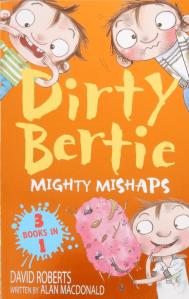
If readers have missed previous high jinks of the Bertie kind, the publishers have recently released another single volume bind-up Dirty Bertie: Mighty Mishaps: containing Yuck!, Loo! and Toothy!

The first contains episodes wherein Bertie turns green at the fair, causes mayhem while dressed in his costume for Victorian Day and teaches a toddler her very first word, “Bum”.
Loo! presents a toilet emergency on the way back from a school outing; a sandcastle competition that is nothing but a damp squib; and the possibility of a house move, something Bertie will do his utmost to prevent.
Toothy! has Bertie suffering from severe dentist-itis; jetting off on holiday and having loo queue trouble during the flight and finally, some ice-cream issues of the worrying kind.
Bertie is one of those characters who, despite everything he does, is a real charmer.and all the books are great promoters of the vital ‘reading is fun’ message.

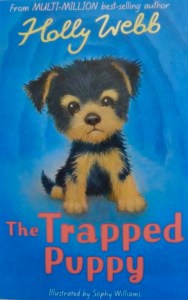
The Trapped Puppy
Holly Webb, illustrated by Sophy Williams

Amelia, her parents and older brother are out walking on the rocky hillside with their dogs, Mickey and Poppet. Amelia throws a stick for Poppet to retrieve, slips over and is a bit dazed. Coming too she realises that Poppet has disappeared but nobody noticed what happened to the puppy. They spend some time looking but with dusk descending they return home hoping to discover Poppet waiting for them. However, the puppy has fallen down an abandoned mineshaft and is unable to get out.

The following morning the search resumes, with the aid, later on of some Mountain Rescue volunteers. Eventually they hear scuffling sounds from underground. Now all they need is to work out a way of extricating little Poppet safely.

The narrative switches between the view point of the rescuers and that of Poppet, which keeps readers on tenterhooks and there are some tense moments – Sophy Williams captures several in her illustrations, but the rescue team are determined. Will Amelia go home with her beloved puppy?

An exciting addition to Holly Webb’s hugely popular puppy series.

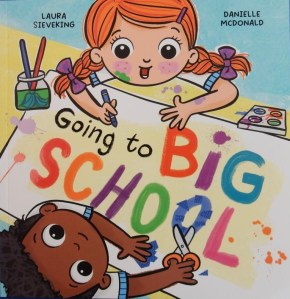
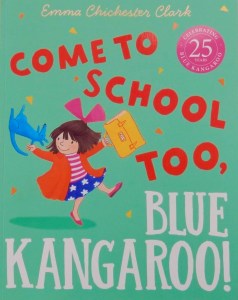
Going to Big School / Come To School Too, Blue Kangaroo!

Told alternately from the perspectives of Ava and Jack, this is an account of their first day at ‘big’ school.
Ava, is excited, enthusiastic and has butterflies fluttering in her tummy, Jack, in contrast is shy and nervous; he has moths flapping around in his tummy. On arrival in the noisy playground, Ava is eager to get involved whereas Jack hangs back, upset by the busyness. Happily however, the kind reception teacher, Miss Moloney notices Jack’s shyness and whispers to him that everybody – she included – has first day nerves.

As we follow the two children through their first day we see how they react differently – at story time, 

fruit time, during a colouring session, at lunchtime and during the afternoon of free play: there’s no sense that one set of reactions is right or wrong (better or worse). By hometime, Ava’s actions have helped Jack feel more relaxed 

and they both depart as happy friends, eagerly looking forward to tomorrow.

The author includes things that by their very newness, might be a challenge for young children – a big, round hat and a lunchbox with clips so stiff they require the help of a buddy to open, both of which are shown in Danielle McDonald’s bright, inclusive illustrations. Whether or not children are moving from a preschool setting or going straight into a reception class, this book will reassure them that the going to big school milestone will be unique for them all, and that everything will be fine.

This is the ideal book for children about to start a new school and with its brilliant, wonderfully warm art and enchanting telling, it remains my very favourite starting school story.

Blue Kangaroo’s owner, Lily is off to a new school and decides to take Blue Kangaroo too. Ready with new bags, both child and toy anticipate the big day: Blue is excited about school – the fun things to do, the friends waiting to be made and new experiences. Lily on the other hand is worried that Blue might be frightened about getting lost, or feel too shy to talk to anybody.

Having been greeted warmly by her teacher, Lily is soon happily engaged in the busy school day, 

and Blue watches thoughtfully from the windowsill as Lily enjoys painting, playing and joy of joys – story time. 

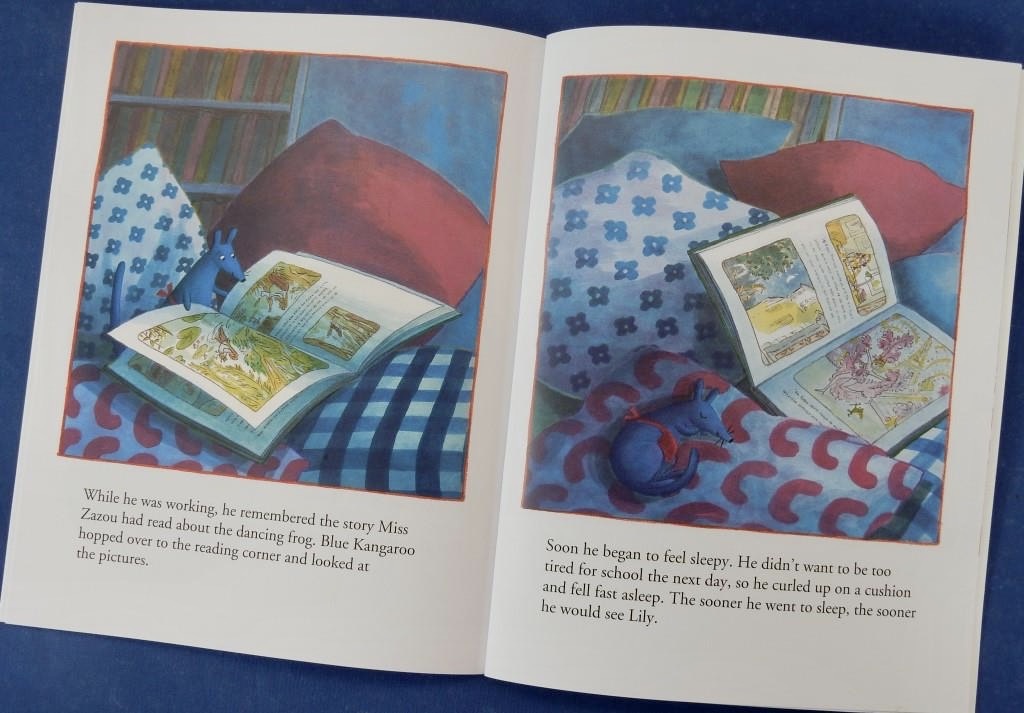
Come hometime, Lily is so excited about her day that the almost inconceivable happens: Blue Kangaroo is left at school all by himself . However, his sadness quickly gives way to happiness because now he can do all the things Lily did during her fantastic school day including reading Quentin Blake’s dancing frog story. 

He also leaves a surprise for everyone to discover the following morning.

It’s so clever the way the author makes Lily express her anxieties and fears about starting school by putting them onto the unworried Blue Kangaroo.

The Ocean Gardener

The Ocean Gardener
Clara Anganuzzi
Little Tiger

The author/illustrator of this book was raised in the Seychelles where this tale is set.
Ayla and her mum’s beautiful island home is surrounded by a coral reef and one morning while out swimming with her mum, Ayla notices that as she goes further out, something is wrong: the colours of the coral are faded and the fish are disappearing.

The girl is upset and asks her mum why these things are happening. Surely it can’t be too late to save this wonderful part of the ocean’s eco-system.

Fortunately, Mum, a marine biologist, has a plan and the very next day she and Ayla start working bringing tiny pieces of coral from the sea into their home and so begins operation coral reef rescue. It’s a lengthy process and eventually after some time Mum decides the coral growths are ready to return to the ocean and they create their ocean garden.

That place is Ayla’s destination each day for what feels like forever; she tends to the coral and awaits the return of the fish until at last …

Clara Anganuzzi’s gorgeous illustrations capture so well the beauty of the coral reef and at the same time present the highly complex issue of global warming in a positive manner that will appeal to young readers, while also offering hope that the work of marine biologists such as Chloé Pozas, whom we meet after the story in a spread giving more information about coral nurseries, can restore these precious parts of our oceans’ ecosystems.

Victor, the Wolf with Worries

Victor, the Wolf with Worries
Catherine Rayner
Macmillan Children’s Books

Victor is a young wolf beset with worries: he worries about almost everything. He considers himself to be not ‘wolfish’ enough, not brave enough, not big enough, nor fierce enough, so he resorts to pretence.
However this leads to worries about how his shortcomings will impact upon other wolves; for example if he attempts to act fiercely, he could end up accidentally frightening his fellow wolves. And so his worries just keep on growing.

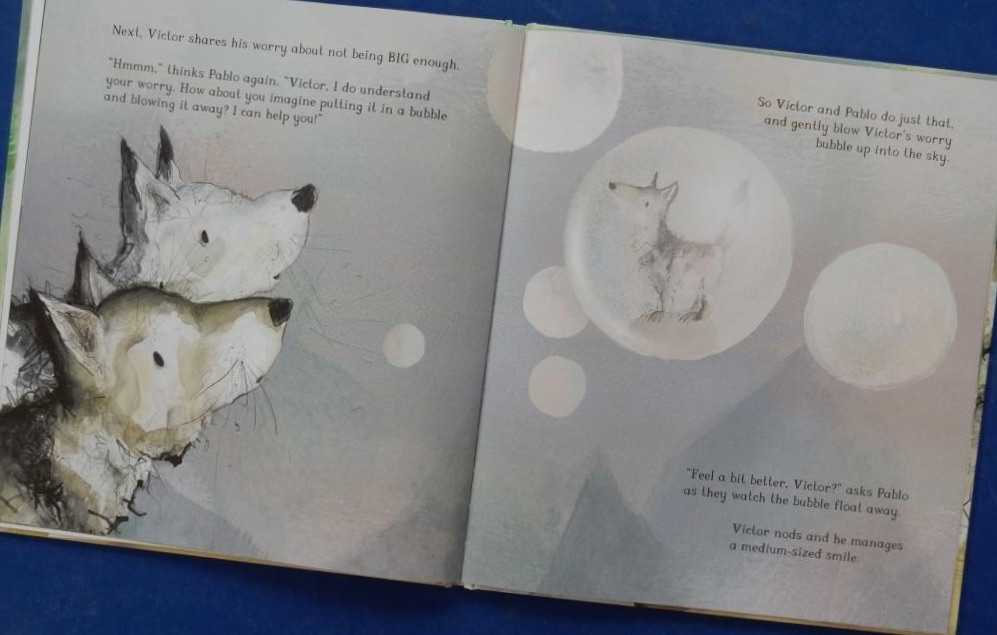
Fortunately, Victor has a best friend, Pablo. Empathetic Pablo notices Victor looks worried and with his help and understanding, and some coping strategies, Victor’s worries gradually recede. He begins to feel braver, bigger, fiercer and increasingly wolfish.

Not only does Victor’s anxiety wane but he also learns something else important: he is not the only one who worries about these things, so too does Pablo and all their fellow wolves.

As it is with wolves, so it is with humans. The practical ways Victor was shown to handle his anxieties, are equally effective with young humans, and not so young ones, so this story offers an ideal starting point to help children deal with issues affecting their mental well-being.

In Victor and indeed Pablo, Catherine has created hugely engaging characters with wonderfully expressive eyes. Those winsome wolves stunningly portrayed in her ink and watercolour illustrations will surely win the hearts of any reader or listener.

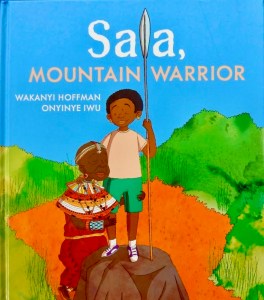
Sala, Mountain Warrior

This image has an empty alt attribute; its file name is dscn9570-2.jpg


Sala, Mountain Warrior
Wakanyi Hoffman and Onyinye Iwu
Otter-Barry Books


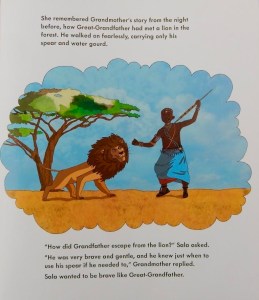
When Sala sees a poster announcing a school camping trip that involves climbing a mountain near her Grandmother’s village, she’s excited at the prospect but also rather worried. Nevertheless, with her Grandmother’s stories, encouragement and a week’s preparation, she registers for the climb – the only girl to do so. She wants to be brave like her Great-Grandfather.

This image has an empty alt attribute; its file name is dscn9571-2.jpg

Before the climbers leave, her Grandmother gives her a water gourd as a good luck present and after a long journey in the school bus, they reach the bottom of the mountain. There they make their base camp.


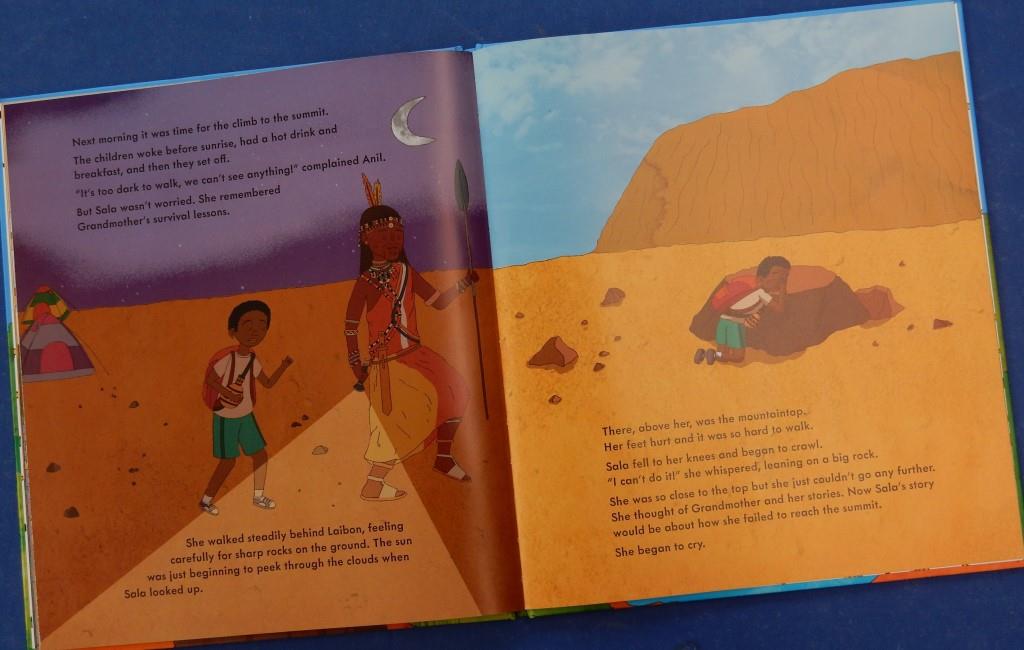
Early the following morning their mountain guide. Laibon, leads them on the first stage of the climb, which they do by afternoon. Next day , the climb is harder work and not everyone reaches the third campsite. Sala perseveres despite feeling a bit shaky and eventually gets to the field of ‘Forever Flowers’ as Laibon calls them, showing the girl his beads and giving her words of encouragement. That night Sala’s dream is of those pink flowers, but all too soon it’s time for the last leg of the climb. Setting off before sunrise, Sala starts to doubt herself.

This image has an empty alt attribute; its file name is dscn9561-2.jpg

Can she make that final push? Yes, with a special something given to her by Laibon.
Back at base camp after their descent, the climbers are greeted by the entire party and somebody unexpected is there too, with something extra special for Sala.


Author, Wakanyi Hoffman’s uplifting present-day story was inspired by her childhood memories of spending school holidays in the foothills of Mt. Kenya where her grandmothers passed down their indigenous knowledge and wisdom through the telling of stories. Onyinye Iwu (you will likely recognise her name if you’re familiar with the Too Small Tola tales) illustrates the text with a colour palette that captures the natural hues of the setting, the intricacy of the Samburu peoples’ beaded accessories and the feelings of the climbers, especially Sala.


An empowering book that deserves to be in every primary school collection.


Princess Minna: The Best Princess / Dragon Storm: Skye and Soulsinger

Both these books are additions to Nosy Crow series that are hugely popular with fantasy loving newly independent readers: thanks to the publisher for sending them for review

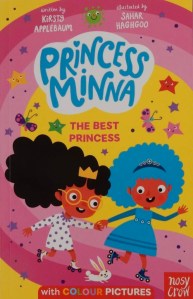
Princess Minna: The Best Princess
Kirsty Applebaum, illustrated by Sahar Haghgoo

For those not familiar with Princess Minna, she lives in Castle Tall-Towers with the King and Queen, wizard Raymond and Lorenzo, the princess’s best dragon friend. Princess Minna loves to sort things out when something isn’t right in the kingdom and she also loves to hear her magic mirror say that she is the best princess of all.

One day though, when she asks the mirror her usual question, she is first puzzled and then very upset at its response: “Well, at the moment, Princess Sky-Blue is the best princess in all the kingdom.” Said princess is apparently on holiday in Princess Minna’s kingdom. Time for the resident princess to put her sorting out skills to use and get rid of this visitor.

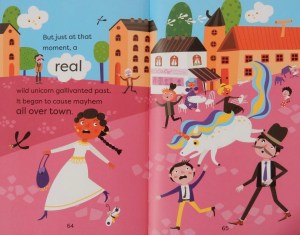
Little does Princess Minna know however, that the rival princess also has a number of special skills for sorting things out and she is able to counter each of the brilliant ideas Princess Minna tries with one of her own. It’s only when a unicorn emergency suddenly hits the town that Princess Minna realises that she must reveal what she’s being trying to keep hidden from Princess Sky-Blue.

Will she be happy with what happens thereafter? Let’s just say that those doves are once more swooping around Castle Two-Towers, which once again has that delightful aroma of tutti-frutti ice cream.

These stories are deservedly popular with young first-chapter book readers and her latest adventure will win Princess Minna many more fans as well as pleasing her established followers.

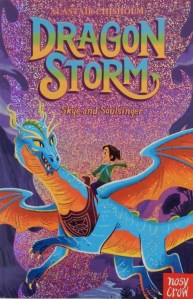
Dragon Storm: Skye and Soulsinger
Alastair Chisholm, illustrated by Eric Deschamps

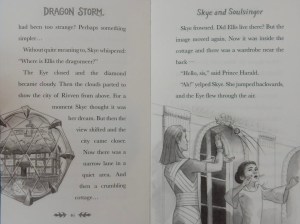
When Princess Skye returns to Riven, she discovers changes are afoot in the city. Quickly she learns that the kingdom of Draconis is under attack from two previously friendly kingdoms and the king himself has been hurt by dragons. As a result citizens of Draconis are preparing to go to war with the Dragonseer Guild. Skye though, is against the war and knows there is no threat from the Guild. So, when her brother is at a meeting, she creeps into Prince Harald’s room, locates the Dragon’s Eye and asks a question of it.

However, she is discovered in the act by her returning brother and has to postpone her anti-war plan until later. This she then sets in motion with the help of her friend and maid, Moira, eventually finding herself face to face with Mira.

Before long Skye meets Lady Bernie and is told that she’s a dragonseer whose dragon is Firedreamer, about which the princess has serious doubts, doubts which are later justified. Eventually with the danger of dragons disappearing for ever, thanks largely to her brother’s reckless warmongering deeds, Skye brings about a transformatory action and there before her is Soulsinger, her dragon.

How this story ends, I won’t divulge, but with Alastair Chisholm’s exciting storytelling and Eric Deschamp’s splendid illustrations, it will surely satisfy readers.

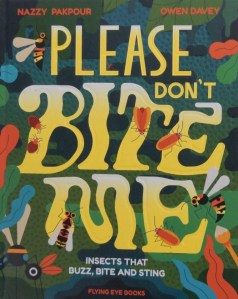
Please Don’t Bite Me!

Please Don’t Bite Me!
Nazzy Pakpour and Owen Davey
Flying Eye Books

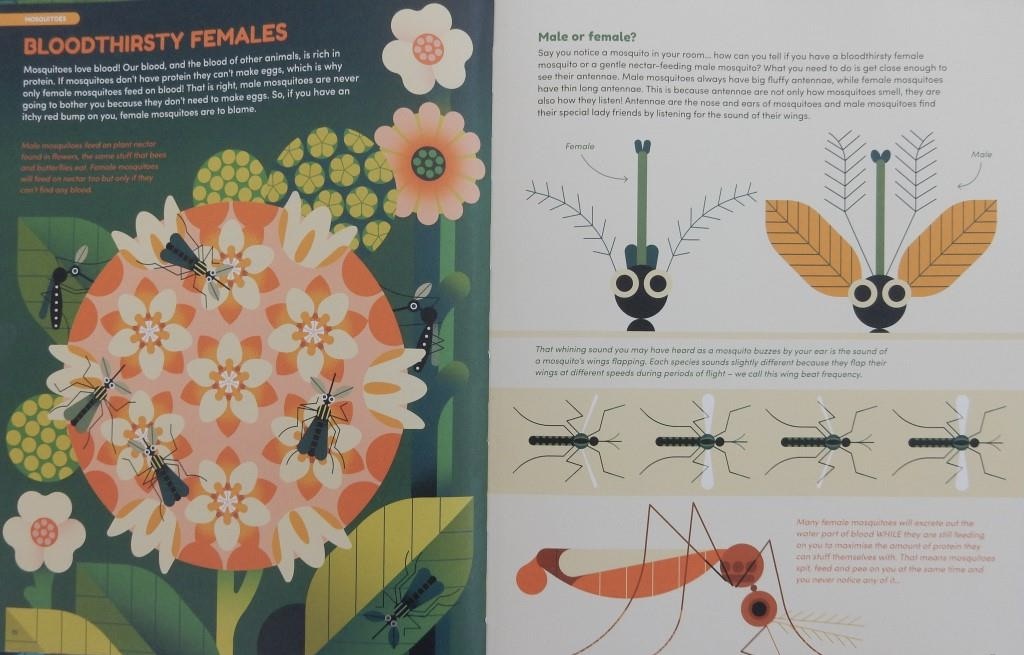
With a partner who can’t walk more than twenty metres without stopping to examine the vegetation for insects in various stages of metamorphosis – complete or incomplete – Nazzy Parker explains the difference – I was I suppose, predisposed to be interested in the contents of this book. It introduces readers to six varieties of insect pests, mosquitoes, lice, wasps, cockroaches, fleas and bedbugs; the very names, excluding wasps, make me want to squirm.

Pakpour starts by defining insects and the scientists who study them after which three or more spreads are devoted to each of the aforementioned pests. She describes their appearance including the difference between males and females, their impact on humans and how they find us, their habitat – I was intrigued to discover that mosquitoes are found everywhere except Antarctica and Iceland where it’s too cold for them to survive, and that it’s only the females that bite.

We also read about their habits and their development from egg to adult. Mosquitoes, wasps, and fleas undergo ‘complete’ ie four stage metamorphosis, whereas lice, cockroaches and bedbugs have a three stage, or incomplete metamorphosis.

Can you believe that there are more than 5,000 different kinds of lice, each kind being specific to the kind of animal it feeds on. Those that feed on humans spit saliva that can take as much as thirty days for us to develop an allergic response to. Weirdly though the very mention of a child in one of my classes having headlice has always made me start itching round my hairline straight away.

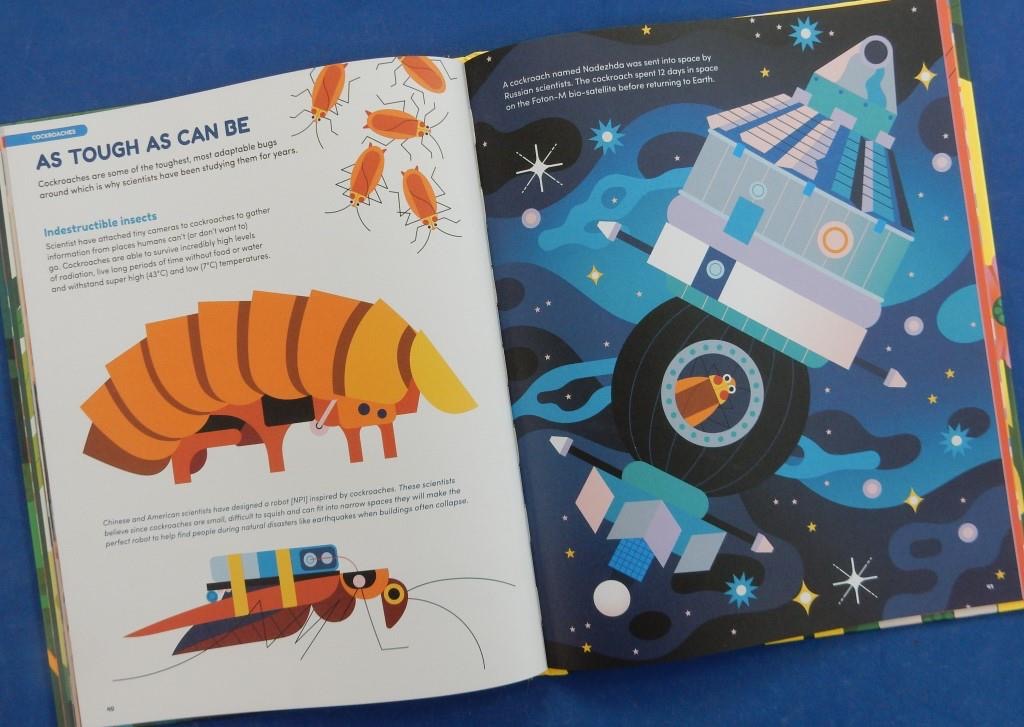
As for cockroaches, I will never forget the sight of an enormous one crawling across the pillow of our room in one of Jaipur’s five-star luxury palace hotels; it certainly didn’t get a five star review from me despite the fact that so we are reminded herein, the creatures don’t actually feed on human blood.

The author provides lots of fascinating snippets of information including that Chinese and American scientists have designed a robot inspired by cockroaches and that Russian scientists sent a cockroach into space for twelve days on a bio-satellite.

Probably though what is most important is the role of various insects in the world’s ecosystem; this is assigned the book’s final paragraph.

Owen Davey’s stylised, stylish illustrations work really well with biologist, Nazzy Pakpour’s text. Not the first book one would go to for general information about insects but a thoroughly engrossing one nonetheless.

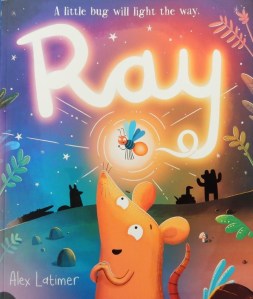
Ray

Ray
Alex Latimer
Oxford Children’s Books

Such were the delights of Mouse’s walk that the little rodent failed to notice the lateness of the day.
After the sun has disappeared he sits alone frightened at the prospect of going home in the dark. Then from within a flower, there comes a glow and from it emerges a firefly; she introduces herself as Ray and offers to light Mouse’s way home. A grateful Mouse accepts but denies being afraid of the dark and off they go.

Mouse follows his guiding light but suddenly stops at the sight of a shadowy shape – ‘a snake’ coiled ready to strike, he thinks. Fortunately he’s mistaken and Meerkat, also not afraid of the dark, joins the travellers. After a while there’s a cry of “A bear! We’re done for!’ Ray investigates and informs her followers, it’s a pair of hens roosting . As you might expect said hens are not afraid of the dark either and off they go again, Mouse, Meerkat and two hens led by Ray until …


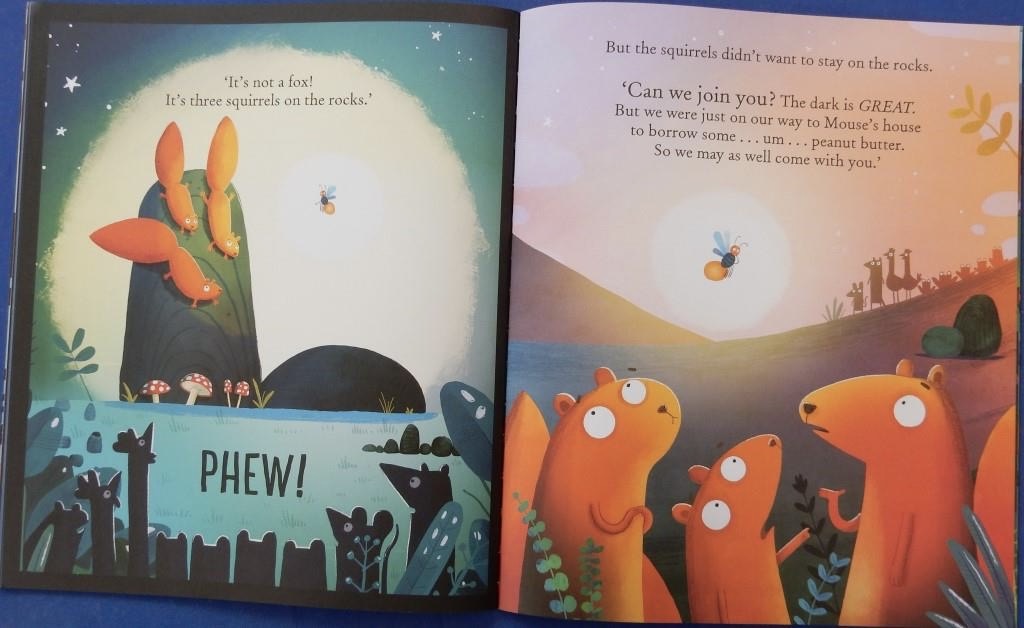
The journey continues with the addition of five green frogs and three squirrels, all of which have ‘reasons’ for joining the entourage, and each being welcomed by the words “Of course, … I’m Ray and I’ll light your way.’

Eventually in front of them a lion shadow looms large. Now Mouse, well used to being bamboozled by shadow shapes says, “ … that’s not a lion at all! That’s my home.’ He tells Ray to illuminate the shape, which she does.

Here our story takes a sudden dramatic turn … confessions re the dark are forthcoming and then a certain firefly proffers her oft repeated promise once more.

Deliciously tongue-in-cheek, Alex Latimer’s travellers’ tale will de-light young listeners, as well as adult readers aloud who will be amused at the excuses given by various animals for wanting to be led by Ray’s light. I have no doubt Alex Latimer had great fun creating his shadow shapes and he might well inspire children to experiment with a black crayon, paint, oil pastel or even play around cutting black paper.

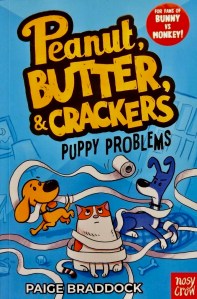
Peanut, Butter & Crackers: Puppy Problems

Peanut, Butter & Crackers: Puppy Problems
Paige Braddock
Nosy Crow

Butter (a cat) and Crackers (a dog) are rescue animals living a life of harmony – more or less – until their human brings home a large box containing not snacks aplenty as they’d hoped, but Peanut, a puppy. Said puppy pees in such inappropriate places as beside Crackers’ water bowl – not the thing to do to a sensitive, considerate home loving dog – especially when the pup then proceeds to drink from the bowl and gobble up Crackers’ favourite crunchy food. If that’s not bad enough, young Peanut keeps both Crackers and Butter up at night and then has the audacity to demolish half of Crackers’ breakfast before the dog has surfaced after a decidedly delayed sleep. The little mischief then upends the rubbish bin leaving the contents strewn across the floor.

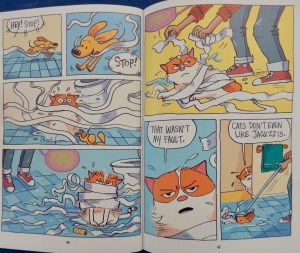
My favourite part was Butter introducing the toilet as a jacuzzi and demonstrating how it works; we end up with loo paper strewn across the bathroom floor and wrapped around instigator of the incident. 

This is followed by chewed trainers, a chomped cushion and dare I say, shredded books.

Back comes the human: now surely such has been the puppy’s behaviour it will mean farewell to him but all that happens is a finger wagging, not even a raised voice. Something must be done and done it is, accidentally on purpose by Butter, at night and it results in the Peanut being alone and lost in the dark. 

This could be the time when, for the two long-time residents, compassion kicks in. Can the three find a way to co-exist so all ends happily in this first book in a series of highly humorous graphic novels?

Paige Braddock’s action-packed illustrations together with the affable banter between Butter and Crackers make for an ideal comic book style starter that younger readers will love, be they or be they not, pet lovers. (An author’s note explains that Peanut, Butter, and Crackers are based on her real life pets; she also provides introductory character information and a pictorial map of the setting.)

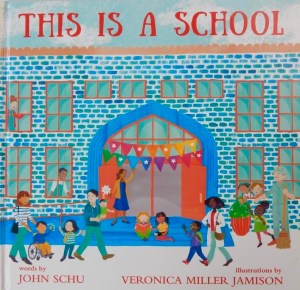
This Is a School / Two Wheels

This Is a School
John Schu and Veronica Miller Jamison
Walker Books

Debut picture book author John Schu and illustrator Veronica Miller Jamison present a school that I would happily teach in or send a child to. In fact it’s much more than a place of learning, or rather perhaps it’s a place of learning in the very broadest sense. What we have here is a community with children at its heart; the very first sentence, ‘This is a child.’ speaks volumes to me, indicating this is somewhere where youngsters are helped to flourish in the broad sense. Children’s experiences lead to growth and transformation – their questions are welcomed

and their mistakes are seen as a vital part of the process of learning. Everybody herein, children, teachers, librarians, other staff, head teachers, helpers and visitors are valued and trusted too: and every single member of this community helps in the creation of its ethos.

This splendid celebration of a school is assuredly one to share with newcomers on their very first day. The illustrations, created in vibrant watercolour, acrylic and digital collage media match the upbeat tone of the writing, both combining to convey a vital message.
Would that all primary schools were more like the one herein.

A considerable amount of learning also takes place in

Two Wheels
David Gibb and Brizida Magro
Walker Books

The father of the little boy narrator of this story is obsessed with bikes and he has several different kinds – one for speed, one for muddy terrain, one for togetherness and one for a relaxing ride. The boy’s siblings and mum also have bikes but our narrator does not. Dad’s response to his refusal to sit on the baby seat any longer is to suggest he try his brother’s three wheeler, which he does. He also likes to help Dad fix other people’s bikes.

One day Dad presents his small son with a balance bike, then relatively soon after, a cycle with two big wheels and two stabilisers. This means that our narrator is allowed to ride out in the street. He practises and practises

until Dad decides it’s time to remove the stabilisers; this he does at the top of a hill. Then with words of encouragement rising in his ears, off goes the boy, gradually building up speed until he reaches the bottom – just in time for a big, congratulatory hug from Dad.

In her textured, patterned illustrations Brizida Magro shows the delight on the child’s face and the thrills as he progresses from tricycle rider to fully-fledged two-wheeler rider (We don’t see any spills though I’m sure there must have been some. One of my relations, after a tumble, kicked her bike and called it, “nincompoop bike!” though she was back in the saddle pretty soon after ) Author David Gibbs’ text portraying a very supportive Dad, is based on his experience of his own Dad teaching him to ride a bike. Becoming an independent cyclist is one most adults and proficient youngsters will recall, along with the trials and tribulations along the way.

This tale of patience and determination is one to share especially with those starting on the road to becoming confident bike riders.

The World’s Most Atrocious Animals

The World’s Most Atrocious Animals
Philip Bunting
Happy Yak

In the third of this fact-filled series Philip Bunting introduces readers to over fifty of the scariest creatures in the natural world, each of which is given both its Latin name and amusing Bunting tag. Thus the death stalker scorpion or Leiurus quinquestriatus is also Lethalus landlobstrous – very appropriate since a sting from this North African nasty can be excruciatingly painful and can cause anaphylaxis.

In similar fashion to the previous titles, the author uses a plethora of puns, some of which will really make you laugh (or groan depending on your mood): a group of orcas ‘sing together to form an orcastra’ and the African amphibian Trichobatrachus robustus – hairy frog to you and me – is ‘known to kermit hideous crimes’ and an encounter with an African giant swallowtail ‘will give you more than butterflies in your tummy’ – that is on account of the vast volume of toxins that flow through its body.

Moreover, should you find yourself paddling on the shores around Madagascar, Mauritius or other countries located in the Indian Ocean, be very sure not to set foot near a geography cone snail; the potent venom of this predatory mollusc could, if the nasty creature chose to inject you, finish you for good since there’s no known antivenom. No wonder that so we read, the beast has ‘shelled out extra for. a fancy pattern’.

Maintaining a good balance between humour and straightforward information, along with large, striking illustrations, Philip Bunting covers a wide range of animals of the truly scary sort. Anyone with an interest in animals, especially of the atrocious or fearsome kind, will love this book; it’s a great addition to The World’s Most …. Animals’ series.

The Midnight Babies

The Midnight Babies
Isabel Greenberg
Abrams Books for Young Readers

The midnight hour strikes but one little toddler is wide awake and waiting. What for you might be wondering: the arrival of the Midnight Babies and they arrive from near and far, some on their feet, others on their knees or perhaps hitching a ride. they’ve brought along a variety of musical instruments and other sound-making equipment to clash and batter along the way.

Tonight it’s the turn of Wide-Awake Baby to lead the parade to Nodoff.. With a rousing song, off they go on their quest, first through the Forest of Nightlights. Here as in other places along the route, the heinous forces of sleep are doing their utmost to lure the tots into slumber and it’s a golden light that one of their number finds irresistible. Zzzzzzz!

Next comes the Sea of Stories where a storyfish with seabooks is too strong a temptation for another baby

but plenty are left to move on to the Garden of Lullabies – uh oh! a third baby drops off.

Now it’s time to cross the Rockabye River and that requires great determination to resist its rolling motion – another baby is lulled by the gentle undulating.

Finally the somewhat depleted army reaches the shores of Nodoff where waits a decidedly intimidating Teddy Army. The babies create a great cacophony but its no match or the blanket of darkness that envelops them, one by one, till every one has succumbed save Wide-Awake. Is there anything that could tempt her to Sleep. “Her eyes begin to close. No. Never! Must . . . stay . . . awake . . . ALL NIGHT.’ But wouldn’t it be nice, oh so nice, to go to Sleep?” … Finally ahhhh-hhaaaaaa! She joins the others in the land of Sleep where they play and eat the night away, unable to remember why they ever tried so hard to stay awake.

The next morning Wide-Awake Baby, aware she fell victim to sleep, resolves to resist more strongly that night …

Featuring as it does, lots of wide-eyed tots, this wry story is definitely not one to read to little ones just before bedtime. The lively pencil and charcoal illustrations, digitally coloured, offer plenty to explore and keep the eyes of tinies wide open.

What Can You See? At the Zoo / Word Museum / Where’s Mr Train?

What Can You See? At the Zoo
Katie Ware and Maria Pereira
Little Tiger

Maria Pereira’s cutaway scenes of a zoo park present an absolute wealth of animals, large and small. Reptiles and insects share the first spread, along with several frogs. Turn over to see lots of brightly coloured birds and a pair of slumbering owls; then it’s off to a more arid part of the park where meerkats await. On the last three spreads there are tigers and monkeys; a watery area with penguins, seals and sharks and finally, hippos keeping cool, rhinos, elephants, zebras and giraffes – two of each creature as well as a couple of wading water birds.
At each location there’s a ‘can you spot … ?’ question and some snippets of information. Plenty to engage little human visitors to this particular zoo.

Word Museum
Sophie Ledesma and Isabel Otter
Little Tiger

Along with Oriel ostrich and her students, little human learners can explore the word museum in this interactive book that introduces them to learning topics – museums and words. The tour starts in the ancient pottery arcade, proceeds to the animal gallery and thence, the furniture hall, after which it’s time for a quick snack break at the rooftop cafe. Next comes an exploration of gadget corridor with lots of different devices on view and the tour concludes outside in the fashion courtyard.
Sophie Ledesma’s lively, patterned illustrations and Isabel Otter’s engaging text will set young children on the road to becoming culture vultures as they explore the exhibits, peek through die-cuts, lift the gatefold on each spread and answer the questions posed, while learning lots of new words along the way. Fun learning, quality board book style that’s just right to share with toddlers

Where’s Mr Train?
Ingela P Arrhenius
Nosy Crow

The latest in this felt-flap hide-and-seek series introduces toddlers to four different means of travelling: a tram, a ferry boat, a bus and a train. Each except the completely hidden bus has a small part slightly visible before the flap is opened and the final spread shows all four in their entirety and there’s a mirror behind the flap.
With simple bright illustrations and a simple question and answer text, this is ideal for the very youngest children.

The Best Bad Day Ever

The Best Bad Day Ever
Marianna Coppo
Frances Lincoln Children’s Books

The feeling when we wake up and straightway know that it’s going to be a bad day, will be familiar to adults and perhaps to some children too. It’s certainly the case for little Wolfie, even his cuddly companion, Pepito, is in a bad mood.

Off Wolfie goes to school, through a street of happy-looking people and arrives late.

Nothing he tries turns out right and our small narrator feels nobody understands how he feels.

Then snack time comes and despite getting a fruit he dislikes, things start to look up. After a rest – not a sleep though for another little one stays awake too – the afternoon passes all too fast

and at home time, two little ones report to their respective parents, “It was the BEST BAD DAY EVER!”
Bring on tomorrow!

In just a brief text and scenes with an abundance of deadpan, gentle humour, Marianna Coppo captures that bad day feeling, going to on show how a kind action by another can change everything, making that great big frown into a beaming smile. All that’s needed is somebody who empathises and interacts, and … gone are those grumps.

Add to any preschool book collection, share it and invite the little ones to talk – to one another – in the first instance.

Barry Loser Double Trouble!

Barry Loser Double Trouble!
Jim Smith
Farshore

Here we have three more supremely silly episodes in the life of the boy with an unfortunate surname and his entourage.

The first, Doppelbärry, sees complete consternation among those on their way to school, when they are summoned to Mogden Square to receive an announcement from the owner of Fronkle Corp regarding the substitution of their favourite drink Fronke with a new, and so the company would have it believe, improved version. Moreover, any remaining cans of the original have been destroyed. Surely things can’t get any worse.

Actually, they can ,for when they arrive at school, their teacher announces the arrival of a newbie in the class, one Harry Doozer, who bears an uncanny resemblance to Barry.

Harry and his family have just moved into the neighbourhood.
From then on the day goes from awful to atrocious ,with some temporary hairlessness, until that is, the gang members pay a visit to a recently opened antique shop, after which things begin to look a whole lot better …

Episode two has Barry judging The short story telling competition during which some pretty terrible tales are told, one starring Bogey and Poopoo with an ending that leaves one of the two characters devastated.

Think Big, episode three, involves these letters DEENTH – gigantic ones at that – and the strong possibility of being stuck inside Darren Darrenofski’s brain forever. Clearly that can’t happen or we’d have no more totally ridunkulous stories featuring Barry et al. – no the adjective I just used is not a misprint, but my made up word, invented long before a very similar one that occurs herein.
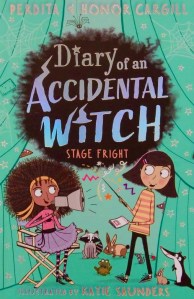
Nonsensical surreal absurdity that will be a winner for the countless, already established fans of Barry and no doubt bag him a fair few new followers too.

A Boy, His Dog and The Sea

This image has an empty alt attribute; its file name is dscn9548-2.jpg


A Boy, His Dog and The Sea
Anthony Browne
Walker Books

To relieve his boredom, Danny’s mother suggests he takes the family dog, Scruff, for a walk on the beach, to which Danny responds, “The beach is boring. Nothing ever happens there.” She replies, “Keep your eyes open; you never know what you might see.” 

Off go Danny and dog onto the beach, Scruff excited, Danny downcast: he’d much prefer to be playing with his older brother. However having found a stick and tossed it into the sea, the boy is impressed when Scruff retrieves it for the first time ever. After spending some time playing that game, Danny feels weary so he sits on the shingle and starts examining the pebbles, discovering on close inspection, lots of interesting things.

This image has an empty alt attribute; its file name is dscn9549-2.jpg

After a while the two continue wandering along the strand till they come upon a number of people waving excitedly as they look out to sea: Danny looks too, wanting to know what they’re waving at. In the distance he spies a tiny person waving too.

This image has an empty alt attribute; its file name is dscn9550-2.jpg

Having thought for a bit, Danny points seaward: “Fetch, Scruff!” he says and the dog does as he’s bid, swimming fast at first, then losing pace but never giving up.

Eventually two figures emerge from the waves, one canine, the other human. But who is it? Danny is very surprised to hear a familiar voice praising him and calling him a hero, something Danny says should rightly be applied to Scruff.

From front to back endpaper, every page is a visual treat; one would expect no less from Anthony Browne: I love the rather portly person with tattoos all over his arms, the faces and other designs on and with, the stones, the clever cloud formations and all the other somewhat surreal things that emerge the more you look at these awesome illustrations. If you share this poignant story with a class or group rather than an individual child, make sure you give them plenty of time to peruse the pictures and leave the book available for further exploration and excited discussion.

The Wonder Brothers

This image has an empty alt attribute; its file name is dscn9581-2.jpg


The Wonder Brothers
Frank Cottrell-Boyce, illustrated by Steven Lenton
Macmillan Children’s Books


The focus of this tale is cousin trio – Middy, Nathan and Brodie, plus a very large, show-stealing rabbit, Queenie. It’s the summer holiday and Nathan and Brodie have, as usual, come to stay with Middy in Blackpool. Middy’s dad, Uncle Kevin is the electrician responsible for the Blackpool Illuminations and the Tower; Middy’s mum, Auntie Anya, is the ‘Boss’ plumber of Blackpool Tower. This enables the three children to be on the scene when the world’s greatest magician, Perplexion, aka the Master of Mystery, comes to switch on the Illuminations as the penultimate stop of his final world tour. He will, as Uncle Kevin tells the children. ‘appear, turn the lights on and then disappear.’


That might just be the understatement of the decade. For, the Wonder Brothers (Middy and Nathan) upstage Perplexion’s appearance with a magic trick of their own; then the morning after Perplexion has magically made the Blackpool Tower disappear, Nathan appears on television, announcing that The Wonder Brothers will make it reappear. Which is why, or maybe how, they accidentally end up, not going home for tea, but in Las Vegas.

This image has an empty alt attribute; its file name is dscn9582-2.jpg

There, following some incidents in the Camelot Casino Hotel, we find them talking to Captain Jimenez of the Metropolitan Police Department. You couldn’t make it up could you? – unless you happen to be the author of this splendidly comical book of course. Comical it might be, but the final sentence is one of considerable depth.


Steven Lenton’s black-and-white illustrations add some visual magic to the wonderful word weaving of Frank Cottrell-Boyce who must have done a considerable amount of research for this story.


It’s said that prestidigitation is the thief of time: it was certainly so where this book is concerned – the minutes and hours whizzed by and I just couldn’t put it down until I’d got to that final Ta-Dah!


Rhinos Don’t Cry

This image has an empty alt attribute; its file name is dscn9500-2.jpg


Rhinos Don’t Cry
Mark Grist and Chris Jevons
Bloomsbury Children’s Books


Milo is a lively life-loving little rhino but he has one small problem. This is on account of having watched his hero, movie star Spike-O Mcree on TV one evening announcing that despite upsetting things happening, ‘rhinos don’t cry!” As a consequence, Milo decides that crying is bad and that’s what he tells himself when something goes wrong. Until that is, he discovers that his beloved pet moggy Pickles has gone missing.

This image has an empty alt attribute; its file name is dscn9501-2.jpg

With Spiko’s words ringing in his ears, Milo holds back his tears as he helps his mum create signs to post in the neighbourhood. Instead of tears Milo gets an unpleasant feeling all through his body and it stays with him even when he and Mum go out to put up their signs.
Milo has just one sign left to post when he pauses outside the cinema and who should approach him but his movie star hero . Hard as he tries, Milo simply cannot hold his tears any longer; he sobs. This causes Spike-O Mcree to start crying too and Milo now feels bewildered at what he sees.

This image has an empty alt attribute; its file name is dscn9502-2.jpg

Having told his hero what he saw on TV just the previous night, the movie star explains that the film was made long back and he now feels completely differently about shedding tears. It can be a brave thing to do.


There they both stand crying together when there comes a familiar sound – not sobbing this time but something very welcome coming from not far away.


Great for opening up discussion, at home or in the classroom, this story has an important message: it’s fine to cry, whoever you are. Spike-O Mcree makes a great role model showing how being tough isn’t always tbe best response, as well as that you can shed tears when you’re sad or scared, but also when you’re happy. It certainly isn’t being weak.

Grandpa is Here

Grandpa is Here
Tanya Rosie and Chuck Groenink
Walker Books

Meeting her Grandpa at the airport with her parents, the little child narrator quickly overcomes her initial shyness when he gives her an enormous hug, and on the drive back home she anticipates all the things she wants to share with Grandpa.

When he opens up his case, out comes the aroma of Persian spice and other culinary delights, including walnuts from his very own trees. The little girl doesn’t speak any Farsi and Grandpa seemingly doesn’t speak English but they laugh in the same language.

After he’s had a nap, our protagonist takes the opportunity to show Grandpa various places she loves as they take ‘the darkest path in the world’, wandering downhill and up tall hills. She introduces him to a horse named Santiago and Malou the frog and hills she calls Mount Sledge-Top and Rabbit View. As they sit looking at the view, the child wishes Grandpa could stay to share the coming of spring. “Grandpa is like snow, I never want him to go, never want his magic to leave,’ she thinks to herself.

As the sun goes down the two make their way back to the family home and there everyone sits and shares a celebratory meal

until they can’t stay awake any longer. Somebody does though and she creeps in to see her Grandpa fast asleep; gently she reaches out her hand and touches his and ‘hope that these days go slowly’ – just like the falling snow flakes she sees through the window.

Tenderly told through Tanya Rosie’s lyrical rhyming narrative in which the loving connection between grandpa and granddaughter is implicit; so it is too in Chuck Groenink’s illustrations which radiate the warmth and tenderness of the intergenerational bond. Like that tight hug at the start of the story, this will surely evoke strong emotions in adult readers who share this with children.

Memories are made like this.

The Song That Sings Us

The Song That Sings Us
Nicola Davies, illustrated by Jackie Morris
Firefly Press

This thought-provoking, dystopian eco-thriller is set in a world governed by the sinister Automators. In this world too, live certain humans who have a power, siardw, that enables them to understand animal thoughts; they are called the Listeners. The ruthless Automators want to destroy anyone who has this gift and drive the rest of the citizens into cities, away from nature’s influences where “They must be made to understand that animals and plants are resources to be owned and used; that they have no rights.” Their slogan is ‘escape the tyranny of nature’ and anything not manufactured is being destroyed.

As the story starts Harlon and her twin siblings, Ash and Xeno, are trying to help their mother defend their home against the approaching Automators. Ma tells them to flee to save themselves – and their world. They must seek out a ‘lost island’. Their flight begins with the three snowboarding down a 6,000-foot sheer slope, but the siblings are separated, so they must each find a way to carry out Ma’s final instruction.

We follow their individual journeys through wild landscapes, even right into the centre of the enemy’s empire. Xeno, with her affinity with birds, and Ash, are in particular danger because they are Listeners and should the merciless Automators discover this, they will obliterate the twins’ minds. All three siblings are really up against things, but like-minded people and nature itself are fighting back and the Automators fail to realise the strength of their network.

Thrumming through this tale is an interconnecting force, liorna that ‘flows from earth and sea to sky’ and runs through all living things, until it’s time to sing the world anew … to unite in ‘the song that sings us … ‘ It’s a song to which readers will definitely add their voices and sing with all their hearts in the joyous finale.

Wow! Just wow! Wow at the quality of the writing and the way Nicola has interwoven all the strands of the story with such consummate artistry: with so many wonderful characters, animal and human, (and some mal-intentioned ones) – this epic tale is powered by her deep love of nature and fuelled by her knowledge and understanding of zoology.

My Brilliant Plan to Fix Everything

My Brilliant Plan to Fix Everything
Ben Davis
Scholastic

It’s the start of the summer holidays – the first since Alex’s mum and dad separated – and the boy is finding it tough. Dad is currently living at Alex’s Uncle Pete’s house, in the granny flat and works as a postie in a small village called Fishwick about a fifteen minute cycle ride from where Alex lives with his mum and older sister, Indie.

Determined to get his parents back together, Alex devises a plan: he just needs his Dad to finish that novel he began writing, way back, thus restoring his self-esteem so he’s back to his normal self – the one Mum fell for. Faking a letter, he tricks his Dad into thinking that he can have a four week sabbatical courtesy of the exclusive ‘Post UK Artistic Leave Scheme’ and thus produce the book he’s always wanted to write. What this means is that Alex will take over his Dad’s postal route and all that entails for the summer holidays. Easy as that!

Convincing Dad’s co-workers, Lloyd and Miriam of the veracity of the scheme is the next step, but having done that Alex realises that what he’s taken on is way harder than he’d envisaged. There are the two biggest bullies in his school who, having mocked him, throw the contents of his delivery bag everywhere, Then he has to avoid bumping right into his Mum showing clients around properties the estate agent she works for, have on their books. Plus the bully boys go on to toss his mail trolley into the middle of the canal; plus, Dad’s boss, Peregrine is getting suspicious.

In addition there’s the girl living on a boat on the canal, Willow. She starts helping Alex with his round but there’s something she keeps from him for some time – something that could wreck the boy’s plan and much more too. Can Alex possibly keep all those plates spinning long enough to accomplish his plan.

Sometimes funny but always full of warmth, love, determination and community spirit, this story has at its heart a very special father-son bond that will have readers rooting for Alex and Carl.
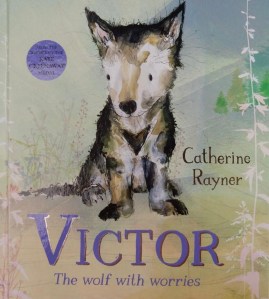
The Happy Hut

The Happy Hut
Tim Hopgood
Walker Books

The child narrator of this story and two siblings loved to visit Grandpa Martin’s bright yellow beach hut, doing so in every season. In spring they enjoyed rock climbing and dodging the showers. In summer they would picnic on the wooden deck and paddle in the sea, though on occasion Grandpa Martin would get soaked, prompting his “flipping fiddlesticks!’ reaction. Summer afternoons were passed in card playing and the evenings in listening to Grandpa Martin read. Autumn days were for kite flying, some meteorological learning
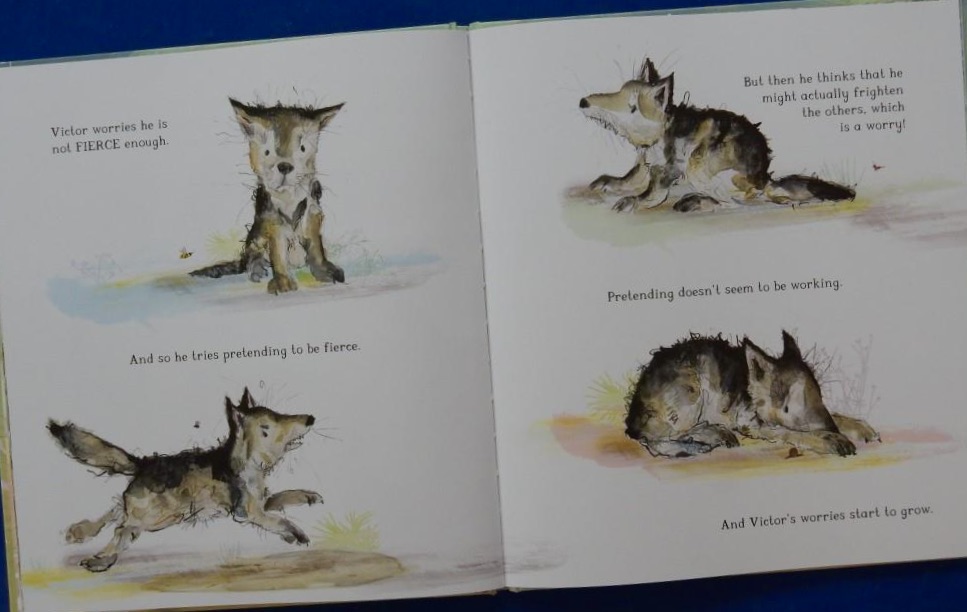
and Grandpa would take the opportunity to do essential repairs and give the hut a coat of paint, aided of course by his three ‘Happy Hut Helpers’. Wintery days were spent walking along the seashore, then back in the warmth of the hut, hot tea, fruit cake and woolly socks awaited.
One spring Grandpa Martin falls ill and the hut is left without any visitors and nobody to do the essential upkeep. That winter a fierce storm badly damaged the yellow hut.
When the family returns the following spring, a big restoration task awaits but rather than repaint the hut in its original yellow, the narrator uses a sky blue hue as a special reminder of their beloved Grandpa Martin: now the hut is a place of cherished memories ‘our happy hut!’

Wonderfully warm, Tim’s tale of love, loss and memories is presented with tenderness and sensitivity in both words and pictures. This is a book to share with Grandpas, as well as to enjoy both with family members and in the KS1 classroom.