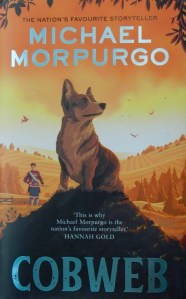
Cobweb
Michael Morpurgo, illustrated by Michael Foreman
Harper Collins Children’s Books
This wonderful story narrated by Cobweb, a Welsh Corgi, was inspired by real life tales of drovers whose job it was to take farmers’ livestock to market to be sold in cities, staying there until all the livestock were sold. One such route was from west Wales to London and Welsh corgis like Cobweb were frequently used.
He was born on a farm and much loved by Bethan, who lived alone with Tad, her father; after her mother and elder brother were both drowned when they went out in their boat to collect the lobster pots against Tad’s advice. We hear how Cobweb became a drover dog when Tad’s second wife gave the dog to her cousin Drover Morgan. The little dog is well cared for and comes to realise that he must remain with the drover and his own much older collie, Goodlad. The latter becomes a good friend and protector, teaching Cobweb the required skills to be a drover’s dog.
Their first trip to London is long and arduous but Drover Morgan is made welcome wherever they stop and ensures both dog’s are fed. Cobweb is kept going by thoughts of Bethan and the drover’s promise that he can return to her once his droving work is done. Then comes news that Napoleon has been taken prisoner and peace is on its way. After delivering all the animals to market in London and resting for a few nights, Cobweb learns the dogs must make their way home sans Drover Morgan.
During the return journey people are celebrating the British victory at the Battle of Waterloo and the two dogs encounter returning soldiers, in particular brothers Robbie and Jonno, the latter having lost his sight in the fighting. They talk of a very brave young French drummer boy they’d brought to England who then disappeared. Later the dogs come upon the very same drummer boy

who accompanies them on the long trek, eventually finding a home with Bethan.
A truly moving portrayal of the powerful bonds that can be formed between animals and humans, and of courage, the ghastliness of war and resulting loss of human life. Michael’s Morpurgo’s words and Michael Foreman’s illustrations together take readers back to an aspect of history that is relatively unexplored in children’s fiction. This would make a great read aloud to KS2 classes.
 Red Reading Hub - Jillrbennett's Reviews of Children's Books