In Focus: Forests

In Focus: Forests
Libby Walden et al
360 Degrees (Little Tiger Group)

Ten exciting illustrators showcase some of the world’s most famous forests in this smashing book that’s been put together under the stewardship of Libby Walden.

Herein is a wealth of information about the natural flora and fauna of these stunning green places as well as associated facts on such things as, in the first and hugely biodiverse location – The Black Forest – things to do, the Brothers Grimm and more. Grace Easton is the illustrator of this place.

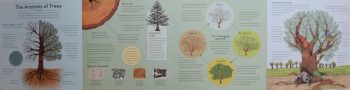
Gate fold flaps are employed by each artist, the second being Julie Colombet who explores The Anatomy of Trees;

Suzanne Washington takes us to the Rainforests; with the artistic work of Sol Linereo we visit National Parks.

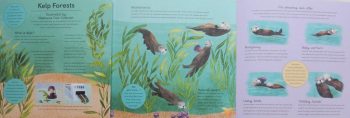
Stephanie Fizer Coleman dives deep to the Kelp Forests to show us the sea otter and many more amazing inhabitants.

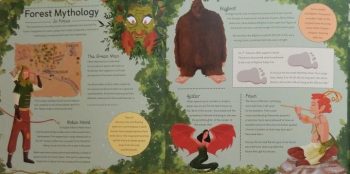
Forest Mythology is the next focus, illustrated by Irene Montano;

the Amazon Rainforest wherein we ‘meet two famous British naturalists, is illustrated by Marc Pattenden;

Alfred Wallace & Henry Bates

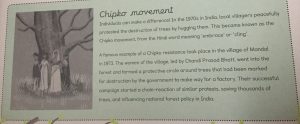
Alessandra Santelli portrays peoples of the Forest; Aaron Cushley, Mangrove Forests and the final topic is Produce and Preservation (including the tree hugging, Chipko movement) illustrated by Jenny Wren.

Each spread is totally absorbing and the entire chunky volume is sure to draw you in to what are probably my favourite places – forests – and hold you there for a considerable time.

A Boy’s Best Friend / The Mountain Lamb

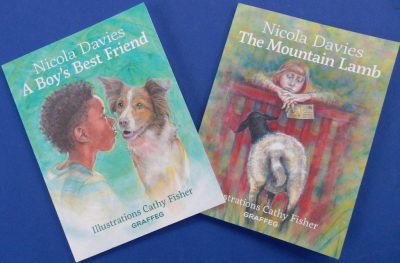
These are books five and six in Nicola and Cathy’s Country Tales short fiction series about young people growing up in a rural environment, published by Graffeg who kindly sent them for review.

A Boy’s Best Friend
The Mountain Lamb
Nicola Davies, illustrated by Cathy Fisher

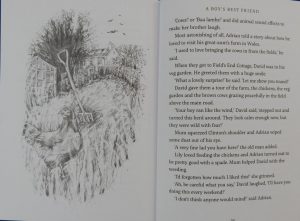
A Boy’s Best Friend starts with young Clinton reluctant to leave his tropical island home, his gran and his fisherman Uncle Cecil to join his mother in London where she’s lived for five years. He feels anxious about meeting his step-father, eager to meet new little sister and very unhappy at the prospect of having to leave behind his much loved dog, Rufus.

But leave the island he does arriving in England as spring approaches. At first, despite the family’s best efforts, he feels lost and as though all the light has been leeched from him in this chill, drear place called London.

Then comes news of a school trip by minibus to a castle in Kent and despite there not being the intended farm visit, Clinton joins the party. But when the minibus meets with an accident and ends up partly in a ditch, Clinton takes the opportunity to help an old man, David with his stampeding cows, scared by the crash.

From then on, despite being in big trouble at school and at home for running off after the accident, things start to look brighter for young Clinton who readily takes up the farmer’s subsequent offer to visit his farm and lend a hand.

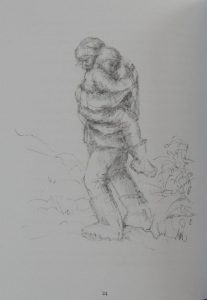
Beautifully told and full of warmth, Nicola’s short tale of love, change and adjusting to a new life, will speak to everyone, especially those who have had to leave much of what they love to start a new life elsewhere. Cathy Fisher’s delicately worked black, white and grey illustrations further add to the atmosphere of the telling.

Young Lolly in The Mountain Lamb is faced with tremendous challenges too. Her mother has died and now Lolly lives on a sheep farm with her grandparents. It’s lambing time and up on the moor, she finds an orphaned baby lamb so small it fits inside the woolly hat she uses to carry it home.

Fearing that it won’t live through the night, Lolly is surprised to hear its tiny bleat next morning at breakfast time: seemingly the lamb wants feeding. Lolly decides to call it Susan after her mother.

Grandpa encourages the girl to take responsibility for rearing the little creature. She rapidly forms at attachment to it, knowing though that it will eventually have to become part of the flock.

After months of not leaving the farm and its surroundings, it’s time for Lolly to return to school but fog causes Gran to abort the journey and they go back to the farm.

Time passes with Lolly staying back rearing the lamb and helping her grandparents indoors and out. One day Susan goes missing and despite a blizzard, Lolly embarks on a perilous search. Is she to meet a fate similar to her mother whom we learn had died in an accident on a Himalayan climb?

Happily not, for her Gran is experienced in Mountain Rescue.

The lost lamb makes its own way safely back and finally Lolly returns to school after a long, hard but rewarding few months.

This tale of courage and love is potent and moving throughout; I couldn’t put it down.

Fabio: Mystery of the Ostrich Express / Ariana and Whisper / Princess of Pets: The Naughty Kitten

Fabio: Mystery of the Ostrich Express
Laura James, illustrated by Emily Fox
Bloomsbury Children’s Books

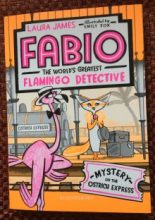
Fabio, flamingo detective and resident of a small town on the banks of Lake Laloozee, returns to solve his second case and it involves a stolen necklace.

Fabio and his trusty associate Gilbert giraffe are about to depart on the Ostrich Express for a much-needed holiday at Coconut Palm Resort when something, or rather someone, catches Fabio’s eye.

Once on the train, a desert fox who introduces herself as Zazie – appears in the dining car sporting a fur stole and enormous ruby pendant – the legendary, -very valuable so she tells Fabio and Gilbert – Lalooze Ruby.

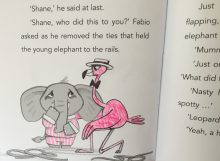
As the train speeds across the desert, unexpected happenings take place, the first being that Gilbert is knocked unconscious when he hits his head against the window as the train is suddenly brought to a full-stop. Leaving his friend in the care of Zazie, Fabio leaves the train and discovers a baby elephant lying beneath the stars tied to the tracks. Fabio unties him and learns that a gang of bandits – hyenas and a leopard – had tied him down.

That though is only the beginning. Soon a scream pierces the dark followed by hyena’s laugh and as Fabio climbs back aboard the train he spots a leopard silhouette and learns that the ruby has vanished from around Zazie’s neck – pulled off by a thief so she says.

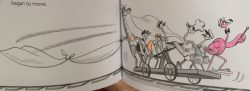
Never fear, Fabio is hot on the case; he merely needs to enlist the aid of the train crew to help power his refurbished handcar,

let loose the tied-together table cloths , … cavort across a few train carriages, execute a deft flick of Gilbert’s cane and … and … that would be telling way too much of this exciting, fast-paced, perfect for just flying solo readers tale.

And with Emily Fox’s dayglo bright, pink and orange powered illustrations and occasional text backgrounds, plus Fabio-patterned chapter breaks, what more can any young reader want?

Ariana and Whisper
Julie Sykes, illustrated by Lucy Truman
Nosy Crow

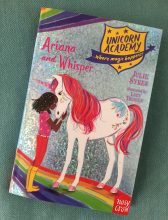
Unicorn Academy is ‘where magic happens’ and now in story number 8, arachnid-fearing  Ariana is finding it hard to make friends. She does however love her special unicorn Whisper and enjoys spending time in the stables bonding with him and helping him discover his magic power.

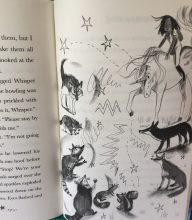
Things improve somewhat when she starts to bond with untidy Matilda and then Ms Nettles announces that the day’s lessons are to be replaced by a field trip to the edges of the woods to find out which animals are leaving and why. An adventure is set to begin: something is very wrong in the woods and Ariana can feel it.

Not long after, Whisper discovers his special power: perhaps with its help, together with the courage of Ariana, her unicorn and the other students, the mystery of what has been happening with the animals can be solved.

Fans of the sparkling series will lap this up with its short, bite-size chapters and Lucy Truman’s enchanting black and white drawings.

Princess of Pets: The Naughty Kitten
Paula Harrison, illustrated by Olivia Chin Mueller
Nosy Crow

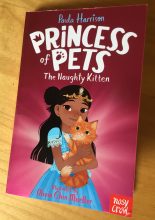
Princess Bea is an animal lover but her father King George tells her time and again that Ruby Palace is ‘no place for a pet’. However, the nine-year-old princess isn’t one to be deterred by royal rules when it comes to taking care of animals needing help.

While she’s at the kite festival with her teacher Mr Wells, Bea climbs up a tree to free her kite and there comes upon a ginger kitten; and of course, she just has to rescue it.

Determined to keep it safe until they can find its owner she manages to sneak it in to the palace but discovers that Tiger as she calls it, is rather excitable. Moreover when her father discovers the creature, he’s far from pleased and gives Bea just 24 hours to get rid of it.

At night the kitten decides to go exploring and Bea needs to summon up all her courage to hunt around the palace in the pitch dark, especially when she hears a noise that doesn’t sound like Tiger …

Young animal lovers just flying solo as readers will enjoy this addition to the series illustrated by Olivia Chin Mueller.

Springtime Picture Book Delights

This is a catch-up of some Macmillan titles:

The Nature Girls
Aki (DelphineMach)
Macmillan Children’s Books

Sixteen inquisitive girls – I love the fact they’re introduced by name on the title page – don identical yellow safari suits and sally forth to explore nature, in particular different biomes.
Bags on backs, having observed some rabbits in their garden, they head for the beach and clad in sub aqua gear, dive down

and swim with dolphins.

Then it’s back on with the safari suits and off they go walking through rainforest, across a desert,

then aboard a safari bus travelling through grasslands; on a plane tundra bound where they board a dog sledge

and finally, they sail off destination a forest alive with sounds of its wildlife.

Observant listeners and readers will notice the less obvious as well as obvious animals and other detail in Aki’s playfully adorable scenes, as her rhyming text bounces along as enthusiastically as the intrepid travellers. I absolutely love the sense of mischief occasionally shown by some of the young female friends in this joyous adventure and the final scene hinting of further wonder-filled adventures in the offing. Hooray for girl power!

A fun introduction to the scientific notion of biomes – the final spread about these may well set the inquisitive off researching the topic further.

Little Bear’s Spring
Elli Woollard & Briony May Smith
Macmillan Children’s Books

As any walk in town or rural parts will show, spring has well and truly sprung now and what better way to celebrate its joys (apart from a walk) than with terrific twosome Elli and Briony’s gorgeous book collaboration that celebrates not only the coming of my favourite time of year, but also, friendship.

When a little bear awakes one morning all he sees is a vast, seemingly empty snowy landscape.
Without a playmate, Little Bear spies a small smooth stone that feels like a promise.
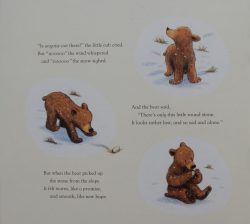
Tucking it into his fur, he heads off down the track in search of friends.

Too busy for friendship, the birds are nest building and bear’s efforts to do likewise fail so off he goes again.

He finds however that the hares and wolves are also busy with spring preparations and his attempts to emulate them are, in the first instance merely a flop and in the second, pretty scary. This brief scariness however, precipitates the perfect finale of the story …

for when Little Bear awakes next morning a whole new world with an exciting surprise awaits …

Delivered in faultless lyrical rhyme Elli’s terrific tale with its wonderful evocations of spring, and Briony’s stupendous scenes of the natural world and the changes therein, (her use of ‘night and light and the half light’) with the terrific portrayal of the zestiness of life in springtime make this book’s a true treasure no matter what time of year you share it.

What Clara Saw
Jessica Meserve
Macmillan Children’s Books

Clara’s enthusiasm for the school trip to a wildlife park could so easily have been thwarted by the egotistic, know-all, humans are vastly superior to other animals, attitude of teacher, Mr Biggity, as he walks around intent on proving the veracity of his fake-scientific assertions to the children in his class at every opportunity, talking down the animals’ awesome characteristics.

Clara in contrast walks around with an open mind and eyes, wondering and observing what the residents of the animal park are doing. “Do animals feel sad?” she asks … ‘no, no and NO, … their brains are far too small for feelings” comes his retort.

And of course they can’t possibly communicate, use tools to get what they need and absolutely ‘don’t care about the world around them’ …

As Mr B. rabbits on, the animals are engaged in using their aptitudes, knowledge, skills and natural instincts to outwit the park keeper and come to the aid of a giant tortoise, about to be transported away from her fellow animals.

So much is shown rather than told. Jessica’s exquisitely observed watercolour and pen illustrations say far more than her words: Clara’s fascination and joy as she watches the animals is evident from the outset as is Mr Biggity’s condescending attitude both to his charges and the animals. Note the position of his right hand as they enter the park, his meticulously tied laces, his upturned foot as he strides forth and in contrast, the expressions of the children, as they look in wonder at what they see.

This humorous, cleverly constructed story brilliantly demonstrates how best to learn; how not to be gulled by false information (HMMM!) and there’s not a tiny weeny touch of the dogmatic preachiness that is Mr B. anywhere in sight.

My Pet Star / Little Fish

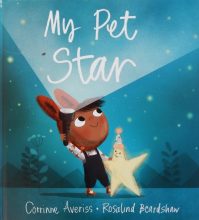
My Pet Star
Corrinne Averiss and Rosalind Beardshaw
Orchard Books

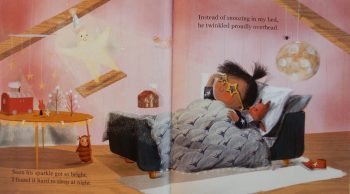
Beneath a tree one night, a little girl discovers a star. The star has been hurt by its fall and its glow has gone, so she takes him home.

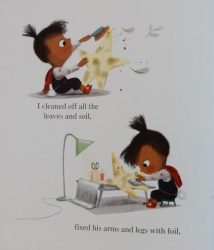
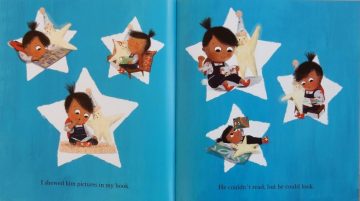
There she acts as a ‘cosmic super vet’ tenderly nurturing her ‘pet’ star, sharing books with him

and cuddling up with him at bedtime.

The days go by and the young narrator finds out a great deal about her star and his habits and all the while, the star glows brighter. She misses him during the day when he sleeps a lot; and he eschews her games merely looking on silently and benevolently.

At night though, he comes to life, his sparkle preventing the girl from sleeping as he twinkles above her bed – until she makes a decision.

Leaping from her bed she opens wide her window and … whoosh! Away flies her astral friend, fully restored, back into the dark sky where he belongs, from there to brighten up the sky and his new friend’s life from afar.

Corrinne’s magical story demonstrates the importance of kindness, altruism and friendship; it’s beautifully illuminated by Ros. Beardshaw in her mixed media scenes. Her narrator is shown as an adorable child who seems to live alone in a shepherd’s hut or travellers’ caravan.

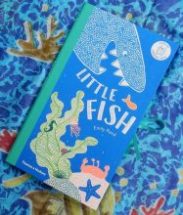
Little Fish
Emily Rand
Thames & Hudson

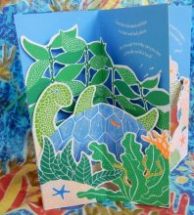
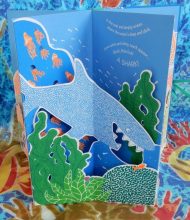
Five vibrant, layered neon scenes of life beneath the ocean waves pop out of this book, the covers of which can be tied back to create a standing carousel.

A short rhyming narrative introduces two orange goby fish playing among the corals. The duo become separated when a large shoal swims past sweeping one of them with it, into a dark patch of kelp in which rests a friendly-looking turtle.

Less friendly though is the hungry grouper that lurks in the cave nearby eyeing the little goby. Then, even more scarifying are the white teeth of a marauding shark that appears on the scene snapping its jaws threateningly.

Happily though, the little fish finally makes it back home where it re-joins its playmate on the reef.

A lovely way to introduce your little ones to marine life, but equally this would be great as part of an early years display for a sea-related theme.

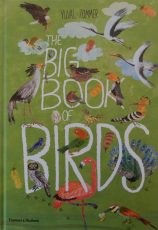
The Big Book of Birds

The Big Book of Birds
Yuval Yommer
Thames & Hudson

This is a cracking series and Yuval’s bird book is an absolute beauty.

Each and every spread, starting with the opening Bird Family Tree is full of fascinating facts and illustrated with that wonderfully playful, ‘twinkle-in-the-eye style the artist has.

Despite my partner being an avid bird spotter, I’d not realised before that there are almost 10,000 bird species and here they’re divided into family groups: birds of prey, owls, woodland and forest birds, seabirds, perching birds, water birds and the flightless kinds.

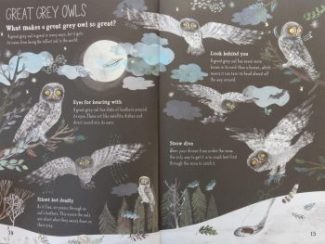
After spreads on being a bird-friendly spotter, feathers and their role in flying, and bird migration, each introduced by a question, we’re given examples of members of each family, zooming in first on great grey owls. Did you know that these are the tallest owls in the world and have special feather-formed discs around their eyes acting as satellite-like dishes directing sounds into their ears; or that with seven more neck vertebrae than humans, a great grey owl can turn its head almost completely around? (The teacher part of me loves that idea.)

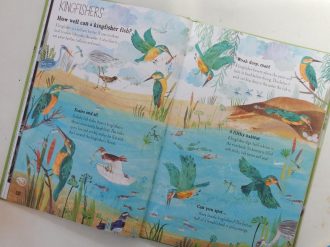
Flamingos (pink feathered on account of their diet) and magpies – not thieves of shiny things – come next and then one of my favourites, kingfishers. Currently living much of the time very close to the Nailsworth Stream along which if I’m lucky, I see a kingfisher flash by, or occasionally spot perching on a overhanging branch, these birds always make me feel uplifted; and so it was here.

I don’t think I’ll go and investigate the bank for a stinky fish bone and poo-filled burrow though.

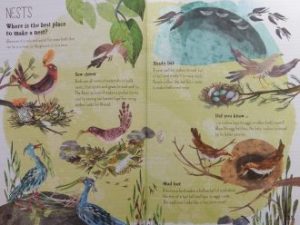
With introductory questions, there are spreads on flightless birds, secretary birds, parrots, bald eagles, puffins, albatrosses, hummingbirds, peacocks – I love to see these on walks in parts of India – robins, swans, hoopoes and red-crowned cranes. Interspersed there are pages looking at nests of various kinds,

eggs – I was amazed to learn as ostrich egg is 16cm long; beaks – their shapes and feeding functions; bird calls and songs – we’re probably all aware of the early dawn chorus these light mornings; city birds and making your garden a bird-friendly place.

If you really want to impress others, there’s a spread on specific vocabulary and as I should have mentioned at the outset, the solution to the ‘can you find the same egg 15 times’ poser from the title.

Absolutely avian-electable; and my copy came with a wonderful pictorial treat – thank you Yuval – before the title page.

If this book doesn’t get your young ones enthusing about our feathered friends, then I’ll be forced to spend a whole day doing various yoga poses like peacock or crow.

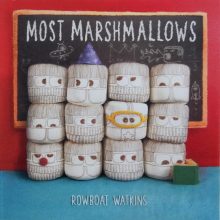
Most Marshmallows

Most Marshmallows
Rowboat Watkins
Chronicle Books

Imagine an entire world populated by marshmallows; it’s what story-inventor extraordinaire, Rowboat Watkins does, one way or another.
As he informs us at the outset, ‘Most marshmallows don’t grow on trees … or come from storks — or even Mars.’

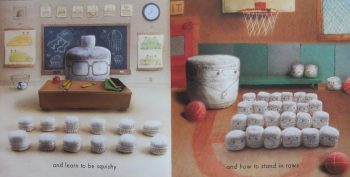
Instead most are mostly born of marshmallow parents and reside in various kinds of homes. They do the kind of things you and I would do like celebrating birthdays, watching television, going to school – well the young ones do, and presumably the marshmallow teachers.

Lessons are taught in being squishy – yes even these already soft confections have to perfect their squishiness, and in standing in rows – I’m not a big fan of that one, but some educational establishments think it’s super important;

and most definitely they should come to understand why they cannot breathe fire (that art is the preserve of dragons).

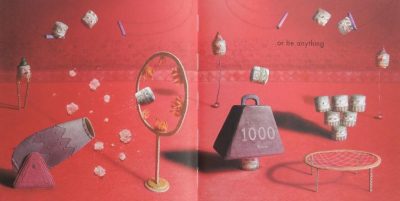
Now happily there are some divergent thinking marshmallows with secret knowledge and it’s something SO important I’ll share it with you humans so you can make sure your little ones know too: ‘Marshmallows – all of them – can do or be anything they dare to imagine.’

Now I’ve always said how crucial the development of the imagination is in education, or anywhere really and now THANK YOU Rowboat for your affirmation of this, with the help of those malleable little confections of yours.

Superbly creative, funny and positively inspiring, this is a truly tasty tale to share with young humans. Rowboat’s mixed media photo images are absolutely terrific; his scenes of what marshmallows do – be that most, the exceptions, or indeed all, are quite brilliant.
I was partial to marshmallows before reading this book, I’m even more so now.

How To Light Your Dragon

How To Light Your Dragon
Didier Lévy and Fred Benaglia
Thames & Hudson

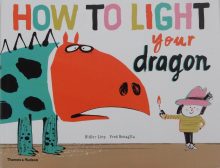
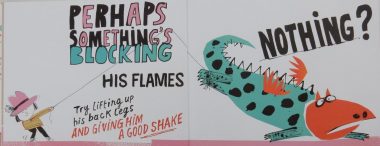
What do you do when you discover that your much-loved pet dragon’s spark has gone out? This delicious book with its exciting amalgam of words and pictures offers a range of possible curative strategies.

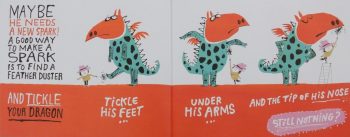
The dragon belonging to a child owner emits not a single flicker when first we encounter it but the child remains upbeat as ideas are put forward one by one in the manner of an instruction guide.

What about lifting his rear legs and giving him a ‘good shake’? Nothing doing?

Maybe use his tummy as a trampoline. No? A feather duster toe-tickle, underarm feathery feel or a nasal nudge duster-style maybe. Uh-uh, no go!

Make him really, really angry by cheating at cards or make a large cake complete with candles – irresistible surely? Actually no; and even the oven shop with its jealousy-inducing latest models pointed out fails to spark a response.

By now said dragon appears decidedly downcast and even consumes the false flames stuck on his snout then flops down defeated and immobile.

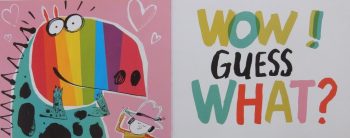
Perhaps the time has come for an entirely different approach; unconditional love – now there’s an idea … recollections of good times shared, a big smacking kiss right on his nostrils and … TA-DA!

The fusion of near show-stopping typography, arresting design, and wildly bright colours is powerful enough; but even that is eclipsed by the message that someone or here, something, is loved no matter what, gives the book its hottest, most radiant magic.

Didier Lévy and Fred Benaglia most definitely lit my fire with this one.

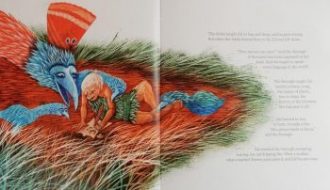
The Phoenix of Persia

The Phoenix of Persia
Sally Pomme Clayton and Amin Hassanzadeh Sharif
Tiny Owl

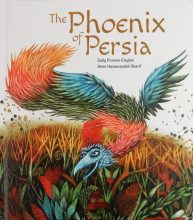
What better way to welcome the month of May than with this wonderful new book and music project from Tiny Owl, The Phoenix of Persia. The tale, told by acclaimed storyteller Sally Pomme Clayton is the second in the publisher’s One Story, Many Voices series.

It’s based on a story from Iran’s most important epic, and one of the world’s greatest, Shahnameh, by 10th century Iranian poet, Ferdowsi and tells of an ancient Persian king.

The setting for the telling is Daneshjoo park where children, including Ali and his sister Shirin, are gathered awaiting the magical ‘Once upon a time …’

We hear of the birth of the multi-hued Simorgh, a firebird with a secret: her feathers have the magical power of granting wishes and making dreams become reality, a bird that is reborn every thousand years from the ashes of her nest. This magnificent creature is the titular Phoenix of Persia.

At that time the land is under the rule of King Sam and Queen Aram who are overjoyed at the birth of a long-awaited child, a son and prince whom they name Zal.

The ruler’s joy is short-lived though for when he uncovers the child’s head he sees, not the locks of a baby but the white hair of an old man. Immediately rejecting what he considers an imperfect infant, the king summons a soldier and orders him to take him to the mountains and leave him. Reluctantly the soldier does as he’s bid, placing Prince Zal on a wind-swept rock.

The sobs of a hungry, distraught babe reverberate over the mountains and are heard by the Simorgh out hunting for food for her chicks. Resolving to care for the tiny human, the creature picks him up, carries him to her nest and tucks him in among feathers.
Years of lessons in languages, the arts,

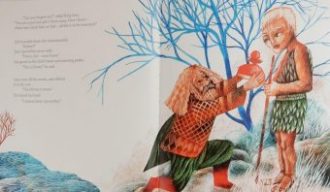
sciences and princely skills follow and sixteen years later Zal is a wise teenager. His parents meanwhile are suffering – his mother from nightmares, his father from regrets. So terrible does he feel that King Sam calls the soldier and the two men ride off into the mountains, and come upon …

“Can you forgive me?” called King Sam.

Forgiveness follows and a paternal plea to return home initially refused, is accepted thanks to Simorgh’s words of wisdom to Zal that bring about a change of heart.

Then father and son (with some special feathers from the phoenix’s tail) travel home to be welcomed by an overjoyed mother. He adds a fiery phoenix feather for protection to his new crown

and there the storyteller in the arena stops, leaving one of the audience wondering about whether it was ever burned.

With acceptance at its heart, Sally Pomme Clayton’s telling really does feel like a drama unfolding before you, all the more so accompanied by Amin Hassanzadeh Sharif’s wonderful, richly textured, jewel-hued scenes. That’s not all though: there’s a QR code at the beginning of the book you can use to listen to a beautiful musical accompaniment on Iranian instruments to Sally’s narration.

Rich in classroom potential, this book is FAB-U-LOUS!